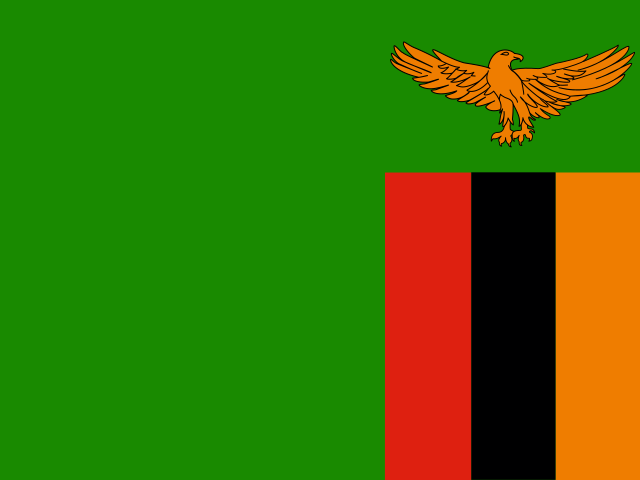
Overview
Zambia, officially the Republic of Zambia, is a landlocked country in Southern Africa. It borders the Democratic Republic of the Congo to the north, Tanzania to the northeast, Malawi to the east, Mozambique to the southeast, Zimbabwe and Botswana to the south (Botswana only through a tiny stretch near Chobe District), Namibia to the southwest via the Caprivi Strip, and Angola to the west.
The capital is Lusaka, in the south-central part of the country. Most people live around Lusaka and in the Copperbelt Province to the north, which are the main economic hubs.
Zambia became independent from the United Kingdom on 24 October 1964 as a republic in the Commonwealth. It has seen peaceful transfers of power since the return of multiparty politics in the early 1990s.
Natural resources include minerals, wildlife, forests, fresh water and farmland. The Common Market for Eastern and Southern Africa (COMESA) has its headquarters in Lusaka. A 2018 estimate put 47.9% of the population in multidimensional poverty.
History
Early humans lived in the area long ago: the Broken Hill (Kabwe) skull is dated to roughly 125,000 to 300,000 years ago. Khoisan and Batwa hunter-gatherers lived in the region until about AD 300, when Bantu-speaking migrants began to settle. Rock art sites such as Mwela, Mumbwa and Nachikufu are linked to these early peoples. The Twa split into the Kafwe Twa near the Kafue Flats and the Lukanga Twa near the Lukanga Swamp.
The Bantu originated in West and Central Africa (around today's Cameroon and Nigeria) and began spreading about 5,000 years ago, one of the largest migrations in human history. They are believed to have brought ironworking to much of the continent, travelling by a western route through the Congo Basin and an eastern route through the Great Lakes. The first Bantu settlers in Zambia lived in self-sufficient villages without a central chief, farmed by slash-and-burn, moved when the soil was exhausted, and kept cattle.
A second wave came by the western route and had spent much time in what is now the DRC. The Bemba and related groups (Lamba, Bisa, Senga, Kaonde, Swaka, Nkoya, Soli) were part of the Luba Kingdom in the Upemba region, an area farmed and iron-worked since the AD 300s. These communities developed nets, harpoons, dugout canoes, canals and dams, and traded fish, copper and iron goods.
In the 1200s another group moved from the Congo Basin via Lake Mweru to settle around Lake Malawi. Known collectively as the Maravi, they included the Chewa. The Maravi Empire was founded in 1480 by a kalonga from the Phiri clan. The Mutapa Empire, formed when a prince named Nyatsimba Mutota broke away from declining Great Zimbabwe, ruled land between the Zambezi and Limpopo, including parts of today's Zambia, Zimbabwe and Mozambique, from the 14th to the 17th century, and took part in Indian Ocean trade with the Swahili.
One of the earliest European visitors on record was the Portuguese explorer Francisco de Lacerda. He led an expedition from Mozambique toward the Kazembe region and died in 1798, after which Francisco Pinto took command. Portugal laid claim to the land linking Mozambique and Angola (the 1885 Pink Map), yet Britain established its control following the 1890 British Ultimatum. The British created the protectorates of Barotziland–North-Western Rhodesia and North-Eastern Rhodesia, which were merged in 1911 to form Northern Rhodesia. Throughout most of the colonial period, the territory was governed by officials named in London, who took counsel from the British South Africa Company.
In 1953 Northern Rhodesia, Southern Rhodesia and Nyasaland (now Malawi) were grouped into the Federation of Rhodesia and Nyasaland, despite opposition from a sizeable minority who demonstrated in 1960-61. The federation was dissolved on 31 December 1963. In January 1964 Kenneth Kaunda won the only election for Prime Minister of Northern Rhodesia, with the support of Governor Sir Evelyn Hone. Soon after, the Lumpa Uprising in the north, led by Alice Lenshina, became his first internal conflict.
Zambia became a republic on 24 October 1964 with Kaunda as first president. His socialist United National Independence Party (UNIP) held power until 1991. From 1972 to 1991 Zambia was a one-party state under the motto 'One Zambia, One Nation', set up under the Choma Commission of 1972. Kaunda took part in regional diplomacy and worked with the United States on conflicts in Southern Rhodesia, Angola and Namibia.
In the mid-1970s the world copper price fell sharply and transport costs to distant markets added to the strain. Zambia borrowed heavily and by the mid-1990s its per capita foreign debt was among the highest in the world. Riots in June 1990 left many protesters dead and Kaunda survived a coup attempt that year. In 1991 he agreed to restore multiparty democracy and lost the election to Frederick Chiluba.
In the 2000s the economy stabilised, with single-digit inflation in 2006-2007, real GDP growth, falling interest rates and rising trade, driven largely by mining investment and higher copper prices. This brought strong interest from aid donors and investors.
Climate
Zambia sits on the Central African plateau at roughly 1,000 to 1,600 m above sea level (average about 1,200 m), which makes the climate tropical but moderated by altitude. Most of the country is classified humid subtropical (Cfa) or tropical wet and dry (Aw), with semi-arid steppe (BSh) in the south-west and along the Zambezi valley.
There are two main seasons: a rainy season from November to April (summer) and a dry season from May/June to October/November (winter). The dry season splits into a cool dry period (May/June to August) and a hot dry period (September to October/November). Altitude gives subtropical rather than tropical conditions in the cool months.
Lusaka (approx. 1,280 m elevation) has a mild, subtropical highland-style climate: warm to hot in the rainy season, cool and dry nights in June-July, and hottest weather in October before the rains. The Copperbelt cities of Kitwe and Ndola (approx.) are similar but slightly wetter, with a longer rainy season. Livingstone in the south is hotter and drier, near the semi-arid Zambezi valley. Ndola and Kitwe highs are mostly mild year-round, while the Zambezi valley is the hottest part of the country (all approx.).
The land is mostly high plateau, rising from about 900 m in the south to 1,200 m in the centre and 1,800 m in the north near Mbala. The highest point is Mafinga Central at 2,339 m in the Mafinga Hills. The country is drained by the Zambezi/Kafue basin (about three-quarters) and the Congo basin (about one-quarter), with part of the northeast draining to Lake Rukwa in Tanzania. The Kafue and Luangwa are major Zambezi tributaries. Zambia is the 39th-largest country by area according to the source.
Biodiversity includes about 12,505 identified species (2015), roughly 3,543 wild flowering plants, 242 mammal species (including the endemic Rhodesian giraffe and Kafue lechwe subspecies) and about 490 fish species, with Lake Tanganyika having the most endemic fish.
Government and politics
Zambia is a presidential representative democratic republic with a multi-party system. The president is both head of state and head of government. Executive power lies with the government, and legislative power with the government and parliament.
Michael Sata was president from 2011 until his death on 28 October 2014; Vice President Guy Scott served as acting president. Edgar Lungu won the January 2015 election with 48.33% against Hakainde Hichilema's 46.67%, and was re-elected in August 2016, when the opposition alleged fraud and the governing Patriotic Front rejected the claim. In the August 2021 election (about 70% turnout), Hichilema won 59% to Lungu's 39%; Lungu conceded and Hichilema was sworn in on 24 August 2021.
On division of power between national and sub-national levels, the source gives no detail on what provinces control. In general knowledge (approx.), Zambia is a unitary state with provinces and districts administered largely by central government and local councils; taxation, health, education and law are mainly set nationally, and traditional authorities have a recognised role in customary matters.
Zambia signed the UN Treaty on the Prohibition of Nuclear Weapons in 2019. Critics say the government has prosecuted critics on public-disorder grounds and that libel laws are used to restrict speech and the press. Same-sex sexual activity is illegal; in 2019 a couple was sentenced to 15 years in prison, and the US ambassador who criticised the case was declared persona non grata by Lungu. In 2026 the government was criticised for postponing the RightsCon human rights conference in Lusaka a week before it was due, after which it was cancelled amid reports that Taiwanese presenters were to be excluded, apparently at Chinese request; commentators raised censorship concerns.
Economy
Zambia's economy has historically been based on copper. Mining and quarrying were about 13.2% of GDP in 2019, and copper was about 69% of goods exports by value. In 2023 Zambia produced 698,000 tonnes of copper, about 4% of the world's output; the source describes it as the second-largest producer in Africa and seventh-largest in the world. The Copperbelt Province accounts for nearly a quarter of GDP and a third of copper production. The exchange rate moves with the copper price.
Copper was nationalised in 1973, and output fell under state control. After privatisation in 1996-2000, investment, production and jobs rose. State-owned ZCCM Investments Holdings holds a 49% stake in Mopani Copper Mines (the other 51% held via the International Holding Company of the UAE) and has interests in mines owned by Vedanta Resources and First Quantum Minerals. Chinese state-linked firms have invested heavily under the Belt and Road Initiative; JCHX Mining owns 80% of Lubambe Copper Mines, with ZCCM holding 20%. Conditions at the Chinese-operated Collum Coal Mine have been politically controversial. Other minerals include gold (Kansanshi), manganese (Serenje), nickel (Munali) and gemstones such as amethyst, beryl, emerald and tourmaline.
Agriculture provides far more jobs than mining, and most rural Zambians are subsistence farmers. Some 150 to 300 white Zimbabwean farmers, on roughly 150 farms as of 2004, grow tobacco, wheat and chilli peppers, and together with liberalisation under President Levy Mwanawasa helped spark an agricultural boom. In 2004 Zambia exported more corn than it imported for the first time in 26 years. In December 2019 it legalised cannabis for medicinal and export purposes only.
Tourism was 5.8% of GDP in 2021, down from a record 9.8% in 2019. It centres on 20 national parks and 34 game management areas. Victoria Falls, a UNESCO World Heritage Site, is shared with Zimbabwe; the Zambian side lies in Mosi-oa-Tunya National Park, and nearby Livingstone is an important tourist centre. Other popular parks are North Luangwa, South Luangwa, Kafue and Liuwa Plain.
Energy: Zambia generated 10.3 TWh in 2009 and relies on hydroelectricity and solar power. A poor 2014/2015 rainy season lowered water in Kariba and other dams and caused a serious energy shortage. In 2019 African Green Resources announced a $150 million investment in a 50 MW solar farm, an irrigation dam and expanded grain storage of 80,000 tonnes.
Exports were $9.1 billion in 2018 and about $7.5-8 billion in 2022. In 2015 about 54.4% lived below the national poverty line (60.5% in 2010), with rural poverty far higher than urban. Unemployment and underemployment in cities are serious. Zambia was ranked 112th in the Global Innovation Index in 2025. Life expectancy was about 40.9 years in 2007 and around 62 years by 2023.
After copper prices fell in the 1970s, the socialist government made several unsuccessful attempts at IMF structural adjustment. Reforms began after 1991, and the economy stagnated until the late 1990s. By 2007 it had nine straight years of growth and inflation of 8.9%, down from 30% in 2000. Zambia qualified for HIPC debt relief in 2000 (foreign debt above $6 billion), but overspending on civil-service wages delayed final forgiveness, and an austerity budget in 2004 triggered a nationwide strike in February 2004. Extensive red tape and widespread corruption remain problems. The government is pursuing diversification into agriculture, tourism, gemstones and hydropower, and in July 2018 signed 12 agreements with Turkey in Lusaka.
Demographics and urbanization
The 2022 census counted 19,610,769 people. The source describes Zambia as one of the most urbanised countries in sub-Saharan Africa, with about 44% of people concentrated along the major transport corridors; rural areas are sparsely populated. The fertility rate was 6.2 in 2007.
Industrial copper mining from the late 1920s triggered rapid urbanisation, and Copperbelt mining townships soon dwarfed older centres. Economic decline from the 1970s to the 1990s changed urban growth patterns, but population remains clustered along the rail and road line running south from the Copperbelt through Kapiri Mposhi, Lusaka, Choma and Livingstone. Largest cities (approx.): Lusaka about 3 million in the metro area, Kitwe about 700,000, Ndola about 600,000, and Livingstone about 200,000.
Zambia nominally has about 73 ethnic groups, though fewer distinct ones in practice; most people are Bantu-speaking. A 2022-type breakdown in the source gives Bemba 33.6%, Nyanja 18.2%, Tonga 16.8%, North-Western peoples 10.3%, Lozi 7.8%, Mambwe 5.9%, Tumbuka 5.1% and Lamba 2%. Bemba predominate in the Northern, Luapula and Copperbelt provinces, Nyanja in Eastern and Central, Tonga in Southern, and Lozi in Western. No group dominates the sparsely populated North-Western Province.
Immigrants, mostly British or South African, live mainly in Lusaka and the Copperbelt, working in mining or finance or retired; about 70,000 Europeans lived there in 1964, but many left. There is a small but economically important Asian population, mostly Indian and Chinese, active in manufacturing; about 80,000 Chinese were reported in 2006. Refugees and asylum seekers numbered about 88,900 (2009), mainly from the DRC, Angola, Zimbabwe and Rwanda. Zambians are generally welcoming towards foreigners. Refugees who want to work need permits costing up to $500 a year.
Under the 1996 constitution Zambia is officially a 'Christian nation' while protecting religious freedom. In 2022, 98.0% were estimated Christian (74.5% Protestant, 17.9% Catholic, 5.6% Jehovah's Witnesses), many blending Christianity with indigenous traditions. Pentecostal churches grew after Frederick Chiluba became president in 1991. About 1 in 18 Zambians is a Seventh-day Adventist, and about 12% belong to the New Apostolic Church. Muslims are about 2.7% (mainly Sunni), Hindus about 10,000 (2019), and there are small Baháʼí, Buddhist, Sikh and Jewish communities.
English is the official language, used in government, education and law. Nyanja (Chewa) is the main local language in Lusaka, followed by Bemba; in the Copperbelt Bemba comes first and Nyanja second. Other widely spoken languages include Lozi, Tumbuka, Kaonde, Tonga, Lunda and Luvale. Claims of 73 languages probably count dialects; the real number is perhaps 20 to 30. Most Zambians speak more than one language, and Zambian slang is heard in Lusaka and other cities.
Capital city
Lusaka is in the south-central part of Zambia, on the high plateau at about 1,280 m (approx.). Its metro population is approx. 3 million, making it the main population centre in the country.
The climate is mild subtropical highland (approx.): a warm, wet season from November to April, a cool dry season from May to August with chilly nights, and a hot dry spell in September-October.
Lusaka is the political capital, home to the president, parliament and government, and the headquarters of COMESA. It is also the main commercial and services centre, with a large share of the country's non-mining business, though the Copperbelt (Kitwe, Ndola) remains the mining centre. Zambia has a single capital, and it is the largest city and also a main economic hub rather than a separate one. Lusaka sits on the north-south transport corridor through Kapiri Mposhi, Choma and Livingstone, and Nyanja is its main local language.
About this summary
Capital-city details, city populations and city climates are approx. and come from general knowledge. Recent-event context beyond the source is also approximate.