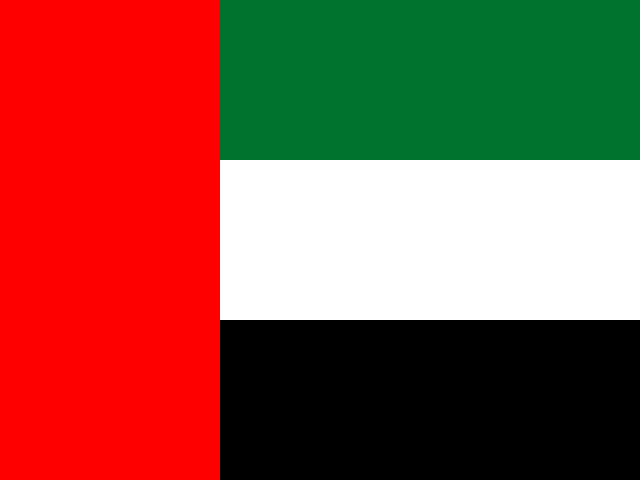
Overview
The United Arab Emirates (UAE) is a federation of seven emirates at the southeastern end of the Arabian Peninsula, in West Asia. Its land neighbours are Oman (to the east and northeast) and Saudi Arabia (to the west and south), and it also has a short, disputed stretch of boundary with Qatar in the northwest. By sea it faces Iran across the Persian Gulf. Abu Dhabi is the national capital, while Dubai is the largest city.
The state is a federal, semi-constitutional monarchy. A Federal Supreme Council made up of the seven ruling sheikhs is the highest authority. Islam is the state religion. Arabic is the official language, but English is the most widely spoken language and is the working language of business.
The country's population was estimated at over 11 million in 2024. Only about 11% are Emirati citizens, and the rest are expatriates and migrant workers, most from South Asia. Citizenship is very hard to obtain except by descent.
The UAE holds the world's seventh-largest oil reserves and seventh-largest natural gas reserves. It is described as the most diversified economy among the Gulf Cooperation Council states, with Dubai acting as a regional hub for finance, tourism, trade and aviation. It scores highly on the Human Development Index (highest in the Arab region), housing, healthcare, education and personal safety. Human rights groups, however, rate it poorly on political and civil liberties.
It belongs to the UN, the Arab League, the Organisation of Islamic Cooperation, the Non-Aligned Movement, the WTO and BRICS, and is a dialogue partner of the Shanghai Cooperation Organisation. It is considered a middle power. It left OPEC with effect from 1 May 2026.
History
Stone tools found in the region point to human presence roughly 127,000 to 130,000 years ago. From about 3000 BCE, trade in copper from the Hajar Mountains linked the area with Mesopotamia, Iran and the Indus Valley (Harappan) culture. Sumerian texts refer to a land called Magan, which is identified with the territory of today's UAE.
Islam reached the region in the 7th century. A letter from the Prophet Muhammad to the rulers of Oman in 630 CE led a group of local leaders to travel to Medina and convert, after which they rose against the Sassanids who controlled the coast. After Muhammad's death, caliph Abu Bakr sent an army to put down revolts among the new Muslim communities south of the Gulf.
Life in the harsh environment centred on mobile tribal groups who combined herding, farming and hunting. Seasonal movements produced both rivalry and a network of seasonal and semi-permanent settlements. Tribal names that survive today include the Bani Yas and Al Bu Falah (Abu Dhabi, Al Ain, Liwa, the west coast) and the Dhawahir, Awamir, Al Ali and Manasir of the interior. The Portuguese arrived around 1500 and built bases while fighting the Persians.
In the 19th century pearling became the main industry, piracy grew common in the Gulf, and Britain intervened. Local sheikhdoms signed agreements with the UK that created the Trucial States, a British protectorate which also shielded them from Saudi and Omani claims. Pearling thrived into the early 20th century, but World War I, the depression of the late 1920s and early 1930s and the cultured pearl wrecked it. It faded entirely after World War II, when newly independent India imposed heavy taxes on imported pearls, and the Trucial States fell into severe hardship until oil was found.
By 1966 Britain could no longer afford to administer and defend the Trucial States. On 24 January 1968 Prime Minister Harold Wilson announced the end of the treaty relationships, a decision reaffirmed by Edward Heath in March 1971. Sheikh Zayed bin Sultan Al Nahyan of Abu Dhabi offered to pay the full cost of keeping British forces, but the offer was refused. The nine Gulf sheikhdoms tried to form a wider union but could not agree on terms by mid-1971. Bahrain became independent in August 1971 and Qatar in September.
On 30 November 1971, the day before the British treaty expired, Iranian forces seized the Tunb islands, and Abu Musa was leased to Iran under a deal with its ruler, Sheikh Khalid bin Muhammad Al Qasimi, for $3 million a year. Saudi Arabia claimed large areas of Abu Dhabi, and a border agreement was only signed in 1974. The islands dispute with Iran remains unresolved.
On 2 December 1971 six emirates (Abu Dhabi, Ajman, Dubai, Fujairah, Sharjah and Umm Al Quwain) formed the UAE. Ras al-Khaimah joined on 10 January 1972. The country joined the Arab League on 6 December 1971 and the UN on 9 December 1971. A 40-member appointed Federal National Council was created in February 1972. The UAE was a founding member of the Gulf Cooperation Council in May 1981, and Abu Dhabi hosted its first summit.
The founding rulers were Zayed bin Sultan Al Nahyan (Abu Dhabi), Rashid bin Saeed Al Maktoum (Dubai), Khalid bin Muhammad Al Qasimi (Sharjah), Rashid bin Humaid Al Nuaimi (Ajman), Ahmad bin Rashid Al Mualla (Umm Al Quwain), Saqr bin Mohammed Al Qasimi (Ras Al Khaimah) and Mohammed bin Hamad Al Sharqi (Fujairah). Sheikh Zayed was president from 1971 until his death in 2004, and used oil income to invest in healthcare, education and infrastructure.
The UAE backed the US-led coalition in the 1991 Gulf War, with Al Dhafra Air Base near Abu Dhabi used for allied operations. It signed defence agreements with the US in 1994 and France in 1995, and in 2008 France agreed to set up a permanent base in Abu Dhabi. The UAE also joined the 2011 military operations in Libya.
Sheikh Khalifa bin Zayed Al Nahyan became president after Zayed's death in 2004. In January 2006 Mohammed bin Rashid Al Maktoum became both ruler of Dubai and prime minister after the death of his brother Maktoum. The first national elections, for half of the Federal National Council, took place on 16 December 2006. The country largely avoided the Arab Spring, though authorities arrested dozens of activists linked to Al Islah on suspicion of plotting a coup, and in 2012 outlawed online mockery of the government and the use of social media to organise protests.
COVID-19 was confirmed in the UAE on 29 January 2020. In March the government closed malls, schools and places of worship, imposed a curfew and suspended passenger flights, causing a sharp downturn. More than half of federal agencies were later merged.
On 29 August 2020 the UAE established normal diplomatic relations with Israel, and later in 2020 the Abraham Accords were signed with US help. In February 2021 the UAE's Hope probe entered Mars orbit, making it the first Arab country to reach Mars. Mohamed bin Zayed Al Nahyan became president on 14 May 2022 after the death of Sheikh Khalifa.
The source states that the United States and Israel launched joint strikes on Iran on 28 February 2026, after which the UAE came under Iranian drone and missile fire in retaliation, with the attacks directed at American military assets and Emirati economic infrastructure. Israel reportedly deployed its Iron Dome air-defence system, along with its operators, to the UAE. Citing unnamed sources, the Wall Street Journal reported that the UAE had secretly conducted strikes against Iran, among them an attack on Lavan Island in early April. On 28 April 2026, the UAE declared it would withdraw from OPEC effective 1 May 2026, in part so it could raise its oil production. A new free trade zone agreement with South Korea was signed by both the UAE and Qatar on 2 May. As of the retrieval date, events were still unfolding.
Climate
The UAE has a hot desert climate, described as subtropical-arid. July and August are the hottest months, with average daily highs above 45 °C on the coastal plain. Average winter lows in January and February are about 10 to 14 °C. In late summer a humid southeasterly wind called the Sharqi makes the coast especially oppressive.
Rainfall is low, averaging under 120 mm a year on the coast, and falls in short, heavy winter downpours that can flood normally dry wadis. Parts of the Hajar Mountains receive up to about 350 mm and are noticeably cooler. Violent dust storms can sharply reduce visibility. Snow was recorded for the first time on Jebel Jais in Ras al-Khaimah on 28 December 2004, and it has fallen only rarely since.
Abu Dhabi, the capital, has a hot, humid desert coastal climate. Summer highs are about 40 to 42 °C (approx.) with high humidity, and winter highs are around the low-to-mid 20s °C (approx.). Annual rainfall is very low, roughly 100 mm or less (approx.).
Dubai, the largest city, is similar: very hot and humid summers with highs often above 40 °C (approx.), pleasant winters with highs of about 24 °C (approx.), and little rain. Al Ain, inland near the Omani border, is drier and hotter in summer, with less humidity than the coast (approx.). Sharjah and Ras al-Khaimah behave much like Dubai, and Ras al-Khaimah has cooler mountain areas nearby. Fujairah on the Gulf of Oman coast is also hot and humid, but receives somewhat more rain.
The coast is mostly low-lying with salt flats reaching 8 to 10 km inland. South and west of Abu Dhabi lie large sand dunes that merge into the Rub al-Khali (Empty Quarter) of Saudi Arabia. The Liwa and Al-Buraimi oases have enough groundwater to support permanent settlement and farming, with date palms, acacia and eucalyptus. Desert vegetation is sparse, made up of grasses and thorn bushes. A conservation programme begun by Sheikh Zayed in the 1970s on Sir Bani Yas Island has helped species such as the Arabian oryx and leopard survive.
Government and politics
The UAE is a federation of seven hereditary emirates, each a sheikhdom ruled by a family: Abu Dhabi, Dubai, Sharjah, Ajman, Umm Al Quwain, Ras Al Khaimah and Fujairah. Rulers are called sheikh rather than emir, reflecting tribal tradition. The Federal Supreme Council of the seven rulers is the top authority. It elects a president and vice president. By convention the head of the Al Nahyan family of Abu Dhabi is president, and the head of the Al Maktoum family of Dubai is prime minister and typically also vice president.
Powers are divided so that anything not given to the federal government stays with the individual emirate. Federal government covers matters such as foreign affairs, defence and the federal courts, while each emirate keeps its own local governments and carries out many functions itself. Each emirate contributes a share of its revenue to the federal budget. Abu Dhabi, Dubai and Ras Al Khaimah run local court systems alongside the federal courts. Healthcare illustrates the split: Abu Dhabi and Dubai have their own health authorities, while the northern emirates fall under the federal Ministry of Health. Education works similarly, with the federal Ministry of Education responsible everywhere except Abu Dhabi, which has its own Department of Education and Knowledge.
The federal executive is the president, who is also commander-in-chief, the prime minister and the Council of Ministers (22 members), which handles internal and foreign affairs. The prime minister is appointed by the Federal Supreme Council and chooses the ministers. The judiciary consists of a federal Supreme Court and lower federal courts. The Federal National Council (FNC) has 40 members from all the emirates, with seats allocated per emirate. Half are appointed by the rulers and half are elected by a limited electorate chosen by the rulers (about a third of citizens at the time of the source). Members must be equally divided between men and women. The FNC is largely advisory. The government notes that in December 2019 women held half the seats in the lower house.
The government has unusual ministries, including those for Tolerance, Happiness and Artificial Intelligence, and a virtual Ministry of Possibilities, plus a National Youth Council.
Legal system: it mixes civil law with Sharia. Sharia courts have exclusive jurisdiction over Muslim family matters, and civil courts handle everything else. In 2020 corporal punishment was removed from federal law, and Islamic law now applies only to retribution and blood-money. Personal status law has been opened to non-Muslims, with Abu Dhabi establishing a civil family court and Dubai allowing civil marriage. Muslim women need a male guardian's consent to marry, and Muslim women may not marry non-Muslims. Apostasy is technically a capital offence but no executions are documented, blasphemy is illegal and expatriates can be deported for it, and same-sex sexual conduct is criminalised. Alcohol and cohabitation rules have been relaxed in recent years, making the country easier for non-Muslim visitors.
Politics: the country has no democratically elected institutions and no formal free-speech commitment. It has been described as a 'tribal autocracy'. Freedom House has rated it 'Not Free' from 1999 onward, and it ranks poorly in press-freedom and democracy indices, while the Bertelsmann Transformation Index calls it a 'moderate monarchy'. Human rights organisations report torture and enforced disappearances of government critics. The government and its supporters stress stability and development. Trade unions are not permitted, and strikes can lead to cancelled permits and deportation of migrant workers.
Territory and borders: Abu Dhabi covers about 87% of the territory (67,340 km²), Dubai about 3,885 km² and Ajman, the smallest, only 259 km². Dubai holds about 35.6% of the population and Abu Dhabi about 31.2%, so over two-thirds of residents live in one of those two. The northern emirates (Fujairah, Ajman, Ras al-Khaimah, Umm al-Qaiwain) together cover about 3,881 km². Two areas are under joint control, one shared by Oman and Ajman, the other by Fujairah and Sharjah. Oman's Madha exclave lies inside Sharjah, and within it is a Sharjah exclave called Nahwa. The Musandam Peninsula is also an Omani exclave separated from Oman by the UAE. The UAE disputes Iran's control of Abu Musa and the Greater and Lesser Tunbs, and disputes some islands and the short land border with Qatar.
Foreign policy: relations are broad, with strong ties described with Bahrain, China, Egypt, India, Jordan, Pakistan, Russia, Saudi Arabia and the United States. Most embassies are in Abu Dhabi and most consulates in Dubai. The UAE cut ties with Qatar in June 2017 and restored them in January 2021. It recognised Israel in 2020. It has engaged with Syria's transitional government after the fall of the Assad regime. It is reported as the main backer of the Rapid Support Forces in Sudan, which the UAE has been accused of arming. Sudan filed a case against the UAE at the International Court of Justice on 6 March 2025 alleging complicity in genocide. The UAE rejects such claims, and the case outcome is not covered here. As of November 2025, a US congressional bill to restrict weapons exports to the UAE was still pending.
Military: forces number about 44,000 in the army, 2,500 in the navy, 4,500 in the air force and 12,000 in the Presidential Guard. Defence spending was about US$20.4 billion in 2022, roughly 4% of GDP. It is considered the most capable military among Gulf states and was nicknamed 'Little Sparta' by US officers. Equipment comes mainly from France, the US and the UK, and it has grown a domestic defence industry. Mandatory military service for adult males, 16 months, has applied since 2014. The UAE has deployed in Somalia, Kosovo, Afghanistan, Libya, Syria and Yemen. In the 2015 Marib attack 52 soldiers died, the heaviest loss in its history.
Economy
The UAE moved from a collection of Bedouin tribes to one of the wealthiest states in about 50 years, and has one of the highest GDP per capita (PPP) figures in the world. Growth was steady, averaging close to 4% real growth between 2000 and 2018, with dips in 2008–09 and a weaker period from 2015 to 2019. In 2018 nominal GDP was about US$414 billion, the second largest in the GCC after Saudi Arabia. GDP per capita is nearly 80% above the OECD average. The IMD ranked the country 7th in its World Competitiveness ranking in 2024.
The population grew from about 550,000 in 1975 to close to 10 million in 2018, mostly through foreign workers. Residence is tied to employment and strict visa rules, so labour supply adjusts quickly to the business cycle and unemployment stays under 3%. Just over 80% of Emirati workers hold government posts, with many others in state-owned firms such as the airline Emirates.
Oil and gas contributed about 26% of GDP in 2018 and about 36% of government revenue. Diversification started before the oil price crash of the 1980s, and the UAE has the most diversified economy in the Middle East and North Africa. The Barakah nuclear plant is the first on the Arabian Peninsula, and Dubai's Clean Energy Strategy targets 25% clean energy by 2030 and 75% by 2050. The state oil company ADNOC and its CEO Sultan Al Jaber came under criticism after leaked documents suggested COP28 contacts were used to pursue oil and gas deals.
Finance and tax: the central bank keeps the dirham pegged to the US dollar and moves rates close to US policy rates. A 5% VAT was introduced on 1 January 2018 and raised roughly 6% of revenue in 2018. Growth was weak in 2017 and 2018 (0.8% and 1.4%). The tax regime is attractive to firms and wealthy individuals, and the Tax Justice Network ranked the UAE among the ten largest tax havens in 2021. In 2024 the UAE was reported as the leading destination for wealthy migrants for the third year running (approx. 6,700 expected). The World Bank's Doing Business 2017 ranked it 26th, and it was 30th in the Global Innovation Index in 2025. Weaker points include education levels, limits in financial and labour markets, trade barriers and turning investment into innovation.
Tourism: Dubai is the leading tourism destination in the Middle East, with about 66% of the UAE's tourism economy against 16% for Abu Dhabi and 10% for Sharjah, and it received 10 million visitors in 2013. Tourist visas have been valid for five years since 6 January 2020. Attractions include the Burj Khalifa, Palm Jumeirah and The World archipelago in Dubai, Sheikh Zayed Grand Mosque and Yas Marina Circuit in Abu Dhabi, and the Hajar Mountains. The Wynn Al Marjan Island resort in Ras Al Khaimah is planned to include the country's first casino and open in March 2027, and Disneyland Abu Dhabi is planned as the Middle East's first Disney park.
Transport: Dubai International became the world's busiest airport by international passengers in 2014, and Abu Dhabi International is the second-largest airport in the UAE. Plans announced on 28 April 2024 would close Dubai International once the Al Maktoum Airport expansion is complete. The E11 highway links Abu Dhabi, Dubai, Sharjah, Ajman, Umm Al Quwain and Ras Al Khaimah. Dubai has the Dubai Metro (the first urban train network on the Arabian Peninsula), a tram, the Palm Jumeirah monorail, buses, taxis, abras and water taxis, and Salik electronic tolls introduced in 2007. A 1,200 km national railway is under construction. Key ports include Khalifa Port, Port Jebel Ali, Port Rashid, Zayed Port and Port Khor Fakkan.
Telecoms: the market has two operators, Etisalat and du (which launched mobile services in 2007). 5G was rolled out nationwide in 2019, and the regulator requires filtering of some religious, political and sexual content.
Demographics and urbanization
The World Bank estimated the population at about 9.89 million in 2020, of which about 88.5% were immigrants and 11.5% Emiratis, and the UAE had one of the world's highest net migration rates. The estimate for 2024 is over 11 million. About 88% of people live in urban areas. Men outnumber women by about 2.2 to 1 overall and about 2.75 to 1 among ages 15 to 65, among the most skewed gender ratios in the world. Life expectancy was about 77 years in 2018.
Dubai accounts for about 35.6% of the population and Abu Dhabi for about 31.2%. Among expatriates in Dubai, Sharjah and Ajman, the largest groups are Indian (about 25%), Pakistani (12%), Bangladeshi (7%) and Filipino (5%), with Emiratis about 9%. More than 2 million Indian migrants live in the country, many from Kerala, Andhra Pradesh, coastal Karnataka and Tamil Nadu. Expatriates from Europe, Australia and North America number about 100,000, and the remainder come from other Arab states.
Largest cities (approx.): Dubai about 3.5 to 3.7 million; Abu Dhabi about 1.5 million in the city and a larger emirate population; Sharjah about 1.5 million; Al Ain about 0.8 million; Ajman and Ras al-Khaimah a few hundred thousand each. Dubai, Sharjah and Ajman form a continuous urban corridor along the Gulf coast.
Language: Modern Standard Arabic is the national language, and Emirati Arabic (a Gulf Arabic variety) is spoken by Emiratis. English is the most commonly spoken language, following British conventions, and many South Asian languages are widely used by migrants.
Religion: Islam is the official religion. About 85% of Emirati citizens are Sunni (mostly Maliki) and about 15% are Shia, concentrated in Dubai and Sharjah. Christians were about 9% of the population in the 2005 census, with estimates of 12.6% in 2010, and there were more than 52 churches in 2023. There are Hindu temples (three at the time of the source), Sikh, Buddhist and Baha'i communities, and a small Jewish community with synagogues in Dubai and Abu Dhabi. The Abrahamic Family House on Saadiyat Island in Abu Dhabi combines a mosque, church and synagogue. The government generally tolerates non-Muslim worship.
Education: public schools are free for citizens and teach in Arabic with English as a second language, and many international private schools charge varying fees. The adult literacy rate was 93.8% in 2015. In QS rankings, the top local universities are United Arab Emirates University, Khalifa University, the American University of Sharjah and the University of Sharjah.
Health: cardiovascular disease causes about 28% of deaths, and WHO data from 2016 show about 34.5% of adults are clinically obese. Mandatory health insurance began in Abu Dhabi and was extended to Dubai government employees. Federal law aims for universal coverage under a compulsory scheme. The country attracts medical tourists from across the Gulf.
Capital city
Abu Dhabi is the federal capital and the seat of the federal government. It sits on the Persian Gulf coast, partly on an island, and is the capital of the largest emirate, which covers about 87% of the country's territory and extends into the desert towards Liwa and Al Ain. The city has roughly 1.5 million people (approx.), with a larger population in the wider emirate.
Climate (approx.): hot desert, with very hot, humid summers (highs about 40 to 42 °C), mild winters with highs in the low-to-mid 20s °C, and rainfall mostly under 100 mm a year.
Role: it is the political centre, with most embassies, and the home of the Al Nahyan ruling family, whose head is traditionally president. It holds most of the country's oil wealth and is the base for ADNOC and major sovereign investment. Major sights include Sheikh Zayed Grand Mosque, Yas Marina Circuit and the Abrahamic Family House on Saadiyat Island, and the city hosts the biennial International Defence Exhibition. Disneyland Abu Dhabi is planned.
Difference between capital and largest city: Dubai, not Abu Dhabi, is the largest city, the main commercial and tourism hub and the home of most consulates. Dubai leads in trade, aviation, tourism and finance, while Abu Dhabi dominates in oil, federal government and sovereign wealth. Both emirates therefore function as economic centres, but Dubai is generally seen as the country's main business city, and Abu Dhabi as its political capital.
About this summary
Approximate city populations, city-level climate figures, total land area and capital-city details come from general knowledge. Recent economic and security context is also partly general knowledge.