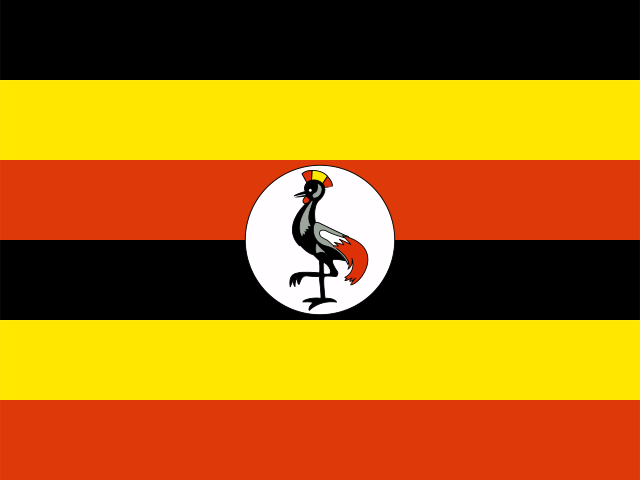
Overview
Uganda, officially the Republic of Uganda, is a landlocked country in East Africa. It borders Kenya to the east, South Sudan to the north, the Democratic Republic of the Congo to the west, Rwanda to the south-west and Tanzania to the south. A large part of Lake Victoria lies in the south of the country and is shared with Kenya and Tanzania. Uganda sits in the African Great Lakes region and almost entirely within the Nile basin.
The population was about 45.9 million in 2024, of whom roughly 1.8 million lived in Kampala, the capital and largest city. The name comes from the Buganda kingdom, which covers much of the south including Kampala; its language, Luganda, is widely spoken. English is the official language and Swahili is the second official language.
Uganda became independent in 1962. It went through a coup and the dictatorship of Idi Amin in the 1970s, then a civil war, before Yoweri Museveni's National Resistance Movement took power in 1986. Museveni's rule has brought relative stability and economic growth, but also criticism over political repression, human rights abuses, corruption and the removal of presidential term limits. He was elected in 2011, 2016, 2021 and January 2026.
The country has made progress in education and health, including higher literacy and a reduction in HIV infection, although maternal health and gender inequality remain problems. Its scenery is varied, with volcanic hills, mountains and large lakes, and it has fertile farmland, untapped oil reserves and rich wildlife that supports tourism. Uganda belongs to the UN, the Commonwealth, the African Union, G77, the East African Community and the Organisation of Islamic Cooperation.
History
Until about 3,000 years ago, much of what is now Uganda was home to Central Sudanic- and Kuliak-speaking farmers and herders. Bantu speakers then arrived in the south and Nilotic speakers in the northeast. By around 1500 AD these groups had been absorbed into Bantu-speaking cultures south of Mount Elgon, the Nile and Lake Kyoga. Oral tradition and archaeology point to the Empire of Kitara, which spread across much of the Great Lakes area between lakes Albert and Kyoga in the north and Victoria and Tanganyika in the south. Several later kingdoms, such as Tooro and Ankole, claim it as an ancestor. Arab traders reached the region in the 1830s and British explorers followed in the late 19th century.
In 1893 the Imperial British East Africa Company handed its administrative rights, covering mainly the Kingdom of Buganda, to the British government, having been bankrupted by religious wars inside Buganda. The Uganda Protectorate was set up in 1894 and extended beyond Buganda through treaties with other kingdoms: Toro in 1900, Ankole in 1901 and Bunyoro in 1933. It lasted until 1962. In the 1950s the colonial authorities encouraged some 500,000 subsistence farmers to join cooperatives.
Uganda became independent from the UK on 9 October 1962, with Queen Elizabeth II as head of state. In 1963 a ceremonial president, chosen from among the traditional kings, replaced the Queen and the governor-general post was abolished. Milton Obote was the first prime minister. The early years were dominated by the question of how to fit the powerful Buganda kingdom into a unitary state, a problem colonial governors had never solved. In 1966 a power struggle between Obote's government and King Muteesa (the Mengo Crisis) ended with Obote suspending the constitution and removing the ceremonial president. A new constitution in 1967 declared a republic, abolished the traditional kingdoms and made Obote president.
On 25 January 1971 General Idi Amin deposed Obote in a military coup and ruled as a dictator for eight years. An estimated 80,000 to 500,000 Ugandans died in mass killings during his rule, and he expelled the Indian minority in 1972. In June 1976 Palestinian hijackers forced an Air France flight to land at Entebbe, and about 100 hostages were held until Israeli commandos rescued them ten days later. Amin fell in 1979 during the Uganda–Tanzania War, when Tanzanian forces and Ugandan exiles invaded, with Tanzanian president Julius Nyerere hoping to return his ally Obote to power.
Obote returned after the disputed 1980 election, which set off the Ugandan Bush War. Museveni's forces took power in January 1986. His Movement system kept political parties alive but allowed them only a headquarters office, with no branches, rallies or direct candidates. A July 2005 referendum ended this ban on multi-party politics. Parliament also abolished presidential term limits in 2005, allegedly after MPs were paid to support the change.
Western governments lauded Museveni in the mid-to-late 1990s, viewing him as one of Africa's emerging new leaders. Since then, his time in office has been shaped by Uganda's role in the Democratic Republic of the Congo, among them the Second Congo War, which has claimed an estimated 5.4 million lives since 1998, as well as by a prolonged struggle against the Lord's Resistance Army (LRA). The LRA stands accused of crimes against humanity, and the fighting in the north left thousands dead and millions displaced.
Museveni won the 2011 election with about 68 percent against Kizza Besigye, who rejected the result. EU observers noted a peaceful campaign but also administrative failures that disenfranchised many citizens. In 2021 Museveni won with about 58 percent against Bobi Wine's 35 percent, and the opposition alleged widespread fraud. He has ruled since 1986 and was re-elected in the January 2026 presidential election. Speculation about a succession plan involving his son, Muhoozi Kainerugaba, has raised tensions.
Climate
Uganda has a warm tropical climate, with average temperatures of roughly 25 to 29 °C. The hottest months are December to February, though evenings can still be mild at around 17 to 18 °C. Most of the country gets about 1,000 to 1,500 mm of rain a year. The south has two wet seasons, March to May and September to November, and two drier spells, January to February and June to August. Heavy rains can make roads hard to use. In the north there is a single long wet period from March to November, followed by a dry spell from December to February.
The average elevation is about 900 metres, which keeps temperatures moderate for a country on the equator (between 1°S and 4°N). Mount Stanley in the Ruwenzori range reaches 5,109 m and Wagagai on Mount Elgon reaches 4,321 m, so the highest peaks are cold.
Kampala, in the south near Lake Victoria, has a mild equatorial highland climate (approx.): warm days around the high 20s °C, cooler nights, and rain in two main seasons with frequent thunderstorms. Entebbe, on the lake shore, is similar but somewhat wetter and more humid (approx.). Gulu in the north has a hotter climate with one long rainy season and a pronounced dry season, as described above (approx.). Mbale, near Mount Elgon in the east, is cooler and wet on the mountain slopes (approx.).
Geographically, the south is shaped by Lake Victoria. Lake Kyoga lies in the centre with extensive marshes, and Lakes Albert, Edward and George are also in the country. The Victoria Nile runs from Lake Victoria to Lake Kyoga and then Lake Albert before flowing north into South Sudan. Small areas of the east and the extreme north-east drain elsewhere. Uganda has 60 protected areas, including ten national parks. Bwindi Impenetrable and Rwenzori Mountains are UNESCO World Heritage Sites. Other parks include Kibale, Kidepo Valley, Lake Mburo, Mgahinga Gorilla, Mount Elgon, Murchison Falls, Queen Elizabeth and Semuliki. Wildlife includes mountain gorillas at Bwindi, golden monkeys at Mgahinga and hippos at Murchison Falls. The 2019 Forest Landscape Integrity Index gave Uganda a mean score of 4.36 out of 10.
Government and politics
Uganda is a republic where a single person, the president, serves as both the head of state and the head of government. To assist in governing, the president names a vice-president and a prime minister. Parliament consists of 557 members. These include constituency representatives, district woman representatives and army (UPDF) representatives, along with 5 youth representatives, 5 workers' representatives, 5 representatives of persons with disabilities and 18 ex officio members.
The country is divided into four regions and 136 districts. Rural parts of districts are split into sub-counties, parishes and villages, and urban areas have municipal and town councils. The Uganda Local Governments Association acts as a voluntary forum linking and supporting local governments. The state is unitary: districts and local councils carry out services under the national framework rather than holding independent powers like federal states. Broad areas such as taxation, law, defence, health policy and education policy are set nationally (approx.), and local governments deliver many services under that framework (approx.).
Alongside the state administration, seventeen traditional kingdoms have official recognition and enjoy mainly cultural autonomy. The oldest and most prestigious are Buganda, Busoga, Bunyoro, Tooro and Rwenzururu. Some groups are seeking recognition of Ankole without success so far. Other kingdoms and chiefdoms recognised by the government include the Alur Kingdom, the Iteso paramount chieftaincy, the Lango monarchy and the Padhola state.
Press freedom has repeatedly been restricted through intimidation and the Public Order Management Act of 2013. Arrests and beatings of opposition MPs and the siege of the High Court during a hearing of Kizza Besigye's case before the 2006 elections drew international criticism. In 2005 the British government withheld part of its aid. The 2006 NGO (Amendment) Act has been criticised for limiting NGO activity through registration rules and requirements that foreign funds pass through the Bank of Uganda.
Transparency International counts Uganda's public sector among the highly corrupt; in 2016 the country placed 151st out of 176, scoring 25 out of 100. In 2012, $12.6 million in donor money was stolen from the Office of the Prime Minister, and as a result the EU, UK, Germany, Denmark, Ireland and Norway suspended their aid. Public procurement carries a high risk of corruption. Critics, among them a Ugandan energy analyst, contended that the Petroleum Bill of 2012 handed the executive excessive control over oil revenue. Protesters in 2014 carried piglets into parliament to object to the pay of MPs.
Human rights concerns include reported torture by security forces, child labour and trafficking, and the conflict in the north. An estimated 1.4 million people were internally displaced. The Anti-Homosexuality Act of 2014 was struck down by the Constitutional Court on procedural grounds. In March 2023 parliament approved a new bill on homosexuality, which was widely condemned abroad. The version that became law did not make identifying as homosexual a crime, though it was strongly criticised internationally.
Uganda's refugee policy is described as one of the most open in the world. Refugees can seek work permits, move freely, receive a plot of land and form associations, but the policy gives no path to citizenship. By October 2025 Uganda hosted about 1.95 million refugees, mainly from South Sudan and the DR Congo, with others from Somalia, Burundi and Rwanda. Since 2023 more than 90,000 people fleeing the war in Sudan have arrived. In August 2025 Uganda agreed with the US to accept African asylum seekers deported from the US; critics, including Muwada Nkunyingi, compared this to human trafficking.
In foreign relations Uganda belongs to the East African Community (with Kenya, Tanzania, Rwanda, Burundi and South Sudan), the Intergovernmental Authority on Development and the Organisation of Islamic Cooperation. The 2010 EAC Common Market Protocol promises free movement and the right to work in other member states, but work permits and other bureaucratic hurdles have stopped it being fully applied. The military, the Uganda People's Defence Force, has about 45,000 active personnel and has been deployed in the DR Congo, the Central African Republic, Somalia and South Sudan.
Economy
The Bank of Uganda is the central bank and issues the Ugandan shilling. Since 1986 the government, with foreign and international support, has rebuilt an economy devastated by the Amin regime and the civil war. Real GDP grew by an average of 6.7 percent a year over 1990–2015, and by 4.6 percent in fiscal year 2015–16. Nominal GDP was about US$26 billion in 2019 and about US$25.9 billion in 2022 according to the IMF and World Bank respectively; on a purchasing-power basis, GDP was about US$80–91 billion.
Agriculture made up 56 percent of the economy in 1986, but services overtook it and reached 52 percent of GDP in 2007. In 2015 export earnings came mainly from coffee (about US$403 million), oil re-exports, base metals, fish, maize, cement, tobacco, tea, sugar, hides and skins, cocoa, beans, simsim and flowers. Uganda has large largely untapped reserves of crude oil and natural gas, found around Lake Albert, and planned the 1,445 km East African Crude Oil Pipeline from Hoima to the port of Tanga in Tanzania at an estimated cost of US$3.5 billion. Uganda also acts as a trade hub for the DR Congo, South Sudan and Rwanda.
Uganda has been an economic trade partner of Kenya, relying on the port of Mombasa on the Indian Ocean, and has sought a second route through Lake Victoria ports to Tanzania. The Uganda Securities Exchange has operated since 1996 and the government has used it for privatisation. A large diaspora, mainly in the US and UK, sends remittances: about US$1.1 billion in 2016. Inflation was 4.6 percent in November 2016 and 3.4 percent in June 2018.
Poverty has fallen from 56 percent of the population in 1992 to 24.5 percent in 2009, but it remains deep in rural areas, where 84 percent of Ugandans live. In 2012 about 37.8 percent of people lived on less than $1.25 a day. Uganda was placed on the Heavily Indebted Poor Countries list in 2012. Rural women do most of the farm work and carry heavy domestic burdens, and gender inequality is a major obstacle to reducing poverty.
Roads carry about 95 percent of freight and passengers. The network is about 129,469 km, of which only about 4 percent (about 5,300 km) is paved. National roads are 17 percent of the network but carry over 80 percent of traffic. Private car ownership is very low, at about 2.94 per 1,000 inhabitants in 2022. The railway network is about 1,260 km, with lines from Kampala to Tororo, Kampala to Kasese and Tororo to Pakwach. There are 36 airports; Entebbe International Airport, about 40 km south-west of Kampala, is the only functioning international airport, with 1.53 million passengers in 2017. Hoima (Kabalega) International Airport received its first passenger aircraft on 27 September 2026.
Mobile telecommunications have grown rapidly: in 2018 there were over 24 million subscribers, and over 95 percent of internet connections are made by mobile phone. Energy resources include hydropower, biomass, solar, geothermal, peat and fossil fuels. The electricity market has been liberalised since 2001, with an independent regulator; independent power producers account for nearly 60 percent of generation capacity, and the main distributor, UMEME, was privately owned under a 20-year concession. Wood and charcoal were the main energy source in the 1980s.
Urban water supply and sanitation got better following reforms carried out between 1998 and 2003, yet by 2010 some 38 percent of Ugandans still had no access to an improved water source. The school system comprises seven years of primary and six years of secondary study. Free primary schooling for all started in 1997, and a decade later, in 2007, Uganda led sub-Saharan Africa by offering universal secondary education as well. The 2002 census put literacy at 66.8 percent. Higher-education institutions include Makerere, Mbarara University of Science and Technology, Kyambogo, Gulu, Uganda Christian University and Kampala International University. When user fees were abolished at public health facilities in 2001, visits climbed by 80 percent. Life expectancy increased from 39.3 years in 1950 to 62.7 in 2021, while fertility dropped to roughly 4.3 births per woman by 2019.
Demographics and urbanization
Uganda's population grew from 9.5 million in 1969 to 34.9 million in 2014 and about 45.9 million in 2024. The median age is about 15, among the lowest in the world, and 49.5 percent of Ugandans were under 18 in 2024. Women are 51.4 percent of the population. Fertility was 5.97 children per woman in 2014, one of the highest in the world at that time.
Roughly 84 percent of Ugandans lived in rural areas according to older data, so the urbanization rate is low, around 25–30 percent (approx.). Most large towns are in the south near Lake Victoria. Kampala has about 1.8 million people in the city proper and a larger metro area of perhaps 4 million (approx.). Other notable towns include Entebbe, Gulu, Mbarara, Jinja, Mbale and Lira, each with populations of roughly 100,000 to 300,000 (approx.).
The population is made up of many ethnic groups, with Bantu-speaking peoples (including the Baganda) dominant in the south and Nilotic and other groups in the north and east. About 80,000 Indians lived in Uganda before Amin's 1972 expulsion, which reduced the number to as low as 7,000; many returned after 1979, and around 90 percent of Ugandan Indians live in Kampala. There are also about 10,000 white Africans and 3,000 Arabs.
English and Swahili are the two official languages; Swahili was added in 2005. Swahili is less popular among Bantu speakers in the south and south-west but serves as a lingua franca in the north, and is widely used in the police and military. Luganda is widely spoken, especially around Kampala.
Catholics were the largest religious group at 39.3 percent, followed by the Anglican Church of Uganda at 32 percent. Evangelical, Pentecostal and Born-Again Christians grew from 4.7 percent in 2002 to 11.1 percent in 2018. Muslims are about 14 percent. Traditional religions, other religions and no affiliation make up a small remainder.
Uganda hosted over 1.4 million refugees in August 2021, mostly from South Sudan (68 percent) and the DR Congo (24.6 percent), and about 1.95 million by October 2025.
Capital city
Kampala is the capital and largest city, on the northern shore of Lake Victoria in the Buganda region of the south, near Entebbe. It had about 1.8 million people in the city proper and a larger metro area of roughly 4 million (approx.). It is built across a number of hills at moderate elevation of about 1,200 m (approx.).
Its climate is mild equatorial highland (approx.): typical highs of about 26–28 °C, nights of about 17 °C, and two rainy seasons (March to May and September to November) with frequent afternoon thunderstorms.
Kampala is the political, administrative and commercial centre. It houses the national government and parliament, and it is also the main economic city, home to major businesses, banks, universities such as Makerere, and most of the country's Indian community. It is also the cultural centre of the Buganda kingdom, whose traditional seat is in Mengo within the city (approx.). Entebbe, about 40 km south-west, has the country's only functioning international airport and was the colonial administrative centre (approx.). Uganda has one capital, and it is also the main economic city.
About this summary
Some figures are general-knowledge approximations: city populations, city climates, capital-city details, and recent economic and political context.