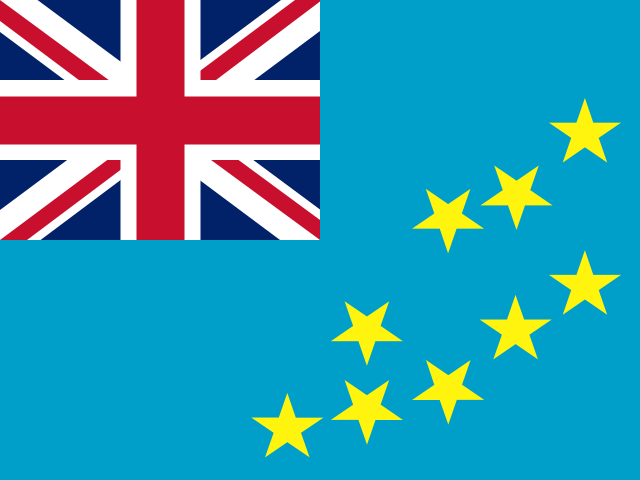
Overview
Tuvalu is a small island nation in the Polynesian part of Oceania, in the central Pacific roughly halfway between Hawaii and Australia. Its neighbours include Kiribati to the north, Fiji to the south, Samoa to the southeast, Nauru to the northwest and Vanuatu to the southwest.
The country is made up of nine islands: three reef islands (Nanumanga, Niutao, Niulakita) and six true atolls (Funafuti, Nanumea, Nui, Nukufetau, Nukulaelae, Vaitupu). They stretch between about 5° and 10° south and 176° and 180° east, just west of the International Date Line.
The 2022 census counted 10,643 people. Total land area is only about 25 to 26 sq km, which puts Tuvalu among the very smallest countries on Earth; the source says only Monaco, Nauru and Vatican City are smaller. Its exclusive economic zone covers roughly 900,000 sq km of ocean.
Tuvalu became independent from Britain on 1 October 1978 and is a constitutional monarchy within the Commonwealth, with Charles III as King of Tuvalu. It joined the United Nations on 5 September 2000.
The islands have very little soil, so the country depends on imported food and on fishing. Income comes mainly from fishing licences, grants and aid, the .tv internet domain, and remittances from seafarers and workers abroad. Because the land is so low, Tuvalu is highly exposed to sea level rise and is an active voice on climate issues within the Alliance of Small Island States.
History
Polynesian settlers reached the Tuvaluan atolls as part of a Pacific-wide expansion that began about 3,000 years ago. Scholars think the voyagers came from the Samoa and Tonga region, and that the atolls then acted as a stepping stone toward Polynesian outlier communities in Melanesia and Micronesia. Canoe travel to nearby islands was frequent. Eight of the nine islands were inhabited, which is the origin of the name Tuvalu, meaning 'eight standing together'. Traces of fires in caves on Nanumanga may hint at a far longer human presence.
The first recorded European sighting was on 16 January 1568, when the Spanish navigator Álvaro de Mendaña passed Nui and named it Isla de Jesús; he met islanders but could not land. On a later voyage in 1595 he sighted Niulakita, calling it La Solitaria. Captain John Byron passed through in 1765. Funafuti was named Ellice's Island in 1819, and the group later became known as the Ellice Islands.
From the mid-19th century trading firms placed European traders on the islands. Jack O'Brien, who settled on Funafuti in the 1850s and married a chief's daughter, is described as the first European resident. The writer Louis Becke traded on Nanumanga and Nukufetau around 1880. The US Exploring Expedition under Charles Wilkes visited in 1841, and Robert Louis Stevenson travelled through the region in 1890.
The islands came under the Western Pacific High Commission in 1877 and fell into the British sphere in 1886. British protectorates were declared over each island in October 1892. In 1916 the Ellice Islands were joined with the Gilbert Islands in the Gilbert and Ellice Islands Colony.
In the Second World War the Ellice Islands sided with the Allies. US Marines landed on Funafuti on 2 October 1942 and on Nanumea and Nukufetau in August 1943. Islanders helped build airfields on Funafuti, Nanumea and Nukufetau, and Funafuti served as a staging base for operations against Japanese-held Gilbert Islands.
A 1974 referendum asked whether the Ellice and Gilbert Islands should have separate administrations. Tuvalu became a distinct Crown colony on 1 October 1975 and its civil service was separated on 1 January 1976. It adopted its own Tuvaluan dollar in 1976, which circulates alongside the Australian dollar. Toaripi Lauti became chief minister in 1977 and the first prime minister when independence came on 1 October 1978, now celebrated as Independence Day.
Tuvalu joined the UN as its 189th member on 5 September 2000. In November 2022 it announced plans to build a digital replica of itself in the metaverse to preserve its culture. On 10 November 2023 it signed the Falepili Union treaty with Australia, covering climate and security cooperation, more Australian support for the Tuvalu Trust Fund and coastal adaptation, and a pathway for 280 Tuvaluans a year to migrate to Australia. In June 2025 Tuvalu ratified the High Seas Treaty.
Climate
Tuvalu has a hot, humid tropical oceanic climate with temperatures that stay fairly steady year-round, typically around 28 to 32°C by day (approx.). There are two seasons: a wetter season from November to April, known as Tau-o-lalo, with westerly gales and heavy rain, and a drier season from May to October, when easterly winds moderate the heat. Monthly rainfall is usually 200 to 400 mm.
The climate is shaped by El Niño and La Niña. El Niño raises the chance of tropical storms and cyclones, while La Niña raises the chance of drought. Cyclones have repeatedly hit the islands: Cyclone Bebe in October 1972 submerged Funafuti and destroyed about 95% of its structures, and Cyclone Pam in March 2015 sent waves of 3 to 5 m over the outer-island reefs and contaminated freshwater on Nui. A satellite-based warning system for outer islands was introduced in 2016.
The highest point is only 4.6 m above sea level, on Niulakita, which is the second-lowest maximum elevation of any country in the source's account, after the Maldives. King tides have peaked at 3.4 m (2006 and 2015) and flood low-lying areas including the airport. The Funafuti tide gauge has shown a rise of about 3.9 mm a year, around twice the global average, while satellite readings since 1993 suggest about 5 mm a year. A 2018 study found many islets had grown in area, but Tuvaluan leaders dispute any suggestion that this makes the country safe, citing saltwater intrusion into groundwater.
Rainwater harvesting is the main source of fresh water. Adaptation work includes the national adaptation programme NAPA and the Tuvalu Coastal Adaptation Project, launched in 2017 with Green Climate Fund support. From December 2022 sand dredged from the Funafuti lagoon has been used to build a raised platform of about 7.8 hectares on Fongafale.
The only city-like settlement is the capital area on Funafuti (Fongafale islet), which has the same hot, humid climate described above (approx. mean temperature near 29°C, annual rainfall around 3,000 mm). No other large cities exist.
Government and politics
Tuvalu is a parliamentary democracy and Commonwealth realm. The King is represented by a governor general appointed on the prime minister's advice. A 2008 referendum on becoming a republic kept the monarchy. The Constitution of Tuvalu Act 2023 took effect on 1 October 2023 and formally recognises the Falekaupule as the traditional governing authorities of the islands.
Every four years, voters elect the 16 members of the single-chamber Parliament. Those members select the Speaker and the prime minister, who serves as head of government, while ministers are appointed by the governor general following the prime minister's advice. Formal political parties do not exist, so candidates campaign by relying on personal and family connections. Parliament sits at the Vaiaku maneapa, and on every island the local maneapa serves as a public gathering place where chiefs and elders hold their discussions.
Power is shared between the national government and island-level bodies. Each of the nine islands is a district with its own ulu-aliki (high chief), sub-chiefs (alikis) and Falekaupule, the traditional assembly of elders. Since the Falekaupule Act of 1997, its powers are shared with an elected village president, the pule o kaupule. Chiefs exercise informal authority locally, and land matters are heavily shaped by customary tenure based on kaitasi, or extended family ownership. National taxation, foreign affairs, health and the main legal framework are handled by the central government (approx.), with Princess Margaret Hospital in Funafuti running clinics on the other islands. Niulakita is administered as part of Niutao. Funafuti has a town council and seven islands have island councils.
The legal system includes eight Island Courts and Lands Courts, a Magistrates Court (civil claims up to T$10,000), the High Court with unlimited original jurisdiction, and a Court of Appeal, with a further appeal to the Privy Council in London. Law draws on Tuvaluan statutes, some UK Acts, common law and customary law. Male homosexuality is illegal. Crime is described as a minor problem, helped by the influence of the Falekaupule and churches.
Tuvalu has no regular military. The Tuvalu Police Force, based in Funafuti, includes maritime surveillance, customs, prisons and immigration. Australia has supplied patrol boats, most recently HMTSS Te Mataili III handed over on 16 October 2024, and a 2023 agreement with Sea Shepherd Global supports action against illegal fishing.
In foreign policy Tuvalu belongs to the UN, Commonwealth, Pacific Islands Forum and Alliance of Small Island States, and joined the IMF in 2010 and World Bank in 2010. It has diplomatic relations with Taiwan, and close ties with Australia, New Zealand, Fiji, Japan, South Korea, the US, the UK and the EU. Climate change is its leading international priority, and it has committed to near-total renewable electricity under the 2013 Majuro Declaration. It is also party to regional fisheries arrangements such as the Nauru Agreement and the US tuna treaty.
Economy
Among sovereign states, the source's account puts Tuvalu's overall GDP at the lowest level. From 1996 to 2002, growth averaged 5.6% per year before easing, and inflation reached its high of 13.4% in 2008. During the pandemic, output contracted by 3.7% in 2020, 0.5% in 2021 and 2.3% in 2022. It then rebounded with 7.9% growth in 2023, roughly 3.3% in 2024 and an estimated 3% in 2025, while the IMF projects around 2.1% for 2026. Weak productivity, growing emigration and climate risk remain structural problems.
Public sector workers make up about 65% of formal employment. About 15% of adult men work as seafarers on foreign merchant ships, and the Tuvalu Maritime Training Institute on Amatuku trains around 120 cadets a year. Remittances from seafarers and from workers in Australia and New Zealand are important, with the latter reaching around 7% of GDP in 2021–2023. Agriculture centres on coconuts and pulaka grown in pits, plus subsistence fishing. Food imports are about 19% of GDP.
Government revenue comes mainly from fishing licences, income from the Tuvalu Trust Fund, and the .tv internet domain, whose marketing was moved to GoDaddy and the Tuvalu Telecommunications Corporation in 2023. Stamps and ship registry add smaller amounts. The Tuvalu Trust Fund, set up in 1987 by the UK, Australia and New Zealand, was worth about $190 million in 2022. Aid also comes from Japan, South Korea, the EU and Taiwan, and the US pays under the Multilateral Fisheries Treaty.
The UN classes Tuvalu as a least developed country. Tourism is minor: about 1,684 visitors in 2010 and around 2,000 in 2016, mostly business or aid-related travellers. Funafuti has the only airport and the only hotels, and outer islands are reached by passenger-cargo ships every three to four weeks. The national bank is the National Bank of Tuvalu, and the currencies are the Tuvaluan dollar and Australian dollar.
Demographics and urbanization
The 2022 census recorded 10,643 residents, among the smallest national populations in the world. Most people are Polynesian, speak Tuvaluan, and are largely Christian, with the Church of Tuvalu dominant (approx.).
Roughly 60% of Tuvaluans live on Funafuti (approx. 6,000+ people), mostly in the narrow Fongafale strip, making it the only real urban area. Urbanisation is a stated national policy concern. The outer islands, such as Vaitupu, Niutao, Nanumea and Nukufetau, have small villages of several hundred to about 1,500 people each (approx.).
Emigration is growing, to New Zealand, Fiji and Australia, supported by labour schemes and the Falepili Union pathway for 280 Tuvaluans a year.
Capital city
The capital is Funafuti, the largest atoll, whose lagoon is about 25 by 18 km. The administrative centre is the village of Vaiaku on Fongafale islet, where Parliament (the Vaiaku maneapa), government offices, the police headquarters, Princess Margaret Hospital and Funafuti International Airport are located. Population is approx. 6,000 to 7,000.
Funafuti has the hot, humid, rainy tropical climate described above, with cyclone and king tide risk. Fongafale is very narrow, often only a few tens to a couple of hundred metres wide (approx.), and was reshaped during WWII when coral was dug for the airfield; the resulting borrow pits were filled in 2015, adding about 8% usable land. A new raised platform is being built there under the coastal adaptation project.
Funafuti is the political, administrative and main economic centre, and is also the only place with hotels and an airport. Tuvalu has no separate economic capital or additional official capitals. It also hosts the Funafuti Conservation Area of about 33 sq km and the Tuvalu Maritime Training Institute on Amatuku.
About this summary
Some details on Funafuti (urban population share, town climate, facilities, role as capital), recent migration and aid arrangements, and approximate rainfall and temperature figures come from general knowledge and are approximate.