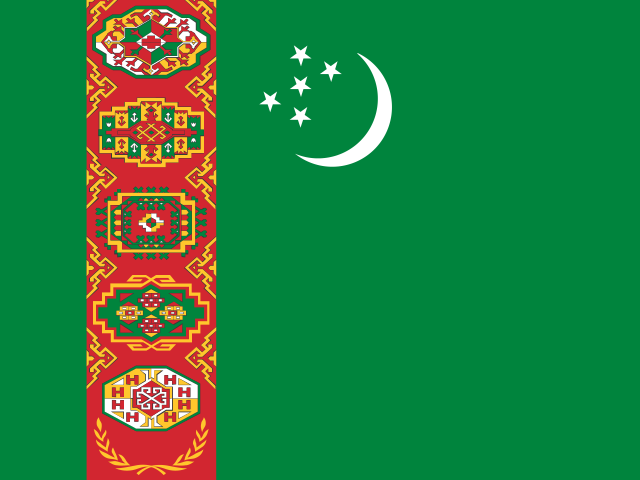
Overview
Turkmenistan is a landlocked country in Central Asia. Kazakhstan and Uzbekistan lie along its northern side, Afghanistan lies to the southeast, Iran forms the southern and southwestern frontier, and the Caspian Sea closes off the west. It is one of six independent Turkic states.
Ashgabat is both the capital and the largest city. The official 2022 census gave a population of about 7.06 million, though that figure is disputed by opposition and offshore media. Turkmenistan has the smallest population of the Central Asian republics and is thinly settled, because more than 80% of its land is the Karakum Desert.
The country has long been a crossing point for empires and cultures. Merv, one of the oldest oasis cities in Central Asia, was once among the largest cities in the world and a major stop on the Silk Road. Russia annexed the territory in 1881, it became a Soviet republic in 1925, and it became independent in 1991.
Turkmenistan has been ruled since independence by Saparmurat Niyazov (until 2006), then Gurbanguly Berdimuhamedow (from 2007), and since 2022 by his son Serdar, with the father still sharing power. Human rights groups and international observers strongly criticise its record on press, religious and minority rights, and the 2022 presidential election was described by observers as neither free nor fair.
The country holds some of the world's largest natural gas reserves (the source gives conflicting rankings of fourth and fifth), and gas is the core of its economy. It has declared permanent neutrality, recognised by the UN in 1995. It is a UN member, an observer in the Organisation of Turkic States and a founding member of TÜRKSOY.
History
The area was first home to Indo-Iranian peoples, and its written history begins when the Achaemenid Empire of ancient Iran annexed it. In the 8th century AD, Turkic-speaking Oghuz tribes moved from Mongolia into Central Asia and became the ethnic basis of the modern Turkmen. From the 10th century the name Turkmen was applied to Oghuz groups that adopted Islam and settled the region, then under the Seljuk Empire. Oghuz groups serving the Seljuks later spread Turkic culture westward into what are now Azerbaijan and eastern Turkey.
In the 12th century Turkmen and other tribes overthrew the Seljuks. The Mongols later took the northern lands where Turkmens lived and pushed them south, helping form new tribal groups. Between the 16th and 18th centuries the nomadic tribes repeatedly split and re-formed confederations, and they had a fierce reputation. By the 16th century most were under the nominal control of the Uzbek khanates of Khiva and Bukhara, and Turkmen soldiers were an important part of their armies. In 1855 the Teke, led by Gowshut-Khan, defeated the Khan of Khiva's invading army, and in 1861 they defeated a Persian army. Before the Russian conquest, Turkmens were known, and feared, for their part in the Central Asian slave trade.
Russia began occupying Turkmen lands in the late 19th century, using Krasnovodsk (now Türkmenbaşy) on the Caspian as a base. The Teke defeated a Russian attempt in 1879, but the last major resistance was crushed at Geok Tepe in 1881 and the region was annexed. An anticonscription revolt swept Russian Central Asia in 1916, and in the 1920s Turkmen fighters joined the Basmachi rebellion against Soviet rule. The Transcaspian Oblast was renamed the Turkmen Oblast in 1921, and the Turkmen Soviet Socialist Republic was formed in 1924 (it became a union republic in 1925). By the late 1930s collectivisation had ended what remained of nomadic life. The 1948 Ashgabat earthquake killed over 110,000 people, about two-thirds of the city's population.
Turkmenistan played its assigned economic role in the USSR and stayed largely outside major events. In 1990 its Supreme Soviet declared sovereignty, and after the Soviet collapse a referendum in October 1991 approved independence (declared 27 October 1991). The Soviet Union ended on 26 December 1991. Niyazov, the former Communist leader, stayed in power and replaced communism with a nationalist ideology and a pervasive cult of personality. Referendums and laws in 1994 and 1999 removed re-election requirements, making him effectively president for life. He carried out frequent purges, kept a policy of neutrality and stayed out of regional organisations such as the Shanghai Cooperation Organisation. An alleged assassination attempt in 2002 led to tighter security and media restrictions. Relations with Uzbekistan were tense from 2002 to 2004 and were restored by treaties in 2004. In 2005 he closed hospitals outside Ashgabat and rural libraries.
Niyazov died suddenly at the end of 2006 without a named successor. Deputy Prime Minister Gurbanguly Berdimuhamedow became interim leader, a step that violated the constitution, and won a non-democratic special election in February 2007. He won again in 2012 and 2017 with about 97% of the vote each time. His son Serdar won a snap election in 2022, described as non-democratic, and was sworn in on 19 March 2022, which established a political dynasty.
Climate
Turkmenistan lies in a temperate desert zone and has a dry continental climate, marked by scant rainfall, few clouds and heavy evaporation. Mountains in the south shut out warm, humid air from the Indian Ocean, whereas the open north allows cold Arctic air to move in. Winters are mild and dry, and the bulk of the precipitation comes from January to May, chiefly from moist air arriving from the west. The Kopet Dag range receives the highest rainfall. Among the world's driest deserts is the Karakum, where certain locations average just about 12 mm annually, and the country enjoys roughly 235–240 sunny days each year.
Summers are extremely hot. Ashgabat has recorded 48.0 °C, Kerki on the Amu Darya an unofficial 51.7 °C in July 1983, and Repetek Reserve 50.1 °C, the highest recorded anywhere in the former Soviet Union. Approx.: Ashgabat, at the foot of the Kopet Dag, has very hot dry summers with July highs around 38–40 °C and cool winters with occasional frost and light snow. Mary and Türkmenabat in the south and east are hot and arid, and Daşoguz in the north has colder winters. Türkmenbaşy and the Caspian coast are somewhat more moderate but also dry.
The terrain is dominated by the Karakum Desert and the Turan Depression, bounded by the Ustyurt Plateau, the Kopet Dag (up to 2,912 m at Kuh-e Rizeh), the Great Balkhan Range (1,880 m at Mount Arlan) and the Köýtendag range, which holds the highest point, Ayrybaba (3,137 m). The Caspian coast is about 1,748 km long. The main rivers are the Amu Darya, Murghab, Tejen and Atrek. The Kopet Dag zone is an earthquake epicentre, with strong quakes recorded in 1869, 1893, 1895, 1929, 1948 and 1994.
The country has seven terrestrial ecoregions, including Kopet Dag woodlands, Caspian lowland desert and Central Asian riparian woodlands. Its greenhouse gas emissions per person (17.5 tCO2e) are well above the OECD average, mainly because of natural gas leakage from oil and gas operations. In 2025 many of the world's largest methane leaks were reported from the country, and by 2026 it had responded to about 20% of reported leaks with repair plans and completed eight repairs.
Government and politics
Turkmenistan is a presidential republic in which the president is both head of state and head of government. It declared independence on 27 October 1991. Niyazov was declared President for Life by the Mejlis on 28 December 1999 after elections with only hand-picked candidates. A new constitution was adopted in 2008 that allowed multiple parties. The Democratic Party of Turkmenistan (the former Communist Party) dominates. A second party was set up in 2012 and an agrarian party followed. Political gatherings are illegal unless the government sanctions them. The country was a one-party state from 1991 to 2012, and its first multi-party parliamentary elections were held in 2013, widely seen as rigged. In practice all parties work under the Democratic Party's direction, and there is no true opposition. International IDEA places the country in the low range on overall democratic measures.
The Assembly (Mejlis) has been the unicameral legislature since January 2023, with 125 members elected for five-year terms in single-seat constituencies. From 2021 to January 2023 it was the lower house of a bicameral National Council. The People's Council (Halk Maslahaty) is described as a representative body with supreme constitutional authority. It can amend the constitution, and its chairperson, the "National Leader", is appointed by the president. Outside observers regard the legislature as a rubber stamp. The OSCE mission for the 2018 elections said they lacked important prerequisites of a genuinely democratic process.
The judiciary is not independent. The president appoints all judges, including the Supreme Court chief justice, and can dismiss them with parliament's consent. The US State Department's 2020 report said the courts were subordinate to the executive and widely reputed to be corrupt and inefficient. Berdimuhamedow's government raised basic education from nine to ten years and higher education from four to five.
Turkmenistan is a unitary state with power centralised in the national government. It is divided into five regions (welayatlar) and one capital city district (Ashgabat). Regions are subdivided into districts (etraplar), which can be counties or cities, and some cities may hold the status of welayat or etrap. Regional and local bodies have little independent authority over tax, health, law or education, which are set nationally, and International IDEA notes particular weakness in local democracy. The five regions are Ahal, Balkan, Daşoguz, Lebap and Mary.
In foreign policy, permanent neutrality was formally recognised by the UN in 1995 and is written into the constitution. It rules out joining multinational defence organisations but allows military assistance. The country has diplomatic relations with 139 countries and belongs to the UN, IMF, World Bank, Economic Cooperation Organization, OSCE, OIC, Asian Development Bank and EBRD, and is an observer in the Organisation of Turkic States. The Global Peace Index 2024 put it 83rd. The armed forces consist of ground forces, an air force and air defence, a navy, and other formations such as border troops and the National Guard. The Interior Ministry commands about 25,000 police, and the Ministry of National Security handles intelligence.
Human Rights Watch calls Turkmenistan one of the world's most repressive countries. Foreign travel is severely restricted, ethnic minorities face discrimination, and teaching Baloch customs and language is forbidden. Religious minorities have faced imprisonment and confiscation of literature, and homosexual acts are illegal. The death penalty was suspended in 1999 and abolished in 2008. Reporters Without Borders ranked it 178th of 180 in 2014. Satellite dishes were banned in 2015, the internet is filtered, Facebook and YouTube are blocked, and VPN use is prohibited. Transparency International's 2021 index scored it 19 out of 100 (169th place), and a former interior minister was convicted of corruption in 2019.
Economy
The economy rests on natural gas, oil and cotton. The country holds some of the world's largest gas reserves, and the Galkynysh field is estimated at 21.2 trillion cubic metres, placing it among the largest gas fields in the world. Türkmengaz controls gas extraction. Reform has been cautious, with a heavy state role. Unemployment was officially estimated at about 4.3% in 2019. Falling hydrocarbon and cotton prices in 2014 caused trade deficits from 2015 to 2017. Poverty, foreign debt and lower Chinese gas purchases weigh on prospects. The official rate is 3.5 manats per US dollar, but in November 2022 the black-market rate was reportedly about 18.5. Free electricity, gas, water and salt for citizens, in place since independence, ended on 1 January 2019. On 1 January 2026 President Serdar Berdimuhamedov signed a law regulating virtual assets and creating a licensing scheme for crypto exchanges under the national bank.
Gas exports were originally tied to Russian-controlled Soviet pipelines. Production grew from about 1.2 billion m³ in 1965 to 13 billion in 1970 and 90 billion in 1989. Russia halted purchases in 2016 and announced a resumption in 2019 at low volumes. Exports to Iran via a pipeline built in 1997 ended in January 2017 over payment arrears. China is now the main buyer, through pipelines opened from December 2009 via Uzbekistan and Kazakhstan, and it bought over 30 bcm in 2019. Turkmenistan's stated quota in this system was 40 bcma in 2023. The East–West pipeline was finished in 2015, aimed at a future Trans-Caspian link to Azerbaijan. The Turkmen section of the TAPI pipeline (Afghanistan–Pakistan–India, estimated cost $25 billion) was completed in 2019, while the Afghan and Pakistani sections remain under construction.
Oil has been known in the west since the 18th century, and commercial drilling began in the 1890s. Output reached over 14 million tons in 1970 and was 9.8 million tons in 2019. Main fields are in the western lowlands and offshore in the Caspian, operated largely by Türkmennebit, with refining at Türkmenbaşy and Seydi. Foreign firms include Eni, Dragon Oil and Petronas. In January 2021 Azerbaijan and Turkmenistan agreed to jointly develop the Dostluk field, with potential reserves of up to 60 million tons.
Power generation is gas-based, with major plants in Mary, Ashgabat, Balkanabat, Dashoguz, Türkmenbaşy, Turkmenabat and Seydi. Generation was about 22.5 TWh in 2019. The Mary thermal plant has 1.37 GW rated capacity, the Mary-3 combined cycle plant 1.574 GW (commissioned 2018) and the Zerger plant 432 MW (2021). Turkmenistan is a net electricity exporter to Central Asia and southern neighbours, including Afghanistan.
Agriculture is fully irrigated. Wheat (761,000 ha in 2019) and cotton (551,000 ha) are the main crops. Turkmenistan is the world's tenth-largest cotton producer, with about 1.5 million tons of raw cotton in 2020. Human rights groups report that public sector workers are forced to pick cotton. Raw cotton exports were banned in October 2018, and the focus shifted to yarn and textiles.
Tourism is small, with 14,438 foreign arrivals in 2019. Visas are required, and most tourists need local agency support. Attractions include Ancient Merv, Nisa, Konye-Urgench, the Darvaza gas crater (ordered extinguished in January 2022) and the Awaza Caspian resort zone. The main road is the M37 from the port of Türkmenbaşy through Ashgabat, Mary and Turkmenabat to the Farap crossing. A toll motorway between Ashgabat and Turkmenabat has been under construction in phases.
Demographics and urbanization
The last census published in full was in 1995. A 2022 census (17–27 December) gave an official population of 7,057,841 in July 2023, but opposition and offshore media dispute this, and opposition sources in 2021 claimed only 2.7–2.8 million based on anonymous sources. Official figures are likely too high given emigration. The 2012 census reportedly counted 4,751,120 people. Approx.: a majority of the population is urban or lives in oasis towns, and about half the population is generally reported as urban (approx.).
Most citizens are ethnic Turkmen, with sizeable Uzbek and Russian minorities and smaller Kazakh, Tatar, Ukrainian, Kurdish, Armenian, Azeri, Baloch and Pashtun communities. Estimates vary: about 85% Turkmen, 5% Uzbek and 4% Russian in 2003 (CIA), and 85.6% Turkmen, 5.8% Uzbek and 5.1% Russian in a reportedly leaked 2012 census. Russians fell from 18.6% in 1939 to 9.5% in 1989 and about 100,000 people in 2021. Main Turkmen tribes are Teke (the most numerous), Yomut, Ersari, Chowdur, Gokleng and Saryk.
Large cities include Ashgabat (approx. 1 million), Türkmenabat (approx. 250,000–400,000), Daşoguz (approx. 200,000–350,000), Mary (approx. 150,000–250,000), Türkmenbaşy (approx. 70,000–100,000) and Balkanabat (approx. 100,000). Settlement concentrates in oases and along the Kopet Dag foothills, the Amu Darya and the Murghab, with the desert interior nearly empty.
Emigration is significant. At least 102,346 citizens reportedly left in 2019, about 78% for Turkey, and a leaked survey said 1.88 million left permanently between 2008 and 2018 from a base of about 5.4 million.
Turkmen is the official language and is partly mutually intelligible with Azerbaijani and Turkish. The Latin alphabet was adopted in 1993, and Russian lost its inter-ethnic status in 1996. In 1999 Turkmen was spoken by 72%, Russian by 12% and Uzbek by 9%. About 93% of the population is Muslim, and around 5–6% belongs to the Eastern Orthodox Church, with small communities of Armenian Apostolic, Catholic, Protestant, Baháʼí and other groups. Niyazov's Ruhnama was given equal status with the Quran, and religious teaching today is limited to the theological faculty of Turkmen State University.
Education is universal and compulsory through secondary level, and in 2013 it became a 12-year system. In 2019–20 nearly 80,000 pupils graduated from high school, with 12,242 entering higher education locally and 9,063 entering the 42 vocational colleges. About 95,000 Turkmen students were studying abroad in autumn 2019.
Capital city
Ashgabat lies in the south of the country, on a plain between the Karakum Desert and the Kopet Dag mountains near the Iranian border. It is the capital and largest city, and has its own status as a capital city district. Approx.: it has about 1 million inhabitants.
Its climate is dry continental, with very hot, dry summers (record 48.0 °C) and cool winters with limited rain mostly from January to May. The 1948 earthquake destroyed most of the city and killed over 110,000 people, about two-thirds of the population.
Ashgabat is the political centre, home to the presidency, parliament, ministries and the Supreme Court. Niyazov spent heavily on renovating it, and it hosts the Olympic Village, powered by the 650 MW Ahal plant. Approx.: it is also the cultural and administrative centre and known for white marble buildings. It is also the main economic and commercial centre, though the energy sector is centred on the gas and oil fields in the Karakum and the west, and Türkmenbaşy is the main port and refining site. The country has a single capital.
About this summary
Approx. facts from general knowledge: capital-city details (population, climate, role), city populations and climates, and some recent economic and political context.