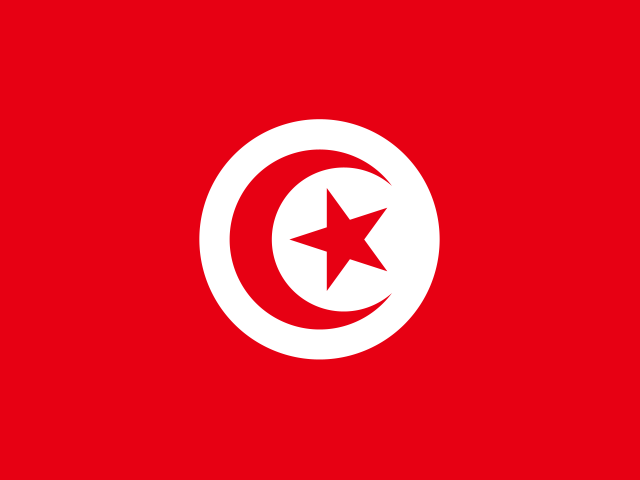
Overview
Tunisia, formally named the Republic of Tunisia, is a North African country in the Maghreb. Its neighbor Algeria borders it on the west and southwest, while Libya lies along its southeastern edge; the Mediterranean Sea washes its northern and eastern shores. The nation spans roughly 163,610 km2 and is home to about 12.1 million people. The capital, Tunis, sits on the northeastern coast and is the source of the country's name.
The land includes the eastern end of the Atlas Mountains and the northern edge of the Sahara, with a good deal of arable land in between. The coastline is over 1,100 km long (the source gives figures of 1,148 km and about 1,300 km depending on how it is measured). Cape Angela is the northernmost point of Africa.
Arabic is the official language. Tunisian Arabic is the everyday spoken variety, and French is widely used in education, business and the press although it has no official status. The population is overwhelmingly Arab-Berber and Muslim.
Famous heritage sites include the ruins of Carthage (settled from the 9th century BC), the Amphitheatre of El Jem and the Great Mosque of Kairouan. The country is also known for old souks, blue-and-white coastal towns and Mediterranean beaches.
Tunisia is a member of the UN, the Arab League, the African Union, the Organisation of Islamic Cooperation, La Francophonie and the Non-Aligned Movement, among others. It has an association agreement with the European Union, close ties with France and Italy, and holds major non-NATO ally status with the United States.
Politically, Tunisia was the country where the 2011 revolution began the Arab Spring. It was regarded as the Arab world's only democracy from 2014 to 2020 by The Economist Democracy Index, but it has since been rated a hybrid regime, and Freedom House says that as of 2025 elections are no longer free and fair.
History
Farming reached the Maghreb around 4000 BC, and the farming communities of the humid coastal plains were ancestors of today's Berber (Amazigh) tribes. Phoenician settlers began arriving from about the 12th century BC and founded coastal towns. Carthage became the strongest by the 7th century BC, and their descendants are known as the Punic people.
Carthage grew into a major trading empire and a military rival of Rome until the Romans defeated it in 146 BC. Rome then held the territory for roughly 800 years, bringing Christianity and monuments such as the Amphitheatre of El Jem. The Church of Carthage became an important centre of early Christian thought.
Arab Muslim armies conquered the region between the later 7th and early 8th centuries. They founded Kairouan, the first Islamic city in northwest Africa, where the Great Mosque (Mosque of Uqba) was built in 670 AD. It has the oldest standing minaret in the world. Large migrations of the Banu Hilal and Banu Sulaym tribes in the 11th and 12th centuries sped up Arabisation, and by about the 15th century the region was almost fully Arabised.
The Ottomans took Tunis in 1534 under Barbarossa Hayreddin Pasha. Their permanent hold dates from the reconquest from Spain in 1574 under Uluç Ali Reis. Ottoman influence lasted until 1881, though in practice local beys ruled with substantial autonomy.
Tunisia declared bankruptcy in 1869 and an international commission took charge of its finances. In 1881 France invaded with about 36,000 troops, citing an incursion into Algeria as a pretext, and forced the Bey to sign the Treaty of Bardo, making Tunisia a protectorate over Italian objections. European settlement was encouraged, and French colonists rose from 34,000 in 1906 to 144,000 in 1945.
After the Germans were driven out in 1943, France restored control and again banned nationalist parties. The popular Moncef Bey was deposed. Habib Bourguiba led the independence movement, including contacts with the Arab League in Cairo in 1945. Tunisia became independent on 20 March 1956, celebrated each year as Independence Day, with Bourguiba as prime minister. A republic was proclaimed in 1957 and he became its first president.
From independence until 2011, the state and the ruling party (the RCD, earlier Neo Destour and the Socialist Destourian Party) were effectively fused. Ben Ali ruled for 23 years. Press reports, citing Amnesty International, depicted the country as relatively modern in social terms but heavily repressive politically.
The 2011 revolution grew from unemployment, food price inflation, corruption and limits on free speech, with labour unions playing a large part. The spark was the self-immolation of street vendor Mohamed Bouazizi on 17 December 2010 after his goods were confiscated and he was humiliated by a municipal official. He died on 4 January 2011, and Ben Ali resigned and fled on 14 January 2011. The former ruling party was banned and the political police dissolved.
Constituent Assembly elections on 23 October 2011 were judged free and fair, and Ennahda won 89 of 217 seats. Moncef Marzouki became president in December 2011. Opposition leader Chokri Belaid was assassinated in February 2013. A new constitution was adopted on 26 January 2014. Elections followed in October and November 2014. In 2015 attacks on foreign tourists killed 22 people at the Bardo National Museum and 38 at a Sousse beach. The National Dialogue Quartet received the 2015 Nobel Peace Prize.
Beji Caid Essebsi, the first directly elected president, died in July 2019, and Kais Saied won the October 2019 election by a landslide. On 25 July 2021 Saied suspended parliament, dismissed the prime minister and removed lawmakers' immunity. Najla Bouden was named prime minister in September 2021. A constitutional referendum on 25 July 2022, on roughly 30% turnout, approved a new constitution that greatly strengthened the presidency.
In 2023 authorities closed Ennahda's headquarters and arrested its leader Rached Ghannouchi, and Abir Moussi of the Free Destourian Party was also detained. Tunisia clashed with the EU over a migration deal and refused 127 million in EU aid. In April 2025 makeshift migrant camps were dismantled, displacing as many as 7,000 people. On 6 October 2024 Saied won a second term with over 90% of the vote on 28.8% turnout, after five parties called for a boycott.
Climate
Northern Tunisia has a Mediterranean climate with mild, rainy winters and hot, dry summers. Rainfall drops sharply moving south. The centre is a hot, dry plain, and the south is semi-arid and merges into the Sahara. The Khroumerie in the northwest reaches about 1,050 m and gets winter snow.
Tunis, on the northern coast, has a typical Mediterranean pattern: mild wet winters (roughly 10 to 15°C by day, approx.) and hot dry summers with highs often around 32 to 35°C (approx.). Bizerte in the north is similar and slightly milder. Sousse, Monastir and the Sahel coast are warm and sunny, with olive-growing country and somewhat lower rainfall than the north (approx.).
Sfax and Gabes on the central and southern coast are drier and hotter in summer (approx.). Inland southern towns such as Gafsa, Tozeur and Douz have desert conditions with very hot summers that can exceed 40°C and cool winter nights (approx.). Djerba island is mild and dry, and is a major beach destination.
Geographic extremes: the highest point is Jebel ech Chambi at 1,544 m, and the lowest is Chott el Djerid at 17 m below sea level. A line of salt lakes (chotts) runs along the northern edge of the Sahara. The country has five terrestrial ecoregions, from Mediterranean forests to North Saharan steppe.
Government and politics
Tunisia is a unitary presidential republic. The president is head of state, a prime minister heads the government, and parliament has two chambers. The legal system follows French-style civil law, while personal status law draws on Islamic law, and sharia courts were abolished in 1956. The 2014 constitution guaranteed women's rights and said the president's religion shall be Islam. After the 2022 referendum, a new constitution greatly strengthened presidential powers.
Democratic indicators have fallen. The Economist classes Tunisia as a hybrid regime, and V-Dem's electoral democracy score dropped from 0.727 to 0.307 between 2020 and 2022. Over 100 political parties are legal, though many are small. Several prominent opposition figures have been jailed or detained.
The country is divided into 24 governorates, which are split into 264 delegations (districts), and these into municipalities and sectors. Because the state is unitary, the governorates are administrative units of the central state and do not have the autonomous powers of federal states over taxation, health, law or education. Those functions are set nationally. Municipalities handle local services. There are no special autonomous jurisdictions.
The Code of Personal Status, adopted in 1956, gave women full legal status, banned polygamy and ended a husband's right to unilateral divorce. Reforms in 1993 let Tunisian women pass on citizenship even if married to a foreigner and living abroad. It applies to all Tunisians regardless of religion and is regarded as among the most progressive civil codes in North Africa.
In foreign policy Tunisia has diplomatic relations with 160+ countries, a long record of good ties with the West, and active roles in Arab and African bodies. It sits in the EU's European Neighbourhood Policy. The military (about 27,000 in the army as of 2008) has been professional and apolitical, though since 2011 it has taken a larger role in domestic security. Tunisia ranked 73rd in the 2024 Global Peace Index.
Economy
Tunisia has a diversified, export-oriented economy covering agriculture, mining, manufacturing, petroleum, and tourism. It grew about 5% a year on average from the early 1990s, but corruption benefiting politically connected elites and weak enforcement of anti-corruption laws have held it back. Youth unemployment is a persistent problem.
By sector, agriculture is about 11.6% of GDP, industry 25.7% and services 62.8%. Industry is mainly clothing and footwear, car parts and electrical machinery. Tourism was about 7% of GDP and 370,000 jobs in 2009. In 2008 the economy was about US$41 billion nominal and US$82 billion in PPP. The source places GDP per capita at 129th globally, and Tunisia ranked 76th in the 2025 Global Innovation Index.
The European Union is the main trading partner, taking about 75% of exports and supplying about 72.5% of imports. Tunisia signed an Association Agreement with the EU in 1995 and completed tariff removal on industrial goods in 2008. The war in Ukraine has hit Tunisia hard through food supply. In 2022 Tunisia sought an IMF bailout amid recession, debt, inflation and unemployment. In June 2023 the World Bank lent US$268.4 million for ELMED, a 600 MW undersea power link to Italy.
Energy: installed capacity was about 5,944 MW in 2024 and generation was 19,520 GWh in 2022, with the state utility STEG holding 92.1% of capacity. Oil production began in 1966, with El Borma the main field, and output was about 29,200 barrels a day in September 2024. Nuclear plans were dropped, and the target is 30% renewables in the electricity mix by 2030.
Transport: about 19,232 km of roads and three motorways (A1 Tunis to Sfax, A3 Tunis to Beja, A4 Tunis to Bizerte), 29 airports (main ones Tunis-Carthage and Djerba-Zarzis, plus Enfidha-Hammamet opened in 2011), and 2,135 km of rail run by SNCFT. Tunis has a light rail network called Metro Leger. Airlines include Tunisair and Nouvelair.
Tourism draws on Tunis, Carthage, Djerba, Monastir and Hammamet. Water and sanitation access is among the best in the region, close to 100% for safe drinking water in urban areas and 90% in rural areas as of 2011.
Demographics and urbanization
Population was about 11.8 million in 2021 per the CIA figure, and about 12.1 million in the lead estimate. Family planning policy has brought growth down to just over 1% a year. Roughly two-thirds to 70% of people live in urban areas (approx.), concentrated on the northern and eastern coast. The Tunis area, Sfax, Sousse and the Sahel are the main population centres, and the interior and south are more sparsely populated.
Largest cities (approx.): Greater Tunis about 2.5 to 3 million; Sfax about 0.3 to 0.9 million depending on the definition; Sousse about 0.3 to 0.7 million; Kairouan, Bizerte, Gabes and Gafsa each a few hundred thousand or fewer.
Over 95% of people are Arab-Berber or Arabized Berber. The CIA estimates Arabs 98%, Europeans 1% and Jews/others 1%, but no official ethnic census has been taken since 1956. Amazigh communities are concentrated in the Dahar mountains, Djerba and the Khroumire region, and Berber speakers are about 2%. Black Tunisians, mostly descended from the slave trade, are estimated at 10 to 15% in the south. Europeans numbered about 255,000 in 1956 but nearly all left after independence, and the Jewish population fell from about 105,000 in 1948 to roughly 1,000 today.
Arabic is official. Tunisian Arabic (Tounsi) is the spoken vernacular. French is widely used in schools (science in secondary school), press and business, with about 6.3 million speakers in 2022 (about 52%). Italian is understood by some, and signs are usually in Arabic and French.
About 98% of people report being Muslim, mostly Sunni of the Maliki school, with some Hanafi (families of Turkish descent) and Ibadite Amazighs. Christians number about 35,000 (about 22,000 Catholics) and Jews 1,000 to 1,400, many on Djerba, home to the El Ghriba synagogue. Surveys show a notable share identifying as non-religious, though the trend is disputed (2021: 44% religious, 37% somewhat religious, 19% non-religious).
Education: schooling is compulsory from ages 6 to 16 and takes about 6% of GNP. Adult literacy was 78% in 2008 and 97.3% among 15 to 24-year-olds. Instruction begins in Standard Arabic, with French from age 8 and English from age 11. University students rose from about 102,000 in 1995 to 365,000 in 2005, with 31% tertiary enrollment in 2007.
Capital city
Tunis lies on the northeastern coast, on a hill slope descending to the Lake of Tunis, on a narrow strip of land between Lake Tunis and Séjoumi. The country takes its name from it. Neighbourhoods on the hills sit at just over 50 m. The Greater Tunis area has roughly 2.5 to 3 million people (approx.), the largest urban concentration in the country.
The climate is Mediterranean: mild rainy winters and hot dry summers, with July and August highs often around 33°C and winter daytime temperatures around 14 to 16°C (approx.). Rain falls mainly from autumn to spring.
Tunis is the political capital, housing the presidency, government and parliament, and it is also the main economic, administrative and cultural centre (approx.). The country has a single capital, and it is the same as the main economic city. Sfax is an important industrial and port rival in the south but does not act as capital.
Sights include the medina, the Zitouna Mosque and the Bardo National Museum, and the nearby ruins of Carthage. The medina has a quarter called Zuqaq al-Andalus, from Moriscos who settled after being expelled from Spain. About a third of Tunisia's Jews live in and around the capital. Tunis-Carthage International Airport is the main airport, and the Metro Leger light rail serves the area.
About this summary
Some details are from general knowledge and approximate: Tunis metro population, city climates, capital-city details, other city populations, urbanization rate, and recent economic indicators.