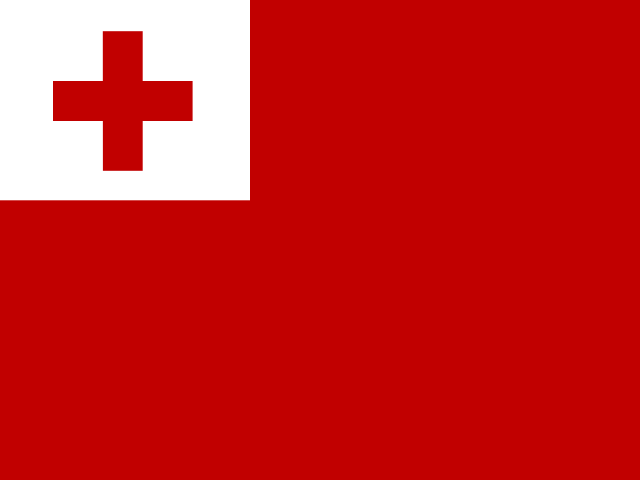
Overview
Tonga, officially the Kingdom of Tonga, is a Polynesian island country in the South Pacific, part of Oceania. It has 171 islands, 45 of them inhabited, with a land area of about 750 km2 spread over roughly 700,000 km2 of ocean. The chain runs about 800 km from north to south.
The source gives a population of about 103,000 as of September 2026, with around 70% living on the main island, Tongatapu. Neighbours include Fiji, Wallis and Futuna, Samoa, Vanuatu, New Caledonia, Niue (the nearest foreign territory) and the Kermadec Islands. New Zealand's North Island is about 1,800 km away.
The islands were settled about 2,500 years ago by people of the Lapita culture, who developed the distinct Tongan identity, language and culture. Tonga was a British protected state from 1900 to 1970 but never gave up its sovereignty. Since 2010 it has been a semi-constitutional monarchy, after reforms allowed its first partly representative elections.
Tonga belongs to the Commonwealth of Nations, the United Nations, the Pacific Islands Forum and the Alliance of Small Island States.
History
Tongan mythology says the demigod Maui pulled the islands up from the sea, beginning with Tongatapu, the Haʻapai group and Vavaʻu. Archaeologists link the first settlers to the Lapita culture, an Austronesian-speaking people who spread from Island Melanesia to Samoa and then Tonga between about 1500 and 1000 BC. Thorium dating shows people were living at Nukuleka, the earliest known settlement, by about 888 BC. Early history was passed on by oral tradition.
By the 12th century the Tuʻi Tonga, the Tongan sacred ruler, was known across the central Pacific, from Niue, Samoa and Rotuma to Wallis and Futuna, New Caledonia and Tikopia. Some historians therefore speak of a Tuʻi Tonga Empire, described as a maritime power whose influence reached Fiji and beyond. Civil wars are recorded in the 15th and 17th centuries.
Europeans first arrived in 1616, when the Dutch ship Eendracht under Willem Schouten stopped briefly to trade. Jacob Le Maire visited Niuatoputapu, and Abel Tasman reached Tongatapu and Haʻapai in 1643. James Cook came in 1773, 1774 and 1777, and Spanish navigators Mourelle (1781) and Malaspina (1793) followed. The first Protestant missionaries landed in 1797 and the Wesleyan minister Walter Lawry in 1822. Whalers were regular visitors from 1799 until the last recorded call in 1899, and the United States Exploring Expedition came in 1840.
In 1845 the warrior and orator Tāufaʻāhau, who held the title Tuʻi Kanokupolu and was baptised Siaosi (George) in 1831, united Tonga as a kingdom. In 1875, with missionary Shirley Waldemar Baker's help, he proclaimed a constitutional monarchy, adopted Western royal style, freed the serfs, and introduced a legal code, land tenure rules and press freedom while limiting the chiefs' power.
On 18 May 1900 Tonga became a protected state under a Treaty of Friendship with Britain, after settlers and rival chiefs tried unsuccessfully to remove the king. A British consul was the highest representative (1901–1970). Tonga kept its sovereignty and remained the only Pacific nation to keep its own monarchy, with an unbroken line of hereditary rulers from one family. The 1918 influenza pandemic, brought by a ship from New Zealand, killed about 1,800 people, roughly 8% of the population.
The treaty and protected status ended in 1970 under arrangements prepared by Queen Salote Tupou III before her death in 1965. Tonga joined the Commonwealth in 1970, unusually as a country with its own monarch, and joined the United Nations in September 1999.
Reform pressure grew in the 2000s. Rioting in Nukuʻalofa on 16 November 2006 destroyed more than 60% of the downtown area and left as many as six dead, with order restored by Tongan forces and a New Zealand-led task force. In 2008 King George Tupou V announced he would give up most day-to-day powers, and the first largely elected parliament followed in 2010. He died on 18 March 2012 and his brother Tupou VI succeeded him, being crowned on 4 July 2015.
In January 2022 the Hunga Tonga–Hunga Haʻapai volcano, about 65 km north of Tongatapu, erupted in an atmospheric explosion unprecedented in the modern geophysical record. The resulting tsunami flooded parts of the archipelago including Nukuʻalofa, four people died in Tonga, and most communications were cut. Repairing the submarine fibre-optic cable took about five weeks. In October 2021 Tonga had reported its first COVID-19 case.
Climate
Tonga has a tropical rainforest climate (Af). A warm season runs December to April, with temperatures that can exceed 32 °C, and a cooler season from May to November, when temperatures seldom pass 27 °C. Average daily humidity is about 80%.
Conditions vary with latitude. Tongatapu in the south averages about 23 °C with roughly 1,700 mm of rain a year, while the northern islands nearer the Equator average about 27 °C and about 2,970 mm. March is typically the wettest month, with about 263 mm. The record high is 35 °C (Vavaʻu, 11 February 1979) and the record low 8.7 °C (Fuaʻamotu, 8 September 1994). Readings of 15 °C or below occur mostly in the dry season and more often in the south.
The tropical cyclone season officially runs 1 November to 30 April, though storms can occur outside it. The WorldRiskReport 2021 ranked Tonga third worldwide for disaster risk because of exposure to multiple hazards, including cyclones, tsunamis and volcanic activity.
Nukuʻalofa, the capital, on the southern island of Tongatapu, has a warm, humid tropical climate that is milder and somewhat drier than the northern groups. Vavaʻu in the north is warmer and wetter, and is the main centre for whale watching and cruise visits. Neiafu is its main town.
Tonga lies within the Tongan tropical moist forests ecoregion. Flying foxes are traditionally sacred and royal property, so they are protected and have thrived. There are 73 bird species, two endemic (the Tongan whistler and the Tongan megapode), and seven are globally threatened.
Government and politics
Tonga is a constitutional monarchy and the only surviving indigenous monarchy in the Pacific islands. Reverence for the monarch carries on the respect once given to the sacred Tuʻi Tonga, and criticising the monarch is seen as contrary to Tongan etiquette. The current king is Tupou VI, crowned in 2015.
Reform has been gradual. The 2003 press licensing amendment (requiring 80% Tongan resident ownership) drew protests and a legal challenge, and several critical papers were refused licences. Under George Tupou V the monarch gave up most day-to-day powers to the prime minister in 2008, and the 2010 elections created a parliament with a mostly elected membership, ending the traditional absolute monarchy. Parliament includes elected People's Representatives and, from general knowledge, nobles' representatives chosen by the nobility. The pro-democracy movement seeks better commoner representation and accountability but not abolition of the monarchy, which retains popular support.
Tonga is a unitary state. It is divided into five administrative divisions: ʻEua, Haʻapai, Niuas, Tongatapu and Vavaʻu. Tax, health, education and law are set nationally rather than by the divisions, and the country has no federal system or special autonomous jurisdictions. The constitution protects land ownership: land cannot be sold to foreigners, though it may be leased, which matters for expats. The nobles and the Crown hold the traditional land system.
Social policy: primary education is free and compulsory, secondary fees are nominal, foreign-funded scholarships support postsecondary study, and all citizens have access to a national health system. Male homosexuality is illegal, with a maximum 10-year sentence, but the law is reportedly not enforced. Sundays are legally a day of rest, with commerce and entertainment halted.
Foreign policy has been described by Matangi Tonga as 'Look East' toward Asia. As of 2021 China was reported to have great influence, financing projects such as a new royal palace and holding about two thirds of Tonga's foreign debt. Relations with the US, Australia and New Zealand are good, and the UK reopened its High Commission in January 2020 after closing it in 2006. Tonga is active in regional bodies and in 2023 joined the 'Port Vila Call' for a fossil-fuel-free Pacific.
Tonga's armed forces (His Majesty's Armed Forces) have contributed to Iraq (2004–2008), Afghanistan (a minimum of 200 troops, completed April 2014), Bougainville and the RAMSI mission in the Solomon Islands. Any elections after the retrieval date are scheduled or not covered here, and their results are not described.
Economy
The economy has a large nonmonetary sector and depends heavily on remittances from Tongans abroad, mainly in Australia, New Zealand and the United States. The royal family and nobles own much of the monetary sector, notably telecommunications and satellite services. Manufacturing, mostly handicrafts and small industries, is about 5% of GDP. The Bank of Tonga opened in 1974, and Tonga joined the WTO on 27 July 2007. Forbes in 2008 listed it among the most corrupt countries, and Euromoney placed it 165th for investment safety in 2011.
Development plans stress private sector growth, better farm productivity, squash and vanilla, tourism, and better communications and transport. A small construction sector has grown on aid and remittances. A government department serves Tongans overseas, and dual citizenship was allowed from 2007. The 2008 global crisis reduced remittances.
Agriculture, forestry and fisheries provide most employment, export income and food. Crops include bananas, coconuts, coffee, vanilla, cassava, sweet potato and taro, with two thirds of farmland in root crops as of 2001. Copra once dominated exports but collapsed. Kava, vanilla and squash became the main exports, and squash exports to Japan began in 1987. Pigs and poultry are the main livestock. The traditional land system discouraged long-term tree planting.
Tourism is modest, under 90,000 visitors a year per the source, and relatively undeveloped. Vavaʻu draws cruise ships and visitors for whale watching, game fishing, surfing and beaches. Tonga's colourful stamps, including heart- and banana-shaped designs, appeal to collectors.
Energy comes mostly from imported diesel. About 10% of electricity was renewable in 2018. The 2010–2020 Tonga Energy Road Map, developed with IRENA, aimed to cut diesel imports by 50% and reach 50% renewables by 2020. A 6 MW solar farm on Tongatapu was announced in 2019, and the Pacific Centre for Renewable Energy and Energy Efficiency opened in Tonga in 2016. The currency is the paʻanga (general knowledge).
Demographics and urbanization
The source gives about 103,000 to 106,000 residents, depending on the date, with over 70% on Tongatapu. Population grew from about 32,000 in the 1930s to over 90,000 by 1976 despite emigration. Overseas, the Tongan population is larger than that at home: 82,389 in New Zealand (2018), about 36,840 in the US (2000) and over 8,000 in Australia. Remittances support relatives who stay.
Urbanization is low to moderate (approx. 20–25%, general knowledge). Nukuʻalofa is the only real urban and commercial centre, where European and Tongan ways of life blend. Elsewhere village life and kinship ties remain strong. Nukuʻalofa has roughly 25,000 people and the Tongatapu urban area somewhat more (approx.). Other towns are small, such as Neiafu in Vavaʻu (approx. 6,000) and Pangai in Haʻapai.
Over 98% of people are Tongan (Polynesian with some Melanesian ancestry). About 1.5% are mixed Tongan, and the rest are mainly European (mostly British), mixed European and other Pacific Islanders. Around 3,000–4,000 Chinese lived there in 2001, but the 2006 riots, which mainly targeted Chinese-owned businesses, led to emigration, leaving about 300.
Tongan and English are official. Tongan is a Polynesian language of the Tongic branch, close to Niuean and more distantly related to Hawaiian, Samoan, Māori and Tahitian.
There is no state religion, and the constitution guarantees religious freedom. The Free Wesleyan Church has a special role, including crowning the monarch. The Factbook estimate for 2016 was 64.1% Protestant (Free Wesleyan about 35%), 18.6% Mormon and 14.2% Roman Catholic. Islam is a small Sunni minority. The Sabbath is protected in the constitution.
Education: schooling is free and compulsory in state schools from ages 6 to 14, and church missions run about 90% of secondary schooling. Higher education options in Tonga are limited, and most degrees are pursued abroad. Literacy is about 98.9%.
Health: Tonga has one of the world's highest obesity rates. In 2011, 90% of adults were considered overweight, with over 60% obese, and about 70% of women aged 15–85 were obese. Non-communicable disease is a major concern.
Capital city
Nukuʻalofa is the capital and sits on the north coast of Tongatapu, the largest island, which covers about 257 km2. The city has roughly 25,000 people (approx.), within a Tongatapu population of about 70,000.
It has a tropical climate with a warm, wetter season from December to April and a cooler, drier season from May to November, similar to the southern pattern of about 23 °C average and 1,700 mm of rain. It is exposed to cyclones, tsunamis and volcanic effects, as the 2022 eruption's tsunami showed.
Nukuʻalofa is the political, economic and cultural centre. It hosts the royal palace, parliament, government offices, the main port and commercial activity, and is the country's only urban commercial centre. It is also the main economic city, so Tonga has no separate economic capital.
The city was heavily damaged on 16 November 2006, when riots destroyed over 60% of the downtown area, and was hit again by the January 2022 tsunami. A new royal palace was built with Chinese financing, according to the source.
About this summary
Capital-city details (Nukuʻalofa population, climate, role), recent political events (post-2019 prime ministers, elections), currency, and recent economic figures are from general knowledge and are approximate.