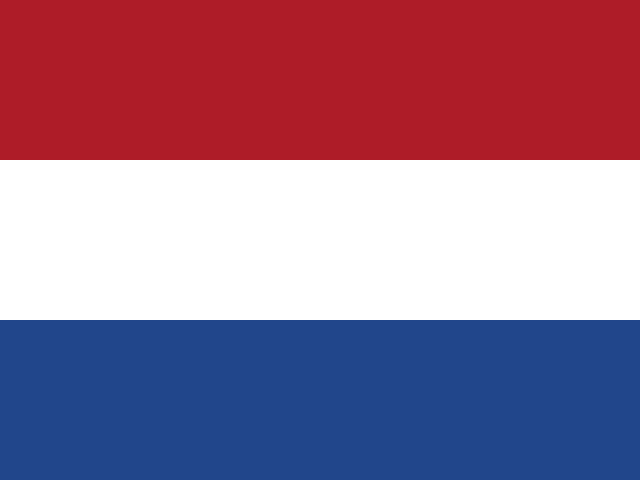
Overview
The Netherlands, often called Holland informally, lies in Northwestern Europe. Its European part borders Germany to the east and Belgium to the south, with a North Sea coastline to the north and west. It also has maritime borders with the United Kingdom, Germany and Belgium in the North Sea. The country is made up of twelve provinces in Europe plus three Caribbean special municipalities (Bonaire, Sint Eustatius and Saba). It is the biggest of the four constituent countries that together form the Kingdom of the Netherlands; the others are Aruba, Curaçao and Sint Maarten.
The name means 'lower countries', a nod to its flat, low terrain. Roughly 26% of the land area and 21% of the population lie below sea level, and much of that land is polder reclaimed from water since the 14th century. Dutch is the official language, with West Frisian co-official in Friesland. In the Caribbean territories Dutch, English and Papiamento have official roles.
More than 18 million people live on roughly 41,850 km2, of which 33,500 km2 is land, giving a density of about 433 inhabitants per km2, among the highest anywhere. Even though the country is small, by value it ranks second worldwide among exporters of agricultural and food products, a position it owes to fertile soil, a mild climate, intensive farming and innovation.
Since 1848, the country's system of government has been a unitary state organised as a constitutional monarchy under a parliament. Its social tolerance has a long history: prostitution and euthanasia are legal, drug policy is liberal, women gained the vote in 1919, and in 2001 it became the first nation to legalise same-sex marriage. The country helped found the EU, the eurozone, NATO, the OECD and the WTO, and it is also part of Schengen and Benelux. Many international organisations and courts are based in The Hague.
History
The oldest human traces, Neanderthal remains about 250,000 years old, come from near Maastricht. After the Ice Age, hunter-gatherer groups such as the Hamburg culture (13,000–10,000 BC) hunted reindeer, and the later Ahrensburg culture used bow and arrow. The world's oldest known canoe, from around 8000 BC, was found in Drenthe. From about 800 BC the Iron Age Hallstatt culture spread, and the King's grave of Oss (700 BC) is the largest burial mound of its kind in Western Europe.
Germanic tribes moved in from the north in the centuries before 250 BC, and Rome later controlled the southern parts. After Roman authority collapsed around 406, the Franks expanded, and by the 490s Clovis I had united the southern Netherlands in one Frankish kingdom. A cultural and linguistic divide grew between Franks who moved south and adopted Latin and those who stayed in the north.
In the 10th and 11th centuries the Holy Roman Empire nominally ruled the Low Countries but could not keep them united; powerful nobles ran Holland, Hainaut, Flanders, Gelre, Brabant and Utrecht almost as private realms. From 1384 to 1581 the Valois-Burgundian dukes and their Habsburg heirs ruled the region, with most fiefs joined in a personal union under Philip the Good in 1433. Amsterdam became Europe's main port for Baltic grain in the 15th century.
After the declaration of independence from Spanish Habsburg rule, seven northern provinces (Holland, Zeeland, Groningen, Friesland, Utrecht, Overijssel and Gelderland) formed the Dutch Republic, a confederation with strong provincial autonomy. The States General sat in The Hague. This was the Dutch Golden Age, when the Dutch East India Company and Dutch West India Company built colonies and trading posts.
The republic declined in the 18th century amid English competition and rivalry between republicans and supporters of the stadtholder. With French revolutionary backing, the Batavian Republic was proclaimed on 19 January 1795, making the country a unitary state. Napoleon set up the Kingdom of Holland in 1806–1810. A monarchy was established in 1815 and parliamentary democracy followed in 1848.
The Netherlands remained neutral throughout World War I. On 10 May 1940, Germany invaded, and after the Rotterdam Blitz most of the Dutch army was forced to surrender. Throughout the occupation, more than 100,000 Dutch Jews were deported to extermination camps, and few survived; the period was also marked by forced labour, reprisals and the plundering of food supplies, while the famine of 1944–45 claimed over 20,000 lives. In 1944–45 the First Canadian Army liberated much of the country. After the war, the Netherlands waged a colonial conflict against the newly proclaimed Republic of Indonesia, which had declared its independence in August 1945.
The 1954 Charter for the Kingdom made Suriname and Curaçao and Dependencies constituent countries; Suriname became independent in 1975. The Netherlands was a founder of Benelux, NATO (1949) and the European Communities in the 1950s. About 500,000 Dutch emigrated after WWII under government encouragement. The 1960s and 1970s brought rapid de-pillarisation and social change. Euro notes and coins arrived in 2002, and in 2010 the Netherlands Antilles was dissolved, with Bonaire, Sint Eustatius and Saba becoming special municipalities.
Climate
The European Netherlands has a temperate maritime climate (approx.): mild winters, cool to warm summers, rainfall spread through the year and frequent wind and cloud. The average temperature rose by more than 2°C between 1901 and 2020, with more droughts and heat waves.
Amsterdam, Rotterdam, The Hague and Utrecht, all in the western Randstad, share a similar oceanic climate (approx.): winter highs of around 5–7°C, summer highs of around 21–23°C, and roughly 700–850 mm of rain a year. The coastal cities, especially The Hague, are windier and slightly milder in winter. Inland and southeastern cities such as Maastricht and Eindhoven are a little warmer in summer and colder in winter (approx.).
Flood risk shapes the landscape. Floods in 1287 and 1421 and the North Sea flood of 1953 (more than 1,800 deaths) led to dykes, water boards and the Delta Works (1958–1997, including the Maeslantkering). The Delta Commission plans for 1.10 m of sea-level rise, and the Room for the River programme gives rivers more space.
The Caribbean Netherlands have a tropical climate with warm weather all year.
Government and politics
Since 1815 the Netherlands has operated as a constitutional monarchy, and since 1848 it has been a parliamentary democracy; it is characterized as a consociational state that aims for broad consensus. Because ministers bear responsibility for the acts of government, King Willem-Alexander, the head of state, holds only limited powers. A prime minister, regarded as first among equals, leads a cabinet that typically includes 13–16 ministers. Rob Jetten has held the office of prime minister since February 2026, following the November 2025 general election, in which D66 took 26 of the 150 seats and went on to form a cabinet.
The States General is bicameral. The 150-seat House of Representatives is elected every four years (or earlier if the cabinet falls) by party-list proportional representation. The 75-member Senate is chosen by the provincial assemblies and can reject but not amend laws. No party has held a majority since the 19th century, so coalitions are the rule. Three party families have dominated: Christian Democrats, Social Democrats and Liberals. Unions and employers are consulted via the Social and Economic Council.
Power is split in a unitary state. The national government and parliament set most law, tax and policy, while 12 provinces, each led by a king's commissioner and an elected provincial assembly, handle regional matters such as spatial planning and regional transport (approx.). The 342 municipalities (2023) carry out many local tasks, including local planning and a wide range of social services (approx.). Education and healthcare are regulated nationally; schools of any denomination get equal public funding, and health insurance is a national mandatory system.
Water management has a separate layer: 21 water boards, the first dating to 1196, are directly elected every four years and handle water levels and flood protection. The Caribbean Netherlands (Bonaire, Sint Eustatius, Saba) are special municipalities outside the provinces. Aruba, Curaçao and Sint Maarten are separate constituent countries in the Kingdom. The Baarle-Nassau area is a notable border curiosity, with 22 Belgian exclaves containing eight Dutch enclaves.
In foreign policy the Netherlands stresses Atlantic cooperation, European integration, development aid and international law. It left neutrality in 1948 and joined NATO in 1949. Conscription ended in 1996 and the military is professional, with about 50,000 military and 20,000 civilian staff. The armed forces have four branches: navy, army, air and space force, and the Royal Marechaussee.
Economy
The Netherlands has a mixed-market advanced economy, about the 17th–18th largest in the world and 11th in per-capita income. Shipping, fishing, agriculture, trade and banking have been key sectors since the 16th century. Main partners include Germany, Belgium, the UK, the US, France, Italy and China. Industries include food processing, chemicals, metallurgy, machinery, electrical goods, services and tourism. Well-known firms include Shell, Philips, ASML, Heineken, KLM, ING, ABN AMRO, Rabobank, DSM, Akzo, Randstad and TomTom.
Income inequality is low but wealth inequality is relatively high. Amsterdam is the financial and business centre and home to the world's oldest stock exchange (part of Euronext). The euro replaced the guilder for accounting in 1999; the Caribbean Netherlands use the US dollar. The country acts as a conduit for corporate profits and has been ranked as the fourth largest tax haven by one assessment. It attracts large foreign direct investment.
Agriculture employs about 4% of workers yet makes up 21% of export value. Agricultural exports earned €94.5 billion in 2019, first in the EU and second worldwide. The country handles about a third of world exports of chillies, tomatoes and cucumbers, 7% of apples and two-thirds of world output of cut flowers and bulbs. Strict limits on farm output to cut pollution have prompted farmer protests.
Large natural gas reserves found from the 1950s brought huge revenues and the 'Dutch disease' debate. Gas production caused earthquakes that damaged homes, and after public backlash the government decided to phase out production. Renewables doubled in share between 2008 and 2019, notably offshore wind and rooftop solar, but the economy remains reliant on fossil fuels and heavy industry. The 2019 Climate Agreement sets targets, and the aim is to cut emissions 49% by 2030.
Transport: the road network is one of the world's densest, and the country has about 30% of EU charging stations (2019). Around half of trips are by car, 25% by bicycle, 20% on foot and 5% by public transport. The rail network (3,013 km, over 400 stations) has frequent services, up to eight trains an hour on the busiest lines, and the HSL-Zuid high-speed line to Belgium. There are at least 18 million bicycles and about 35,000 km of segregated cycle tracks.
Rotterdam is Europe's largest port and the world's tenth largest container port (2022). The Betuweroute freight railway to Germany opened in 2007, and Amsterdam is Europe's fourth largest port. Schiphol, southwest of Amsterdam, is the fourth busiest airport in Europe, KLM's hub and linked to over 300 destinations. Smaller airports are at Eindhoven, Rotterdam, Maastricht and Groningen.
Demographics and urbanization
The population was about 18.08 million in June 2025, with density of roughly 424 per km2. It almost doubled from 5.1 to 10 million between 1900 and 1950 and reached 15.9 million by 2000. The fertility rate is 1.39 (2024), well under replacement, and the average age is 42.7. Life expectancy is about 84.3 for women and 79.7 for men (2020 estimate). The Dutch are the tallest people by nationality.
In 2022 the population was 74.8% ethnically Dutch, 8.3% other European, 2.4% Turkish, 2.4% Moroccan, 2.0% Indonesian, 2.0% Surinamese and 8.1% other. About 4.4 million residents had at least one foreign-born parent. Some 150,000–200,000 expatriates live in the country, mostly around Amsterdam and The Hague, close to 10% of those cities' populations. Minorities include about 700,000 Frisians.
The country is highly urbanised (approx. 92–93% urban). The Randstad, with about 8.2 million people, holds the four largest cities: Amsterdam (city approx. 930,000), Rotterdam (approx. 660,000), The Hague (approx. 570,000) and Utrecht (approx. 370,000). Other notable cities include Eindhoven, Groningen, Maastricht, Arnhem and Nijmegen (approx.).
Dutch is spoken by the vast majority. West Frisian is co-official in Friesland, and Low Saxon, Limburgish, Yiddish, Romani and others are protected under the European Charter. English is formal in Saba and Sint Eustatius, and Papiamento in Bonaire. About 90% can converse in English, 70% in German and 29% in French. English is compulsory in secondary school.
In 2025, 58% were non-religious, 16% Catholic, 12% Protestant and 6% Muslim, with 7% other faiths. North Brabant and Limburg are historically Catholic, and a Protestant Bible Belt runs from Zeeland to northern Overijssel. Religious holidays such as Christmas and Easter are national holidays.
Education is compulsory from 5 to 16, extended to 18 without a starting qualification. After primary school (about ages 4–12) pupils enter VMBO, HAVO or VWO streams, leading to MBO, HBO or research universities. University tuition is about €2,000 a year for Dutch and EU students and about €15,000 for non-EU students.
Health insurance is mandatory. Everyone over 18 buys basic insurance, and insurers must accept all applicants. Long-term care is covered by state insurance. Basic premiums are about €135 a month, with subsidies for low incomes. The system topped the Euro Health Consumer Index in 2016 and uses family doctors as gatekeepers to specialist care.
Capital city
Amsterdam is the nominal capital and sits in North Holland in the west, on the IJ and Amstel rivers (approx.). The city has about 930,000 people and the metropolitan area about 2.5 million (approx.). The Hague, in South Holland, is the seat of government: it hosts the States General, the cabinet and the Supreme Court, as well as many international courts and organisations. The royal residence in practice is also near The Hague (approx.).
Amsterdam is the cultural and financial heart: it is the financial and business capital, home to the Amsterdam stock exchange, a major tourism destination (over 4.2 million international visitors in the source figure), and near Schiphol airport. It is Europe's fourth largest port. So the capital and main economic city are the same, but the political centre is The Hague, and Rotterdam is the industrial and port centre.
Amsterdam's climate is oceanic (approx.): January highs around 6°C and lows near 1°C, July highs around 22°C, and rain through the year of about 800 mm. Winters are damp and grey with occasional frost, and summers are mild with occasional heat waves.
Amsterdam is a top expat destination, with a large international community and English widely spoken. It is known for canals, museums and cycling, though housing is expensive and tight (approx.).
About this summary
Capital-city details (Amsterdam metro population, city climates, institutions), city populations and some recent political and economic context are from general knowledge and approximate.