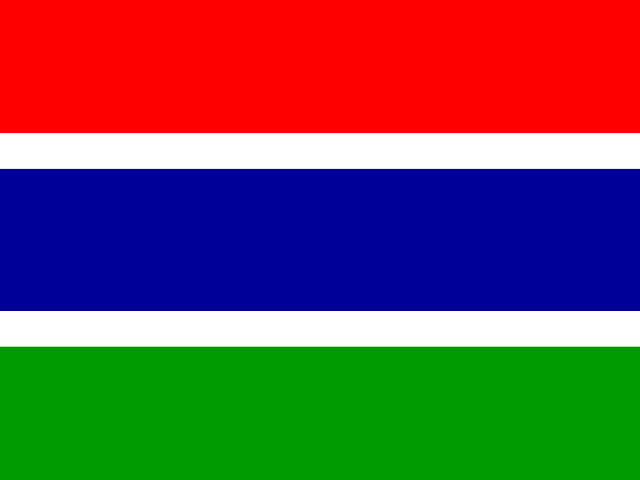
Overview
The Gambia, officially the Republic of The Gambia, is a small country in West Africa. It is the smallest country on the African mainland. Senegal surrounds it on three sides, and a short Atlantic coastline of about 80 km forms its western edge.
The country is a thin strip of land on both banks of the lower Gambia River, which runs through its centre into the Atlantic. It is less than 50 km wide at its widest point and covers about 11,300 sq km, roughly 11.5% of which is water. That is slightly more than the island of Jamaica.
The 2024 census counted 2,422,712 people, about 30% more than in 2013. The capital, Banjul, sits on an island at the river mouth. Serekunda and Brikama are the next largest urban centres, and other notable towns are Kanifing, Farafenni, Basse and Soma.
English is the sole official language. The economy rests on farming, fishing and above all tourism. In 2022 about 17.2% of people lived in extreme poverty (under US$2.15 a day, 2017 PPP). The country is a founding member of ECOWAS and rejoined the Commonwealth in 2018 after leaving in 2013.
Wildlife is rich for such a small country, with more than 500 resident bird species, mangroves along the river, savanna woodland and sandhills inland. Tourism is built around birdwatching, beaches and river trips.
History
Arab traders wrote the first accounts of the Gambia region in the 9th and 10th centuries. Muslim merchants and scholars set up communities in West African trading centres, and trans-Saharan routes carried captives, gold and ivory out and manufactured goods in. Sunni Islam spread through the region in this period. The Portuguese were the first Europeans to arrive, in 1455, but never built much trade.
In 1588 a claimant to the Portuguese throne sold trade rights on the river to English merchants, and in 1618 King James I chartered an English company to trade with the Gambia and the Gold Coast. Between 1651 and 1661 parts of the territory, including St Andrew's Island with Fort Jakob and St Mary Island (modern Banjul), were held by the Duchy of Courland and Semigallia. The British established a colony in 1765.
After the abolition of the slave trade, the Royal Navy's West Africa Squadron returned intercepted slave ships' captives to the Gambia, with some released on MacCarthy Island upriver. Britain founded the military post of Bathurst (now Banjul) in 1816. Bathurst was at times under the governor in Sierra Leone, and the Gambia became a separate colony in 1888.
An Anglo-French agreement in 1889 set the colony's boundaries, and a joint boundary commission began work in 1891 against resistance from local leaders whose lands were divided. Final borders took nearly 15 years to settle, leaving British control of land about 16 km either side of the river. The territory was administered as a colony (Banjul and surroundings) and a protectorate (the rest).
The Gambia became independent on 18 February 1965 as a constitutional monarchy within the Commonwealth. A first republic referendum narrowly failed to reach the required two-thirds majority, but a second succeeded and the country became a republic on 24 April 1970 under Dawda Jawara, who was re-elected five times.
On 29 July 1981 a group of leftists attempted a coup while Jawara was in London. Senegal sent troops (about 2,700 by 6 August) and defeated the rebels; between 500 and 800 people died. In 1982 the two states formed the Senegambia Confederation, which the Gambia left for good in 1989.
In July 1994 Lieutenant Yahya Jammeh, aged 29, led a bloodless coup. He later won elections under a new 1996 constitution and ruled for 22 years, with widespread accusations of human rights abuses. In 2013 he took the country out of the Commonwealth, and in December 2015 he declared it an Islamic Republic by decree, though the constitution stayed secular.
Opposition candidate Adama Barrow won the 1 December 2016 election. Jammeh first conceded, then rejected the result, creating a constitutional crisis. An ECOWAS force intervened, Barrow was sworn in at the Gambian embassy in Dakar on 19 January 2017, and Jammeh left the country on about 20 January.
Barrow dropped the word Islamic from the country's name, and the Gambia rejoined the Commonwealth on 8 February 2018. Barrow won re-election on 4 December 2021. On 20 December 2022 an alleged coup attempt was reported with four soldiers arrested, though the armed forces denied any attempt. Barrow's reliance on foreign troops for security has reduced his popularity. The next presidential election is scheduled for December 2026 and its outcome is not covered here.
Climate
The Gambia has a tropical savannah climate with a short rainy season from about June to September and a longer, drier and cooler period from October to May. Its climate is similar to that of neighbouring Senegal, Mali and northern Guinea.
Banjul and the neighbouring coastal cities of Serekunda and Brikama share a hot, humid pattern: heavy rain in July to September (approx. 1,000 to 1,300 mm a year), and warm, dry, sunnier months from November to May, when the harmattan wind can bring dust and haze. Coastal temperatures are tempered by the sea (approx. highs of 30 to 33°C most of the year, rising in the hot months before the rains). Inland towns such as Basse, Farafenni and Janjanbureh are hotter and drier in the dry season (approx. highs above 38°C in April and May).
The country includes three ecoregions: Guinean forest-savanna mosaic, West Sudanian savanna and Guinean mangroves.
Government and politics
The Gambia is a unitary presidential republic. After independence in 1965 it was ruled by Dawda Jawara and his PPP until the 1994 coup, then by Yahya Jammeh until 2016. Adama Barrow, backed by an opposition coalition, won in 2016 and was re-elected in 2021. The 2023 V-Dem indices ranked it 68th of 179 countries and 11th of 56 in Africa.
The 1996 constitution, kept after 2016, makes the president head of state, head of government and commander-in-chief. The post of prime minister was abolished in 1970. The president appoints the vice president and ministers, five National Assembly members, superior court judges, regional governors and district chiefs, along with members of key bodies like the Public Service Commission and the Independent Electoral Commission. The president is elected by simple majority for five-year terms with no term limit; the constitution has been under review, with a two-term limit expected.
Power is not divided federally. Laws are made centrally for the whole country, while local authorities can make by-laws as part of a decentralisation policy (phase 1 in 2015 to 2019, phase 2 in 2020 to 2024). The country has eight local government areas, including Banjul as a city, further subdivided into 43 districts. Kanifing and Kombo Saint Mary are effectively part of Greater Banjul.
Foreign policy has been non-aligned, with close ties to the UK and Senegal. The Gambia belongs to the Commonwealth, ECOWAS, the Organisation of Islamic Cooperation, the UN and the African Union. China broke ties in 1995 after Gambia recognised Taiwan and restored them in 2016. In November 2019 it filed a genocide case against Myanmar at the International Court of Justice in The Hague.
The armed forces were created in 1985 and number roughly 900 in the army, plus a small navy. They have taken part in UN, African Union and ECOWAS peacekeeping. The country ranked 82nd in the 2024 Global Peace Index.
On human rights, the WHO estimates 78.3% of girls and women have undergone female genital mutilation. LGBT activity is illegal and punishable by life imprisonment, though the Barrow administration has said it would not prosecute consenting couples nor repeal the law.
Economy
The Gambia has a liberal, market-based economy with low import duties, minimal administrative procedures and a floating exchange rate. It combines subsistence farming, groundnut exports, re-export trade through its port, and a significant tourism sector. GDP was about US$1.6 billion in 2018 per the World Bank, and growth ran at 5 to 6% a year from 2006 to 2012.
Agriculture makes up about 30% of GDP and engages around 70% of workers. Peanuts are about 6.9% of GDP, other crops 8.3%, livestock 5.3%, fishing 1.8% and forestry 0.5%. Industry is about 8% of GDP and services around 58%. Manufacturing is small and mostly agro-based: peanut processing, bakeries, a brewery, a tannery, soap, soft drinks and clothing.
Trade partners have shifted from the UK and the EU towards Senegal, the United States and Japan for exports, while imports come from Denmark, the United States, China, the UK, Germany, Ivory Coast and the Netherlands. The 2007 trade deficit was US$331 million.
In 2009 there were twelve commercial banks, including one Islamic bank. Standard Chartered traces its presence to 1894, and Nigerian and other foreign banks have opened subsidiaries. Since 2017 China has invested under its Belt and Road Initiative, notably in fish meal processing, whose economic and environmental impacts are controversial. The first solar power plant opened in 2024.
Public and private operators together provide the country's transport links. The Trans-Gambia Highway follows both banks of the river, and travelers can cross the water either by ferry or over the Senegambia bridge. The country has no railways. Only 723 km of its 3,742 km of roads are paved. Banjul, managed by the Gambia Ports Authority, is the sole port, while Banjul International Airport, located at Yundum 26 km from the capital, is the only international airport.
Demographics and urbanization
The 2024 census counted 2,422,712 people. Urbanisation was 57.3% in 2011 and has been rising as more areas are classified as urban. Most people live in the western coastal belt of Greater Banjul (Banjul, Kanifing, Serekunda, Brikama), with a population of roughly 1 million for the wider urban area (approx.). Other towns include Farafenni, Basse and Soma, each far smaller. Serekunda is roughly 400,000 to 500,000 and Brikama about 300,000 to 400,000 (approx.).
Mandinka are the largest ethnic group, followed by Fula, Wolof, Jola, Serahule, Serer, Manjago, Bambara, Aku (Krio), Bainunka and Tukulor. About 3,500 non-Africans, mainly Europeans and Lebanese-origin families, live in the country. As first languages, Mandinka is spoken by 38%, Pulaar by 21%, Wolof by 18%, Soninke by 9% and Jola by 4.5%. English is used officially and in education, and French is fairly widely understood.
About 96% of people are Sunni Muslim (mostly Maliki and Sufi), and roughly 4% are Christian, mainly Roman Catholic and living in the west and south. Religious freedom is protected by the constitution, and Muslim-Christian intermarriage is common. Commerce largely stops during major Muslim holidays.
The total fertility rate was about 3.98 in 2013. Life expectancy was 65.9 years in 2023 (64.2 for men, 67.5 for women). Health spending was only 1.52% of GDP in 2022. The 2010 UNDP report placed the Gambia in the Low Human Development category, and the 2024 Global Hunger Index ranked it 88th of 127 with a score of 19.9.
Primary education is constitutionally free and compulsory, but resources are limited, and about 20% of school-age children attend Quranic schools. Higher education includes Gambia College (1978) and the University of the Gambia (1999), whose new Faraba campus opened on 12 March 2024. The International Open University is headquartered in the Gambia.
Capital city
Banjul, the national capital, lies on an island (St Mary's Island) where the Gambia River meets the Atlantic. It was founded as the British military post of Bathurst in 1816 and renamed after independence. The city proper is small (approx. 30,000 to 40,000 people), but the Greater Banjul area, including Kanifing and Kombo Saint Mary, has roughly a million residents (approx.).
Banjul is the political and administrative centre and hosts the only port, which handles most of the country's trade. It is classified as a city local government area. The Krio (Aku) community has traditionally concentrated there, and a small synagogue exists in the city.
Climate is tropical savannah with a rainy season from June to September and warm, dry weather the rest of the year, tempered by sea breezes (approx. highs 30 to 33°C).
Banjul is not the main economic or population centre in practice: much of the commerce and population lives in nearby Serekunda and the Kanifing municipality, and Brikama is another large urban centre. The country has a single capital. The international airport is at Yundum, about 26 km away.
About this summary
Some details on metro populations, city climates, capital-city details, recent economic figures and the 2026 election timetable come from general knowledge and are approximate.