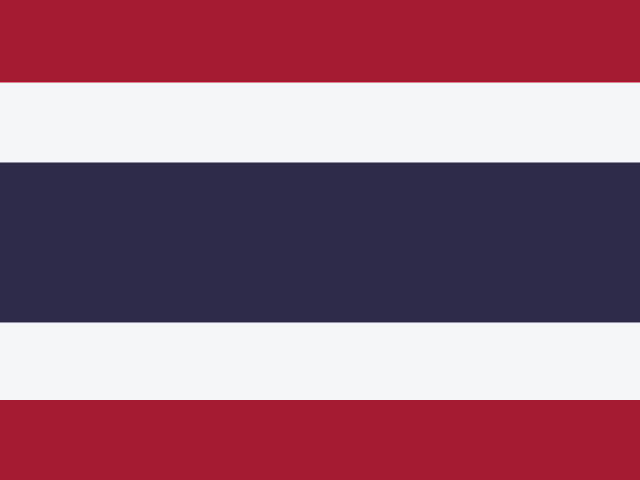
Overview
Thailand, officially the Kingdom of Thailand and formerly called Siam, lies in mainland Southeast Asia. Its neighbours on land are Myanmar (west and northwest), Laos (northeast and east), Cambodia (southeast) and Malaysia (south). It has coastlines on the Gulf of Thailand and the Andaman Sea, with sea boundaries shared with Vietnam, Indonesia and India.
The country covers roughly 513,000 km2 (about 198,000 sq mi) and had a population of about 66 million (65.95 million in 2025). Bangkok is both the capital and the largest city.
Thailand is a unitary state with a parliamentary system under a constitutional monarchy. It is a member of the United Nations and ASEAN and a major non-NATO ally of the United States. It is a newly industrialised economy that relies mainly on manufacturing, agriculture and tourism.
It was the only Southeast Asian country that avoided European colonisation, although it gave up territory, trade rights and legal privileges through unequal treaties. In the 21st century its politics have been shaped by conflict between supporters and opponents of Thaksin Shinawatra, the coups of 2006 and 2014, and border tensions with Cambodia.
History
People have inhabited the area for a minimum of 20,000 years, though the lead mentions evidence stretching back as far as 40,000 years. Around 2000 BCE, rice farming got underway. In the northeast, Ban Chiang holds the distinction of being Southeast Asia's oldest known hub for producing copper and bronze (roughly 2000–1000 BCE), while iron was being worked by about 500 BCE. Indian culture and religion had a strong influence on the region.
Tai-speaking peoples are thought to have come from the Yangtze basin and gradually moved southwest, settling northern Thailand, Laos and northeastern Myanmar. Indigenous groups include the Mon, Khmer and Malay. The Mon Dvaravati culture flourished along the Chao Phraya from the 7th to 11th century, with centres at Nakhon Pathom and U Thong. It was linked to Theravada Buddhism and wrote in Sanskrit and Mon. Lavo (Lopburi) came under Khmer influence.
In 1238 Pho Khun Bang Klang Hao rebelled against Khmer rule and became the first king of Sukhothai, which Thai historians count as the first Thai kingdom. It reached its greatest extent under Ram Khamhaeng and functioned largely as a network of local lords. Lan Na arose in the north.
The Ayutthaya Kingdom (1351–1767) grew out of Lavo and Suphannaphum. It expanded through conquest and political marriage, sacked the Khmer capital Angkor, and absorbed Sukhothai. Portuguese envoys arrived in 1511. Ayutthaya was destroyed in 1767 by Burmese forces of the Konbaung dynasty.
The realm then split into five warlord domains. Taksin, from Chanthaburi, retook Ayutthaya within about seven months and founded the Thonburi Kingdom (1767–1782). He drove the Burmese out of Lan Na in 1775 and took Vientiane in 1778. In his last years, alleged insanity led to a coup and his execution by General Chao Phraya Chakri, who became Rama I, founder of the Chakri dynasty. He moved the capital to Bangkok in 1782 and started the Rattanakosin Kingdom.
Rattanakosin repelled Burmese invasions and extended its overlordship across much of Laos and Cambodia. In 1826 the Burney Treaty was concluded, and in the same year Anouvong's Lao uprising was crushed, with Vientiane destroyed. Under King Mongkut, who reigned from 1851 to 1868, Siam agreed to the Bowring Treaty, which began a long series of unequal treaties. King Chulalongkorn (Rama V) accelerated modernisation, ending slavery among other reforms, and consolidated power in the state as an absolute monarchy. Siam entered World War I alongside the Allies, in part hoping to renegotiate the unequal treaties.
The bloodless revolution of 24 June 1932 by the Khana Ratsadon (People's Party) forced King Prajadhipok to accept a constitution. He later abdicated and the young Ananda Mahidol became king. Plaek Phibunsongkhram became premier in 1938, pursued a nationalist agenda and renamed the country Thailand. In 1940 he launched the Franco-Thai War to reclaim territory from French Indochina. In World War II Thailand allied with Japan, but the Free Thai Movement's Declaration of Peace was recognised by the Allies and Thailand was not treated as a defeated nation.
During the Cold War Thailand aligned with the United States, joined SEATO, sent troops to Korea and Vietnam, and hosted US bases. A popular uprising in 1973 toppled the military regime, but the Thammasat University massacre led to a return to right-wing military rule. Prem Tinsulanonda's 1980s semi-democracy ended the communist insurgency. Chatichai Choonhavan became the first freely elected prime minister since 1976 in 1988. A 1991 coup and the Black May protests of 1992 ended after King Bhumibol intervened, and the 1997 People's Constitution followed.
The 1997 Asian financial crisis hit the economy hard and required an IMF bailout. Thaksin Shinawatra's era saw the coups of 2006 and 2014. The military National Council for Peace and Order ruled from 2014 to 2019, and the 2017 Constitution remains in force. Protests have called for democracy and monarchy reform. Border tensions with Cambodia flared in 2008–2011 and again in 2025, involving territorial disputes and military clashes.
Climate
Thailand has a monsoon climate. Most of the country is tropical savanna, the south and the eastern tip are mostly tropical monsoon, and parts of the south are tropical rainforest. There are three seasons: rainy (mid-May to mid-October, southwest monsoon), cool or winter (mid-October to mid-February, northeast monsoon, mostly dry and mild), and hot (mid-February to mid-May, pre-monsoon). August and September are the wettest months. Mean annual rainfall is about 1,200–1,600 mm.
The north, northeast, centre and east can reach about 40 °C in March to May, while some upland areas in winter get close to freezing. The south has milder, more even temperatures year-round because of the sea, with heavy rain especially in October and November. Thailand is among the countries most exposed to climate change, particularly rising seas and extreme weather.
City examples (approx.): Bangkok is hot and humid year-round, with a wet season from May to October and temperatures mostly around 25–35 °C. Chiang Mai in the north has a hot, dry March to May, a wet season, and a cooler, drier winter with cool nights. Phuket on the Andaman coast is warm and very wet from May to October, and drier from December to March. Khon Kaen and Nakhon Ratchasima in Isan are hot and drier, with large seasonal swings.
Thailand's landscape differs from one region to the next. In the north, mountains prevail, and Doi Inthanon, the nation's highest peak, reaches 2,565 m. The northeast is occupied by the Khorat Plateau, bordered by the Mekong River. At the center, the Chao Phraya valley spreads out as flat lowland, and farther south the Kra Isthmus widens to form the Malay Peninsula. Nearly 31% of Thailand's land is protected, a network that includes 156 national parks, along with 58 wildlife sanctuaries, 67 areas where hunting is prohibited, and 120 forest parks. Elephant numbers have fallen from about 100,000 in 1850 to an estimated 2,000, and both poaching and the trade in wildlife remain ongoing problems.
Government and politics
Thailand is a constitutional monarchy and a unitary state. Absolute monarchy ended with the 1932 revolution. Since then it has had 20 constitutions and charters, including the current 2017 constitution, and the real form of government has ranged from military rule to electoral democracy. It has been described as a hybrid of democracy and dictatorship, and has had many coups. Uniformed or ex-military men led the country for 55 of the 83 years from 1932 to 2009.
The king is head of state. King Vajiralongkorn (Rama X) has reigned since October 2016. His constitutional powers are limited and mainly symbolic, but customary royal rulings exist, and some academics, such as Duncan McCargo and Federico Ferrara, describe an extraconstitutional 'network monarchy'. A strict lèse-majesté law carries three to fifteen years in prison.
Legislature: the National Assembly has a 500-member directly elected House of Representatives and a 200-member indirectly elected Senate. The 2024 Senate election, the first under the current constitution, was criticised as extremely complicated. The most recent general election was in 2026, and a coalition led by the Bhumjaithai Party holds the majority.
Executive: the prime minister is head of government and is chosen by the House from candidates nominated by parties before the election. The cabinet has up to 35 members. The current prime minister is Anutin Charnvirakul of Bhumjaithai.
Judiciary: formally independent, but rulings are often suspected of political motives. In 2024 the Constitutional Court banned the Move Forward Party, the winner of the 2023 election, and its leaders from politics over its plan to reform the lèse-majesté law. The Economist described this as 'lawfare', while the court said the plan threatened the constitutional order. Freedom House rated Thailand 'not free' from 2014 and 'partly free' in its 2024 report.
Sub-national structure: the 1991 National Government Organisation Act splits the executive administration into central, provincial and local levels. There are 76 provinces, plus two specially governed districts, Bangkok and Pattaya. Bangkok is at provincial level and is often counted as a province. Provinces divide into districts (amphoe) and sub-districts (tambon). Provincial governors and district chiefs are appointed by the central government, so power stays centralised; the source gives no detail on which taxes, health, law or education powers sit at local level.
Foreign policy has been described as 'bamboo bending with the wind', meaning adaptable and pragmatic, balancing great powers. Thailand was a Cold War ally of the US, is a founding member of ASEAN, contributed troops to peacekeeping in East Timor, and is a major non-NATO ally. Under Thaksin, free trade talks began with China, Australia, Bahrain, India and the US.
Economy
Thailand is a newly industrialised economy that relies heavily on exports, which make up more than two-thirds of its GDP. Its leading shipments include rice, rubber, jewellery, fishery products, textiles and footwear, as well as cars, computers and electrical appliances. In 2022, goods exports reached roughly US$290 billion, while imports came to approximately US$305 billion. The 2026 GDP figure is about US$1.96 trillion (PPP), which makes it the second-largest economy in Southeast Asia, behind Indonesia. Thailand also serves as an anchor economy for Laos, Myanmar and Cambodia.
Manufacturing: the car industry is the largest in Southeast Asia, with annual output near 1.5 million vehicles, mostly commercial ones built under foreign (mainly Japanese and American) licences. Low taxes on pick-up trucks make Thailand a very large pick-up market, and pick-ups were 42% of new vehicle sales in 2014. Laem Chabang is the busiest commercial port and Sattahip the main deepwater port.
Tourism is about 6% of the economy directly, and a larger share when indirect effects are counted (around 20% by one estimate). Thailand received 39.8 million international tourists in 2019 and earned about US$60.5 billion. Visitors come to Bangkok, the southern beaches and islands (Phuket, Krabi), and the north for trekking; Isan gets the fewest. Medical tourism drew over 2.5 million visitors in 2018. The sex trade is also a de facto part of the economy.
Agriculture employs about 49% of the workforce, down from 70% in 1980. Rice is the main crop, taking about 55% of arable land, and Thailand was long the top rice exporter before India and Vietnam overtook it. About 27% of land is arable.
Challenges: low productivity, weak education outcomes, high household debt (about 89% of GDP in early 2023), low private investment and slow growth. The Bank of Thailand projected growth of about 2.2% in 2025 and 1.6% in 2026, with US tariffs weighing on exports. The public debt ceiling was raised from 60% to 70% of GDP.
Inequality and informality: Credit Suisse in 2014 ranked Thailand among the most unequal countries, with the top 10% holding 79% of assets. In 2017 median household income was about 26,946 baht per month. About 17.2% of people were poor or near poor in 2016. Informal workers made up an estimated 62.6% of the workforce in 2012.
Demographics and urbanization
Population was about 65.95 million in 2025, including about 64.95 million Thai nationals and about 1 million non-Thai residents. The first census, in 1909, counted 8.2 million. Population growth has fallen from 3.1% in 1960 to around 0.4%. Fertility fell to about 1.0 in 2024, an ultra-low level. More than 20% of people are over 60, and average household size fell from 5.7 in 1970 to 3 in 2022.
Urbanisation: the population is still largely rural, concentrated in the rice-growing areas of the centre, northeast and north. About 44% lived in urban areas in 2010, up from 29% in 1990 and 31% in 2000. The urban share today is likely higher. Bangkok is by far the main urban centre (metro region about 11 million, approx.). Other large cities (approx. city or metro populations): Nonthaburi and Samut Prakan in the Bangkok sprawl (each roughly 0.3–0.5 million), Chiang Mai (about 0.2 million city, about 1 million metro), Nakhon Ratchasima (about 0.2–0.4 million), Khon Kaen (about 0.1–0.4 million), Hat Yai (about 0.2 million), Udon Thani (about 0.1–0.4 million) and the Pattaya–Chonburi area (about 1 million).
Ethnic groups: in 2010 Thai nationals were about 95.9% of the population, with Burmese 2.0%. Thirty-year-old data (1997 ethnolinguistic maps) put Central Thai at about 34%, Lao (Isan) at about 25%, Khon Muang (northern Thai) at about 10%, Southern Thai at about 7.5%, Northern Khmer at about 2.3%, and Malay at about 1.5%. Thai Chinese are about 14% of the population, and up to 40% have some Chinese ancestry. Sixty-two ethnic communities are officially recognised. Migrants from Myanmar, Laos, Cambodia, Nepal and India were estimated at about 3.5 million in 2009, and about 41,000 Britons and 20,000 Australians live in Thailand.
Language: Thai, a Kra–Dai language based on the central Thai dialect, is the official language and is written in the Thai alphabet. Sixty-two languages are recognised. The largest minority language is Isan Lao, and Kelantan-Pattani Malay is spoken in the far south. Teochew is the best-represented Chinese variety, and many hill-people languages are spoken.
Religion: about 93.5% identified as Buddhist (mainly Theravada) in 2018, about 5.4% as Muslim (concentrated in Pattani, Yala, Satun, Narathiwat and part of Songkhla) and about 1.1% as Christian. Small Hindu, Sikh and Jewish communities exist. There is no state religion and freedom of religion is provided.
Education: schooling is compulsory to age 14, and the state must provide free education to 17. Youth literacy was 98.1% in 2015. There are 156 higher education institutions, with Chulalongkorn University and Mahidol University the top-ranked.
Capital city
Bangkok (Krung Thep Maha Nakhon) is the capital and largest city. It lies in the central Chao Phraya River plain, near the head of the Gulf of Thailand. It became the capital in 1782 under Rama I, after the Thonburi period. It is a specially governed area at provincial level.
Population is approx. 5.5–10 million in the city administrative area and approx. 11–15 million in the wider metropolitan region, depending on definition.
Climate (approx.): tropical savanna, hot all year. Average highs are around 33–35 °C, the hottest period is March to May, the rainy season runs from May to October with heavy rain in August and September, and the cooler, drier months are November to February. Flooding is a recurring risk because the city is low-lying, and Thailand is highly exposed to rising sea levels.
Role: Bangkok is the political seat (government, parliament, royal institutions), the main economic and financial centre, and the cultural and transport hub. It is also the main gateway for international visitors, and Asian and Western tourists both visit Bangkok. Because it is both the capital and the main economic city, there is no split capital arrangement. Chatuchak market, one of its best-known markets, is mentioned in the source. Pattaya is the other specially governed district in the country.
About this summary
Approx. general-knowledge facts: metro and city populations, city climates, and capital-city details. Some recent political context is also from general knowledge.