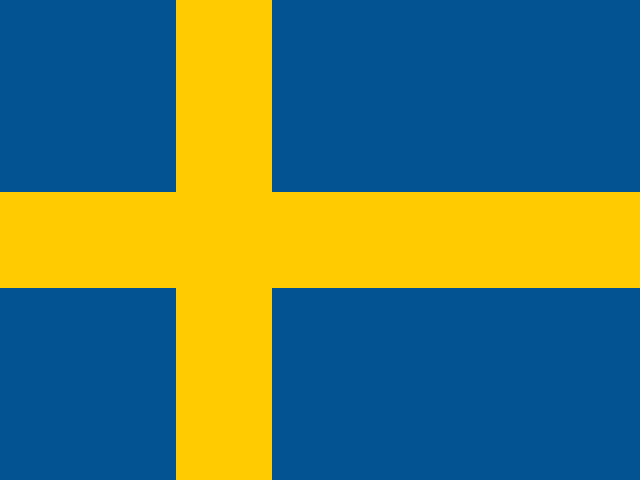
Overview
Sweden, officially the Kingdom of Sweden, occupies the eastern side of the Scandinavian Peninsula in Northern Europe. Norway lies along its western and northern frontier and Finland to the east, while Denmark is reached across the sea to the south-west and linked by the Öresund Bridge.
With about 450,000 km² of territory and roughly 10.6 million people, it is the largest and most populous Nordic country and one of the larger countries of Europe by area. Density averages about 25 people per km², but 88% of residents live in urban areas, which cover only about 1.5% of the land, mostly in the south and centre.
Sweden is a highly developed constitutional monarchy and parliamentary democracy with a Nordic welfare model offering universal health care and tertiary education. It joined the EU in 1995 and NATO in 2024, and also belongs to the UN, Schengen Area, Council of Europe, Nordic Council, WTO and OECD. It keeps its own currency, the krona.
History
People have lived in what is now Sweden since the end of the last ice age, around 12,000 BC, when reindeer hunters of the Bromme culture camped at the ice edge in Scania. Tacitus described the Suiones (Swedes) in 98 AD as a powerful seafaring tribe. Over time the Svear of Svealand and the Götar (Geats) of Götaland emerged and eventually came under one ruler, with a unified Swedish state taking shape in the late 10th century.
The Viking Age ran roughly from the 8th to the 11th century. Swedish Norsemen mostly travelled east and south through the Baltic lands, Russia and Ukraine along rivers such as the Dnieper to Constantinople and even Baghdad. Those known as Rus are believed to have helped found early Russian states, and some served the Byzantine emperor as the Varangian Guard. Norse paganism, centred on Uppsala, gave way to Christianity from the 11th century.
In 1397 Sweden entered the Kalmar Union with Denmark and Norway and left it in 1523. The Reformation of the 1530s abolished Catholic authority, and Lutheranism was confirmed as the official religion by the Uppsala Synod of 1593.
Under Gustavus Adolphus (reigned 1611-1632) Sweden entered the Thirty Years' War on the Protestant side, took land from Russia and Poland-Lithuania, and won at Breitenfeld in 1631. He died at Lützen in 1632. The resulting Swedish Empire controlled much of the Baltic and stayed a great power until the early 18th century. The territories outside the peninsula were mostly lost during the 18th and 19th centuries, and the eastern half of the realm, present-day Finland, passed to Russia in 1809.
The Swedish East India Company, founded in 1731, made Gothenburg a major port. The population doubled between 1750 and 1850, and mass emigration to America followed, with over 1% of people leaving each year in the 1880s. Sweden's last war was in 1814, when it forced Norway into a personal union that lasted until 1905.
Sweden stayed officially neutral in both world wars, though in World War I it made concessions to Germany, such as mining the Öresund. After 1945 it remained outside NATO and the Warsaw Pact, received Marshall Plan aid, helped found EFTA and built on an intact industrial base. Social Democratic governments dominated the post-war era and expanded the welfare state. The oil shocks of 1973-74 and 1978-79 brought decline and restructuring in the 1980s, including the end of shipbuilding.
A property bubble and recession caused a fiscal crisis in the early 1990s: GDP fell about 5%, and in 1992 the central bank briefly raised interest rates to 500%. The response was spending cuts, reforms and some privatisation. A 1994 referendum approved EU membership by 52.3%, and Sweden joined on 1 January 1995. Voters rejected the euro in 2003. On 28 September 1994 the ferry MS Estonia sank en route from Tallinn to Stockholm, killing 852 people, 501 of them Swedes.
In recent decades immigration has made Sweden more diverse, bringing social challenges and periodic unrest such as the 2013 Stockholm riots. The 2015 migrant crisis led the government to tighten entry rules. Magdalena Andersson became the first female prime minister in November 2021. A right-leaning bloc narrowly won the September 2022 election and Ulf Kristersson of the Moderate Party became prime minister on 18 October 2022.
After Russia's 2022 invasion of Ukraine, Sweden abandoned its long non-alignment and joined NATO on 7 March 2024 after delays caused by Turkey and Hungary.
Climate
Despite its northern latitude (about 55°N to 69°N and beyond), most of Sweden has a temperate climate with four distinct seasons, softened by the Gulf Stream and westerly winds. The far south has weak winters, the central parts a humid continental climate and the north a subarctic climate. The coastal south is classed as either humid continental or oceanic depending on the method used.
July daytime highs in municipal seats range from about 19 to 24 °C, and January highs from about -9 to 3 °C. The warmest summers occur in the Mälaren Valley around Stockholm. The record high is 38 °C (Målilla, 1947) and the record low -52.6 °C (Vuoggatjålme, 1966).
Most of the country gets 500-800 mm of precipitation a year, while the south-west receives 1,000-1,200 mm and some northern mountains up to 2,000 mm. Much of Sweden sits in the rain shadow of the Scandinavian Mountains, and the south and centre can have almost no snow in some winters. Sunshine totals 1,100-1,900 hours a year.
Daylight varies greatly. North of the Arctic Circle the sun never sets for part of summer and never rises for part of winter. In Stockholm the sun is up over 18 hours in late June and about 6 in late December.
Major cities (approx., general knowledge): Stockholm has warm summers with highs around 22 °C and cold winters with averages near or slightly below freezing. Gothenburg on the west coast is milder and wetter, with an oceanic-leaning climate. Malmö in the far south has the mildest winters and is relatively sunny. Kiruna in the north is subarctic, with long, very cold winters.
Vegetation falls into five zones: southern deciduous forest, southern coniferous forest, northern coniferous forest (taiga), alpine-birch and bare mountain. About 65% of the land is forested. Sweden ranked sixth in the 2024 Environmental Performance Index.
Government and politics
Sweden is a constitutional monarchy and parliamentary democracy. King Carl XVI Gustaf is head of state, but under the 1974 Instrument of Government he has only ceremonial and representative duties, such as opening the Riksdag session and receiving ambassadors. The constitution consists of four fundamental laws: the Instrument of Government, the Act of Succession, the Freedom of the Press Act and the Fundamental Law on Freedom of Expression. These can be changed by the Riksdag alone, but only by two votes separated by a general election.
Legislative power lies with the 349-member unicameral Riksdag, elected by proportional representation every four years. The prime minister is nominated by the Speaker and elected by a Riksdag vote, then appoints and dismisses the other ministers. The Government is collectively responsible to the Riksdag. Individual ministers are not responsible for the agencies in their portfolios, and interfering in them is called ministerstyre.
The judiciary is independent. There are two parallel court systems, general courts for criminal and civil cases and administrative courts for disputes with authorities, each with three tiers. The Supreme Court has 16 justices. Courts do not carry out judicial review; the Council on Legislation gives non-binding opinions, and precedent is influential but not binding.
Sweden is a unitary state with 21 regions (counties, län) and 290 municipalities, but local authorities hold constitutionally protected self-rule and their own tax base, with powers defined by the Riksdag through the Local Government Act. Regions run health care, public transport and some cultural institutions. Municipalities run preschools, primary and secondary schools, water, waste, elderly care and rescue services. Both levels have elected assemblies chosen at the same time as national elections.
Gotland is a special case: it is a region with a single municipality, and one organisation performs both roles. The state also has 21 County Administrative Boards, led by governors appointed for six-year terms, which coordinate regional state administration. The 25 historical provinces and three lands (Norrland, Svealand, Götaland) have no administrative role but carry cultural weight.
Party politics long featured five parties, later joined by the Greens (1988), the Christian Democrats (1991) and the Sweden Democrats (2010). Turnout is high: 87.18% in 2018. A general election is held every four years; the next is scheduled for September 2026, and its result is not covered here.
In foreign policy Sweden pursued non-alignment for most of the 20th century, was active in UN peacekeeping and aid, joined the EU in 1995 and NATO in 2024. Conscription ended in 2010 but basic military training was reintroduced in 2017, with the first recruits in 2018 under gender-neutral rules.
Sweden has been described as historically low in crime, but gang-related and organised crime and firearm homicides have risen in recent decades.
Economy
Sweden is an export-oriented mixed economy with a high standard of living. Timber, hydropower and iron ore form the resource base. Engineering accounts for about half of output and exports, with telecoms, automotive and pharmaceuticals also important. Agriculture is about 2% of GDP and employment. Large firms dominate, and most industry is privately owned. Well-known companies include Volvo, Ericsson, H&M, IKEA, Electrolux, Sandvik, SKF, Atlas Copco and Securitas.
Per-capita GDP ranks among the highest in the world (14th by the lead of the source). The currency is the krona. The Riksbank, founded in 1668, is the oldest central bank in the world and targets 2% inflation. Main trading partners are Germany, the United States, Norway, the United Kingdom, Denmark and Finland.
Taxes are high: 45.8% of GDP in 2010, versus a peak of 52.3% in 1990. Public-sector jobs make up about a third of the workforce. Income inequality is low (Gini 0.25 in 2010), but wealth inequality is high (0.853), and inequality has grown quickly since the mid-1980s per the OECD.
Labour relations rely on collective agreements, with union density around 69% in 2015-2016. Unions can elect two board representatives in firms with more than 25 employees. Unemployment was 7.2% in May 2017 and youth unemployment was 24.2% in 2012 (older figures; current rates should be checked).
Electricity in 2006 came about 47% from nuclear, 44% from hydropower, 9% from biofuels and 1% from wind (older figures; wind share is much larger now, approx.). Sweden was the first country to adopt carbon pricing and has some of the highest carbon prices in the world.
Roads include about 1,428 km of expressways, and the Öresund Bridge links Sweden to Denmark. Stockholm has the country's only metro, and Gothenburg has the largest tram network. Main airports are Stockholm-Arlanda, Göteborg-Landvetter and Stockholm-Skavsta. Gothenburg has one of Scandinavia's largest ports. Ferries connect to Denmark, Germany, Poland, Finland, Åland, Estonia, Latvia, Lithuania and Norway. Sweden switched from left- to right-hand traffic on 3 September 1967.
Sweden has a long record of innovation: Nobel (dynamite), Ericsson, Tetra Pak, Dalén (AGA), Wenström (three-phase systems) and the Automatic Identification System by Håkan Lans. Its public welfare spending is among the highest in the OECD.
Demographics and urbanization
The resident population was 10,588,020 in January 2025, having passed 10 million in January 2017. Density is about 25 per km². 88% live in urban areas, covering 1.5% of the land, and 63% live in large urban areas. Norrland covers about 60% of the territory but has fewer than five people per km². The densest regions are the Mälaren valley and Stockholm, southern Scania along the Öresund and the west coast up to Bohuslän.
Stockholm's municipality has roughly 950,000 residents, while its urban area holds 1.5 million and the wider metropolitan region reaches 2.3 million. The second and third largest cities are Gothenburg, with approximately 600,000 people in the municipality and around 1 million across its metro region, and Malmö, which has approximately 360,000 in the city proper and about 700,000 in the metro region. Uppsala, home to approximately 240,000 people, and Lund are important university cities.
No official ethnic statistics exist. In 2021, 2,752,572 people (26%) had a foreign background (born abroad or with two foreign-born parents). A further 805,340 had one foreign-born parent. Five minorities are officially recognised: Jews, Romani, Sámi, Sweden Finns and Tornedalians. The average age is 41.1, among the oldest populations in the world.
Swedish is the official language (since 2009). Finnish, Meänkieli, Sámi, Romani and Yiddish are recognised minority languages. Arabic is probably more widely spoken than Finnish. English proficiency is very high: 90% reported conversational ability in a 2023 Eurobarometer survey, followed by German (25%) and French (12%), which is helpful for expats.
At the end of 2024, 51.4% belonged to the Church of Sweden, which separated from the state in 2000, though only about 2% of members attend services regularly. About 30% are unaffiliated or unspecified. Muslims number an estimated 600,000, and there are about 100,000 Orthodox and 92,000 Catholic Christians.
Health care is mainly tax-funded, universal and run by the 21 regions, with only a small private role. Sweden ranks among the top five for low infant mortality. Education is free: a guaranteed preschool place from age 1, compulsory school from 6 to 16, free school lunches, and a voucher system since 1992 allowing for-profit independent schools. The oldest universities are in Uppsala, Lund, Gothenburg and Stockholm.
Capital city
Stockholm is Sweden's capital and its biggest city. It sits on the country's east coast, at the point where Lake Mälaren flows into the Baltic Sea, and its territory covers both islands and mainland. The municipality has roughly 950,000 inhabitants, the urban area holds 1.5 million, and the wider metropolitan area totals 2.3 million.
Its climate is humid continental or oceanic-leaning (approx.), with warm summers (July highs around 22 °C) and cold, damp winters averaging around freezing. Daylight stretches to over 18 hours in late June and shrinks to about 6 in late December. The Mälaren valley has the warmest summers in Sweden.
Stockholm is the seat of the King, the Riksdag, the Government and the country's main institutions, and hosts the Nobel Prize ceremonies and many cultural institutions. It is also the main economic centre, with major corporate headquarters, and a strong tech and finance sector (approx.). It is the only city with a metro, which has about 100 stations. Arlanda Airport lies about 40 km north and is Sweden's busiest, with 16.1 million passengers in 2009.
Sweden has a single capital, and it is also the main economic city. Gothenburg is the main port and industrial city on the west coast, and Malmö is the hub of Scania, linked to Copenhagen by the Öresund Bridge.
About this summary
Capital-city details, metro populations, city climates, recent political events and some recent economic context come from general knowledge and are approximate.