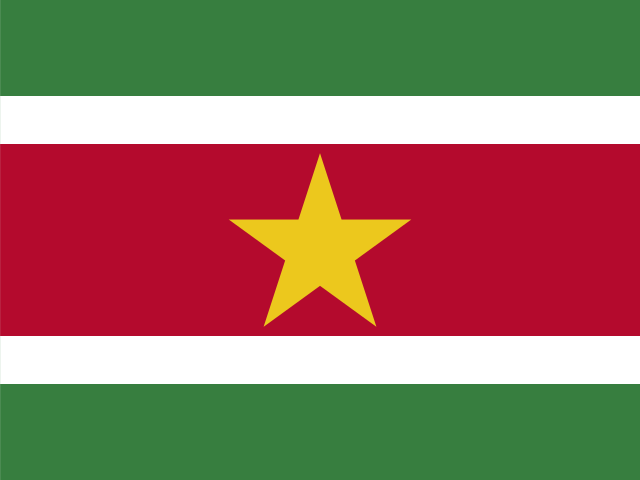
Overview
Suriname, officially the Republic of Suriname, sits on the northern coast of South America and is often grouped culturally and politically with the Caribbean. It lies just north of the equator. Rainforest blankets more than 90% of the land, one of the highest forest shares in the world.
Its neighbours are the Atlantic Ocean on the north side, French Guiana on its eastern flank, Brazil along the south and Guyana along the western frontier. With about 613,000 people (2021) on roughly 165,940 square kilometres, it is the smallest sovereign state in South America by both population and area.
Paramaribo is the capital and largest city and holds around half of the national population. The country gained independence from the Netherlands on 25 November 1975 and keeps close diplomatic, economic and cultural links with it.
Dutch holds official status in Suriname, making it the sole sovereign nation beyond Europe's borders with that distinction, and it serves as the principal language of government, business, media and education. Roughly 60% of the population speaks it as a first language. Sranan Tongo, a creole based on English, functions as the common lingua franca, and English is also widely understood.
No ethnic group is a majority. Descendants of enslaved Africans and of indentured workers from Asia make up most of the population. Proportionally, its Muslim and Hindu communities are among the largest in the Americas.
Suriname is a developing nation that nonetheless ranks high in human development. Its economy depends on natural resources, namely gold, oil, agriculture and, in the past, bauxite. The country is a member of CARICOM, the United Nations, the Organisation of Islamic Cooperation and the Organization of American States.
History
Indigenous peoples have lived in the area since about 3,000 BC. The Lokono, a coastal people who hunted, foraged and fished, are the earliest described inhabitants. The Carib (Kalina) later arrived, overcame the Lokono using stronger sailing vessels and settled at Galibi near the mouth of the Marowijne River. Smaller groups lived in the interior rainforest.
From the 16th century, French, Spanish and English explorers visited. In the following century, Dutch and English settlers set up plantation colonies along the rivers of the fertile Guiana plains. An English settlement at Marshall's Creek on the Suriname River is the earliest documented colony, followed by a short-lived English colony called Surinam (1650–1667). By the late 17th century the Dutch controlled most of the present territory.
Jews who had been expelled from Spain and Portugal started settling there in the early 17th century, and in 1665 they were granted religious freedom. Suriname developed under Dutch rule into a lucrative sugar plantation colony that relied on the labour of enslaved Africans. About 300,000 Africans were transported to the colony as part of the transatlantic slave trade, which ran from the mid-1600s until the early 1800s.
During the American Civil War, the Lincoln administration briefly discussed with the Dutch government the relocation of freed African Americans to Suriname, but the idea was dropped after 1864. The Netherlands abolished slavery in 1863 through a gradual process. Afterwards, indentured workers were recruited chiefly from British India and the Dutch East Indies (Java).
On 23 November 1941, during World War II, 2,000 US soldiers arrived to guard the bauxite mines for the Allied war effort. In 1954 Suriname became a constituent country of the Kingdom of the Netherlands, with the Netherlands keeping defence and foreign affairs.
Independence came on 25 November 1975. Johan Ferrier, the former governor, became the first president and Henck Arron prime minister. In the years before independence, nearly a third of the population emigrated to the Netherlands. Politics soon became ethnically polarised and marred by corruption, and the governing party was accused of using Dutch aid money for partisan ends.
On 25 February 1980, a group of 16 sergeants led by Dési Bouterse overthrew Arron's government. Several counter-coup attempts followed in 1980, 1981 and 1982. On 7 December 1982 the military killed a number of prominent opponents at Fort Zeelandia in Paramaribo (the 'December murders').
From 1986 a civil war pitted the army against Maroons loyal to rebel leader Ronnie Brunswijk, and more than 10,000 people, mostly Maroons, fled to French Guiana. Elections were held in 1987 and a new constitution allowed Bouterse to keep control of the army. In 1990 he dismissed ministers by telephone (the 'Telephone Coup'), and his power declined after the 1991 elections. In 1988 Anthony Nesty won Suriname's first Olympic medal, a gold in the 100 m butterfly. Nonviolent protests over economic conditions marked early 1999, and a Dutch court convicted Bouterse in absentia of drug smuggling that year.
In 2002 the historic inner city of Paramaribo was listed as a UNESCO World Heritage Site for its Dutch colonial architecture. Bouterse was elected president on 19 July 2010 and re-elected in 2015. In 2012 the National Assembly extended an amnesty law that covered the December murders case. A Surinamese court nevertheless convicted him on 29 November 2019 and sentenced him to 20 years for the 1982 killings.
After the 2020 elections Chan Santokhi was the sole candidate and was elected president by acclamation on 13 July, taking office on 16 July in a ceremony closed to the public because of COVID-19. In February 2023 heavy protests over living costs took place in Paramaribo, with demonstrators accusing the government of corruption and storming the National Assembly. Bouterse died in December 2024. On 6 July 2025 parliament elected Jennifer Geerlings-Simons of the National Democratic Party (NDP) as the country's first woman president.
Climate
Suriname lies two to five degrees north of the equator and has a hot, wet tropical climate with little seasonal temperature variation. Relative humidity is typically 80–90%, and the heat can feel up to about 6 °C hotter than the recorded temperature. The source gives average temperatures of roughly 29–34 °C.
There are two wet seasons (April to August, and November to February) and two dry seasons (August to November, and February to April).
Paramaribo, the capital on the northern coast, has a tropical rainforest/monsoon-type climate with warm weather all year, daytime highs around 30–32 °C (approx.) and heavy rain especially in the long wet season. Nieuw Nickerie in the west and Moengo and Albina in the east, all on the coastal plain, have a similar hot, humid pattern (approx.). The interior highlands and savanna in the south, where few people live, are also hot and humid with high rainfall in the forest.
Climate change is bringing warmer temperatures and more extreme weather. Thanks to its extensive forests, the country has run a carbon-negative economy since 2014. Coastal flooding and mangrove loss are concerns near Paramaribo, where mangrove rehabilitation work is under way.
The land divides into a cultivated northern lowland coastal belt, where most people live, and a southern zone of tropical rainforest and sparsely inhabited savanna covering about 80% of the land. The highest peak is Julianatop at 1,286 m. Forest cover is about 90%, and about 16% of the land is national parks and lakes per UNEP-WCMC, while another figure in the source puts legally protected reserves at about 30%. The Central Suriname Nature Reserve is a UNESCO World Heritage Site. Illegal gold mining with mercury is damaging rivers such as the Lawa and Maroni.
Government and politics
Suriname is a representative democratic republic under the Constitution of 1987. The legislature is a 51-member unicameral National Assembly elected by popular vote for five years.
The president is both head of state and head of government, elected for five years by a two-thirds majority of the National Assembly. If that majority cannot be reached, a People's Assembly, made up of National Assembly members plus regional and municipal representatives elected in the most recent national vote, chooses the president by majority. The president appoints a cabinet of sixteen ministers. A vice president is normally elected at the same time. The constitution has no mechanism to remove the president other than resignation.
The High Court of Justice (Supreme Court) stands at the top of the judiciary and supervises the magistrate courts. The president appoints its members for life, after consulting the National Assembly, the State Advisory Council and the National Order of Private Attorneys.
Suriname is a unitary state rather than a federation. It has ten administrative districts, each led by a district commissioner appointed, and removable, by the president. The districts are subdivided into 62 resorts (ressorten). Local bodies at district and resort level have limited power, and the main decisions on tax, health, law and education are made nationally. Regional and municipal representatives do take part in the People's Assembly when it is convened. No special autonomous jurisdictions are described in the source.
The armed forces have an army, air force and navy, with the president as supreme commander and a minister of defence assisting. Foreign relations are shaped by a long special relationship with the Netherlands, which has been strained by the Bouterse cases, and the Netherlands dropped Suriname from its development programme in 2014. Suriname cooperates with the United States through programmes such as the Caribbean Basin Security Initiative, takes part in EU-CARIFORUM dialogues and the Cotonou Agreement, and has development partnerships with China and Brazil. Boundary disputes exist with French Guiana (Marowijne River) and Guyana (Corantijn River), and part of the maritime dispute with Guyana was arbitrated in 2007.
Presidential and parliamentary elections are held every five years; the 2025 outcome mentioned above is the latest covered, and any later events are not covered.
Economy
The economy is based on natural resources and is less dependent on Dutch aid than in the past. Bauxite once accounted for over 15% of GDP and 70% of export earnings until 2015, when Alcoa ended its bauxite operations. Gold now makes up an estimated 60–80% of export earnings; in 2023 gold exports were worth about US$1.83 billion. Large-scale mining supplies about 58% of gold output and small-scale mining 42%.
Oil adds about 10% of GDP. The state oil company Staatsolie handles extraction and refining, with 2022 revenue of US$840 million (US$320 million paid to the state) and 2023 revenue of US$722 million (US$335 million to the state), the dip reflecting lower oil prices. Offshore oil discoveries in recent years have raised expectations of further development (approx., general knowledge).
Agriculture, especially rice and bananas, plus shrimp, fish and timber, remains important, and about a quarter of people work in the sector. Ecotourism is growing. Main trade partners include Switzerland, China, the Netherlands, the United States, Canada and Caribbean states such as Trinidad and Tobago. In 2012 exports were about US$2.56 billion (main buyers the US, Belgium and UAE) and imports about US$1.78 billion (main suppliers the US, the Netherlands and China).
Older reference figures: 2010 GDP about US$4.8 billion, real growth 3.5%, GDP per capita about US$9,900 and inflation 6.4% in 2007. In the late 1990s heavy spending, weak tax collection and a large civil service produced a deficit of about 11% of GDP and sharp inflation. Registering a business has been very slow, reportedly 694 days.
Tourism centres on rainforest biodiversity: the Central Suriname Nature Reserve, Brownsberg Nature Park overlooking the Brokopondo Reservoir, Raleighvallen, Tafelberg and Voltzberg reserves, and various waterfalls. Maroon and Amerindian villages can be visited. Crime is rising in Paramaribo, with armed robberies not unusual; the 2025 US travel advisory rated Suriname Level 1 (exercise normal precautions).
Infrastructure: about 4,300 km of roads (2003), of which about 1,100 km is paved. Traffic drives on the left. There are 55 mostly small airports, and Johan Adolf Pengel International Airport is the only one handling large jets, with flights to Amsterdam, Miami, Port of Spain, Curaçao, Georgetown and Belém among others. The Jules Wijdenbosch Bridge (about 1.5 km long, completed 2000) links Paramaribo with Commewijne.
Demographics and urbanization
The population was about 624,900 in 2022 (UN estimate), compared with 541,638 in the 2012 census. Suriname is one of the least densely populated countries in the world. About 90% of people live in Paramaribo or on the coast, and the interior is sparsely settled.
Paramaribo accounts for nearly half the population and most urban residents, and is larger than the next nine largest cities combined. Its metropolitan area, including Wanica, holds roughly 300,000 people (approx.). Other towns such as Lelydorp (Wanica), Nieuw Nickerie, Moengo and Albina are much smaller, each only tens of thousands at most (approx.).
Ethnic makeup: Asian Surinamese about 43%, including Indo-Surinamese (Hindustanis) at 27.4%, mostly descended from 19th-century indentured workers from northern India, and Javanese at 14%. Afro-Surinamese together are about 37.4%, split into Maroons (21.7%, in six tribes: Ndyuka, Saramaccan, Paramaccan, Kwinti, Aluku, Matawai) and Creoles (15.7%). About 13.4% identify as mixed, Chinese about 7.3%, Indigenous peoples 3.7% (Akurio, Lokono, Kalina, Tiriyó, Wayana) and Europeans about 1%, mostly descendants of Dutch farmers known as Boeroes. Lebanese and Jewish communities also exist. Newer migrants include Brazilians, Haitians and Chinese, many of them in gold mining and many without legal status.
Emigration has been large. In the late 2010s about 272,600 Surinamese lived abroad, around 192,000 of them in the Netherlands, about 25,000 in France (mostly French Guiana) and about 15,000 in the United States.
Languages: Dutch is the sole official language and the language of education, government, business and media; over 60% are native speakers and 20–30% speak it as a second language. In Paramaribo, Dutch is the main home language in two-thirds of households. Sranan Tongo is the most widely used everyday vernacular. Sarnami Hindustani is the third most used, and others include six Maroon languages, Javanese, Chinese varieties and Amerindian languages. English is understood by a majority, and Portuguese, Spanish and French are heard near the borders.
Religion (2012 census): Christians 48.4% (Protestants 26.7%, Catholics 21.6%), Hindus about one fifth, and Muslims 13.9%, the highest share in the Americas. Winti (Afro-American religion), Javanism (0.8%) and Indigenous traditions also exist.
Health and education: life expectancy was about 72 years in 2017 (men 69, women 75), with cardiovascular disease, cancer and diabetes/kidney disease the leading causes of death. Education is compulsory to age 12, net primary enrolment was 94% in 2004, and the main university is Anton de Kom University of Suriname.
Capital city
Paramaribo, the capital and largest city, lies on the Suriname River a short distance inland from the Atlantic coast, in the northern lowlands. It has roughly 240,000 residents in the city proper and perhaps 350,000 in the wider urban area (approx.), about half of the national population by the source's account.
Its climate is hot and humid all year (daytime highs around 30–32 °C, approx.), with two wet and two dry seasons as in the rest of the coast, and heavy rainfall especially from April to August.
Paramaribo is the political, administrative, economic and cultural centre. The president, National Assembly and ministries are based there, and it is also the main commercial hub, so the political capital and main economic city are the same. Gold and oil operations are located elsewhere, but company headquarters and services are concentrated in the capital (approx.). The only large international airport, Johan Adolf Pengel, is about 45 km to the south (approx.).
The inner historic city was made a UNESCO World Heritage Site in 2002 for its Dutch colonial architecture. Notable landmarks include Sts. Peter and Paul Cathedral, a synagogue standing beside a mosque in the centre, and the Hindu Arya Diwaker temple in Wanica. The Jules Wijdenbosch Bridge links the city to Commewijne across the river.
Dutch is the main home language in about two-thirds of Paramaribo households and Sranan Tongo is the everyday street language. Crime, including armed robbery, has been rising. Protests over living costs and alleged corruption took place in the city in February 2023. Conservation International Suriname is based here.
About this summary
Some details on Paramaribo (metro population, climate, role), recent politics, currency, and recent economic and oil developments come from general knowledge and are approximate.