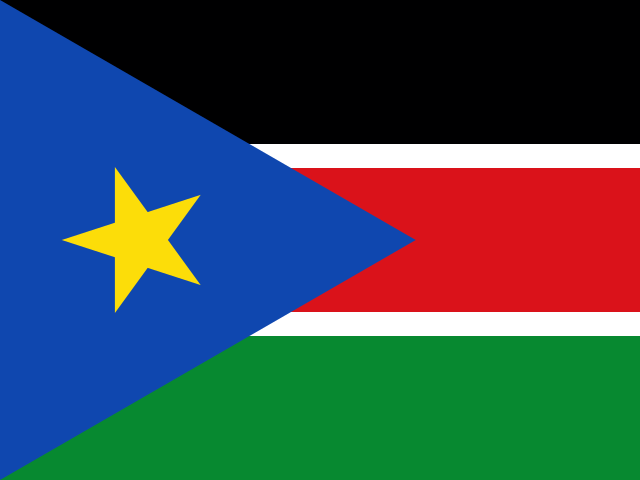
Overview
South Sudan, formally the Republic of South Sudan, is a landlocked country in East Africa. Its neighbours are Sudan (north), Ethiopia (east), Kenya, Uganda, the Democratic Republic of the Congo and the Central African Republic (clockwise from the southeast to the west).
The land includes wide plains and plateaus, dry and tropical savannah, inland floodplains and forested uplands. The Nile system is the main physical feature, flowing from south to north through the middle of the country, where the huge Sudd swamp dominates.
Population was estimated at just over 12.7 million in 2024. Juba is both the capital and the largest city.
The country became independent on 9 July 2011 after a January 2011 referendum in which 98.8% backed separation. As of 2026 the source describes it as the most recent widely recognised sovereign state.
A civil war ran from 2013 to 2018, with forced displacement, ethnic massacres and killings of journalists reported. A coalition of the former rival factions, led by Salva Kiir (SPLM) and Riek Machar (SPLM-IO), has governed since, while ethnic violence continues.
The population is mainly Nilotic and one of the youngest in the world, with roughly half under 18. Most people are Christian or follow traditional indigenous faiths, with a sizeable Muslim minority.
South Sudan belongs to the United Nations, the African Union, the East African Community and the Intergovernmental Authority on Development. It ranks lowest on the Human Development Index and has historically had the lowest nominal GDP per capita in the world.
History
Nilotic peoples such as the Dinka, Anyuak, Bari, Acholi, Nuer and Shilluk arrived in the area before the tenth century. Between the 15th and 19th centuries, migrations, largely from the Bahr el Ghazal area, settled the Anyuak, Dinka, Nuer and Shilluk in Bahr el Ghazal and the Upper Nile region, while the Acholi and Bari settled in Equatoria. The Zande, Mundu, Avukaya and Baka entered in the 16th century and founded the largest state in the Equatoria region.
Egypt under the Muhammad Ali dynasty occupied Sudan in the 1800s. From 1899 it was run as an Anglo-Egyptian condominium until Sudan became independent in 1956.
After the First Sudanese Civil War, a Southern Sudan Autonomous Region existed from 1972 to 1983. The Second Sudanese Civil War began in 1983 and ended with the Comprehensive Peace Agreement of 2005, after which an Autonomous Government of Southern Sudan was set up. John Garang, a founder of the SPLA/M, led it until his death on 30 July 2005, and Salva Kiir succeeded him.
A self-determination referendum was held from 9 to 15 January 2011, and 98.83% of voters chose independence. A steering committee announced the name Republic of South Sudan on 23 January 2011; other names considered included Azania, Jubanda, Nile Republic, Kush Republic and Juwama. Independence was declared on 9 July 2011, and a transitional constitution took effect the same day.
In December 2013 a power struggle inside the ruling SPLM led to civil war. An analyst had earlier warned, in September 2013, of growing autocracy at the top of the party. The source dates the war variously as 2013 to 2018 and 2013 to 2020, and refers to a 2020 peace agreement.
South Sudan signed the East African Community treaty on 15 April 2016 and became a full member on 15 August 2016. Elections were first set for 2023 under the peace deal, then moved to late 2024 by agreement in 2022, and postponed again in September 2024.
In 2025 fighting spread across Jonglei, Unity and Upper Nile states, with air strikes, river operations and ambushes causing civilian deaths and displacement. In March 2025 clashes in Nasir between the army and the Nuer White Army left dozens dead. On 26 March 2025 Vice-President Riek Machar was arrested on Kiir's orders, accused of backing the White Army, which denied links. The SPLM-IO said the arrest broke the ceasefire. Ugandan forces arrived at Kiir's invitation. UN Secretary-General Antonio Guterres said the peace agreement was in shambles and the country was close to collapsing into civil war.
In March 2026 at least 169 people were killed and 50 injured when armed youth from Unity State attacked Abiemnom County in the Ruweng Administrative Area, burning markets and homes before the army drove them out.
On 24 September 2026, Kiir brought the transitional government to an end. Until a newly elected president takes the oath, he keeps all of his constitutional authority, and he named certain ministers and governors to continue as caretakers. Elections are set for 22 December 2026, and this paragraph does not address their result.
Climate
South Sudan has a tropical climate with a humid, rainy season followed by a drier one. Temperatures are high all year. July is the coolest month, with averages roughly 20 to 30 °C, and March is the warmest, roughly 23 to 37 °C.
Most rain falls between May and October, though the season can start in April and last into November. May is on average the wettest month. The rains follow the yearly shift of the Inter-Tropical Zone, with southerly and southwesterly winds bringing slightly lower temperatures, higher humidity and more cloud.
One study suggests climate change will raise rainfall rates, but it is unclear whether the number of rainy days will rise or fall.
City climate (approx., general knowledge): Juba, the capital, has a hot tropical savanna climate with a long rainy season from about April to November and a drier, hotter spell from December to March. Other towns such as Wau, Malakal and Bor share this pattern, with Malakal and the northern Sudd lowlands generally hotter and more prone to flooding.
Geography and habitats: the country lies between roughly 3° and 13°N and 24° and 36°E, covered by tropical forest, swamp and grassland. The White Nile, locally the Bahr al Jabal, passes Juba and feeds the Sudd, one of the world's largest wetlands. Ecoregions include East Sudanian savanna, Northern Congolian forest-savanna mosaic, the Sudd flooded grasslands, Sahelian Acacia savanna, East African montane forests and Acacia-Commiphora bushlands.
Wildlife and protection: 23 protected areas cover about 143,000 km², roughly 15% of the territory. The Sudd Wetland (about 57,000 km²) is a Ramsar site with over 400 bird, 100 mammal and 100 fish species. Other areas include Boma, Southern, Bandingilo (about 8,400 km²), Nimule (about 410 km²) and Shambe (about 620 km²) national parks. Bandingilo hosts what the source calls the second-largest wildlife migration in the world, and surveys from 2005 found a migration of about 1.3 million antelope largely intact. Species include white-eared kob, Nile lechwe, tiang, elephants, giraffes, lions and African wild dogs. Many protected areas suffer illegal hunting and livestock grazing. The country scored 9.45/10 on the 2019 Forest Landscape Integrity Index, fourth of 172 countries.
Government and politics
South Sudan has a presidential system under a transitional constitution ratified by the Southern Sudan Legislative Assembly and signed by President Salva Kiir on 9 July 2011, replacing the 2005 interim constitution. The president is head of state, head of government and commander-in-chief.
The National Legislature has two houses: the directly elected National Legislative Assembly and the Council of States, which represents the states. The constitution provides for an independent judiciary headed by the Supreme Court. In May 2021 Kiir dissolved parliament as part of the 2018 peace deal, to form a new 550-member legislative body. The 2023 V-Dem indices ranked South Sudan third lowest among African electoral democracies.
Under a peace agreement signed on 22 February 2020, the country has ten states, two administrative areas and one area with special status. Bahr el Ghazal: Northern Bahr el Ghazal, Western Bahr el Ghazal, Lakes, Warrap. Equatoria: Western Equatoria, Central Equatoria (home of Juba) and Eastern Equatoria. Greater Upper Nile: Jonglei, Unity, Upper Nile. The administrative areas are Greater Pibor and Ruweng (Rubkotna); Abyei has special administrative status. These are grouped under the three historical provinces of Sudan.
The source does not detail how tax, health, law and education are split between national and state levels, so no such detail is given here.
Disputed areas: Kafia Kingi is contested between South Sudan and Sudan, and the Ilemi Triangle between South Sudan and Kenya.
In February 2011 the government resolved to study a new planned capital, and in September 2011 leaders accepted Ramciel, in Lakes state near the Central Equatoria and Jonglei borders, which is seen as the geographic centre. The reasons were Juba's weak infrastructure, rapid growth and off-centre position. As of 2024 the relocation is stalled and funding was unclear.
Foreign relations: South Sudan is a member of the UN, African Union, East African Community, COMESA and IGAD, and joined UNESCO on 3 November 2011. It has applied to the Commonwealth and the Arab League (applied 25 March 2014, pending) and plans to seek membership of others such as the IMF and World Bank. The US backed the 2011 referendum, and Sudan-related sanctions were lifted for South Sudan in December 2011, though some activities still need OFAC authorisation. Relations with Sudan have shifted since independence, including a retracted dual-citizenship offer. In July 2019 South Sudan was among 37 countries whose UN ambassadors signed a letter backing China's treatment of Uyghurs. A reported 20-year loan of $12 billion from a UAE firm was to be repaid in oil priced $10 per barrel below market.
Economy
The economy is among the least developed in the world, with little infrastructure and, as of 2011, the highest maternal mortality and female illiteracy rates. It relies heavily on agriculture and exports timber. Resources include petroleum, iron ore, copper, chromium, zinc, tungsten, mica, silver, gold, diamonds, hardwoods, limestone and hydropower.
Oil dominates: it provided over 90% of state revenue in 2023, and an earlier ministry figure put it above 98% of the budget. The country has the third-largest oil reserves in Sub-Saharan Africa and about four times Sudan's deposits. Under the 2005 peace agreement revenues were split 50-50 with Khartoum because exports use pipelines and Port Sudan facilities in Sudan. After independence, South Sudan objected to a US$34 per barrel transit fee, and in January 2012 it halted production, sharply cutting revenue while food costs rose by 120%. Nile Drilling & Services became the first locally owned drilling firm in 2017.
Sudan and South Sudan share about US$38 billion in debt built up over five decades: roughly US$5.3 billion to institutions like the World Bank and IMF (2009 figure), over US$11 billion to Paris Club members, over US$13 billion to other bilateral creditors and about US$6 billion to private creditors.
Inflation was about 45% in 2011 and 2012, low in 2013-2014, then rose and peaked at 380% in 2016 before declining through 2019. It stayed low or negative from 2020 to 2022, then rose to around 90% in 2024 and about 102% the following year. The source attributes it to central bank financing of the deficit. Many urban and rural households could not afford minimum food needs.
South Sudan joined the East African Community in 2016, after a bid started in 2011; early moves on rail and pipeline links with Kenya and Uganda suggested a shift away from reliance on Sudan. It has also applied to join the Commonwealth.
Transport: road is the most common and cheapest mode. The White Nile is the main waterway, navigable from Lake Albert to Khartoum, though the stretch between Juba and Uganda needs a channel, and parts are navigable to Wau and Gambela (Ethiopia) for part of the year. The railway is 248 km of 1,067 mm gauge track from the Sudanese border to Wau, with proposed extensions to Juba and to Kenyan and Ugandan networks. Juba Airport is the busiest, with flights to Asmara, Entebbe, Nairobi, Cairo, Addis Ababa and Khartoum.
Demographics and urbanization
The source gives roughly 11 million people in one place and just over 12.7 million (2024 estimate) in another. The society is mostly rural and subsistence-based. War has affected the region in all but 10 years since 1956, causing over 2 million deaths and more than 4 million displaced or refugees.
Urbanization rate: the source gives no figure, but it describes the economy as predominantly rural. Juba is the largest city (approx. 500,000 to over 1 million people). Other towns such as Wau, Malakal, Yei and Bor are much smaller (approx. under 300,000 each).
Census data are disputed. The 2008 Sudan census counted 8.26 million in the south, but southern officials rejected it as an undercount; a US adviser said only about 89% were reached. A 2009 census effort was criticised for how it counted the diaspora.
Ethnic groups: Dinka about 40%, Nuer about 20%, Azande about 10%, plus Shilluk and Bari. Around 800,000 expatriates from the Horn of Africa live in the country. Nearly 1.5 million South Sudanese have left as refugees or workers, with large diaspora communities in the US, Canada, UK and Australia.
Languages: about 70 are spoken, 60 of them indigenous with constitutional status as national languages. English is the sole official language and language of instruction, but few speak it natively. Main languages are Dinka (1.35 million), Nuer (740,000), Bari (595,000) and Zande (420,000). Juba Arabic, a creole, is the urban lingua franca, spoken by about 1.45 million. Arabic lost official status in the 2011 constitution, and Swahili has been proposed as a second official language.
Religion: mostly Christian, with traditional beliefs and a Muslim minority. Pew estimated in 2012 and 2020 about 60.5% Christian, 32.9% folk religions and 6.2% Muslim. Main denominations are Catholic, Episcopal and Presbyterian, along with Pentecostal and African Inland churches. Christianity has grown quickly in recent decades.
Capital city
Juba is the capital and largest city. It lies on the White Nile in the south of the country and is the capital of Central Equatoria state and the seat of Juba County.
Population is approx. 500,000 to over 1 million. Its climate is tropical savanna, hot all year, with rains from roughly April to November and a drier period from December to March (approx.).
It is the political centre and hosts Juba Airport, the busiest and most developed airport in the country, with regional connections. It is also the main commercial centre (approx.), so the capital and main economic city are the same. Juba Arabic is the urban lingua franca.
Juba has poor infrastructure, rapid growth and an off-centre location, which prompted plans for a new capital at Ramciel, though the project is stalled as of 2024. No other capitals are named in the source.
About this summary
Approximate general-knowledge details: country area, Juba's population and climate, and other city sizes. Capital-city role details are also from general knowledge.