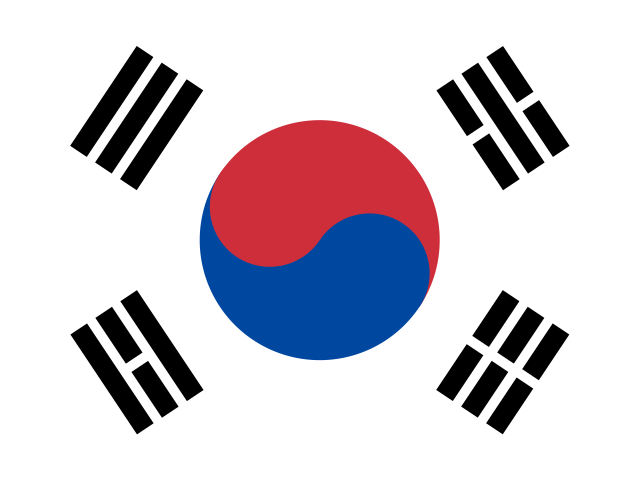
Overview
South Korea, officially the Republic of Korea, occupies the southern half of the Korean Peninsula in East Asia, together with many nearby islands. It shares a border with North Korea along the Korean Demilitarized Zone, with the Yellow Sea to the west and the Sea of Japan to the east.
The population is about 52 million, and roughly half of all people live in the Seoul metropolitan area. Other major cities are Busan, Daegu and Incheon.
The country is a unitary presidential republic with a unicameral National Assembly, governed under the 1987 constitution (the Sixth Republic). It is a high-income, highly industrialized economy, a G20 member and a major non-NATO ally of the United States.
It is known for fast internet, dense high-speed rail, strong education and innovation results, long life expectancy, and the global influence of the Korean Wave in music, TV drama and film. It also faces one of the world's lowest fertility rates and rapid population aging.
Technically the Korean conflict continues, because the 1953 armistice was never replaced by a peace treaty.
History
People lived on the Korean Peninsula as early as the Lower Paleolithic. Founding myth places the start of Korean history with Gojoseon in 2333 BC under the legendary Dangun; Chinese records mention Gojoseon by the early 7th century BC. It grew to control the northern peninsula and parts of Manchuria.
Several early states (Buyeo, Okjeo, Dongye, Samhan) were followed by the Three Kingdoms of Goguryeo, Baekje and Silla. Goguryeo was the largest and most militaristic, with a golden age under Gwanggaeto the Great and his son Jangsu. Silla unified most of the peninsula in the late 7th century CE, while Balhae succeeded Goguryeo in the north.
In 936 Wang Geon united the Later Three Kingdoms and founded Goryeo (918–1392 as a dynasty), which absorbed Balhae's last crown prince after Balhae fell to the Khitan in 926. Goryeo invented metal movable type printing and shaped lasting Korean identity. The Joseon dynasty (1392–1897) followed, producing cultural and scientific achievements, including the Hangul script created in 1446, but turned isolationist from the mid-17th century.
King Gojong proclaimed the Korean Empire in 1897. Japan made Korea a protectorate in 1905 and annexed it in 1910, suppressing Korean language, culture and history. The March First Movement of 1919 led to resistance groups in exile.
After Japan's surrender in 1945, Korea was split into a Soviet-occupied north and US-occupied south. The Republic of Korea was founded in August 1948 with Syngman Rhee as president; the North became the Democratic People's Republic of Korea the following month under Kim Il Sung.
North Korea invaded on June 25, 1950, starting the Korean War. A UN Command led by the United States defended the South, while China sent large numbers of troops to back the North. The armistice of 1953 left about three million Koreans dead and both economies in ruins.
A student uprising (the April Revolution) forced Rhee out in 1960. After a brief, unstable Second Republic, General Park Chung Hee took power in a coup on May 16, 1961. His rule brought rapid export-led growth, known as the Miracle on the Han River, alongside political repression; South Korea also fought in the Vietnam War. Authoritarian rule continued into the 1980s.
The June Democratic Struggle of 1987 ended military-backed rule and created the Sixth Republic. Roh Tae-woo won that year's election, and Seoul hosted the 1988 Olympics. South Korea joined the UN in 1991 (alongside North Korea).
Kim Dae-jung, a former political prisoner, was elected in 1997 and took office in February 1998 during the Asian financial crisis, restructured the economy on IMF advice, and pursued the Sunshine Policy. A North-South summit was held in Pyongyang in June 2000, and he received the Nobel Peace Prize that year. Korea and Japan co-hosted the 2002 FIFA World Cup. A conservative, Lee Myung-bak, won in 2007.
In 2010 the warship Cheonan sank, killing 46 sailors (allegedly by a North Korean submarine; the UN report did not name North Korea), and North Korean artillery hit Yeonpyeongdo, killing 4.
Park Geun-hye became the first female president in 2012, and was removed from office after a corruption scandal and mass protests from November 2016; she was sentenced to 24 years in 2018. Moon Jae-in took office on May 10, 2017, and his term saw improved ties with the North and the Pyeongchang Winter Olympics. COVID-19 helped cause deaths to exceed births, the first population fall on record.
Yoon Suk Yeol of the People Power Party narrowly won in March 2022. He declared martial law on December 3, 2024, and the National Assembly voted 190–0 to nullify it, so he ended it on December 4. He was impeached on December 14, 2024 and removed from office on April 4, 2025. Lee Jae-myung of the Democratic Party won the following election and took office on June 4, 2025.
Climate
The climate of South Korea combines humid continental and humid subtropical types, and the East Asian monsoon influences it. The country experiences four clear seasons. Spring lasts from about late March until early May. Summer begins in mid-May and ends in early September, while autumn covers the period between mid-September and early November. Winter then follows, lasting from mid-November through mid-March.
Rain is concentrated from June to September, with a short rainy season called jangma from late June through July. Late-summer typhoons hit the southern coast with strong winds, heavy rain and occasional floods.
Seoul: January averages about −7 to 1 °C and August about 22 to 30 °C, with roughly 1,370 mm of rain a year. Busan on the southern coast is milder in winter and gets about 1,470 mm a year. Daegu (inland southeast) is approx. hotter in summer, while Incheon has a climate similar to Seoul's but moderated by the sea (approx.).
Winters are warmer on the southern coast and much colder in the mountainous interior; summers are hot and humid, with temperatures above 30 °C in most places. Jeju Island, the largest island, is approx. the mildest region.
Air quality is a recurring concern, with acid rain, sulfur oxides and spring yellow dust, partly blamed on pollution from China. South Korea has a green growth programme, and Seoul's tap water is now marketed as safe to drink under the name Arisu. The country has set a net-zero emissions goal for 2050.
Government and politics
South Korea is a constitutional democracy under a constitution first promulgated in 1948 and revised several times. The current order since 1987 is called the Sixth Republic. Power is split into executive, legislative and judicial branches, with a directly elected president as chief executive and a unicameral National Assembly.
Executive and legislative functions operate mainly at the national level, though some ministries carry out local tasks. Courts work at both national and local levels. Local governments are semi-autonomous, with their own executive and legislative bodies. The state is unitary, so sub-national units derive their powers from national law; in practice (approx.) national government keeps most tax, law and education policy, while local governments handle local services and administration.
Administrative divisions: the country has ten provinces and three special self-governing provinces. It also has five metropolitan cities, which are self-governing cities outside any province, along with a single special city, a single special metropolitan city, and a single special self-governing city. Seoul is the special city.
Politics is broadly split between the liberal camp, led mainly by the Democratic Party, and the conservative camp, led by the People Power Party. The World Factbook calls the democracy fully functioning, while the Economist Democracy Index classifies it as a flawed democracy (32nd of 167 in 2024). Some experts described democratic backsliding under Yoon Suk Yeol, culminating in the December 2024 martial law attempt. It scores 63 on the Corruption Perceptions Index (31st).
Foreign relations: a UN member since 1991, linked with ASEAN through ASEAN Plus Three and the East Asia Summit. The US alliance rests on a Mutual Defense Treaty, with about 28,500 US troops stationed in the country. China is by far the largest trading partner; Japan is third, and ties with Japan have improved in the 2020s despite disputes over history and the Liancourt Rocks (Dokdo/Takeshima).
North Korea: South Korea claims sovereignty over the whole peninsula. The two states remain technically at war and share one of the world's most heavily fortified borders. The Sunshine Policy of the late 1990s and 2000s was complicated by missile tests, relations improved in the late 2010s and worsened in the 2020s, and in 2024 the North dropped peaceful reunification plans and labeled the South its most hostile country.
Military: about 2.6% of GDP goes to defence. Men must serve, typically 18 months. Reported personnel were about 3.6 million in 2022 (500,000 active, 3.1 million reserve). Conscientious objection was legalised in 2018 by Constitutional Court and Supreme Court rulings. A UN Command sits atop the chain of command, and wartime operational control transfer to South Korea has been repeatedly delayed.
Economy
South Korea has a mixed, high-income economy, the 14th largest by nominal GDP and by PPP, and is the most industrialized OECD member (joined 1996). It grew among the fastest in the world from the early 1960s to the late 1990s, recording the fastest GDP per capita rise from 1980 to 1990, known locally as the Miracle on the Han River.
It is heavily trade-dependent: exports are about 46% of GDP, and semiconductors and AI-related equipment make up around 40% of exports. Chaebol such as Samsung, LG, SK and Hyundai dominate. Growth is concentrated in a few tech firms, while smaller businesses employing about 60% of workers grow more slowly, and competition from China is rising.
It recovered quickly from the 1997 Asian crisis, tripled GDP afterwards and avoided recession in 2008. The IMF cites low public debt and large fiscal reserves; the country holds one of the world's largest foreign-exchange reserves. Tension with North Korea can hurt credit ratings and markets.
Transport: KTX high-speed rail on the Gyeongbu and Honam lines, Korail intercity services, toll expressways, express buses, ferries, and metro systems in Seoul, Busan, Daegu and other cities. Incheon International Airport is the main gateway (58 million passengers in 2016); Gimpo, Busan and Jeju are other international airports. Korean Air and Asiana are the main carriers, with low-cost airlines like Jeju Air.
Energy: nuclear supplied about 45% of electricity at the source's reference date and the country exports reactors (UAE, Jordan research reactor, Argentina). It may not enrich uranium independently because of US pressure. A renewable portfolio standard ran from 2012 to 2022.
Science: R&D spending rose from about 3.9% of GDP in 2013 to above 4.9% in 2022, second highest in the world. It leads the OECD in science and engineering graduates, ranked 4th in the 2025 Global Innovation Index and ranks 9th in the Networked Readiness Index. Nuri rocket reached orbit in October 2021, giving indigenous launch capability. Robotics and biotechnology are state priorities, and SK Bioscience produced COVID-19 vaccines for worldwide distribution.
Tourism: more than 17 million foreign visitors in 2019, helped by the Korean Wave. Some nightlife venues restrict entry to foreigners, which is worth knowing for expats.
Welfare: spending is lower than the OECD norm. The national pension covers ages 18 to 59, with old-age pensions from 60 after at least 20 years of coverage. Universal health care is in place.
Demographics and urbanization
Population was about 51.7 million in 2022, up from 21.5 million in 1955 and 50 million by 2010. It was expected to peak near 52 million in 2024 and fall to about 36 million by 2072. Deaths exceeded births from 2020.
Fertility is the world's lowest: 0.81 in 2021, 0.78 in 2022, 0.72 in 2023 and 0.80 in 2025. The government calls it a national emergency and created a dedicated ministry in May 2024, with newborn cash allowances and childcare and fertility funding. Births rose in late 2024. People aged 65 and over are due to exceed 20% by 2025 and approach 45% by 2050.
Most people live in cities after rapid rural-to-urban migration from the 1970s to the 1990s. About 24.5 million (roughly half) live in the Seoul Metropolitan Area. Other cities: Busan (3.5 million), Incheon (3.0 million), Daegu (2.5 million), Daejeon (1.4 million), Gwangju (1.4 million), Ulsan (1.1 million). Density is about 515 per km², over ten times the world average. Urbanization is approx. 80 percent or higher.
About 96% are ethnic Koreans. Foreign residents reached a record 2.46 million by November 2023 (nearly 5% of the population), mostly workers and students. Chinese nationals are the largest group (56.5% of foreigners), about 70% of whom are ethnic Korean Joseonjok. About 43,000 English teachers live temporarily in the country. Large diasporas live in China (2.3 million), the US (1.8 million), Japan (850,000) and Canada (250,000).
Life expectancy is about 83.5 years (fifth highest in 2024 per source). Korean is the official language and uses Hangul, created in 1446; English is taught throughout schooling. Religion: 51% unaffiliated in 2024, 31% Christian (20% Protestant, 11% Catholic), 17% Buddhist, plus small Muslim and indigenous groups. No state religion.
Education is strong and centralized: students scored 519 against an OECD average of 492, spending was 5.1% of GDP in 2015, and cram schools are common. School violence victimization hit 2.5% in 2025. Health care is universal with advanced facilities, though the suicide rate is the highest in the OECD.
Capital city
Seoul is the capital and largest city, in the northwest of the country on the Han River, close to the border with North Korea. The city proper has approx. 9 to 10 million people, and the wider metropolitan area about 24.5 million, around half the national population.
Climate: January averages about −7 to 1 °C and August about 22 to 30 °C, with approx. 1,370 mm of annual rain, mostly in summer and during the jangma season.
Seoul is the political centre (presidency, National Assembly and ministries, approx. with some government functions in Sejong City), and also the main economic, financial, cultural and educational hub, home to major corporate headquarters. It hosted the 1988 Olympics. It is a special city with its own self-governing status.
Seoul has an extensive metro network, KTX connections and access to Incheon International Airport and Gimpo airport. The Cheonggyecheon stream restoration and drinkable Arisu tap water are notable urban improvements. Seoul is both the capital and the main economic city; the country has no separate capital for other functions.
About this summary
Some history details, Seoul metro and capital-city details, city climates, and recent economic and political context are filled from general knowledge and marked approx.