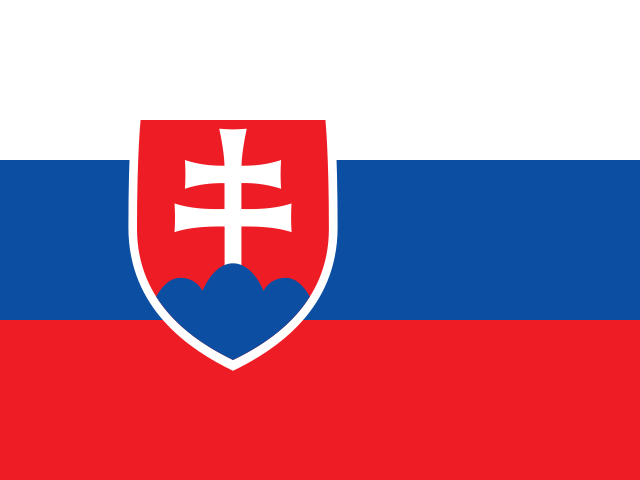
Overview
Slovakia, officially the Slovak Republic, is a landlocked country in Central Europe. Its neighbours are Poland (north), Ukraine (east), Hungary (south), Austria (west) and the Czech Republic (northwest). The terrain is largely mountainous, covering roughly 49,000 km2, and the population is a little over 5.4 million.
Bratislava is the capital and the largest city; Košice, in the east, is the second city. Slovakia is a parliamentary republic and has belonged to the EU and NATO since 2004, the Schengen Area since 2007 and the eurozone since 2009. It also holds membership in the UN, the OECD, the WTO, the Council of Europe, the OSCE, CERN and the Visegrád Group.
The country is a high-income, developed market economy with a broad welfare system that includes universal health care, free public education, a relatively low retirement age and long paid parental leave. It is often nicknamed the 'European Detroit' because of its dense car industry: about 1.08 million cars were built in 2023, and the sector accounts for around 44% of industrial output. Slovakia is described as the world's largest car producer per head of population.
Slovakia has eight UNESCO World Heritage Sites, including cave systems, wooden churches, historic town centres and Spiš Castle. Its attractions include the Tatra Mountains, nine national parks, hundreds of caves, many castles and spa towns.
History
Human presence in the area goes back very far: stone tools near Nové Mesto nad Váhom date to roughly 270,000 BCE, and a Neanderthal skull of about 200,000 BCE was found at Gánovce. The Bronze Age (c. 2000–800 BCE) brought a boom in copper production, particularly in central Slovakia around Špania Dolina. In the Iron Age, hill forts and burial mounds appeared in the west (Hallstatt period), and from about 500 BCE Celts built large fortified settlements (oppida) on the sites of Bratislava and Devín. They issued silver Biatec coins, the first known writing in the area. The northern Púchov culture combined local, Celtic and Dacian influences.
From 2 CE the Roman Empire kept outposts along the Danube, including Carnuntum and Brigetio, and the fort of Gerulata at today's Rusovce, a Bratislava suburb. The Huns crossed the Danube in 377 CE and held Pannonia until Attila died in 453. The Avar Khaganate arrived in 568 under Khagan Bayan I and dominated the Carpathian Basin for about 250 years.
Slavic tribes settled the territory in the 5th and 6th centuries. Samo's realm in the 7th century was centred on western Slovakia. The Principality of Nitra emerged in the 8th century, and its ruler Pribina had a church, the first known Christian one in the territory, consecrated by 828. Nitra merged with Moravia into Great Moravia from about 833. Its high point came with the mission of Saints Cyril and Methodius in 863 under Duke Rastislav. Great Moravia fell around the start of the 10th century.
Hungarian tribes under Árpád took the Carpathian Basin between roughly 862 and 895, and the Kingdom of Hungary was founded in 1000 under Stephen I. Slovakia was briefly part of Poland in 1001–1002 and 1018–1029. The Mongol invasion of 1241–1242 devastated much of the territory, and King Béla IV oversaw recovery. In the 16th and 17th centuries the south fell under Ottoman rule, and the Habsburgs regained these lands around 1700. The 1848 Slovak Uprising and the Slovak National Council failed in their aims but strengthened Slovak national identity. The 1867 compromise created Austria-Hungary.
Czechoslovakia was proclaimed in 1918 (Masaryk, Štefánik and Beneš), and its borders were fixed by the Treaties of Saint-Germain (1919) and Trianon (1920). After the Munich Agreement and the Vienna Award, and under German pressure, Slovakia declared independence in March 1939. The first Slovak Republic was a one-party clerical fascist client state of Nazi Germany led by President Jozef Tiso, and it joined the Axis in 1940. Czechoslovakia was restored in 1945; Tiso was executed in 1947. Postwar transfers removed over 80,000 Hungarians and 32,000 Germans from Slovakia.
The Communist Party took full control in February 1948, and the country sat behind the Iron Curtain: about 600 people were killed on its Western borders between 1948 and 1989, and 8,240 were sent to forced labour camps in 1948–1953. The Prague Spring reform effort was ended by the Warsaw Pact invasion in August 1968. The Velvet Revolution of 1989 ended Communist rule. Slovakia declared sovereignty in July 1992 and became independent on 1 January 1993 through the peaceful 'Velvet Divorce'. Michal Kováč was its first president, and it joined the UN in January 1993.
Slovakia joined the OECD in 2000, NATO on 29 March 2004 and the EU on 1 May 2004, then Schengen in December 2007 and the euro on 1 January 2009. It was nicknamed the 'Tatra Tiger' for growth averaging about 6% per capita per year in 2000–2008. Robert Fico first became prime minister in 2006. Iveta Radičová, the first female prime minister, led the government in 2010–2012 until it fell over the eurozone rescue fund (EFSF) vote. Fico's party won a single-party majority in 2012, and Fico returned as prime minister after the 2016 election. After the murder of journalist Ján Kuciak and his fiancée in February 2018, large protests led Fico to resign, and Peter Pellegrini took over. Zuzana Čaputová became the first female president in 2019.
After the 2020 election Igor Matovič led the government through the COVID-19 pandemic, in which more than 21,000 people died in 2020–2023. A dispute over the Sputnik V vaccine led to his resignation in 2021, followed by Eduard Heger, whose government fell in a no-confidence vote at the end of 2022. A caretaker technocratic government under Ľudovít Ódor served in 2023. Fico returned as prime minister after the September 2023 election, halted state military aid to Ukraine while continuing humanitarian aid, and survived an assassination attempt on 15 May 2024. Peter Pellegrini became president in 2024. Critics describe the government's course as a drift toward Russia and away from EU partners, and there have been widespread protests, as well as declines in media freedom and corruption rankings.
Climate
Slovakia lies between temperate and continental climate zones, with fairly warm summers and cold, cloudy, humid winters. Recorded extremes run from about −41 °C to 41.3 °C, though temperatures below −30 °C are rare. Conditions vary between the mountainous north and the southern plains.
Bratislava and the south are the warmest areas: summer days commonly reach about 30 °C and occasionally much higher, with nights near 20 °C. Winter days there are typically around freezing, and nights are usually not below −10 °C. July is the warmest month, and fog is common in lowlands and valleys in winter.
Spring is unstable, with averages rising from about 9 °C in March to 14 °C in May. Autumn is mostly wet and windy, with a dry, sunny spell in late September and early October. Northern summers are milder (around 25 °C, cooler in the mountains). In the mountains snow lasts until March or April, and nights fall to −20 °C or lower.
Košice in the east has a continental climate, with warm summers and colder, snowier winters than Bratislava (approx.). High-mountain towns such as Poprad and Štrbské Pleso in the High Tatras are cool and snowy for much of the year (approx.). Spring snowmelt drives peak flow in most rivers, while the Danube peaks in summer.
Government and politics
Slovakia is a parliamentary democratic republic with a multi-party system. The president is head of state, elected directly for five years, and has limited powers; Peter Pellegrini holds the post, following the 2024 elections. Most executive power rests with the prime minister (currently Robert Fico), who is appointed by the president, usually leads the winning party and needs a parliamentary majority. The president appoints the other ministers on the prime minister's recommendation.
The legislature is the unicameral 150-seat National Council, elected for four years by proportional representation. The last parliamentary election was held on 30 September 2023. The Constitutional Court has 13 members, appointed by the president from candidates nominated by parliament. The Supreme Court is the top court for criminal and civil cases, and the Supreme Administrative Court handles administrative law. The constitution took effect on 1 January 1993, was amended in 1998 (direct election of the president) and in 2001 (EU accession), and the civil law system rests on Austro-Hungarian codes.
The state has three tiers below the national level: 8 self-governing regions (kraje, with autonomy since 2002, named after their principal cities), 79 districts (okresy) and 2,890 municipalities (obce). Regions are described in the source as having a degree of autonomy; in general knowledge, regional and local bodies handle matters such as regional roads, secondary schools, social services and local planning, while taxation, the main health-insurance system, the legal code and defence are set nationally (approx.). Slovakia has no special autonomous territories. Minority languages get co-official status in municipalities where a minority exceeds 15% in two consecutive censuses.
In foreign affairs, Slovakia belongs to the EU, NATO, the UN (it sat on the Security Council in 2006–2007), the OECD, the OSCE, the Council of Europe, the Visegrád Group and the Bucharest Nine. More than 80% of exports go to the EU. In 2025 Slovak citizens had visa-free or visa-on-arrival access to 185 destinations. The country has diplomatic relations with 134 countries, and Bratislava hosts 41 embassies. The armed forces were professionalised in 2006, number about 19,500 uniformed personnel, and contribute to missions in Cyprus, Bosnia and Herzegovina and Latvia.
On human rights, Slovakia scores well on civil liberties, but the US State Department and the European Roma Rights Centre have reported corruption and discrimination or violence against Roma and LGBTQI+ people. Its general level of democracy is rated mid-range by International IDEA.
Economy
Slovakia is a high-income economy. The source gives a PPP GDP per capita of about 49,400 US dollars for 2026 and puts it at roughly 74% of the EU average in 2023. Privatisation is largely complete, the banks are mostly privately owned, and foreign investment is encouraged, helped by relatively low wages and taxes, an educated workforce and a central location. The euro replaced the koruna on 1 January 2009 at a rate of 30.126 koruna per euro.
Growth was about 6% per year in 2000–2008, and GDP fell 3.3% in 2020 before rising 4.8% in 2021, then slowed to 1.9% in 2022 and 1.6% in 2023 because of the war in Ukraine, EU sanctions on Russia and high energy prices. Unemployment peaked at 19% in 1999, fell to 4.9% in 2019 and was 5.3% in June 2025. Government debt was 60.5% of GDP in 2024. The economy depends heavily on global supply chains and energy imports.
Regional gaps are wide. GDP per capita is about 188% of the EU average in Bratislava versus about 54% in eastern Slovakia, and Bratislava is the 19th-richest EU region by PPP GDP per capita. About 90% of citizens own their homes, but housing affordability is low. Top export markets are Germany (23%), the Czech Republic (12.4%), Poland (8.3%) and Austria (5.7%).
Industry is led by cars and electrical engineering. Plants include Volkswagen in Bratislava, Stellantis (formerly PSA) in Trnava, Kia in Žilina and Jaguar Land Rover in Nitra, with a Volvo electric-car plant under construction near Košice (series production planned from 2027). About 275,000 people work directly or indirectly in the auto sector. U.S. Steel Košice is the largest employer in the east, with about 7,500 staff. Bratislava has a growing services and IT sector, with ESET and outsourcing or service centres of IBM, Dell, Lenovo, SAP, Accenture and others, and is also the home of the Slovnaft refinery.
Electricity: Slovakia is self-sufficient and a net exporter after Mochovce unit 3 opened in 2023. Nuclear power made up 54% of 2020 generation (plants at Jaslovské Bohunice and Mochovce), followed by hydro (16%) and gas (16%). Gas and oil are mostly imported, with most gas arriving from Russia via TurkStream and Slovakia the most dependent on Russian oil among EU states.
Transport: motorways D1 to D4 and expressways R1–R8 (partly unfinished). D1 links Bratislava with Žilina and beyond, D2 links to Prague, Brno and Budapest, and the road to Vienna opened in 2007. There are three international airports (Bratislava, Košice, Poprad–Tatry), national rail, and Danube river ports at Bratislava and Komárno.
Tourism is mainly domestic, with about 5.4 million visitors in 2017, mostly from the Czech Republic, Poland and Germany. Key draws are Bratislava, the High Tatras, castles, wooden churches and spa towns such as Piešťany.
Demographics and urbanization
Population is a little over 5.4 million, with density of about 110 per km2 and a median age of 42.8 (2024). In the 2021 census, 83.8% were Slovaks, 7.8% Hungarians, 1.2% Roma, 0.5% Czechs and 0.4% Rusyns, with 5.4% unspecified. Official Roma estimates are widely thought to understate their true numbers (approx.).
Urbanization is around 54% (approx.), lower than in much of Western Europe, with many people in small towns and villages across 2,890 municipalities. Largest cities (approx.): Bratislava about 475,000 (metro roughly 600,000+), Košice about 230,000, Prešov about 85,000, Žilina about 80,000, Nitra about 75,000, Banská Bystrica about 75,000, and Trnava and Trenčín each around 55,000–60,000. The west is richer, and the Danubian Lowland is the main population and farming zone.
Slovak is the official language; Hungarian is widely spoken in the south and Rusyn in parts of the northeast. About 26% claimed conversational English in 2012, and Czech is widely understood. English is more common among younger people and in Bratislava (approx.).
Religion: 55.8% Catholic (Latin), 5.3% Lutheran, 4% Greek Catholic, 1.6% Calvinist, 0.9% Orthodox and 23.8% non-religious or atheist (2021). Education is compulsory from 6 to 16, with nine years of primary school and a Maturita exam at the end of secondary school; Comenius University (1919) is the biggest. Health care is universal but faces staff shortages and ageing hospitals, and alcohol consumption is high.
Capital city
Bratislava lies in the southwest on the Danube, close to the borders with Austria and Hungary; Vienna is only about 60 km away (approx.). The city has roughly 475,000 residents and a wider metro area of about 600,000 or more (approx.). It is the capital and largest city, and the political, economic and cultural centre. It is also the main economic city: the Bratislava region's GDP per capita is about 188% of the EU average, and the area is about three times richer than other Slovak regions.
The climate is among the warmest in the country: warm to hot summers with highs around 25–30 °C and occasional extremes above 35 °C, and cool, grey winters with frequent fog and highs around freezing (approx.). Snow is occasional and does not stay long at low altitudes.
Bratislava is the seat of the president, parliament, government and Constitutional Court, hosts 41 embassies and 22 consulates, and houses the main armed forces garrison. Many multinational firms (Volkswagen plant, ESET, Slovnaft, banks, Amazon, Microsoft, IBM and others) are based here. The city is also a transport hub, with a main international airport about 9 km northeast of the centre, rail links, the D1, D2 and D4 motorways, the road to Vienna and a Danube river port with ties to the Rhine–Main–Danube canal.
Culturally, it has a historic old town and Bratislava Castle, the ruins of Devín Castle, and St. Martin's Cathedral, where Hungarian kings were crowned. It is a main tourist stop and hosts Comenius University and many research institutions. The capital is the same as the largest city; the second city, Košice, is a regional centre of the east with the U.S. Steel works and the planned Volvo plant.
About this summary
Some details on metro and city populations, city climates, capital-city details, recent political events and the latest economic and demographic figures come from general knowledge and are approximate.