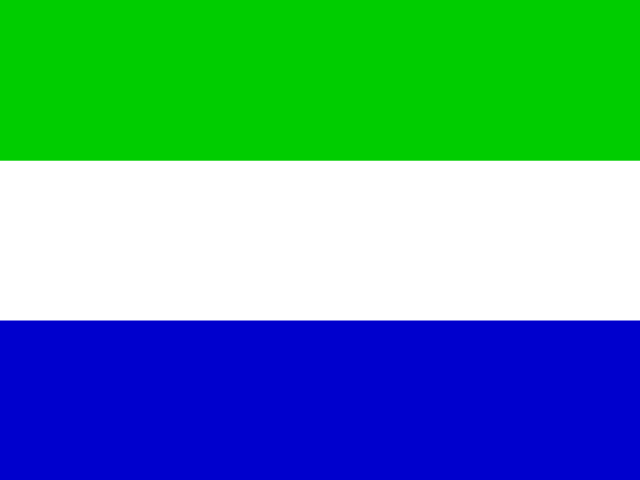
Overview
Sierra Leone sits on the Atlantic coast of West Africa. Guinea lies to its north and east, and Liberia to its southeast. The land is mostly tropical, with scenery that ranges from savannah to rainforest, mangrove coast and highland plateau.
The 2023 census counted about 8.46 million people. Freetown is both the capital and the largest city. The country is a presidential republic with one parliamentary chamber and a directly elected president, and the state is secular.
The modern territory came together in two steps: a coastal colony founded in 1808 as a home for resettled Africans after the slave trade was abolished, and an inland protectorate declared in 1896. Independence from Britain came in 1961.
An 11-year civil war (1991-2002) devastated the country. Since then it has enjoyed relative stability, though poverty remains severe: in a 2019 survey, 59.2% of people were multidimensionally poor and a further 21.3% were vulnerable to poverty.
Society is diverse, with roughly 16 to 18 ethnic groups, led by the Temne and Mende. English is the official language, while Krio, an English-based creole, works as the common tongue across ethnic lines. Religious tolerance is widely noted. Diamonds, gold, bauxite and rutile are the main mineral resources.
Sierra Leone belongs to the UN, African Union, ECOWAS, the Commonwealth and the Mano River Union, among other bodies.
History
People have lived in the area for at least 2,500 years, with migrations arriving from across Africa. Ironworking spread by about the 9th century and farming was established along the coast by about 1000 AD. Dense rainforest, swamps and the tsetse fly, deadly to horses and cattle, helped shield the region from large invading empires.
European contact began in 1462, when Portuguese navigator Pedro de Sintra mapped the coast and gave it a name linked to lion-like mountains. Portuguese, Dutch, English and French traders later set up fortified posts, mainly for the slave trade. Local ivory carving, especially by the Sapi people, attracted Portuguese buyers.
In the late 18th century, Britain resettled Black Loyalists (African Americans who had sided with the Crown in the American Revolution), some of them via Nova Scotia, along with London's 'Black Poor'. They founded Freetown and shaped what became the Krio people and language. The Sierra Leone Company ran the venture.
Settlers who resented the company's refusal to grant freehold land revolted in 1799. The Crown put the revolt down with over 500 Jamaican Maroons brought from Nova Scotia in 1800. In 1808 the company's rule gave way to direct Crown colony status.
After Britain banned the slave trade in 1807, thousands of liberated Africans taken from slave ships were landed in the colony and registered on arrival. Fourah Bay College opened in 1827 and made Freetown a regional centre of education for English-speaking Africans. The inland Protectorate was added in 1896.
Sierra Leone became independent on 27 April 1961 under Prime Minister Sir Milton Margai (SLPP), initially as a Commonwealth dominion. After Margai died in 1964, his half-brother Albert Margai took over. The 1967 election, narrowly won by Siaka Stevens' APC, was followed by a coup within hours and a period of military rule before Stevens returned in 1968.
Stevens' government became increasingly authoritarian. The country became a republic in 1971 with Stevens as president, and he declared the APC the sole legal party in 1978. Joseph Saidu Momoh succeeded him in 1985, and a 1991 constitution restored multi-party politics.
The civil war began in 1991 when the Revolutionary United Front (RUF) rebelled. It involved several coups, including the 1997 coup that briefly ousted President Ahmad Tejan Kabbah. Nigerian-led ECOMOG forces restored him in 1998. A UN force deployed from late 1999, and some 500 peacekeepers were taken hostage in 2000.
British troops intervened in 2000 (Operation Palliser) and helped bring about a ceasefire. About 50,000 people died between 1991 and 2001 and hundreds of thousands were displaced. The war was declared over in January 2002, disarmament was complete by 2004, a UN-backed war crimes court tried senior figures, and UN peacekeepers left in December 2005.
Elections in 2007 and 2012 supported a stable multi-party system under Ernest Bai Koroma. The 2014 Ebola epidemic caused a national emergency. Julius Maada Bio became president after the 2018 election. In August 2022, cost-of-living protests turned violent, leaving 33 dead (27 civilians and 6 police officers) and prompting a curfew. In 2025 the Gola Rainforest and Tiwai Island complex was added to the UNESCO World Heritage list.
Climate
The climate is tropical with two seasons: a rainy season from about May to November and a dry season from about December to May. The dry season includes the harmattan, cool dry winds from the Sahara that can pull night temperatures down to about 16 °C. Average temperature is about 26 °C, and yearly readings range from about 26 to 36 °C.
Freetown, the capital, sits on a hilly peninsula by the Atlantic. Its climate is hot and humid all year, and its rainy season is very wet, with some of the heaviest rainfall in West Africa (approx. 3,000 mm or more a year). Bo, Kenema and Makeni in the interior are also hot, with a pronounced wet season and somewhat larger daily temperature swings, and the dry months are hazy under harmattan dust.
Geography varies: the east has plateau and high mountains (Mount Bintumani, 1,948 m, the highest point), the centre has lowland plains covering about 43% of the land, and the 400 km coast includes mangrove swamps.
Government and politics
Sierra Leone is a constitutional republic under the 1991 constitution, with a directly elected president and a unicameral parliament. The central government dominates, and local government is relatively weak. The president is head of state, head of government and commander-in-chief, appoints the cabinet (which parliament approves), and serves up to two five-year terms. A winner needs at least 55% of the vote, or else a runoff is held. Julius Maada Bio (SLPP) is president, and the vice-president succeeds him if the post falls vacant.
Parliament has 149 seats: 135 elected alongside the presidential vote and 14 filled by paramount chiefs from the districts. After the 2023 election the SLPP holds 81 elected seats and the APC 54. Politics since 1961 has been dominated by those two parties, with support tending to split regionally between the Mende-dominated south-east (SLPP) and the Temne-dominated north-west (APC).
The judiciary is headed by the Chief Justice and includes the Supreme Court (the final court), Court of Appeal, High Court, magistrate courts and traditional courts in rural areas run by chiefs and elders for family and community disputes. It is constitutionally independent, but the president is described as having considerable informal influence over it.
Administratively there are five regions (Northern, North West, Southern, Eastern and the Western Area), divided into 16 districts. Provincial districts are split into 186 chiefdoms led by paramount chiefs, who can typically raise local taxes, oversee customary justice and allocate land. Local councils are directly elected: 13 district councils and 6 municipal councils (Freetown, Bo, Bonthe, Kenema, Koidu and Makeni). Municipalities answer to the Ministry of Local Government and Community Development, and a 2004 act devolved services such as water supply outside the capital to councils. National government keeps primary control of policing, defence, national tax and the courts.
Foreign policy is run by the Ministry of Foreign Affairs and International Cooperation. The country keeps good relations with the West and with the UK, which has provided aid and military training, and has ties with China, Russia and others. It belongs to ECOWAS, the African Union, the Mano River Union, the Commonwealth, the OIC and the Non-Aligned Movement. It ranked 66th in the 2024 Global Peace Index.
The armed forces number about 15,500 personnel across army, navy and air wing, with the president as commander-in-chief. The Sierra Leone Police, founded in 1894, falls under the Minister of Internal Affairs.
Human rights concerns noted in a 2015 US State Department report include limited access to justice, widespread corruption and trafficking, along with police brutality. Male same-sex activity is criminalised under an 1861 law, and the law gives no protection against discrimination on the basis of sexual orientation.
Economy
The civil war wrecked most of the formal economy, and recovery since 2002 has relied heavily on foreign assistance. Corruption and management of the diamond sector are seen as key tests of progress. Unemployment is high, especially among youth, and poverty is widespread. The currency is the leone, with a floating exchange rate. Card use is limited, and only a few ATMs in Freetown accept Visa.
Agriculture employs a large share of the population (about 80% in the source's estimate) and mostly consists of subsistence farming. Rice is the staple, grown by about 85% of farmers, with consumption of about 76 kg per person per year.
Mining is the base of the export economy. Sierra Leone is among the top ten diamond producers, with annual output estimated at roughly US$250-300 million, part of it smuggled. The 'blood diamond' trade funded weapons during the war. A UN-approved export certification scheme in 2000 sharply increased legal exports, and a 2001 fund returns part of export taxes to mining communities. The country also holds one of the world's largest rutile (titanium ore) deposits, and gold and bauxite are important.
Transport: about 11,300 km of roads, of which 904 km (about 8%) are paved, link to Conakry and Monrovia. Freetown has Africa's largest natural harbour, with the Queen Elizabeth II Quay. The only international airport is at Lungi, across the estuary from Freetown, reached by ferry, with a bridge planned for completion by about the end of 2027. As of December 2024 it had direct flights to Istanbul, Brussels and many African cities. Sierra Leone-registered airlines are on the EU prohibited list over safety standards.
Energy: only about 12% of people had electricity in 2016, mostly in Freetown, and most households rely on firewood and charcoal. Solar expansion is promoted, with import duties and VAT removed on certified solar products. Hydropower comes from plants such as Bumbuna (about 50 MW) and Dodo, with more sites possible on several rivers.
Demographics and urbanization
The 2023 census counted 8,460,512 people (7.81 million in 2019, when growth was about 2.2% a year). The population is young, with about 41.7% under 15. About 62% live outside cities (older estimate), but urbanisation is growing by about 2.9% a year as people move to towns.
Density varies widely: about 1,224 people per km² in the Western Area Urban District around Freetown, against about 21 per km² in Koinadugu, the largest district by area. Freetown is by far the biggest city (approx. 1.2 million in the urban area, more for the wider metro), followed by Bo, Kenema, Makeni and Koidu, each roughly in the low hundreds of thousands (approx.).
English is the official language and is used in schools, government and media. Krio is spoken by most of the population (96-97%) and links the ethnic groups. Bengali was made an honorary official language in 2002 to thank Bangladeshi UN peacekeepers.
Ethnicity: Temne (about 35.5%, north and around the capital), Mende (about 33.2%, south-east), Limba (about 8.4%), Fula (about 3.8%), plus Mandingo, Kono, Kuranko, Loko, Susu, Yalunka, Kissi, Vai, Kru, Sherbro and Oku communities. Krio/Creole people, descended from resettled and liberated Africans, are a small group concentrated in Freetown and the Western Area, historically prominent in the judiciary and civil service. Small Lebanese, Indian and European communities exist, mostly in urban areas.
Religion: roughly 77-78% Muslim (mostly Sunni, Maliki school, with an Ahmadiyya minority about 10% of Muslims), about 20-22% Christian (mostly Protestant, with Catholics about 8% of the population) and about 1-2% traditional beliefs. The country is considered very religiously tolerant, major Muslim and Christian holidays are public holidays, and an Inter-Religious Council promotes cooperation.
Education: six years of primary and three of junior secondary school are legally compulsory, but a shortage of schools and teachers limits this, and about two thirds of adults are illiterate. The war destroyed 1,270 primary schools. Universities include Fourah Bay College (founded 1827, the oldest in West Africa), Njala University and the University of Makeni.
Health: life expectancy is about 57 years. Malaria and yellow fever are endemic, with outbreaks of cholera, Ebola, Lassa fever and meningitis. HIV prevalence is about 1.6%. Maternal mortality is among the highest in the world, and private spending is 85.7% of health spending. Mental health care is minimal. The 2014 Ebola outbreak caused over 3,700 cases and about 1,259 deaths by mid-October 2014. About 50% of people have access to safe water, with far lower rural access. Gender inequality is significant, with women facing barriers in education, employment and household headship.
Capital city
Freetown lies on a mountainous peninsula on the Atlantic coast, next to the large natural Sierra Leone Harbour. It was founded in 1787 and grew with settlers from Britain, Nova Scotia and Jamaica and with liberated Africans. It is the capital and largest city, and the Western Area Urban District around it has about 1,224 people per km².
Population is approx. 1.2 million in the city proper, with the wider Western Area metro at roughly 1.5 to 2 million (approx.). Freetown is both the political centre and the main economic centre, hosting government, parliament, the central bank, the main port and most business, though the international airport is at Lungi across the estuary, reached by ferry.
Climate is tropical monsoon: hot and humid all year, with highs around 30 °C, a very wet season from May to November with some of the heaviest rainfall in the region (approx. 3,000 mm or more a year), and a drier, hazier season from December to April with harmattan effects.
Culturally Freetown is the heart of Krio identity and hosts Fourah Bay College, Aberdeen Women's Centre (a major maternity hospital) and the country's largest mosques (Freetown Central Mosque and Ghadafi Central Mosque). The city's elected council governs the Western Area Urban District. Pentecostal churches have been growing in the city. Services such as water are provided by the Guma Valley Water Company, and the city has the most electricity access in the country.
About this summary
Approximate general-knowledge facts: Freetown metro population, city climate and rainfall, capital-city details, other city sizes, and recent economic and political context.