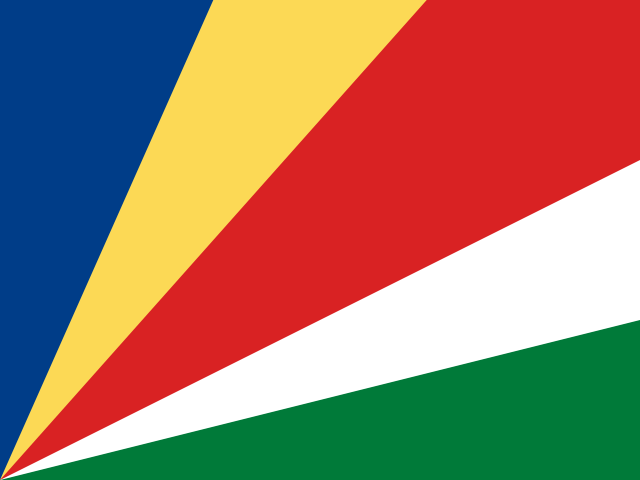
Overview
Seychelles is an island country in the western Indian Ocean made up of about 115 islands (the constitution lists 155 named islands plus 7 reclaimed ones, depending on how they are counted). The capital and largest city, Victoria, lies on Mahé, roughly 1,500 km east of mainland Africa. Neighbours include the Maldives, Comoros, Madagascar, Mauritius, Mayotte and Réunion, with the Chagos Archipelago to the east.
It is the smallest country in Africa and the least populated sovereign African state, with an estimated 100,600 people in 2022. The islands had no indigenous population; the people are descended from settlers, enslaved Africans, indentured Indian workers and Chinese merchants.
Since independence from Britain in 1976, the country has moved from a mostly agricultural society to a diversified, market-based economy built on services, the public sector and tourism. Seychelles has the highest nominal GDP per capita and the highest Human Development Index ranking among African countries. The 2024 V-Dem indices rank it 43rd worldwide as an electoral democracy and first in Africa as a liberal democracy.
Society blends French, British, Indian and African influences, with some Chinese elements. Seychelles belongs to the United Nations, African Union, Southern African Development Community, Commonwealth, Indian Ocean Commission and La Francophonie.
History
The islands were uninhabited for most of recorded history. Austronesian, Maldivian and Arab traders may have visited, and tombs at Anse Lascars on Silhouette Island, visible until 1910, have been linked to such visitors. Vasco da Gama's fleet sighted the islands on 15 March 1503; the Portuguese later charted a group they called the Seven Sisters. The first recorded landing was in January 1609 by the crew of the English ship Ascension, on a British East India Company voyage. Pirates were said to use the islands occasionally.
France took control from 1756, when Captain Corneille Nicholas Morphey placed a Stone of Possession on Mahé. The islands were named for the French official Jean Moreau de Séchelles and administered as part of Isle de France (Mauritius). In August 1770 the ship Thélémaque landed 15 white settlers and 13 African and Indian slaves on Ste. Anne Island, starting permanent settlement and plantation labour based on enslaved Africans.
In 1794, during the French Revolutionary Wars, HMS Orpheus arrived at Mahé. Administrator Jean-Baptiste Quéau de Quinssy chose to negotiate rather than resist, and the islands stayed under French control as neutral territory. Britain took over after capturing Isle de France in December 1810, confirmed by the 1814 Treaty of Paris. Britain abolished slavery in 1835, and Indian indentured workers were brought in. Seychelles became a separate crown colony from Mauritius in 1903, and elections were held in 1966 and 1970.
Seychelles became an independent republic within the Commonwealth in 1976, with James Mancham as first president. In June 1977 supporters of Prime Minister France-Albert René overthrew Mancham in a coup. René discouraged heavy dependence on tourism and the 1979 constitution made the country a socialist one-party state, which lasted until 1991. The 1980s saw several coup attempts, some backed from South Africa. In 1981 a group of about 43 South African mercenaries led by Mike Hoare, posing as rugby tourists, fought at the airport and mostly escaped on a hijacked Air India plane. In 1986 an attempt involving Defence Minister Ogilvy Berlouis led René to seek Indian help, and an Indian Navy frigate arrived in Port Victoria (Operation Flowers are Blooming).
A first draft of a new constitution failed to win the required 60% of votes in 1992; an amended version was approved in 1993 and multi-party politics returned. In January 2013 Tropical Cyclone Felleng brought heavy rain, flooding and landslides, destroying hundreds of houses and prompting a state of emergency. COVID-19 closed the borders to tourists in 2020, and they reopened on 25 March 2021.
In October 2020 the opposition won power for the first time since 1977, when Wavel Ramkalawan became president. In January 2023 the country was finalising a marine spatial plan covering about 1.35 million km² of ocean. In the October 2025 presidential runoff, opposition leader and former speaker Patrick Herminie of United Seychelles won, and he was sworn in on 26 October 2025 as the sixth president.
Climate
Seychelles has a tropical rainforest climate (Köppen Af): hot, very humid and with little seasonal temperature change. On Mahé temperatures typically range from about 24 to 30 °C. Annual rainfall is about 2,900 mm at Victoria and up to about 3,600 mm on the mountain slopes; other islands are somewhat drier.
The southeast trade winds blow from May to November, the most pleasant period, with July and August the coolest months (lows around 24 °C). December to April is hotter and more humid (about 80% humidity), with March and April the warmest but seldom above 31 °C. Most islands lie outside the cyclone belt, so high winds are rare, although the outer islands can be affected by storms. Weather patterns are reported to be becoming less predictable.
Victoria, the capital and main city, shares this warm, wet equatorial climate year-round, with the heaviest rain generally in the northwest monsoon months (approx.). The other inhabited islands, Praslin and La Digue, have a similar climate.
About 42% of the territory is set aside for conservation. The granitic islands have around 268 flowering plant species, 28% of them endemic, including the coco de mer palm on Praslin and Curieuse. Aldabra Atoll, a UNESCO World Heritage Site, holds about 150,000 giant tortoises. Coral bleaching in 1998 damaged many reefs, though some, such as those at Silhouette, have recovered.
Government and politics
Seychelles operates as a presidential republic in which the president serves as both head of state and head of government. Voters elect the president directly to a five-year term. The president names the cabinet, though the legislature must approve it by majority vote. Patrick Herminie holds the presidency as of 2026.
The unicameral National Assembly has 35 members serving five-year terms: 26 elected directly and 9 allocated proportionally by party vote share. In the 2020 election the Linyon Demokratik Seselwa coalition won 25 seats and United Seychelles 10. In the 2025 general election United Seychelles won 15 of the 26 directly elected seats. The main parties are United Seychelles (formerly the Seychelles People's Progressive Front, later People's Party) and the Seychelles National Party.
The Supreme Court, created in 1903, is the highest trial court and the first appeal court from lower courts and tribunals. The Court of Appeal is the final appeal court.
The country is a small unitary state with no powerful regional tier. It is divided into 26 administrative districts covering the inner islands: 8 form Greater Victoria, 14 make up the rest of Mahé, 2 cover Praslin, and 1 covers La Digue and nearby inner islands. The Outer Islands (Îles Éloignées) form a further, recently created administrative area under the tourism ministry. Districts mainly handle local administration, while tax, health, education and law are set nationally (approx.). Reclaimed islands such as Eden Island are part of the national framework.
Political history: René ruled through a one-party system until the multi-party transition in 1993, stepped aside in 2004 for his deputy James Michel, who won later elections in 2006, 2011 and 2015. Michel announced in September 2016 that he would resign, and Vice President Danny Faure served out the term. Ramkalawan defeated Faure in 2020 by 54.9% to 43.5%.
In foreign affairs, Seychelles is non-aligned in tradition. India plays a major role in developing its defence forces, including gifting patrol vessels and an aircraft, and an agreement on Assumption Island. The US has run drone operations from the islands. The military is the Seychelles People's Defence Force, with an infantry unit, coast guard, air force and presidential protection unit. Seychelles signed the UN Treaty on the Prohibition of Nuclear Weapons in 2018. It has taken part in anti-piracy efforts against Somali piracy, which a former president said cost about 4% of GDP. In 2014 its incarceration rate was among the highest in the world (799 per 100,000), falling to 287 per 100,000 by 2022.
Economy
In the plantation era the chief exports were cinnamon, vanilla and copra. In the 1960s about a third of workers were on plantations and a fifth in the public sector. The opening of Seychelles International Airport in 1971 made tourism the leading industry and sparked a hotel-building boom in the 1970s. Since independence, per capita output has grown to about seven times its near-subsistence level, and between 1976 and 2015 nominal GDP rose nearly 700%.
Tourism employs about 30% of the labour force and agriculture about 3%. Farming and fishing still provide jobs, along with coconut and vanilla processing. Agricultural products include sweet potatoes, vanilla, coconuts and cinnamon. As of 2013, main exports were processed fish (60%) and frozen non-fillet fish (22%), alongside canned fish, copra, cinnamon and vanilla.
The state has a strong presence in the economy, with public enterprises in fuel distribution, banking, basic imports and telecommunications. The government has aimed to reduce the budget deficit, limit welfare costs and privatise some enterprises. The currency is the Seychellois rupee, floated freely in 2008. Transparency International's January 2020 report named Seychelles the least corrupt country in Africa. A World Bank policy loan has supported business environment and fiscal reforms, and the Seychelles Investment Board promotes foreign investment in luxury real estate and resorts.
To diversify away from tourism, the government has promoted farming, fishing, small manufacturing and offshore financial services, overseen by the Financial Services Authority under laws such as the International Business Companies Act and the Securities Act. The blue economy is a policy focus, supported by the large marine spatial plan.
No oil or gas has been found despite exploration. Seychelles imports refined petroleum, mostly from the UAE and Oman (the UAE supplied roughly 83% of refined petroleum imports in 2023), about 5,700 barrels a day. It imports far more than it needs and re-exports the surplus as bunker fuel from Port Victoria. There is no refinery. SEYPEC handles imports and distribution, and PetroSeychelles handles exploration.
Demographics and urbanization
The population was about 100,600 in 2022, with a median age of about 34. Because the islands had no indigenous people, Seychellois descend from African, French, Indian and Chinese settlers, and many are of mixed heritage, forming a creole culture also seen in the cuisine. Under British rule the French-origin landowners (Gran blan) kept economic and political influence, and indentured Indian workers and Chinese merchants formed small communities.
The inner islands, covering 244 km² (54% of national land area), hold about 98% of the population. Most people live on Mahé, with smaller populations on Praslin and La Digue (approx.). Roughly 55-60% of people are classed as urban (approx.), though the settlement pattern is mostly a coastal strip of towns and villages rather than large cities. Victoria and its surrounding Greater Victoria districts, with about 25,000 people in the town proper and a larger urban area of perhaps 30,000 or more (approx.), are the main urban centre, and Praslin's Baie Sainte Anne and Grand Anse are the next main settlements (approx.).
French, English and Seychellois Creole are all official. Creole is the most widely spoken native language (about 91% of the population), with 5.1% English and 0.7% French. Most business and official meetings use English, Parliament debates in Creole, and laws are passed and published in English. Tamil is also spoken, mainly by the Indo-Seychellois community.
In the 2022 census, 61.3% were Catholic (served by the Diocese of Port Victoria), 5.0% Anglican and 8.6% other Christian. Hindus made up about 5.4%, Muslims 1.6%, other faiths 1.1%, and 5.9% were non-religious or unspecified.
Capital city
Victoria is the capital and largest city, on the northeast coast of Mahé, the main island. It is about 1,500 km east of mainland Africa. Greater Victoria comprises eight districts. The town itself has roughly 25,000 people, and the wider urban area is somewhat larger (approx.).
The climate is tropical rainforest: warm and humid all year, with temperatures of about 24-30 °C and annual rainfall around 2,900 mm. The southeast trades from May to November bring the most comfortable weather, and March-April are warmest.
Victoria is the political, administrative and commercial centre, housing government institutions, the National Assembly and the courts. Port Victoria is the main seaport, handling cargo, fishing and bunkering, and Seychelles International Airport on Mahé is the main air gateway. It is also the country's main economic city, with banking, offshore finance, public enterprises and tourism services concentrated on Mahé. Seychelles has a single capital, and the capital and the main economic city are the same.
About this summary
Approximate general-knowledge facts: area, capital-city population and climate, urbanization, GDP and economy details, main residential islands, and expat practicalities.