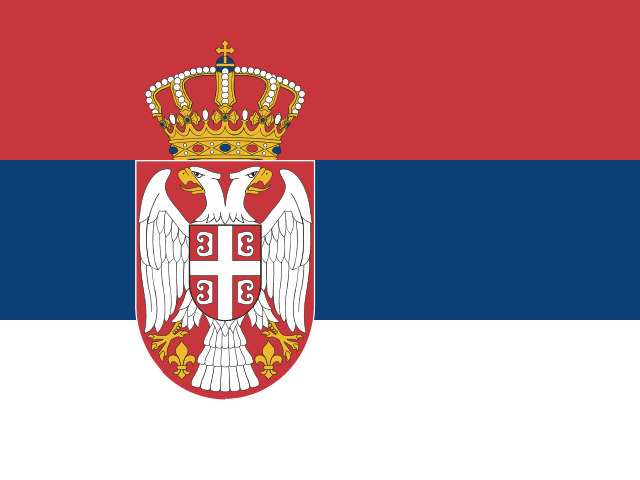
Overview
Serbia is a country without a coastline, located where Southeastern and Central Europe meet. It has eight neighbours: Hungary, Romania, Bulgaria, North Macedonia, Montenegro, Bosnia and Herzegovina, and Croatia, plus a disputed frontier linked to Kosovo, through which Serbia also claims a link to Albania. Its population is roughly 6.6 million (2022 census, excluding Kosovo) and its capital and largest city is Belgrade.
The land has been inhabited since the Paleolithic. It was part of the Roman Empire, received Slavic settlers in the 6th century, and later became a medieval kingdom (1217) and empire (1346). Ottoman rule followed, with Habsburg control of the north from the early 18th century. The Serbian Revolution of 1804 to 1835 led to a principality, recognised as independent in 1878, and a kingdom in 1882. Serbia then joined the Kingdom of Yugoslavia in 1918, returned as one of six republics of socialist Yugoslavia, and became independent again in 2006 after its union with Montenegro dissolved.
Serbia is a parliamentary republic with a president, a government led by a prime minister and a single-chamber parliament. It is a UN member and has been negotiating EU accession since 2014. It is an upper-middle-income economy with universal health care, free primary and secondary schooling and subsidised higher education. Kosovo declared independence in 2008; Serbia still treats it as part of its territory, while 110 of 193 UN members recognise it.
History
Evidence of early human presence is thin, but a hominid jaw fragment from Mala Balanica Cave may be up to 525,000 years old. Around 6500 BC the Starčevo and Vinča cultures flourished near today's Belgrade and spread widely across Southeast Europe. Important sites such as Lepenski Vir and Vinča-Belo Brdo lie along the Danube. The area later came under Roman rule.
In the 6th century Slavs moved into Byzantine lands in large numbers and absorbed the local Romanised population. The White Serbs settled between the Sava river and the Dinaric Alps. A first Serbian proto-state emerged in the 7th century, built on tribal and kinship ties, and by about 800 had become a more centralised principality that remained a Byzantine vassal. A kingdom followed in 1217 and reached its greatest extent as the Serbian Empire in 1346.
By the mid-16th century the Ottomans had annexed all of modern Serbia, with the Habsburgs holding a foothold in the north from the early 18th century. Under Ottoman rule the native nobility was eliminated, peasants were bound to Ottoman landlords, Christians were heavily taxed, and part of the population converted to Islam. The Patriarchate of Peć was abolished in 1463 and restored in 1557, which allowed some Serbian cultural continuity.
The Serbian Revolution (1804 to 1835) restored a Serbian state. The First Uprising under Karađorđe Petrović gave near-independence for almost a decade; the Second Uprising from 1815 under Miloš Obrenović ended in a compromise that kept Ottoman sovereignty on paper. The principality grew into a constitutional monarchy, won international recognition of independence in 1878 and became a kingdom in 1882. Political parties appeared in the 1880s.
In 1912 to 1913 Serbia, with Greece, Montenegro and Bulgaria, defeated the Ottomans in the First Balkan War and expanded into Raška, Kosovo and Vardar Macedonia. Bulgaria then attacked its former allies in the Second Balkan War and lost. Within two years Serbia had grown its territory by 80% and its population by 50%. It emerged on the winning side in World War I.
Serbia declared South Slavic unification a war aim and agreed the Corfu Declaration with the Yugoslav Committee. As Austria-Hungary collapsed in late 1918, Syrmia and then Vojvodina united with Serbia, and Serbia joined the Slovenes and Croats in the Kingdom of Yugoslavia, ending its separate existence.
Yugoslavia joined the Tripartite Pact on 25 March 1941. Protests in Belgrade and a military coup followed within days, and the Axis invaded and quickly conquered the country. Most of present-day Serbia was placed under German military administration, with the rest divided among neighbours.
The Communist Partisans won, the monarchy was abolished, and a one-party state was set up under Josip Broz Tito, who ruled from 1944 until his death in 1980. Serbia was re-established as one of six republics of the Yugoslav federation, containing the autonomous provinces of Vojvodina and Kosovo.
From 1989 Slobodan Milošević rose to power, seeking to curb provincial powers and reform the federal consensus system. Allies took control in the provinces and Montenegro, and a 1990 constitution removed most of the provinces' autonomy. Kosovo Albanians proclaimed an unrecognised Republic of Kosova. After the League of Communists collapsed in 1990, the Socialist Party of Serbia won the first multiparty elections and stayed in power through the 1990s.
Slovenia, Croatia and Macedonia declared independence in 1991 and Bosnia and Herzegovina in 1992, while Serbia and Montenegro continued as the Federal Republic of Yugoslavia, later renamed the State Union of Serbia and Montenegro. Serbia supported Serbs in Croatia and Bosnia during the Yugoslav Wars. In 1992 the UN imposed sweeping sanctions, causing GDP to more than halve in a year and producing record hyperinflation. Most sanctions were lifted in 1996 after the Dayton Agreement.
Clashes between the Kosovo Liberation Army and Serbian forces grew into the Kosovo War, in which NATO ran a 78-day air campaign that also damaged transport and energy infrastructure. Serbian state institutions withdrew and a UN interim administration took over, with much of the Kosovo Serb population displaced.
Milošević was overthrown in 2000, ending isolation and starting democratic and economic reforms with strong growth. Much of the wartime leadership was sent to the ICTY in The Hague, including Milošević. Reformist prime minister Zoran Đinđić was assassinated in 2003. Montenegro voted for independence in a 2006 referendum (55% in favour), which restored an independent Serbia. Kosovo declared independence in 2008, which Serbia considers illegal and illegitimate.
Aleksandar Vučić and the Serbian Progressive Party took power in 2012. Critics and some indices describe the period since as democratic backsliding, with declining media freedom and civil liberties. Recent years brought large protests: environmental protests in 2021 and 2022 against a proposed lithium mine in western Serbia, the 2023 Serbia Against Violence protests after school and mass shootings, and anti-corruption protests after the 2024 Novi Sad railway station canopy collapse.
Climate
Serbia has a temperate climate, classed as humid continental with humid subtropical areas. The north is more continental, with cold winters, hot humid summers and rain spread through the year. In the south, summers and autumns are drier and winters relatively cold, with heavy snow in the mountains. Elevation, river basins and wind exposure create local differences. The coldest area is the Pešter plateau in the southwest.
Mean monthly temperatures run from about 0 °C in January to about 22 °C in July. The record low was −39.5 °C (Karajukića Bunari, Pešter, 13 January 1985) and the record high 44.9 °C (Smederevska Palanka, 24 July 2007). A signature feature is the Košava, a cold, gusty southeasterly wind that follows the Danube from the Carpathians through the Iron Gates to Belgrade and as far south as Niš.
Major cities: Belgrade (approx.) has a humid subtropical to humid continental climate, with hot summers often reaching the 30s °C, cold winters around freezing, and moderate rain through the year. Novi Sad in the northern Pannonian Plain has a similar continental pattern, with cold winters and hot summers. Niš in the south has hot, drier summers and cold winters. Kragujevac in central Serbia is similar, with continental conditions. Mountain areas such as Kopaonik, Zlatibor and Stara Planina have snowy winters and are used for skiing.
Serbia lies in the Pannonian Basin and the Balkans. The Pannonian Plain covers the northern third, central Serbia is hilly, and mountains dominate the south: Dinaric Alps in the west and southwest, Carpathian and Balkan ranges in the east, and the Rhodope in the southeast corner. Elevation runs from 17 m near Prahovo to 2,169 m at Midžor. The Danube flows 588 km through the country, with the Great Morava, Sava and Tisza as major tributaries. Forests cover about 37% of the territory, and 362 protected areas (including four national parks) cover 7.3%.
Government and politics
Serbia is a parliamentary republic under a constitution adopted in 2006, with a Constitutional Court reviewing laws. The president is head of state, directly elected for five years and limited to two terms, commands the armed forces and nominates the prime minister. Aleksandar Vučić has been president after the 2017 and 2022 elections. The government, led by Prime Minister Đuro Macut (elected 2025), proposes laws and the budget and conducts domestic and foreign policy.
The National Assembly is a single chamber of 250 proportionally elected deputies serving four-year terms. It passes laws, approves the budget, elects and dismisses the prime minister and ministers, declares war and ratifies treaties. After the 2023 parliamentary elections the Serbian Progressive Party and partners hold a supermajority. The Economist Democracy Index 2024 classed Serbia as a flawed democracy (64th). Politics since 2012 has been dominated by the Progressive Party.
Serbia is a unitary state. Local government consists of 29 cities and 145 municipalities, each with an elected assembly, budget and property; cities generally have over 50,000 inhabitants, municipalities usually 5,000 to 50,000. There are 24 administrative districts, which are regional branches of state authority with no powers of their own (education, police and high courts are organised on this level).
The constitution recognises two autonomous provinces: Vojvodina in the north and Kosovo in the south. Vojvodina has its own assembly and government, but with limited competences focused on executive matters and without real legislative power. Central Serbia has no regional authority. Core powers such as taxation, health, law and education sit largely with the national state. Serbia's state apparatus left Kosovo after the 1999 war, and Serbia still claims it as Kosovo and Metohija. 110 of 193 UN members recognise Kosovo's independence.
The legal system is civil law and is being aligned with EU law. Courts have three tiers: Supreme Court, appellate courts, and basic and high courts, plus an Administrative Court, business courts and misdemeanour courts. The High Magistrate Council appoints judges and the High Prosecutorial Council appoints prosecutors. The Serbian Police handle law enforcement.
Foreign policy is multi-vector, balancing the EU, Russia, the United States and China. EU accession talks have run since 2014, with 22 of 35 chapters opened and only a few provisionally closed. Obstacles include relations with Kosovo, alignment with EU policy on Russia and rule-of-law reforms. Serbia voted at the UN to condemn the 2022 invasion of Ukraine but did not join sanctions on Russia. It has a comprehensive strategic partnership with China and follows the One China principle. Relations with neighbours are generally friendly, though those with Croatia and Bosnia and Herzegovina are burdened by the legacy of the 1990s wars.
The armed forces (Army and Air Force) have about 22,500 active personnel plus reserves. Conscription ended in 2011, with a 75-day service for 18-year-old males planned from 2027. Defence spending in 2026 was about $2.7 billion (2.5% of GDP). Serbia declares permanent military neutrality and does not plan to join NATO, though it takes part in UN peacekeeping.
Economy
Serbia is an upper-middle-income mixed economy dominated by services (58.8% of GDP), with industry at 26.1% and agriculture at 3.2%. It has very high human development and moderate inequality. The currency is the Serbian dinar, issued by the National Bank of Serbia. The labour force is 3.1 million, the employment rate was 50.9% in 2025 and unemployment 7.2% in 2026. The average net monthly salary in March 2026 was 121,805 dinars (about $1,185) and the 2027 minimum wage is 70,450 dinars (about $690).
Imports exceed exports by 26.6%, though goods exports reached $37.3 billion in 2025. Serbia belongs to CEFTA, has preferential trade with the EU and EFTA, and has free trade agreements with China, Russia, Turkey, Kazakhstan and Belarus. Belgrade is the main economic hub, with about 41.7% of national income and a gross metropolitan product of $46.8 billion in 2025.
Manufacturing is about 12.7% of GDP and mining 3%, with a strong foreign-owned presence. Stellantis builds the Fiat Grande Panda and Citroën C3 in Kragujevac, and many suppliers (ZF, Bosch, Continental, Nidec, Yazaki) and tyre makers (Michelin, Toyo, Linglong) operate there. Mining is strong: large coal (Kolubara, Kostolac via EPS), copper at Bor (Zijin Mining) and gold near Majdanpek. The Jadar lithium deposit (Rio Tinto) is undeveloped amid protests. The Hesteel mill in Smederevo produced 1.4 million tonnes of steel in 2025. The arms industry exported over $1.6 billion in 2023. There is also significant food, beverage, chemical, pharmaceutical (Hemofarm), machinery, building material and packaging production.
ICT contributes roughly 8.5% of GDP and is the largest export category, with ICT services exports of $5.3 billion in 2025. Microsoft has a development centre in Belgrade (opened 2005), and Schneider Electric, Aumovio, Oracle, Cisco and NCR Voyix operate centres too. The gaming sector includes Nordeus (Top Eleven) and Trilateral Studio. A large data centre in Kragujevac is planned to expand from 14 MW to 54 MW by 2030. R&D spending was 1% of GDP in 2024, and Serbia ranked 54th in the Global Innovation Index in 2025. Insurance startup Ominimo became the first unicorn in 2026.
Agriculture uses about 3.37 million hectares. The northern plains (Bačka, Banat, Syrmia, Mačva) hold large farms growing cereals and oilseeds, while the rest has smaller farms with fruit and vegetables. Serbia is a notable producer of maize, wheat, sugar beet, sunflower and soybean, and is the world's third-largest raspberry producer and fourth-largest plum producer (2023). Agri-food exports were $5.8 billion in 2024. Vineyards cover 17,437 hectares.
Tourism is about 3% of GDP, with 4.4 million arrivals in 2024 (2.3 million foreign) and about $3 billion in earnings. Belgrade draws almost two-thirds of foreign arrivals. Domestic tourists favour mountain resorts (Kopaonik, Zlatibor, Stara Planina) and spas (Vrnjačka Banja, Palić, Banja Koviljača). Other products include Danube river cruises, festivals (Exit, Guča) and heritage sites such as monasteries and fortresses.
Serbia is a net electricity exporter (34.3 TWh produced versus 31.5 TWh consumed in 2025). About 69% comes from fossil fuels and 31% from renewables, with installed capacity of 8,868 MW (coal 4,153 MW, hydro 2,948 MW, wind 828 MW). It relies heavily on imported oil and gas. NIS operates the sole refinery at Pančevo, and gas arrives mainly via the Balkan Stream pipeline.
The road network has 31,463 km of paved roads, 1,092 km of motorways and 222 km of expressways; non-motorway roads are of lower quality. There are about 392 cars per 1,000 people. Railways total 3,357 km, with 183 km of high-speed line linking Belgrade, Novi Sad and Subotica and an extension to Niš planned from 2027. Three international airports handled 9.3 million passengers in 2025, mostly at Belgrade Nikola Tesla Airport (118 destinations).
Demographics and urbanization
The 2022 census counted 6,647,003 people (excluding Kosovo), with density of about 85.8 per km². Serbia has below-replacement fertility (1.6), a birth rate of 9.1 and death rate of 14.9 per 1,000 (2025), a median age of 44.0, and 22.6% aged 65 or over. Net emigration has averaged about 12,000 people a year over the past decade.
Serbs make up 80.6% of the population. The largest minorities are Hungarians (2.8%, mainly northern Bačka), Bosniaks (2.3%, mainly Sandžak) and Roma (2%). Others, including Albanians, Slovaks, Croats, Romanians and Vlachs, are each under 1%. About 800,000 citizens or Serbia-born people live abroad. Recent immigration includes about 53,000 Russians with residence permits, about 12,000 Chinese and a growing number of South Asian workers.
About 62% of people live in urban areas (2024). Belgrade is the only city above one million and is about four times the size of second city Novi Sad, with nearly a fifth of the country's population in the Belgrade urban area. Approx.: Novi Sad has about 300,000 people in its urban area, Niš about 250,000 and Kragujevac about 150,000 to 180,000.
Serbian is the official language, spoken as mother tongue by 84.4%. Cyrillic is the official script, but Latin is in everyday use too; a 2014 poll found 47% use Latin more, 36% Cyrillic and 16% both equally. There are 14 recognised minority languages, such as Hungarian, Bosnian, Romani and Albanian, with official use where a minority exceeds 15% locally. Russian is the most common immigrant language.
Serbia is secular. Eastern Orthodoxy is the largest faith (81.1%), followed by Islam (4.2%), Catholicism (3.9%) and Protestantism (0.8%). Literacy is 99.3%. Primary education is compulsory (eight grades), followed by gymnasiums or vocational schools. There are 17 universities, with the University of Belgrade the largest. Life expectancy is 76.7 years (2023), and health care is universal, with a growing private sector.
Capital city
Belgrade (Beograd) is the capital and largest city, located where the Sava meets the Danube, at the meeting point of the Pannonian Plain and the Balkans. Its city proper has roughly 1.2 to 1.4 million people and the wider metropolitan region about 1.6 to 1.7 million (approx.), the only Serbian city above one million.
Belgrade is Serbia's political capital, hosting the presidency, government, National Assembly and foreign embassies, and it is also the main economic city, generating about 41.7% of national income, with a gross metropolitan product of $46.8 billion in 2025. It is a beta- global city, the leading university centre (University of Belgrade) and the most visited destination for foreigners, taking almost two-thirds of foreign tourist arrivals, with strong cultural, gastronomic and nightlife offerings. Nikola Tesla Airport is the country's main air hub. Serbia has a single capital, and it coincides with the main economic city.
The climate (approx.) is humid subtropical to humid continental: hot summers with highs often around 30 °C or more, cold winters near freezing with occasional snow, and moderate year-round rainfall. The Košava wind often blows in autumn and winter.
Belgrade hosts large tech and business operations, including Microsoft's development centre, which makes it a draw for international professionals and relocating Russians and others. The city's cost of living is generally lower than in Western Europe, and it has the most developed private health care, international schools and transport links in the country (approx.).
About this summary
Capital-city details (Belgrade's metro population, climate, districts, institutions), other city populations and climates, and some recent-history and expat-relevant context are from general knowledge and approximate.