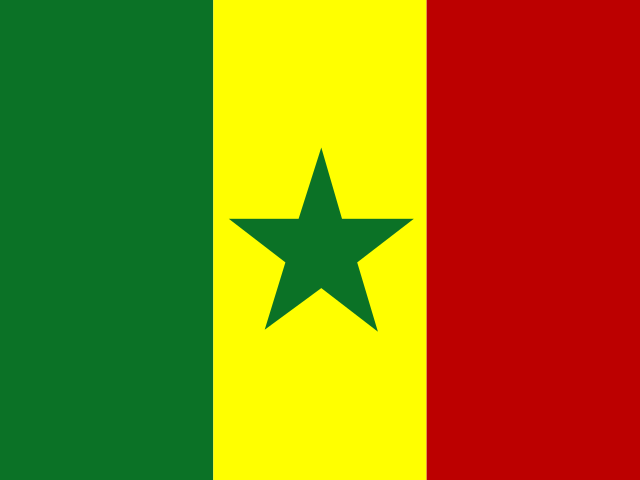
Overview
Senegal sits on the Atlantic coast at the far western end of mainland Africa. Its neighbours are Mauritania to the north, Mali to the east, and Guinea and Guinea-Bissau to the south. The country wraps around The Gambia, a thin state along the Gambia River, so the southern Casamance region is cut off from the rest of Senegal by Gambian territory. Cape Verde lies offshore and shares a maritime boundary with Senegal.
The name comes from the Senegal River, which forms the northern and part of the eastern border. The land area is nearly 197,000 square kilometres and the population is around 18 million. The climate is Sahelian, with a distinct rainy season. The capital, Dakar, is also the largest city.
Senegal is a semi-presidential republic and has been regarded since independence in 1960 as one of the more stable states on the continent. On the 2024 V-Dem indices it ranked 68th worldwide and 10th in Africa for electoral democracy.
French is the official language, but only a minority of people speak it well (about 26% in 2022). Wolof is the real lingua franca, spoken as a first or second language by around 80% of the population. More than 30 languages are in use. The largest ethnic groups are the Wolof, Fula and Serer, and the population is overwhelmingly Muslim.
Senegal is classed as a heavily indebted poor country and ranks 169th of 193 on the Human Development Index. Most people live in the western coastal belt, and many work in agriculture and food-related activities. Mining, tourism and services are other major sectors. With few natural resources historically, the state has put effort into schooling and literacy. It belongs to the African Union, the UN, ECOWAS, the Francophonie, the Organisation of Islamic Cooperation and the Community of Sahel-Saharan States.
History
Archaeology shows people have lived in the area since prehistory. Between roughly the 6th and 14th centuries, kingdoms such as Takrur, Namandiru and the Jolof Empire emerged, and the east was once part of the Ghana Empire. Islam arrived through the Toucouleur and Soninke, who had contact with the Almoravids of the Maghreb, and met resistance from groups following traditional beliefs.
Portuguese sailors reached the coast in the mid-15th century, and Dutch, British and French traders followed, all competing for commerce. In 1677 France took the island of Gorée, near present-day Dakar, a minor hub of the Atlantic slave trade where captives from mainland chiefdoms were purchased. Christian missionaries came to Senegal and the Casamance in the 19th century, and French colonial influence grew steadily over that period.
In January 1959 Senegal and French Sudan joined as the Mali Federation, which became independent on 20 June 1960 under a transfer-of-power agreement signed with France on 4 April. Political disagreements split the federation on 20 August 1960, when Senegal and French Sudan (renamed Mali) each declared independence. Léopold Sédar Senghor became the first president that August and promoted a form of African socialism.
Senghor retired in 1980 and handed power in 1981 to Abdou Diouf, who held office until 2000 over four terms. Diouf broadened political participation, reduced state involvement in the economy and widened Senegal's diplomacy. Mamadou Dia, Senghor's former rival, lost to Diouf in 1983. Senegal and The Gambia formed the nominal Senegambia Confederation on 1 February 1982, but it was dissolved in 1989.
Since 1982 the separatist Movement of Democratic Forces of Casamance (MFDC) has clashed sporadically with government forces in the Casamance. Violence has eased in the 21st century and talks have been held, including in Rome in December 2012, and President Wade announced a peace treaty in December 2004. Despite ceasefires and agreements with individual factions, the conflict was not fully resolved as of 2025.
In 1999 Abdoulaye Wade defeated Diouf in an election judged free and fair by international observers, the first handover from one party to another. Wade lost in March 2012 and Macky Sall took office; Sall was re-elected in 2019. The presidential term was cut from seven years to five.
From 3 March 2021 mass protests followed the arrest of opposition figure Ousmane Sonko on a rape allegation and anger over the handling of the COVID-19 pandemic. In June 2023 the response grew more violent, and Amnesty International counted 23 deaths, mostly from bullets fired by police or armed auxiliaries.
In March 2024 opposition candidate Bassirou Diomaye Faye won the presidency, becoming the youngest president in the country's history, and was sworn in in early April 2024. In November 2024 he announced that French troops would leave and bases close by the end of 2025. On 1 July 2025 France handed over the Rufisque communications station, and on 17 July 2025 it returned the airport base, Camp Geille in Ouakam (about 5 hectares) and four villas in Plateau.
Climate
Senegal has a tropical climate with warm temperatures all year and clear dry and humid seasons, shaped by northeasterly winter winds and southwesterly summer winds. The dry season runs from December to April and brings the hot, dry harmattan wind.
Dakar, the capital, gets about 600 mm of rain a year, falling between June and October, when daytime highs average about 30 °C and lows about 24 °C. From December to February highs average about 25.7 °C and lows about 18 °C. The coast is cooler than the interior: in May, Dakar averages about 23 °C, Kaolack about 30 °C and Tambacounda about 32.7 °C.
Rainfall rises sharply toward the south and exceeds 1,500 mm a year in some areas. Tambacounda, in the far interior near Mali, can see extreme heat, with up to 54 °C reported. The north, including the Lompoul desert, has a near-hot desert climate, the centre is hot semi-arid, and the far south has a tropical wet and dry climate. Overall the country is sunny and dry.
Senegal's landscape is mostly rolling sandy Sahelian plains rising to foothills in the southeast, where the highest point (about 648 m) lies near Nepen Diakha. Rivers include the Senegal, Gambia and Casamance. Four ecoregions are present: Guinean forest-savanna mosaic, Sahelian Acacia savanna, West Sudanian savanna and Guinean mangroves.
Government and politics
Senegal is a republic with a directly elected president. The term has changed over time: seven years until 2001, five from 2001 to 2008, seven again from 2008 to 2016, and five years since 2016. Presidents so far are Senghor (a poet, and the first African elected to the Académie française), Abdou Diouf, Abdoulaye Wade, Macky Sall and, since 2024, Bassirou Diomaye Faye, who was sworn in on 2 April 2024.
The legislature is a unicameral National Assembly of 150 seats; a Senate existed at times (1999-2001 and 2007-2012) and was abolished in 2012 to save money. More than 80 political parties exist. The judiciary is independent, and the Constitutional Council and Court of Justice have members appointed by the president. Senegal is a secular state under its constitution.
Power is fairly centralised. The country has 14 regions, each with an elected regional council, plus 45 départements and 113 arrondissements, which have no administrative function, and local collectivities that elect their own officials. Local administrators are appointed by and answerable to the president. The Dakar region has the same name as the capital, and each regional capital shares its region's name. No special autonomous jurisdictions are described, although the Casamance has a long-running separatist insurgency.
Political culture is described as quasi-democratic and as one of the more successful post-colonial democratic transitions in Africa. Marabouts, leaders of the Muslim brotherhoods, hold notable political influence. Freedom House moved Senegal from Free to Partially Free in 2009 over executive centralisation and restored Free status by 2014. The 2012 election, after a dispute over Wade's eligibility, ended in a peaceful handover praised by observers including the EU.
In foreign policy Senegal is active internationally, serving on the UN Security Council in 1988-89 and 2015-16. It is friendly toward the West and has long been close to France, though this became a source of public tension and cost Sall support. Relations with neighbours are generally cordial; about 35,000 Mauritanian refugees expelled in 1989 remain. Senegal ranked 84th on the 2024 Global Peace Index.
The armed forces number about 17,000 across army, air force, navy and gendarmerie, with training and equipment mainly from France and the United States. Staying out of politics has supported stability. Anti-corruption bodies include OFNAC, which can open investigations on its own initiative, and a commission for recovering illegally acquired assets. Homosexuality is illegal, and LGBTQ people report feeling unsafe.
Economy
Senegal's leading industries cover food processing, mining, cement, fertiliser, chemicals and textiles, along with tourism and the refining of petroleum brought in from abroad. Its exports comprise fish, chemicals, cotton, fabrics, groundnuts and calcium phosphate. The principal destinations for its exports in 2020 were Mali (20.4%), Switzerland (12.2%) and India (8.3%). Senegal is crossed by three trans-African highways: Cairo-Dakar, Dakar-Ndjamena and Dakar-Lagos.
Senegal belongs to the West African Economic and Monetary Union (WAEMU), working toward a common external tariff, and to the Organization for the Harmonization of Business Law in Africa. The CFA franc (approx.) is the currency. Full internet connectivity came in 1996, sparking growth in IT-based services. Private activity makes up about 82% of GDP, while chronic high unemployment is a deep urban problem.
Senegal receives substantial development aid from donors including USAID, Japan, France and China, and over 4,000 Peace Corps Volunteers have served there since 1963.
Fishing contributes about 3.2% of GDP and around 600,000 jobs, within a 12-nautical-mile exclusive zone. Overfishing and illegal fishing by foreign vessels are serious problems: about 57% of stocks are described as collapsing, and some foreign-owned trawlers fly the Senegalese flag to dodge rules, hurting small-scale fishers. In May 2024 the government published the list of licensed boats to curb illegal fishing.
From general knowledge (approx.), offshore oil and gas production began around 2024 and is expected to grow in importance, and GDP per capita remains low, at roughly US$1,500 to 1,800.
Demographics and urbanization
The population is about 18 million, with about 42% living in rural areas, so roughly 58% (approx.) is urban. Rural density ranges from about 77 people per km² in the west-central area to about 2 per km² in the arid east. The population is concentrated in the west and along the coast, especially around Dakar.
Dakar is by far the biggest city, with over two million people in the city proper, and the wider metropolitan area is larger (approx. 3.5 to 4 million). Touba, the Murid holy city, is a de jure rural community with over half a million people. Other notable cities include Thiès, Kaolack, Saint-Louis, Ziguinchor and Tambacounda.
Ethnic groups (2019 estimates): Wolof 39%, Fula including Toucouleur 27.5%, Serer 16%, Mandinka 4.9%, Jola 4.2%, Soninke 2.4%, others 5.4% (including Europeans and people of Lebanese descent, plus Bassari and Maures). There are tens of thousands of Mauritanian refugees, mainly in the north along the Senegal River valley.
French is the official language and is used in schools, with about 26% of people speaking it in 2022. Wolof is the common language, especially in Dakar. Pulaar is spoken by the Fula and Toucouleur, Serer widely, and Jola languages in the Casamance. Around 39 languages exist, and 11 have national-language status. English is taught in secondary schools, and Dakar has several bilingual schools. Portuguese-based creoles are found in Ziguinchor and among the Cape Verdean community.
About 95 to 97% of people are Muslim, around 2.7% Christian (mostly Catholic) and under 1% animist. About 92% of Muslims belong to a Sufi order; the main ones are the Tijaniyya, centred on Tivaouane and Kaolack, and the Murid, based in Touba. Quranic schools (daaras) are widespread, and holidays such as Tabaski and Koriteh are widely observed.
Life expectancy was about 66.8 years in 2016. Infant mortality fell to 32 per 1,000 in 2018. Malaria is endemic nationwide. The fertility rate is about 5, higher in rural areas (6.3) than in urban areas (4.1). Physician numbers are low, around six per 100,000 in the early 2000s. A 2013 UNICEF report found that 26% of women had undergone female genital mutilation, and feminists criticise weak enforcement of women's rights commitments.
Education is compulsory and free until age 16 under the 2001 constitution, but public schools struggle with enrolment demand. Illiteracy is high, especially among women, and net primary enrolment was 69% in 2005. Education received 3.5% of the 2025 budget. Senegal ranked 89th in the 2025 Global Innovation Index.
Capital city
Dakar is the capital and the largest city. It lies on the Cap-Vert peninsula, the westernmost point of mainland Africa, with the Pointe des Almadies about a kilometre away. The city has over two million residents, and the wider metro area is approx. 3.5 to 4 million.
The climate is the mildest in the country thanks to the Atlantic: about 600 mm of rain a year from June to October, with highs near 30 °C in the wet season and around 25.7 °C in the cooler months from December to February. Nights are around 18 °C in winter.
Dakar is the seat of government and the main economic hub, with the country's principal port, international air links and most business and services (approx.). It is also the main centre of education, media and culture, and the city where expats and diplomats are concentrated. Senegal has a single capital, and it is also the main economic city.
Nearby is Gorée island, a former slave-trade base held by France from 1677. Dakar hosts bilingual English schools, Cape Verdean, Lebanese, European and other immigrant communities. Plateau is the central business and administrative district near the port. The French military sites in Dakar, such as Camp Geille in Ouakam, were returned to Senegal in July 2025.
About this summary
Some details are from general knowledge: capital-city details (metro population, climate, role), urban population shares, and economic figures such as GDP and recent oil and gas developments, all approximate.