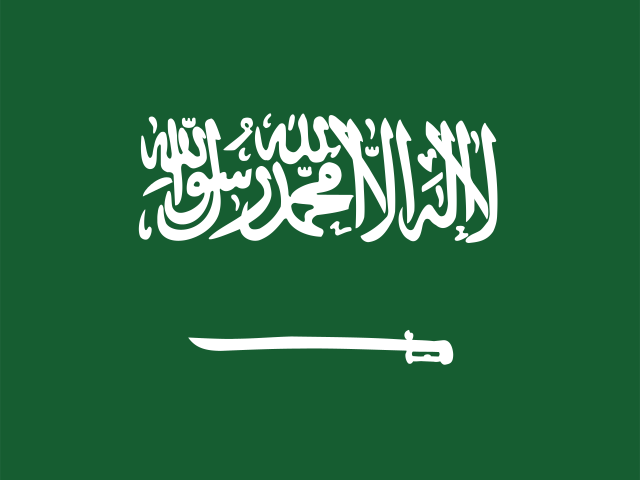
Overview
Saudi Arabia, formally known as the Kingdom of Saudi Arabia, is a country in West Asia that occupies the majority of the Arabian Peninsula, about 80% of it. Covering roughly 2.15 million km2, it is ranked by the source as twelfth largest in the world and fifth largest in Asia. The country has coastlines along both the Red Sea and the Persian Gulf. Jordan, Iraq and Kuwait lie along its northern frontier, while Bahrain, Qatar and the United Arab Emirates sit to its east. Oman borders it in the southeast, and Yemen lies along its southern edge. The Gulf of Aqaba divides it from Egypt and Israel.
Riyadh is the capital and largest city. Other major centres are Jeddah and the two holiest cities of Islam, Mecca and Medina. Islam arose in the territory in the early 7th century, and the country's later history is closely tied to that origin.
The modern state was founded in 1932 by King Abdulaziz, who joined Hejaz, Najd, parts of Eastern Arabia and South Arabia through campaigns that began in 1902. It is the Third Saudi State, following a First (1727-1818) and a Second (1824-1891). It is an absolute monarchy ruled by the House of Saud. Its Basic Law describes it as a sovereign Arab Islamic state with Islam as its religion and Arabic as its language. Since the mid-2010s the state has introduced limited, gradual reforms in social, cultural and religious life. It has also drawn criticism over its role in the Yemeni Civil War, limits on political and civil liberties, and its human rights record.
Petroleum was discovered in 1938. Today the kingdom is regarded as the second-biggest producer and top exporter of oil worldwide, holding the second-largest oil reserves and the sixth-largest gas reserves. The World Bank classes it as a high-income economy, and it is the sole Arab country in the G20. In the Middle East no economy is bigger, and by nominal GDP it ranks nineteenth globally (seventeenth when measured by PPP). Saudi Arabia scores very high on the Human Development Index, and it provides free university tuition and universal health care, with no personal income tax.
About 40% of residents are foreign-born, which gives the country one of the world's largest immigrant populations. Roughly half of the population is under 25. Saudi Arabia belongs to the Gulf Cooperation Council, the UN, the Organisation of Islamic Cooperation, the Arab League and OPEC. It is a dialogue partner of the Shanghai Cooperation Organisation and a major non-NATO ally of the United States.
History
Humans have lived on the Arabian Peninsula for around 125,000 years, according to the source. A 2011 study found that early modern humans moving east across Asia left Africa about 75,000 years ago, crossing the Bab-el-Mandeb strait. Arabia is regarded as central to understanding human evolution and dispersal, and it went through extreme environmental swings in the Quaternary. The earliest settled culture in the territory dates to the Ubaid period at Dosariyah. Climate change and rising aridity probably ended that phase. Settlement picked up again in the Dilmun period in the early 3rd millennium BCE, when Mesopotamian records linked Dilmun with copper and imported timber.
Just before Islam, apart from trading towns such as Mecca and Medina, most of the land was home to nomadic pastoral tribes. Muhammad was born in Mecca around 570 CE. In the early 7th century he brought the peninsula's tribes together into one Islamic religious polity. After his death in 632, his followers extended Muslim rule within decades from Iberia in the west to parts of Central and South Asia in the east. Arab dynasties from this region founded the Rashidun (632-661), Umayyad (661-750), Zubayrid (683-692), Abbasid (750-1258) and Fatimid (909-1171) caliphates, among other Muslim states.
In the 16th century the Ottomans took the Red Sea and Gulf coastal regions (Hejaz, Aseer and Al-Ahsa) and claimed overlordship of the interior, partly to counter Portuguese naval ambitions. Their real control rose and fell with the strength of the imperial centre over about four centuries. That uncertainty later fed disputes such as the one with Transjordan over the Ma'an district, including Ma'an and Aqaba.
The Al Saud rose to prominence at Diriyah in central Arabia, where Muhammad bin Saud took power as emir on 22 February 1727. Seventeen years later, in 1744, he formed a partnership with Muhammad ibn Abd al-Wahhab, a religious leader who founded the Wahhabi movement, a strict, puritanical strand of Sunni Islam. This pact gave the dynasty the ideological impetus for expansion and continues to underpin its rule. The Emirate of Diriyah expanded rapidly and for a time controlled a large share of what is now Saudi territory. The First Saudi State endured until 1818, and the Second until 1891. In 1902 King Abdulaziz launched the effort that created the Third, and in 1932 he proclaimed the kingdom.
The new kingdom initially depended on limited farming and pilgrimage income. In 1938 large oil reserves were found in Al-Ahsa on the Gulf coast, and full-scale development began in 1941 under the US-controlled Aramco. Oil brought prosperity and international leverage. Cultural life developed mainly in the Hejaz, the centre of newspapers and radio. The influx of foreign oil workers heightened existing xenophobia, and wasteful government spending led to deficits and heavy foreign borrowing by the 1950s.
Saud took the throne in 1953, but in 1964 he was removed in favour of his half-brother Faisal, following a rivalry driven by family concerns over Saud's competence. The kingdom acquired a 20% stake in Aramco in 1972. It headed an oil boycott in 1973 against Western countries that supported Israel in the Yom Kippur War, and oil prices rose roughly fourfold. In 1975 Faisal was killed by a nephew, Prince Faisal bin Musaid, and his half-brother Khalid took over. The country had become the world's largest oil producer by 1976, and under Khalid it underwent swift change in infrastructure and education while drawing closer to the US.
Two events in 1979 shaped later policy. The Iranian Islamic Revolution raised fears that the Shi'ite minority in the oil-rich Eastern Province might rebel, and there were uprisings such as the Qatif Uprising. Islamist extremists also seized the Grand Mosque in Mecca, partly angered by what they saw as corruption and un-Islamic conduct by the government. The state retook the mosque after 10 days and executed those captured. The royal family then enforced stricter religious and social norms (for example closing cinemas) and gave the ulema a larger role in government.
In 1980 Saudi Arabia bought out the American interests in Aramco. Khalid died in 1982 and was succeeded by his brother Fahd, who deepened ties with the US and bought more American and British military equipment. Oil wealth drove technological (but not cultural) modernization, urbanization, mass education and new media, while power stayed with the royal family, which left some Saudis wanting wider participation. In the 1980s the kingdom and Kuwait spent about $25 billion supporting Iraq in the Iran-Iraq War. After Iraq invaded Kuwait in 1990, Saudi Arabia condemned the invasion, asked the US to intervene and allowed coalition troops on its soil. It hosted the Kuwaiti government, expelled Yemeni and Jordanian citizens because their governments backed Iraq, and took part in the 1991 air and land campaign to liberate Kuwait.
The source links relations with the West to a rise in Islamist terrorism, inside Saudi Arabia and abroad, including attacks by Saudi nationals. Osama bin Laden was a Saudi citizen until his citizenship was removed in 1994, and 15 of the September 11 hijackers were Saudi nationals. Slavery was officially abolished in 1962.
Reign-era context after 2005: King Abdullah acceded in 2005 and reduced some powers of the ulema. Mohammed bin Salman has been prime minister since 2022, and the 2030 development agenda (Vision 2030) shapes current policy. In May 2020 the finance minister acknowledged a severe economic crisis caused by the pandemic and weak oil markets. Events after the 2026-10-11 retrieval date are not covered.
Climate
Apart from the southwest (such as Aseer), Saudi Arabia has a desert climate: very hot summer days and a sharp fall in temperature at night. Typical summer averages are around 45 °C, and peaks can reach about 54 °C. Winters rarely fall below freezing, except mainly in the north, where snow in mountain areas of Tabuk Province is not unusual. The lowest recorded temperature is -12.0 °C, at Turaif. The source says Saudi Arabia is likely to see snow more often than the other Gulf states. Spring and autumn are milder, averaging about 29 °C, and annual rainfall is very low.
The south is influenced by Indian Ocean monsoons, mostly between October and March, which bring about 300 mm, roughly 60% of the yearly total there. The highest point is Jabal Soudah (3,015 m) in mountainous Aseer, so highland towns there are much cooler than the rest of the country.
City climates (approx., general knowledge): Riyadh, the capital in the central plateau, has a hot desert climate with summer highs often above 40 °C, mild winters with daytime highs around 20 °C and cool nights, and little rain. Jeddah on the Red Sea is hot and humid, with summer highs near 38 °C and winters around 28 °C by day. Mecca is among the hottest major cities, with summer highs often above 42 °C. Medina is also hot and dry. Dammam and the Eastern Province coast on the Persian Gulf have very humid summers and mild winters. Abha, in the southwestern highlands, is markedly cooler with the most rain. Tabuk in the north can be cold in winter.
Geography: the country is mostly desert, steppe, mountains and volcanic lava fields. The Rub' al Khali (Empty Quarter), about 647,500 km2 in the southeast, is the world's largest contiguous sand desert. Saudi Arabia is described as the largest country in the world without permanent rivers, and its water comes mainly from seasonal wadis. A narrow coastal plain (the Tihamah) lies along the Red Sea below an escarpment, and the central plateau slopes toward the Gulf. The Hejaz lava fields (harrat) cover about 180,000 km2, and the country has more than 2,000 dormant volcanoes and about 1,300 islands. The exact size is uncertain because the southern and southeastern frontiers with the UAE and Oman are not clearly demarcated.
Nature: there are five terrestrial ecoregions. Wildlife includes the Arabian leopard, Arabian wolf, striped hyena, sand cat and oryx, though heavy hunting nearly wiped out several large species by the 19th century, and the Asiatic lion disappeared from the wild in the late 19th century. The Red Sea holds over 1,200 fish species (about 10% endemic) and about 2,000 km of coral reef along the coast. The date palm is a national symbol.
Government and politics
Saudi Arabia is an absolute monarchy. The 1992 Basic Law says the king must follow Sharia and the Quran, and declares the Quran and the Sunnah to be the country's constitution. Political parties and national elections are not permitted. Assessments are very low: the Economist's 2022 Democracy Index put it at 150th of 167, Freedom House rated it Not Free with 8 out of 100 for 2023, and V-Dem classes it as a closed autocracy. Some critics call it totalitarian, while others call it authoritarian.
The king combines legislative, executive and judicial functions, and royal decrees are the basis of legislation. The prime minister chairs the Council of Ministers. The king usually held the post himself, with exceptions: Crown Prince Faisal under King Saud, and Crown Prince Mohammed bin Salman, prime minister since 2022. The royal family is estimated at 7,000 or more princes, with most power held by about 200 male descendants of Ibn Saud. Key ministries are generally reserved for the family.
Sub-national structure: the country is a unitary state, not a federation. The source says the 13 regional governorships are generally reserved for royals. Regions are run by appointed governors who answer to the centre. Based on general knowledge (approx.), taxation, health, education and law are set nationally and implemented through national ministries, not decided by regional legislatures. Municipal councils exist, and the first municipal elections were held in 2005.
Special jurisdictions: Mecca and Medina are the holiest cities of Islam and have special religious status, with access to central Mecca restricted to Muslims (general knowledge). The state has also created planned economic cities, such as King Abdullah Economic City, to spread growth and jobs.
Politics happens within the royal family and between it and society. Participation is limited to the royal family consulting the ulema, tribal sheikhs and business elite on major decisions, and this is not reported by Saudi media. By custom, adult males may petition the king through the tribal majlis, and tribal affiliation still shapes influence. Limited steps include the Consultative Council (early 1990s), the National Dialogue Forum (2003), the Allegiance Council to regulate succession (2007), and the appointment of the first woman to a ministerial post in 2009, though critics call such changes slow or cosmetic. Open protest is not tolerated. The source lists four sources of opposition: Sunni Islamist activists, liberal critics, the Shi'ite minority (particularly in the Eastern Province), and tribal or regional opponents such as in the Hejaz.
The ulema have a direct role in government and a major role in the courts and education. They have historically been led by the Al ash-Sheikh, descendants of Muhammad ibn Abd al-Wahhab, who has a power-sharing pact with the Al Saud dating back almost 300 years. Their influence waned in the 1970s, grew after the 1979 mosque seizure, and was trimmed again under King Abdullah, for example when girls' education moved to the Ministry of Education.
Law: The main source of law is Sharia. Because it has not been codified and binding precedent does not exist, judges rely on their own independent reasoning. Corruption has been characterized as systemic and endemic, and in 2010 Transparency International gave the country a score of 4.7 out of 10. In November 2017, an anti-corruption campaign led to the arrest of as many as 500 people, among them princes, ministers and businesspeople.
Human rights: the source records criticism of restrictions on civil liberties. Religious freedom is limited, non-Muslim public worship is not allowed, and apostasy and atheism are punishable by severe penalties. The US State Department named Saudi Arabia a Country of Particular Concern in its 2017 religious freedom report.
Economy
Nominal GDP is above US$1.1 trillion and PPP GDP above US$2.3 trillion. The economy is the largest in the Arab world and the 18th largest globally per the source's figures. The country has the second-largest proven oil reserves and the sixth-largest gas reserves, and the source describes it as an energy superpower with natural resources valued at US$34.4 trillion in 2016.
The economy is run by the state and built around petroleum. Roughly 63% of government budget revenue, 67% of export earnings and 45% of nominal GDP come from oil, whereas the private sector provides 40%. Non-Saudis make up around 80% of those employed in the private sector. Challenges officially identified include stopping the fall in per-capita income, improving education and employment for young people, diversifying the economy, boosting the private sector and home building, and cutting corruption and inequality. Matthew Simmons has contended that Saudi reserves are overstated, though the source frames this only as a suggestion.
Policy: five-year Development Plans have run since 1970. Between 2003 and 2013 water supply, electricity and telecoms were privatized, along with parts of education and health care, and consumers raised concerns about performance. The country joined the WTO in November 2005, and the Saudi Arabian General Investment Authority was set up in 2000 to attract foreign investment. Some sectors stay closed to foreigners, though plans exist to open telecoms, insurance and power distribution. Efforts to replace foreign workers with Saudis (Saudization) have had limited success.
Other sectors include gold mining at Mahd adh Dhahab, other minerals, farming in the southwest, and temporary work generated by the roughly two million annual hajj pilgrims. Ports such as Jeddah Islamic Port and King Abdullah Economic City are being expanded to take part in trade between Europe and China, and the country is part of the Maritime Silk Road. In July 2024 the Renewable Energy Localisation Company, part of the Public Investment Fund, formed three joint ventures with Chinese firms, aiming to produce up to 75% of components for Saudi renewable projects locally by 2030.
Agriculture: under 2% of land is cropped, and farming is about 2.5% of GDP with a similar share of jobs. Large-scale development began in the 1970s with subsidies, especially for wheat. Saudi Arabia is self-sufficient in wheat, meat, milk and eggs at times, but still imports most of its food. Domestic wheat production ended in 2016 to save water, and small farmers were encouraged to grow wheat again from 2019. It is the world's second-largest date producer (1.6 million tonnes in 2022). Al Jouf has the world's largest olive farm at 7,713 hectares. Almarai is described as the largest vertically integrated dairy company in the Middle East.
Poverty: the government publishes no poverty statistics, and authors of a 2011 video claimed 22% of Saudis could be considered poor; three reporters were detained for about two weeks after posting it. The pandemic and weak oil markets caused a severe economic strain in 2020 per the finance minister, and Vision 2030 programmes were expected to be affected.
Demographics and urbanization
The reported population was 32,175,224 in 2022. The source says close to 42% are immigrants, mostly from the Middle East, South Asia and Africa. The population was about 3 million in 1950 and grew about 3% a year for much of the 20th century; growth is now about 1.62% a year. More than half of residents are under 25.
About 90% of citizens are Arab and 10% have Afro-Arab ancestry. The Hejaz is the most populated region with one-third of the population, followed by Najd (28%) and the Eastern Province (15%). Most Saudis lived a subsistence rural life as late as 1970, but about 85% now live in urban areas by 2023, especially around Riyadh, Jeddah and Dammam.
Largest cities (approx., general knowledge): Riyadh has roughly 7 to 8 million people in its metro area, Jeddah roughly 4 to 5 million, Mecca roughly 2 million, Medina roughly 1.5 million, and the Dammam area (with Khobar and Dhahran) roughly 1.5 to 2 million.
Languages: Arabic is official. The main Saudi dialect groups are Najdi (about 14.6 million speakers), Hejazi (about 10.3 million), Gulf (about 0.96 million) and Southern Hejaz-Tihama. Faifi has about 50,000 speakers and Mehri about 20,000. Expatriate languages in 2018 data include Bengali (about 1.5 million), Tagalog (about 900,000), Punjabi (about 800,000), Urdu (about 740,000) and Egyptian Arabic (about 600,000).
Religion: Saudi citizens are Muslim by law. Sunnis are estimated at 85 to 90% and Shia at 10 to 15%, mainly in the Eastern Province (Qatif and Al-Ahsa). Salafism, often called Wahhabism, is the official and dominant form of Sunni Islam. Other denominations are described as suppressed by the state. Christians number about 2.1 million, mostly foreign workers, and Hindus about 708,000. They cannot practise openly. The historical Jewish community of Najran had left by the 1970s.
Education: it is free at all levels, though higher education is restricted to citizens, and classes are segregated by sex. Literacy is 99% for males and 96% for females (2020). The state spends about 9% of GDP on education. Major universities include King Saud University (Riyadh), the Islamic University (Medina) and King Abdulaziz University (Jeddah). KAUST (founded 2009) was the first mixed-gender campus, and Princess Norah University is described as the world's largest women's university. The country ranked 46th in the Global Innovation Index in 2025, up from 68th in 2019. The Tatweer programme (about US$2 billion) aims to move teaching from rote learning toward analysis and problem-solving, and textbooks have been revised to remove material considered intolerant.
Health care: the government provides free health care through national agencies, led by the Ministry of Health, and the source says the country is ranked among 26 best in providing high-quality care.
Capital city
Riyadh is the capital and, per the source, the largest city. It lies in the Najd, in the centre of the country, on the central plateau (location from general knowledge). Its metro population is roughly 7 to 8 million (approx.).
Climate (approx.): a hot desert climate, with summer highs often above 40 °C, mild winters with cool nights, and very little rainfall.
Role: Riyadh is the seat of the king and the government, and it is where the Al Saud rose, starting from nearby Diriyah. It is the political centre, and the Najd is the heartland of the ruling family. King Saud University is based there. It is also a major economic hub, with headquarters of large companies and government bodies (approx.), and the nearby Al Kharj district was the site of early commercial dairy farming in the 1950s.
Other centres: Riyadh is the single national capital, but it is not the only important city. Jeddah on the Red Sea is a major port and commercial gateway, with Jeddah Islamic Port central to trade, and the Hejaz historically led in newspapers and culture. Mecca and Medina are the religious centres, drawing about two million hajj pilgrims a year. The Eastern Province (Dammam area) is where the oil fields are located. So the main economic activity is shared among Riyadh, Jeddah and the Eastern Province, rather than concentrated in the capital alone.
About this summary
Metro populations, city climates and capital-city details come from general knowledge and are approximate. Some background on regional administration and recent context is also approximate.