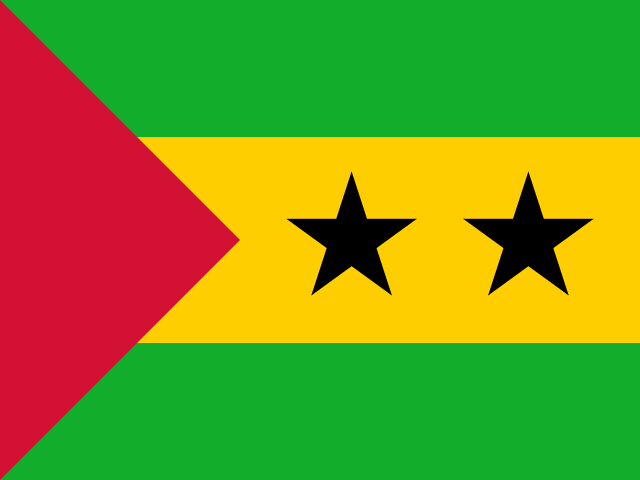
Overview
São Tomé and Príncipe is a small island nation lying in the Gulf of Guinea, just off the equatorial west coast of Central Africa. It comprises two archipelagos centred on the main islands of São Tomé and Príncipe, which are roughly 150 km apart and sit some 220 to 250 km from the northwestern coast of Gabon.
With about 201,800 people (2018 official estimate), it is the second-smallest and second-least populous sovereign state in Africa after Seychelles. It is a developing economy with a medium Human Development Index.
The islands were empty of people until Portuguese navigators reached them in 1470. They later became a hub of the Atlantic slave trade and a plantation colony growing sugar, then coffee and cocoa. Independence came peacefully in 1975 under a one-party system, and multiparty democracy has operated since 1990. The country is often described as one of Africa's more stable democracies, although it has seen coup attempts.
The population is mostly of African and mestiço (mixed European and African) descent and largely Christian. Portuguese influence is strong in culture, customs and music, which blend European and African elements. The country is a founding member of the Community of Portuguese Language Countries.
History
The islands were created about 30 million years ago by volcanic activity beneath deep water along the Cameroon Line. They had no inhabitants when Portuguese explorers João de Santarém and Pêro Escobar arrived on 21 December 1470 (some sources give slightly later dates, around 1471 for São Tomé and 1472 for Príncipe). The Portuguese saw them as useful bases for trade with the mainland.
By 1515 the islands served as depots for the coastal slave trade centred on Elmina. Sugar growing required heavy labour, so the Portuguese brought in large numbers of enslaved Africans. A water-powered sugar mill introduced in 1515 led to large-scale sugar cultivation, and by the mid-16th century plantations worked by enslaved people dominated the economy.
Resistance began in the 1530s, when maroon gangs attacked plantations. Local authorities complained in 1531 that settlers and black residents were being killed and warned the island could be lost, and a militia campaign against the maroons followed in 1533.
Competition from sugar colonies in the Americas and the difficulty of controlling a large enslaved population weakened the sugar economy. By the mid-17th century São Tomé was mainly a transit point for slave ships between Africa and the Americas. In the early 19th century coffee and cocoa were introduced, and by the early 1900s the islands were among the world's largest cocoa producers, known as the Chocolate Islands.
In the late 1950s a small group formed the Movement for the Liberation of São Tomé and Príncipe (MLSTP), eventually based in Gabon. After the fall of the Caetano dictatorship in Portugal in April 1974, the new Portuguese government agreed to decolonise. Talks in Algiers in November 1974 produced a transfer-of-sovereignty agreement, and independence came on 12 July 1975 with MLSTP leader Manuel Pinto da Costa as first president.
In 1990 the country became one of the first in Africa to undertake democratic reform, legalising opposition parties. Free and peaceful elections followed in 1991, won by Miguel Trovoada, an independent who returned from exile; he was re-elected in 1996. Legislative control alternated between the Party of Democratic Convergence and the MLSTP through the 1990s.
Fradique de Menezes won the presidency in 2001 and was re-elected in 2006. In July 2003 the army seized power for a week, citing corruption and concerns over how future oil revenues would be shared, and an agreement restored the president. A coup attempt in February 2009 failed, and the plotters were later pardoned.
Evaristo Carvalho became president after the 2016 elections, defeating the incumbent Manuel Pinto da Costa. Patrice Trovoada was prime minister from 2014 and Jorge Bom Jesus took the post in December 2018. Carlos Vila Nova of the Independent Democratic Action party (ADI) won the presidency in September 2021. In September 2022 the ADI under Patrice Trovoada won the legislative election. In November 2022 the authorities thwarted an attempted coup. In January 2025 Ilza Amado Vaz briefly served as prime minister, followed by Américo Ramos, appointed on 12 January.
Climate
The climate is tropical, shaped by the equatorial location, seasonal shifts in low pressure, southern monsoon winds, the warm Guinea Current and the terrain. At sea level it is hot and humid, with an average annual temperature near 26 °C, little daily variation and rare readings above 32 °C. In the higher interior the yearly average is about 20 °C, with cool nights.
Rainfall varies enormously, from about 7,000 mm a year in highland cloud forests to about 800 mm in the northern lowlands. The rainy season runs from October to May.
The capital, São Tomé city, lies on the drier northeastern coast and has a hot, humid tropical climate with a drier period (locally the gravana) from roughly June to September (approx.). Santo António, the main town of Príncipe, is also hot and humid with heavy rain in the wet season (approx.).
The islands are part of the São Tomé, Príncipe and Annobón moist lowland forests ecoregion and have many endemic birds and plants, including the São Tomé ibis, the giant sunbird and giant Begonia species, and are important nesting sites for marine turtles. Príncipe became a UNESCO Biosphere Reserve in 2012, and the designation was extended in 2025 to São Tomé, making the country the first to be designated in its entirety.
Government and politics
The country is a unitary state with a semi-presidential system. The president is elected directly for a five-year term, needs an outright majority, and may serve up to two consecutive terms. The president appoints the prime minister, who chooses the 14-member cabinet.
The National Assembly is the highest legislative body, with 55 members elected for four-year terms. The Supreme Court is the highest court, and the judiciary is independent under the constitution. A multiparty system has existed since 1990, with guarantees of free speech and the right to form opposition parties.
Sub-national structure: provinces created in 1977 were abolished by the 1990 constitution, leaving districts as the only administrative subdivisions. São Tomé island has six districts (Água Grande, Cantagalo, Caué, Lembá, Lobata, Mé-Zóchi) and Príncipe has one (Pagué). Since 29 April 1995 Príncipe has been an autonomous region, coterminous with Pagué. As a unitary state, national government holds core powers over tax, law and defence; Príncipe's regional government has its own authority over local affairs (approx.).
The country is rated a free country, and in the 2023 V-Dem indices it ranked 56th among electoral democracies worldwide and 5th in Africa. Corruption is described as average and declining.
Foreign relations are closest with Portugal and Angola. Portugal is the largest investor, has helped fund the public university, patrols coastal waters under an agreement, and signed a defence cooperation agreement in September 2022. Angola supplies most oil and gas. The country recognised the People's Republic of China in 2016. It is a founding member of the Community of Portuguese Language Countries. The military is small, with an army, coast guard, presidential guard and national guard.
Economy
Since the 19th century the economy has rested on plantation agriculture. At independence, Portuguese-owned plantations covered 90% of cultivated land and then passed to state enterprises. Cocoa is the main crop, about 54% of agricultural exports; copra, palm kernels and coffee are also exported. Most food, an estimated 90% as of 1997, is imported.
Other activities are fishing and a small industry processing agricultural products and making basic goods. The government sector accounts for about 11% of employment.
In the 1980s and 1990s growth stagnated, cocoa output collapsed after plantation land was seized and world prices fell. A 1987 IMF structural adjustment programme began a shift toward privatisation. The country received IMF and World Bank support, including a 2000 poverty-reduction facility and debt relief under the Heavily Indebted Poor Countries initiative. Donors have included the UN, World Bank, EU, Portugal, Taiwan and the African Development Bank.
GDP grew about 5.5% a year on average from 2009 to 2017, largely thanks to government spending financed by foreign loans, then slowed after 2014 as loans and tax revenue fell. Challenges include a small workforce and domestic market, the island geography, climate variability, limited diplomatic resources and poverty. The country outperforms the sub-Saharan average on the Human Development Index: all children are enrolled in school, life expectancy is about 70, and most people have piped water and electricity.
Tourism is seen as a diversification route, with resorts built on beaches. Main ports are São Tomé city and Neves, modernised in 2014, and the international airport near the capital was expanded. Roads and phone networks are good by African standards, and internet is available mostly in urban areas.
In 2001 the country agreed with Nigeria on a joint development zone for oil in disputed waters; bidding opened in 2003, and block one bids were announced in 2004, with São Tomé to receive 40% of a 123 million dollar bid. Oil revenues have remained poorly defined.
The Central Bank oversees monetary policy and banking. There are six banks, the oldest and largest being Banco Internacional de São Tomé e Príncipe, a subsidiary of Portugal's Caixa Geral de Depósitos.
In 2018 exports were about 24 million euros, half of them cocoa beans and a fifth electrical machines. Main buyers were the Netherlands (19%), Portugal (14%), Poland (13%), France (7%) and Germany (6%). Imports in 2018 were about 161 million dollars; a fifth was refined oil, mainly from Angola. About 51% of imports come from Portugal, a fifth from Angola, 6% from China and 4% each from the US and Brazil. Portuguese goods include machinery, wine, wheat, rice, milk and soy oil.
Demographics and urbanization
The population was estimated at 201,800 in May 2018, with about 193,380 on São Tomé and 8,420 on Príncipe. Natural increase is about 4,000 people a year. The urbanization rate is roughly 75% (approx.), with most people living on São Tomé's northeastern coast around the capital.
Nearly all residents descend from people brought to the islands by the Portuguese from 1470. Groups include Luso-Africans (filhos da terra), Angolares (said to descend from Angolan slaves shipwrecked in 1540 and traditionally fishers), Forros (descendants of freed slaves), serviçais (contract labourers from Angola, Mozambique and Cape Verde), Tongas (their children born on the islands), plus Europeans, mainly Portuguese, and Asians, mostly Chinese, including Macanese.
Portuguese is the official and national language, spoken by about 98.4%, many as a first language. Creoles include Forro (36.2%), Cape Verdean Creole (8.5%), Angolar (6.6%) and Principense (1%). French (6.8%) and English (4.9%) are taught in schools.
Most residents are Catholic, with close ties to the Church in Portugal, plus sizeable Protestant minorities (Seventh-day Adventists and other Evangelicals) and a small but growing Muslim population.
Literacy among those aged 15 and over was about 92.8% (CIA World Factbook, 2018), among the highest in sub-Saharan Africa. Education is compulsory for six years. The system faces classroom shortages, undertrained and underpaid teachers, poor materials and heavy dependence on foreign funding. Tertiary institutions include the National Lyceum and the University of São Tomé and Príncipe.
Besides the capital, the largest towns are small: Santo Amaro, Neves and Trindade on São Tomé each have populations in the low tens of thousands or less, and Santo António is Príncipe's main town with a few thousand people (all approx.).
Capital city
São Tomé, the capital, sits on the northeastern coast of São Tomé island, in the Água Grande district. It has a population of roughly 80,000 to 100,000 (approx.), making up a large share of the national total.
The climate is hot and humid tropical, with temperatures around 25 to 30 °C through the year and a drier spell from about June to September (approx.).
São Tomé is the political, administrative, economic and cultural centre. The presidency, National Assembly and government ministries are based there, as are the main port, the nearby international airport and the main banks. It is also the main economic city, and the country has no separate economic capital. Príncipe's regional government sits in Santo António, but the national capital is São Tomé.
About this summary
Capital-city details (population, climate, role), recent political developments and some economic and demographic figures come from general knowledge and are approximate.