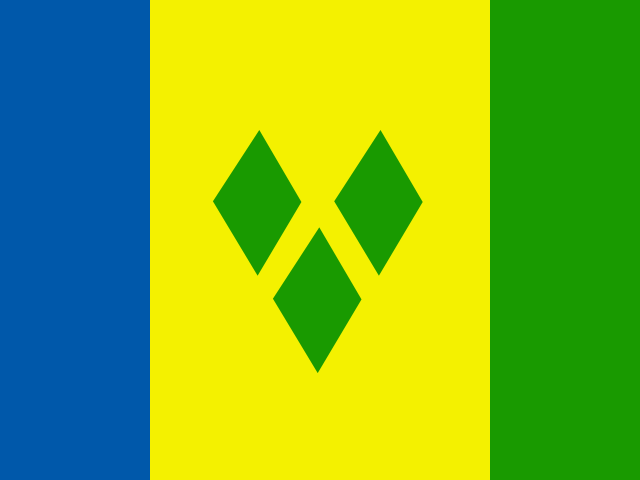
Overview
Saint Vincent and the Grenadines (often shortened to Saint Vincent, or SVG) is a small island nation in the eastern Caribbean. It sits in the southeast Windward Islands of the Lesser Antilles, where the Caribbean Sea meets the Atlantic Ocean. Saint Lucia lies to the north, Barbados to the east and Grenada to the south.
The country has a land area of about 389 km2. Most of it is the main island of Saint Vincent (about 344 km2), which holds the capital and largest city, Kingstown. Stretching south from it are the northern two-thirds of the Grenadines, a chain of smaller islands and cays covering about 45 km2; the southern third of the chain belongs to Grenada. The source counts 32 islands and cays in all. Seven are inhabited by one count, and nine by another that includes tiny islets such as Young Island and Palm Island. The best-known Grenadines include Bequia, Mustique, Canouan, Mayreau, Union Island and Petit St Vincent.
The population is around 109,000 (the source gives about 109,296 and a density of roughly 281 people per km2). Most people descend from enslaved Africans brought by the French and later the British, who contested the islands in the 18th century. The islands were a British colony from 1783 until peaceful independence in 1979, and the language, institutions and legal system still reflect that legacy. SVG is a Commonwealth realm with King Charles III as head of state.
SVG belongs to the Organisation of Eastern Caribbean States, CARICOM, the Bolivarian Alliance for the Americas (ALBA), CELAC, the Commonwealth, the UN, the Organization of American States and the Association of Caribbean States. In April 2021 the La Soufrière volcano erupted repeatedly, with explosive events lasting about two weeks and some 16,000 residents evacuated. Nearby islands, the United Kingdom and UN agencies helped, and the World Bank announced US$20 million in long-term funding on 13 April 2021.
History
Indigenous peoples from South America first settled Saint Vincent around 5000 BC. Arawaks followed around the 3rd century AD, and the Kalinago displaced them in the 14th century. The Kalinago called the island Youloumain. Columbus is thought to have sighted it in 1498 and named it St Vincent. The Kalinago resisted European settlement strongly.
English and Dutch attempts to claim the island failed. The French settled first, founding Barrouallie on the leeward coast in 1719 and bringing enslaved Africans to work plantations of sugar, coffee, indigo, tobacco, cotton and cocoa. Britain took the island during the Seven Years' War, confirmed by the Treaty of Paris (1763), and began building Fort Charlotte, which was completed in 1806. Britain held the islands from 1783.
Uneasy relations between the British and the Garifuna (Black Caribs) led to the Second Carib War of 1795 to 1797. The Garifuna, led by paramount chief Joseph Chatoyer and backed by the French (notably Victor Hugues from Martinique), were defeated in 1797 by forces under Sir Ralph Abercromby. Almost 5,000 Garifuna were deported to Roatán off Honduras, to Belize, and to Baliceaux in the Grenadines.
La Soufrière erupted in 1902, killing roughly 1,500 to 2,000 people, damaging farmland and weakening the economy. Under Britain the colony passed through several stages: a representative assembly in 1876, Crown Colony government in 1877, a legislative council with limited franchise in 1925, and universal adult suffrage in 1951. Britain repeatedly tried to merge the Windward Islands administratively, and a West Indies Federation project of the 1960s collapsed in 1962.
On 27 October 1969 Saint Vincent became an Associated State of Britain, with full control of internal affairs short of legal independence. La Soufrière erupted again in April 1979 without deaths, though thousands were evacuated and crops were badly hit. Full independence came on 27 October 1979, now a public holiday. The country stayed in the Commonwealth with the monarch represented by a Governor-General.
Milton Cato of the centre-left Saint Vincent Labour Party was the first Prime Minister (Premier since 1974) and governed until losing the 1984 election to James Fitz-Allen Mitchell of the centre-right New Democratic Party (NDP). A brief rebellion on Union Island in December 1979, led by Lennox 'Bumba' Charles, was quickly put down. Strikes marked the early 1980s. Mitchell stayed in office 16 years, until 2000, winning three consecutive elections and promoting regional integration. Hurricanes damaged banana and coconut estates in 1980 and 1987, and Hurricane Lenny hit the west coast hard in 1999.
Arnhim Eustace succeeded Mitchell as NDP leader and PM in 2000 but lost a year later to Ralph Gonsalves of the Unity Labour Party (ULP). Gonsalves, known as 'Comrade Ralph', argued that European states owe Caribbean nations reparations for the Atlantic slave trade. He won further terms in 2005, 2010, 2015 and 2020, the last being a fifth straight ULP victory. A 2009 referendum on a new constitution that would have made the country a republic with a non-executive president failed: it needed a two-thirds majority and received about 43.1% in favour against 55.6% opposed.
La Soufrière erupted again on 9 April 2021, sending ash miles into the atmosphere, after about 16,000 people were evacuated beforehand. In the 2025 general election, Godwin Friday's NDP defeated Gonsalves' ULP, winning 14 of 15 seats and forming the government. Stanley John became Governor-General on 5 January 2026.
Climate
SVG has a tropical maritime climate typical of the Windward Islands: warm all year, with temperatures usually in the mid-20s to low 30s °C (approx.). The drier season runs roughly from December to May, and the wetter season from June to November (approx.). Trade winds from the east moderate the heat.
Kingstown, on the leeward south-west coast of Saint Vincent, is warm and humid, with a distinct wetter season and a drier, sunnier winter and spring (approx.). Rainfall is much heavier in the mountainous interior and on the windward east side than on the coast. Bequia, Mustique, Canouan and Union Island in the Grenadines are low-lying and drier, with steady breezes (approx.).
Saint Vincent is a volcanic island with dense forest cover, abrupt slopes and very little flat land. Its windward coast is steep and rugged, whereas sandy beaches and bays are found more often along the leeward coast. La Soufrière, at 1,234 m, is the island's highest point. Richmond Peak, Mount Brisbane, Colonarie Mountain, Grand Bonhomme, Petit Bonhomme and Mount St Andrew are among the other significant peaks. Two terrestrial ecoregions occur in the country: Windward Islands moist forests and Lesser Antillean dry forests.
Most of SVG lies in the Main Development Region for Atlantic tropical cyclones. Hurricane season runs June to November, and storms have repeatedly damaged crops and housing, as with hurricanes in 1980 and 1987, Hurricane Lenny in 1999 and Tropical Storm Bret in 2023. La Soufrière adds volcanic risk, with eruptions in 1902, 1979 and 2021.
Government and politics
SVG is a constitutional monarchy run as a parliamentary democracy. King Charles III is head of state but does not live in the islands. He is represented by a Governor-General, currently Stanley John (since 5 January 2026), whose duties are largely ceremonial, such as opening the House of Assembly and making certain appointments. Real executive power rests with the Prime Minister and cabinet. The current Prime Minister is Godwin Friday, elected in 2025.
Parliament is a single chamber, the House of Assembly. It has 15 elected members from single-member constituencies plus six appointed Senators. The term is five years, but the Prime Minister may call elections earlier. The two parties with seats are the NDP and the ULP. The Leader of the Opposition, from the largest minority party, is Ralph Gonsalves.
The courts include district courts and the Eastern Caribbean Supreme Court, with the Privy Council in London as the final court of appeal.
SVG is a unitary state, so power is concentrated nationally rather than shared with states or provinces. Taxation, health, education and law are set by the central government. There are six parishes: five on Saint Vincent and Grenadines Parish, covering the northern two-thirds of the Grenadines. For census purposes the country is split into thirteen divisions (eleven on Saint Vincent and two in the Grenadines). Kingstown lies in Saint George Parish and is the central administrative centre. The Grenadines are governed from the national level, and the source notes Union Island neglect claims behind the brief 1979 revolt.
SVG has no formal army. The Royal Saint Vincent and the Grenadines Police Force includes a Special Service Unit and a supporting militia. It signed the UN Treaty on the Prohibition of Nuclear Weapons in 2017.
Foreign ties are close with Canada, the United Kingdom and the United States, and the country cooperates through the OECS and CARICOM. Its embassies and missions are in London (a High Commission), Washington D.C., Havana, Caracas, Brussels and Taipei (opened 8 August 2019). In 2019 it became the smallest country ever elected to the UN Security Council. It joined the OAS in 1981 and boycotted the 9th Summit of the Americas in June 2022. It has called for European reparations for the slave trade, and protesters raised the issue during a British royal visit in April 2022. It also objects to Venezuela's claim giving full effect to Aves Island, which extends a Venezuelan maritime zone across much of the Caribbean Sea.
It signed the CARICOM Double Taxation Relief treaty in 1994 and a FATCA Model 1 agreement with the US in 2014, in force from 2016. Under Section 148 of the Criminal Code, same-sex acts of 'gross indecency' are an offence punishable by up to five years in prison, which is relevant for LGBT visitors and residents.
Economy
SVG is a lower-middle-income economy in which agriculture, led by bananas, has long been the most important sector. Services, mostly tourism, are growing in importance. Dependence on a single crop has been the main obstacle to development, since tropical storms often wipe out much of the harvest. Efforts to bring in new industries have been relatively unsuccessful, and unemployment has been high: 19.8% in the 1991 census and 15% in 2001.
The economy includes a modest manufacturing industry as well as a limited offshore financial sector that caters to international business; its secrecy laws have prompted some concern abroad. Interest in financial services, including stock exchange activity and intermediaries, is on the rise. Under International Whaling Commission subsistence quotas, natives of Bequia are permitted to hunt as many as four humpback whales annually. The Eastern Caribbean dollar, which is pegged to the US dollar (approx.), serves as the currency.
Tourism has considerable potential. Filming of the Pirates of the Caribbean movies raised the country's profile with visitors and investors. Recent growth has come from construction and better tourism. The Grenadines, notably Mustique, Bequia and Canouan, are known for upscale yachting and resort tourism (approx.).
Argyle International Airport opened on 14 February 2017 on the east coast, about 8.3 km from Kingstown, replacing E.T. Joshua Airport. Mobile phone subscriptions grew from about 10,000 in 2002 to roughly 131,800 in 2010, and landlines numbered about 21,700 in 2010. Digicel and Flow are the two providers of mobile and internet service. Mobile coverage reaches most of Saint Vincent and the Grenadines.
Demographics and urbanization
The 2021 population estimate was 104,332, and the lead cites about 109,296 with a density near 281 per km2. The ethnic mix is about 66% of African descent, 19% mixed, 6% East Indian, 4% European (mainly Portuguese from Madeira), 2% Kalinago and 3% others. The Portuguese and East Indian communities arrived as plantation labour after slavery was abolished, and there is a growing Chinese community.
English is the official language and is used in education, government, religion and other formal settings. Most Vincentians also speak Vincentian Creole, locally called 'dialect', in informal settings at home and with friends.
The 2023 census showed 78.1% Christian, down from 82.3% in 2012, while those with no religious affiliation rose from 7.5% to 14.0%. Between 2001 and 2023 Anglicans fell from 17.8% to 10.5%, Methodists from 10.9% to 6.3% and Roman Catholics from 7.5% to 4.4%. Pentecostals rose from 17.6% to 26.4%, now the largest Christian group, Evangelicals from 2.8% to 4.3%, and Seventh-Day Adventists from 10.2% to 11.6%. Rastafarianism is the largest non-Christian faith at 0.8% (down from 1.5% in 2001), with Muslims about 0.2% and Hindus about 0.1%.
Most people live on the main island of Saint Vincent, especially in and around Kingstown and along the leeward coast, with smaller communities on Bequia, Canouan, Union Island, Mustique and other Grenadines. The country is moderately urbanised, with an urban share of roughly 50 to 55% (approx.). Kingstown and its suburbs hold roughly 25,000 to 30,000 people (approx.). Other notable towns include Georgetown, Barrouallie, Layou and Port Elizabeth on Bequia, all small (approx.).
Capital city
Kingstown is the capital and largest city, on the south-west (leeward) coast of Saint Vincent in Saint George Parish. The city itself has roughly 13,000 people and the wider urban area roughly 25,000 to 30,000 (approx.). Argyle International Airport is about 8.3 km away on the east coast.
Its climate is tropical and warm all year, with a wetter season from about June to November and a drier season from about December to May (approx.). It lies within the Atlantic hurricane belt, and the La Soufrière volcano is to the north.
Kingstown is the political and administrative centre and hosts the government and House of Assembly. It is also the main commercial and port city, so SVG has a single capital that doubles as the main economic centre (approx.). Its landmarks include Fort Charlotte, built by the British and finished in 1806, which overlooks the city (approx.), and the ferry links to the Grenadines (approx.).
About this summary
Approximate general-knowledge facts: city climate details, capital-city population and role, and some economic and recent-event context (currency, sector shares, tourism, 2025 election aftermath).