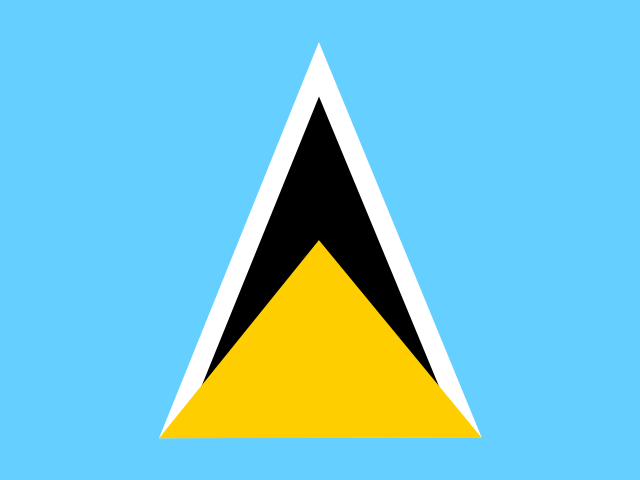
Overview
Saint Lucia is a small island nation in the eastern Caribbean, part of the Windward Islands in the Lesser Antilles. It lies north or northeast of Saint Vincent, northwest of Barbados and south of Martinique. Land area is about 617 sq km (238 sq mi), and the officially estimated population was just over 184,100 in mid-2023. The capital and largest city is Castries.
The island is volcanic and mountainous, famous for the twin Pitons, and its economy rests mainly on tourism. English is the official language, while a French-based Creole (Kwéyòl, often called Patois) is widely spoken.
Saint Lucia became independent from the United Kingdom on 22 February 1979 and remains a Commonwealth realm. It belongs to the United Nations, the Organization of American States, the World Trade Organization, CARICOM, the Organisation of Eastern Caribbean States and the Organisation internationale de la Francophonie. Because control passed so often between Britain and France, it was nicknamed the 'Helen of the West'.
History
The first confirmed inhabitants were the Arawaks, who probably came from northern South America around 200–400 AD; their pottery turns up at many archaeological sites. Around 800 AD the Kalinago (Island Caribs) arrived and took control, reportedly killing Arawak men and absorbing the women.
Columbus may have sighted the island in 1502 but did not record it. Juan de la Cosa's 1500 map shows it as El Falcon, a Spanish decree of 1511 mentions it, and a 1520 globe in the Vatican labels it Sancta Lucia. In the late 1550s the French pirate François le Clerc, nicknamed Jambe de Bois (wooden leg), based himself on Pigeon Island to raid Spanish ships.
The French were the first Europeans to settle, and they made a treaty with the Caribs in 1660. The English took control in 1663. Once slave-based sugar developed, both powers wanted the island; in the 1700s it changed hands or was declared neutral about a dozen times, and England and France fought over it 14 times in total. French settlements persisted, and it was effectively a French colony for much of the eighteenth century. In 1722 George I granted Saint Lucia and Saint Vincent to the 2nd Duke of Montagu, who named Nathaniel Uring deputy-governor. Britain gained firm control in 1814, shortly after Napoleon's defeat.
Representative government began in 1924, with the first election in 1925. In the Second World War, on 9 March 1942 a German U-boat sank two British ships in Castries harbour. The US used the island as a military hub, with a secondary naval base at Gros Islet and an air base on the site of today's international airport. Universal suffrage came in 1951. Saint Lucia was part of the West Indies Federation from 1958 until it dissolved in 1962, and in 1967 became one of six West Indies Associated States with internal self-government.
Independence was peacefully achieved on 22 February 1979 under Sir John Compton of the United Workers Party (UWP), with the British monarch remaining head of state, represented by a Governor-General. Compton's first term lasted only months before the Saint Lucia Labour Party (SLP) under Allan Louisy won the 1979 election. Hurricane Allen struck in 1980, wrecking much infrastructure. Compton returned in 1982; in his second period banana exports grew sharply to become the main revenue source, infrastructure improved and education reached rural areas. Saint Lucia was a key staging point for the 1983 US invasion of Grenada.
Under Kenny Anthony in the 1990s and 2000s the economy shifted from agriculture toward tourism. The 2001 September 11 attacks killed two Saint Lucians and slowed the economy. The Great Recession and Hurricane Tomas (2010) kept growth weak in the early 2010s, and the economy then recovered until contracting in 2020 because of the COVID-19 pandemic.
In June 2016 the UWP under Allen Chastanet won 11 of 17 seats and ousted Anthony's SLP. The SLP won again in July 2021, making Philip J. Pierre the ninth prime minister since independence, and kept its majority in the 2025 election.
Climate
Saint Lucia has a tropical rainforest climate (Af), moderated by northeast trade winds. The dry season runs from 1 December to 31 May and the wet season from 1 June to 30 November. Daytime temperatures average about 30 °C (86 °F) and nights about 24 °C (75 °F), with little difference between winter and summer.
The capital Castries is hot and humid year-round, with highs around 30–31 °C and lows around 23–25 °C (approx.), and rainfall concentrated in the wet season. Gros Islet and Rodney Bay in the north are somewhat drier and sunnier, and Vieux Fort in the south, home to Hewanorra airport, is breezy and relatively dry (approx.). Soufrière in the southwest, near the Pitons, is wetter because of the nearby mountains. Higher inland areas are cooler and rainier.
Tourist numbers peak in the dry months, January to April. The island lies in the Atlantic hurricane belt, and storms such as Hurricane Allen (1980) and Tomas (2010) have caused serious damage, with the main risk period roughly June to November (approx.).
The island is volcanic and very mountainous; its highest point is Mount Gimie at 950 m (3,120 ft). The Pitons are two volcanic plugs and the best-known landmark. The Soufrière volcanic centre in the southwest, centred on the Qualibou depression, has geothermal activity at Sulphur Springs (described as the world's only drive-in volcano), a phreatic eruption in 1776 and seismic activity in 2000–2001. People mostly live along the coast, while dense forest keeps the interior sparsely populated. Endemic species include the lizard Anolis luciae and the snake Boa orophias, and there are five terrestrial ecoregions.
Government and politics
Saint Lucia is a unitary state operating under a parliamentary system, and it is a constitutional monarchy within the Commonwealth. Charles III is the current monarch, and Errol Charles serves as the governor-general who represents him. Philip J. Pierre is the current prime minister; he leads the government and the cabinet and is ordinarily the head of the largest party in the House of Assembly.
The House of Assembly has 17 members, each elected by plurality in a single constituency. The Senate has 11 appointed members, most of them appointed on the prime minister's advice. The SLP governs, having won in 2021 and kept its majority in 2025.
Because the state is unitary, power sits with the central government, which sets taxes, health, law and education policy nationally. The island is divided into 10 districts, named by the French and kept in anglicised form by the British: Anse la Raye, Canaries, Castries, Choiseul, Dennery, Gros Islet, Laborie, Micoud, Soufrière and Vieux Fort. They serve as administrative divisions rather than self-governing units with their own powers, and Castries is the largest by area and population. There are no federal-style states or special autonomous jurisdictions.
The legal system is mixed, combining civil law and English common law. The 1867 Civil Code drew on the Quebec Civil Code of 1866, supplemented by common-law style legislation. The Privy Council was the final appeal court until 2023, when a constitutional amendment moved that role to the Caribbean Court of Justice.
Saint Lucia has no army; security is handled by the Royal Saint Lucia Police Force, which includes a Special Service Unit and a Coast Guard. It signed the UN Treaty on the Prohibition of Nuclear Weapons in 2018. It joined the UN as its 152nd member on 18 September 1979. Relations are friendly with the UK and Canada, France is a close partner because of neighbouring Martinique, and the US is the largest trading partner.
Crime is a concern: there were 75 homicides in 2021, up 34.5% from 55 in 2020, the highest total and rate in the country's history at about 40 per 100,000 people.
Economy
Saint Lucia is a Small Island Developing State. Services made up 86.9% of GDP in 2020, industry 10.9% and agriculture 2.2%. Tourism is the largest contributor, with offshore banking also significant. The country attracts foreign investment thanks to an educated workforce and improved roads, communications, water, sewerage and ports.
Tourism draws on the weather, scenery, beaches and resorts, with 1.29 million visitors in 2019. Attractions include Sulphur Springs, the Botanical Gardens, Pigeon Island and the Pitons. Cruising and yachting matter greatly: the main sea port is in Castries and the main marina is at Rodney Bay, home of the St. Lucia Yacht Club.
Bananas were once the leading sector, but competition from South America has cut their importance. Agriculture still provided 7.9% of jobs and 2.2% of GDP in 2021, and about 18% of land was farmed in the early 2020s. Crops include bananas, coconuts, cocoa, mangoes, avocados, vegetables, citrus and root crops like yams and sweet potatoes. Livestock is mainly poultry; the island is self-sufficient in eggs and pork and poultry output has grown. Fishing is also important.
Manufacturing has been called the most diverse in the Eastern Caribbean, with plastics produced on a large scale. The currency is the Eastern Caribbean dollar (EC$), shared in the Eastern Caribbean Currency Union (pegged to the US dollar, approx. 2.70 per US$). Main trade partners are the US, UK, EU and other CARICOM states.
Infrastructure: a wide private-owned bus network with government-set routes and hubs, and roads covering most of the island although some rural areas lack proper roads. There are two airports, including Hewanorra International. The main oil refinery is at Bexon. Electricity comes mainly from oil via the sole Cul De Sac Power Station, with solar a significant contributor and attempts to introduce geothermal and wind power.
Demographics and urbanization
The 2010 census counted 165,595 people in 58,920 households, up 5.1% from 157,490 in 2001; the mid-2023 estimate is just over 184,100. In 2010, 24.1% were aged 0–14 and 8.6% were 65 or over, and the median age was 33.1 in 2021. Nearly 40% of the population lived in Castries district.
Urbanization is moderate (roughly 18–20% by common World Bank-style measures, approx.), but settlement is concentrated along the coast, especially the northwest around Castries and Gros Islet, with Vieux Fort, Soufrière and Micoud/Dennery as other population centres. The interior is sparsely populated because of dense forest. Castries, the largest city, has a city population of about 20,000–25,000 and a wider urban area of roughly 60,000–70,000 (approx.).
The fertility rate was 1.4 children per woman in 2021, the lowest in the Americas, compared with 3.4 in 1990 and a peak of 6.98 in 1959. Emigration is mostly to English-speaking countries: nearly 10,000 Saint Lucian-born people live in the UK, with over 30,000 of Saint Lucian heritage, and many live in Miami, New York City and Montréal. Life expectancy was 71.1 years in 2021 (67.8 men, 74.7 women), down from 73.4 in 2019, largely due to COVID-19.
As of 2010, 85.3% were black, 10.9% multiracial, 2.2% Indo-Caribbean, 0.6% white and 0.6% Indigenous. A few Kalinago live in the Choiseul area and on the west coast, and there is a small Lebanese and Syrian community.
English is official; Kwéyòl (Saint Lucian French Creole, or Patois), related to Haitian Creole and derived mainly from French and West African languages, is spoken by most people. Attempts to make it official have not succeeded.
In the 2022 census a majority identified as Christian; 50.6% were Catholic, and the rest mostly Protestant (Seventh-day Adventist, Pentecostal). About 1.9% were Rastafari and 14.1% reported no religion, up from 5.9% in 2011. There is no state religion and freedom of religion is constitutionally guaranteed.
Education is free and compulsory from ages five to fifteen, with seven years of primary and three to five of secondary school; students prepare for regional CSEC exams. Public education spending was 3.6% in 2020. Tertiary institutions are mostly private (Monroe University, International American University), with public options including Sir Arthur Lewis Community College and the University of the West Indies. Health services are split between public and private providers, with two public hospitals and several health centres; most dental and vision care is private. Public health spending was 2.1% in 2019.
Capital city
Castries, the capital and largest city, is on the northwest coast of the island, in the district of the same name, which is the largest by area and population. The city has roughly 20,000–25,000 residents, and the wider urban area around 60,000–70,000 (approx.). Nearly 40% of the nation's people live in the district.
Castries has the same tropical rainforest climate as the rest of the island: hot and humid all year, with highs around 30–31 °C and a wet season from June to November (approx.).
It is the seat of government and Parliament and the main commercial and administrative centre. Its harbour is the island's main sea port and a cruise-ship stop, and it was the scene of the 1942 U-boat attack. The Bexon oil refinery is nearby. Rodney Bay and Gros Islet, just north, form the main tourism and marina hub, and Hewanorra International Airport is far to the south at Vieux Fort, while the smaller airport is closer to Castries (approx.).
Castries is both the political capital and the main economic city; there is no separate capital.
About this summary
Capital-city details (population, climate, role), city climate figures, and some recent economic and demographic context are from general knowledge and are approximate.