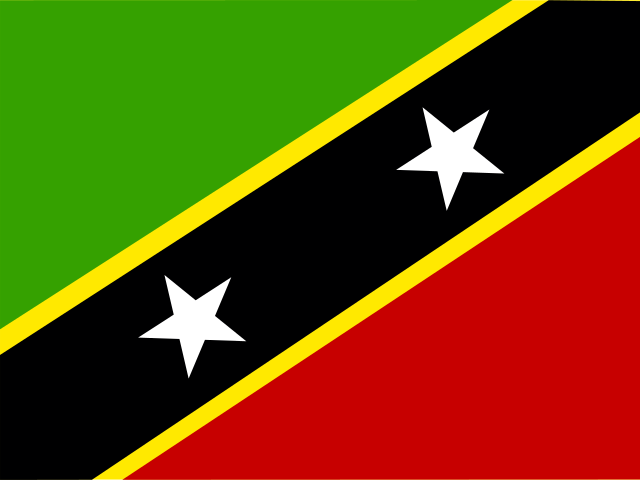
Overview
Saint Kitts and Nevis, formally the Federation of Saint Kitts and Nevis, is a Caribbean island nation made up of two islands, Saint Kitts and Nevis, in the Leeward Islands part of the Lesser Antilles. Its territory covers about 261 square kilometres (101 sq mi) and it has roughly 48,000 residents. The source describes it as the smallest sovereign state in the Western Hemisphere by both area and population, and the smallest sovereign federation in the world.
The country belongs to the Commonwealth realms: Charles III is its monarch and head of state. The capital, Basseterre, lies on the larger island, Saint Kitts, and doubles as the chief port for cruise passengers and cargo. Nevis sits about 3 km (1.9 mi) to the southeast, across a shallow channel called the Narrows.
Anguilla was once part of the same union, known as Saint Christopher-Nevis-Anguilla, but left in 1967 and is still a British overseas territory. Saint Kitts was the site of the first British and French colonies in the Caribbean and is nicknamed the Mother Colony of the West Indies. The federation became an associated state of the UK with full internal self-government in 1964 and gained independence in 1983, making it the most recent British Caribbean territory to do so.
History
Pre-colonial period: The first known inhabitants were pre-ceramic, pre-agricultural hunter-gatherers, often called Archaic people, who moved down the island chain from Florida as early as about 3000 BCE. Because they left no pottery or durable artifacts, little is known of their cultural ties. Around 100 BCE the Saladoid people, farmers who made pottery, arrived from the Orinoco region of present-day Venezuela and introduced agriculture and ceramics.
European arrival: Christopher Columbus sighted the islands in 1493. The English established the first permanent European settlement in 1623 under Thomas Warner at Old Road Town on the west coast of Saint Kitts, after reaching an understanding with the Carib chief Ouboutou Tegremante. The French settled on Saint Kitts in 1625 under Pierre Belain d'Esnambuc, and the two powers agreed to divide the island into French and English sectors. The English began settling Nevis from 1628.
British colonial period: Thanks to its slave-based sugar industry, Saint Kitts was, by the close of the 1700s, the wealthiest of Britain's Crown colonies in the Caribbean when measured per capita. Nevis, which had earlier been the more prosperous island, lost its economic lead to Saint Kitts over the course of the 18th century. Alexander Hamilton, who went on to serve as US Treasury Secretary, was born on Nevis in either 1755 or 1757. While Britain was fighting its American colonies, France retook Saint Kitts in 1782, yet the Treaty of Versailles (1783) handed it back to Britain.
The slave trade ended across the British Empire in 1807 and slavery was abolished in 1834, followed by a four-year paid apprenticeship period. Some 8,815 enslaved people were freed on Nevis and 19,780 on Saint Kitts. The two islands were federated with Anguilla in 1882.
Early 20th century: Economic hardship fostered a labour movement, and the Great Depression led sugar workers to strike in 1935. In the 1940s the labour party that became the Saint Kitts and Nevis Labour Party (SKNLP) was founded under Robert Llewellyn Bradshaw, who was Chief Minister and then Premier from 1966 to 1978 and sought more state control of the sugar economy. The more conservative People's Action Movement (PAM) was founded in 1965.
Path to independence: After a short spell in the West Indies Federation (1958-62), the islands became an associated state with full internal autonomy (the source gives 1967; the lead gives 1964). Nevis and Anguilla resented domination by Saint Kitts, and Anguilla declared independence unilaterally in 1967. Britain resumed control in 1971 and formally separated Anguilla in 1980. Attention then turned to Nevis, and it was agreed it would have its own Premier and Assembly and a constitutional right to secede if a referendum won a two-thirds majority.
Independence and after: The country became independent on 19 September 1983, with Kennedy Simmonds of the PAM, Premier since 1980, as first Prime Minister. It stayed in the Commonwealth with the monarch represented by a Governor-General. Simmonds won elections in 1984, 1989 and 1993, and the SKNLP under Denzil Douglas took power in 1995.
In 1998 a Nevis referendum on leaving the federation produced a 62% vote in favour, short of the two-thirds threshold. Hurricane Georges in September 1998 caused roughly US$458 million in damage and held back growth. The loss-making sugar industry, long dependent on subsidies, was closed in 2005.
Timothy Harris and his People's Labour Party won the 2015 election with PAM and the Nevis-based Concerned Citizens' Movement under the Team Unity banner. Team Unity won again in June 2020. In snap elections in August 2022 the SKNLP returned to power and Terrance Drew became the fourth prime minister.
Climate
Saint Kitts has a tropical savanna climate (Köppen Aw) and Nevis a tropical monsoon climate (Am). In Basseterre, the capital and main city, mean monthly temperatures stay within a narrow band of about 23.9 °C to 26.6 °C (75 to 80 °F) all year.
Annual rainfall averages about 2,400 mm (90 in), and over 1901-2015 it ranged from about 1,356 mm to 3,183 mm. Approx. general knowledge: the wetter months run roughly from late summer to autumn, which is also the peak of the Atlantic hurricane season (June to November), and the drier months are in late winter and spring. Charlestown, the main town of Nevis, has a similar warm, humid climate.
Hurricane Georges in 1998 illustrated that hurricanes pose a genuine threat. Fresh water comes from rivers that descend from the mountains on both islands. Two terrestrial ecoregions are found within the country: the Leeward Islands moist forests and the Leeward Islands dry forests.
Government and politics
Saint Kitts and Nevis is a sovereign, democratic, federal nation and a constitutional monarchy among the Commonwealth realms, with Charles III as its king. The monarch's representative is a governor-general, who follows the guidance of the prime minister and Cabinet. The prime minister heads the majority party in the House, while the Cabinet manages the affairs of state and is accountable to Parliament.
The legislature is a single chamber, the National Assembly, with fourteen members: eleven elected representatives (three from Nevis) and three appointed senators. Two senators are appointed on the prime minister's advice and one on the opposition leader's advice. Senators sit alongside the elected members rather than forming a separate upper house. All serve five-year terms.
Power is shared between the federal government and Nevis. Nevis has its own semi-autonomous assembly, a Premier, and a constitutionally protected right to secede if a referendum gets a two-thirds majority; the 1998 vote of 62% fell short. Approx. general knowledge: the Nevis Island Administration handles many local matters, while defence, foreign affairs and most national policy remain federal. The country is divided into fourteen parishes, nine on Saint Kitts and five on Nevis.
Foreign relations: There are no major international disputes. The country is a full member of CARICOM, the Organisation of Eastern Caribbean States and the Organization of American States (joined 1984). It signed the CARICOM Double Taxation Relief Treaty in 1994 and a Model 1 FATCA agreement with the US in 2014, in force from 31 August 2015. A tax information exchange agreement with Ireland followed in 2015.
The defence force has about 300 personnel, mainly doing policing and drug interdiction. Male homosexuality has been legal since 29 August 2022; in 2011 the government said it had no mandate from the people to decriminalise it.
Economy
The economy is a twin-island one built mostly on tourism, agriculture and light manufacturing. Sugar was the main export from the 1940s, but high costs and low world prices led to the closure of the state sugar company in 2005. Since then the government has pursued diversification through agriculture, tourism, export-oriented manufacturing and offshore banking.
Tourism is the dominant driver and has grown strongly since the 1970s. Arrivals to Saint Kitts reached 587,479 in 2009, up from 379,473 in 2007 (almost 40%), then fell during the Great Recession and recovered slowly. Cruise ships dock at Basseterre.
Transport: There are two international airports, Robert L. Bradshaw International on Saint Kitts, with services to the Caribbean, North America and Europe, and Vance W. Amory International on Nevis, with flights within the Caribbean. The St Kitts Scenic Railway is described as the last operating railway in the Lesser Antilles.
Citizenship by investment: Established in 1984, the programme is described as the oldest of its kind in the world. It grew sharply after 2006 when Henley & Partners helped restructure it to include donations to the sugar industry. Applicants undergo background checks and an interview, then make a qualifying investment. Options listed are designated real estate worth at least US$400,000 plus fees, or a contribution of at least US$250,000 to the Federal Consolidated Fund (the Sustainable Island State Contribution) or to an Approved Public Benefactor. The programme advertises lifelong, inheritable citizenship with no residency or language requirement. Some researchers criticise such programmes for risks of corruption, money laundering and tax evasion.
Science: Nevis participated in May 2026 in an experiment described as the Caribbean's first to reach space, which lifted off on 31 May 2026 aboard a Swedish Space Corporation mission from Esrange in Sweden. The research examined the effect of altered gravity on gene expression in human immune cells, and Nevis science teachers were involved. Oliver Ullrich and Cora Thiel of the University of Zurich led the Swiss-Caribbean project.
Demographics and urbanization
The population was estimated at about 53,000 in 2019, and 47,606 inhabitants were recorded in 2021. Life expectancy is about 76.9 years. Numbers have been broadly flat for a long time: 42,600 at the end of the 19th century, just over 50,000 by the mid-20th century, a fall from 50,000 to 40,000 between 1960 and 1990, then a recovery. Heavy emigration explains the stagnation, and the 2007 total was little different from 1961. Emigration to the US was 3,513 in 1986-1990, falling to about 1,800 in each of 2001-2005 and 2006-2010.
About three-quarters of people live on Saint Kitts, mostly on the flatter coastal areas, with around 15,500 in Basseterre. Other settlements include Cayon (about 3,000) and Sandy Point Town (about 3,000) on Saint Kitts, and Gingerland (about 2,500) and Charlestown (about 1,900) on Nevis. Approx. general knowledge: the population is largely urban or semi-urban, with an urbanization rate of roughly 30-35%, though towns are small.
Ethnicity (2001 estimate): Afro-Caribbean 92.5%, European descent 2.1%, Indian descent 1.5%. English is the only official language and Saint Kitts Creole is widely spoken.
Religion: About 82% are Christian. The 2011 census gave Anglican 17%, Methodist 16%, Pentecostal 11%, Church of God 7% (as listed: 7%), Roman Catholic 6%, Baptist, Moravian, Seventh-day Adventist and Wesleyan Holiness 5% each, and other groups 4%. Hinduism is the largest non-Christian religion at about 1.82% and Islam is second.
Education is compulsory from age 5 to 16. There are eight public high and secondary schools and several private secondary schools.
Notable people include Alexander Hamilton, John Gorrie (a pioneer of mechanical refrigeration), singer-songwriter Joan Armatrading, sprinter Kim Collins (2003 men's 100 m world champion), FIFA referee Kimbell Ward, and former governor-general Sir Edmund Wickham Lawrence.
Capital city
Basseterre is the capital and largest town, on the southwest coast of Saint Kitts. It has roughly 15,500 inhabitants according to the source (approx. 15,000-20,000 in the wider urban area). It is the country's political centre, housing the main government institutions, and the principal port for cruise passengers and cargo.
The climate is tropical savanna, with monthly mean temperatures between about 23.9 °C and 26.6 °C and about 2,400 mm of rain per year. Approx. general knowledge: the wettest period is late summer to autumn, which overlaps with hurricane season.
Basseterre is also the main economic centre, hosting commerce, tourism services, banking and the port. The capital does not differ from the main economic city, and there is only one national capital. Nevis has its own administrative town, Charlestown (about 1,900 people), which is the seat of the island's semi-autonomous government. Robert L. Bradshaw International Airport lies close to Basseterre on Saint Kitts and links the country to the Caribbean, North America and Europe. Approx. general knowledge: Basseterre has colonial-era architecture around the Circus and Independence Square and is the base for visiting Brimstone Hill Fortress, a UNESCO World Heritage Site since 1999.
About this summary
Some details on the capital city (approx. population, role, port and airport facilities), recent elections and GDP and tourism context come from general knowledge and are approximate.