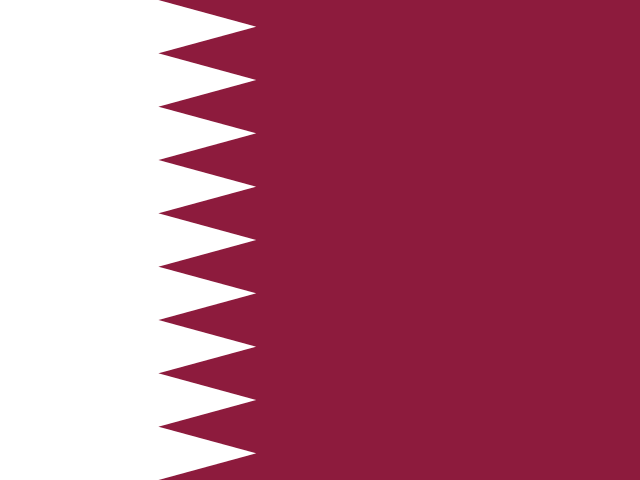
Overview
Qatar, formally the State of Qatar, sits in West Asia on a thumb-shaped peninsula jutting north from the northeastern Arabian coast into the Persian Gulf. Its only land frontier is with Saudi Arabia in the south. The Gulf of Bahrain separates it from the island state of Bahrain. The terrain is mostly flat, low and sandy desert, and the capital Doha holds more than 80% of the population.
The country has been ruled by the House of Thani as a hereditary monarchy since 1868, when Mohammed bin Thani reached an agreement with Britain that recognised Qatar as a separate entity. It passed from Ottoman influence to British protection in 1916 and became independent in 1971. The current emir is Tamim bin Hamad Al Thani, who took power in 2013.
As of 21 June 2026 the population was about 3.18 million, of whom roughly 3.02 million are foreign expatriates and migrant workers. Islam is the state religion. Qatar ranks very high worldwide for GDP (PPP) per capita and GNI per capita, and sits 42nd on the Human Development Index, the third highest in the Arab world.
Its wealth rests on vast natural gas and oil reserves; the gas reserves are the third largest in the world. Qatar is among the biggest exporters of liquefied natural gas and has the highest per-person carbon dioxide emissions in the world. Since the 2000s it has acted as a middle power, with a major non-NATO ally relationship with the United States (since 2022), the Al Jazeera media network, an extensive mediation role, and membership in the Gulf Cooperation Council.
History
Human presence on the peninsula goes back around 50,000 years, with Stone Age tools and settlements found. Mesopotamian artefacts of the Ubaid period (c. 6500–3800 BC) turned up in abandoned coastal sites, the main one being Al Da'asa on the west coast, probably a small seasonal camp. Kassite Babylonian pottery and crushed snail shells on the Al Khor Islands point to second-millennium BC trade with the Kassites and perhaps to an early shellfish purple-dye industry.
In AD 224 the Sasanian Empire took control of the lands around the Gulf, and Qatar took part in its commerce. In the Umayyad period it was known for breeding horses and camels. From the 8th century its strategic position made it a pearl-trading centre, and pearling grew substantially under the Abbasids, when ships travelling between Basra, India and China called at its ports. Chinese porcelain, West African coins and Thai artefacts have been found there.
In the 16th century Portugal, after vassalising Ormus in 1515 and seizing much of eastern Arabia from 1521, held influence along the coast up to Al Hassa, while the Ottomans competed for the region. From 1766 members of the Al Khalifa, part of the Utub confederation, moved from Kuwait to Zubarah in Qatar. In 1783 Qatar-based Bani Utbah clans and allied tribes took Bahrain from the Persians, and the Al Khalifa governed Bahrain while keeping Zubarah. Qatar was later contested between Bahraini and Saudi (Diriyah) influence.
The Al Thani emerged as a leading clan in the 1850s. In 1868 Britain recognised their rule over the peninsula. In 1871, under pressure from Midhat Pasha, governor of the Ottoman Vilayet of Baghdad, they accepted Ottoman rule, and Tanzimat reforms on taxation and land registration followed. Relations cooled, notably in 1882 when the Ottomans declined to help in a campaign over Khor Al Adaid. Under the 1913 Anglo-Ottoman Convention the Ottomans renounced their claim, but the garrison stayed in Doha through the early part of World War I until Abdullah bin Jassim Al Thani, who favoured Britain, persuaded it to leave in 1915. Qatar became a British protectorate on 3 November 1916.
On 3 September 1971 the special treaty arrangements with Britain ended and Qatar became independent. Ruler Ahmad bin Ali announced it from Switzerland and was deposed on 22 February 1972 by Khalifa bin Hamad. In 1991 Qatar took part in the Gulf War, including the Battle of Khafji, and let coalition air forces operate from its territory. In 1995 Hamad bin Khalifa took power from his father with the backing of senior royals and the United States; a counter-coup failed in 1996. A permanent constitution was approved by referendum in 2003. In 1999 Qatar held its first elections, to the advisory Central Municipal Council, with women voting and standing, a first among Gulf states. Some scholars regard the liberalisation of this period as largely symbolic.
The 2000s brought exceptionally fast GDP growth, built on North Field gas developed from the 1990s; the population tripled between 2001 and 2011, mainly through foreign arrivals. In 2003 Qatar hosted US Central Command during the Iraq invasion. In March 2005 a suicide bombing at the Doha Players Theatre killed a British teacher, the country's first such attack. During the Arab Spring Qatar joined NATO operations in Libya and reportedly armed rebel groups in Libya and Syria, deepening tensions with Saudi Arabia, the UAE and Bahrain. It also took part in the Saudi-led Yemen intervention until 2017.
In June 2017 Saudi Arabia, the UAE, Bahrain, Egypt and Yemen cut diplomatic ties, accusing Qatar of supporting terrorism, a dispute that also covered its links to the Muslim Brotherhood and Iran. The crisis ended in January 2021 with the al-Ula declaration; none of the 13 original demands were met. Qatar won the 2022 FIFA World Cup hosting rights on 2 December 2010, becoming the first Arab and Muslim-majority host, and held the tournament from 21 November to 18 December 2022. Tamim became emir in June 2013 when his father handed over power. In 2020 he led a government focused on citizens' welfare, health, education and infrastructure.
In 2026 the Iran war affected Qatar directly: on 2 March 2026 the Qatari defence ministry said Ras Laffan Industrial City and Mesaieed Industrial Area were hit by Iranian drones, after which QatarEnergy halted gas production and declared force majeure. Satellite analysis reported by Bloomberg and a Tokyo research institute indicated Ras Laffan appeared undamaged before the shutdown. Later developments are not covered here.
Climate
Qatar has a hot desert climate: sunshine nearly all year, mild winters and very hot summers. January averages about 18.5 °C, summer temperatures often reach 40 °C or more, and annual rainfall averages only about 70 mm, mostly between October and March.
Doha, the capital, on the east coast, has mild winters with daytime highs around the low-to-mid 20s °C (approx.) and extremely hot, humid summers when highs commonly exceed 40 °C (approx.). Because most people live in and around Doha, the capital's climate is effectively the climate experienced by nearly all residents. Other settlements such as Al Wakrah, Al Khor, Al Rayyan and Umm Salal share the same hot desert pattern, with humidity higher on the coast.
The terrain is a low, sandy plain. The highest point is Qurayn Abu al Bawl at 103 m in the Jebel Dukhan, a low limestone range in the west, where the main onshore oil lies; gas fields are offshore to the northwest. The Khor al Adaid inland sea, with dunes, lies in the southeast. Outdoor activity is comfortable for much of the year apart from the peak summer months (approx.).
Government and politics
Qatar is officially a constitutional hereditary monarchy, though scholars and observers describe it as authoritarian, autocratic, or an absolute monarchy. Under the constitution the emir holds nearly all executive, legislative and judicial authority and alone appoints the prime minister and ministers, who form the Council of Ministers, the supreme executive body. The Council initiates legislation, which the Shura Council approves.
The Shura Council has a limited ability to block legislation and dismiss ministers, but the emir has the final say. The 2003 constitution provided for 30 of 45 members to be elected. The first election was held in October 2021 after several postponements; in November 2024 the country returned to a fully appointed council. Political parties and trade unions are not permitted by law. In the V-Dem 2025 report Qatar ranked near the bottom of the Electoral Democracy Index. In 2024 it ranked 40th of 180 in the Corruption Perceptions Index.
Qatar is a small unitary state: power is not shared with strong sub-national governments. It is split into eight municipalities, subdivided into 98 zones and then blocks. These are administrative units, not self-governing regions, and tax, health, law and education policy are set nationally. The 1999 Central Municipal Council elections were the country's first, held on 8 March, International Women's Day, with men and women voting. There is no income tax for individuals and no separate sub-national tax system. Special jurisdictions include free-trade zones such as the Qatar Science & Technology Park and Education City, run through the Qatar Foundation (approx. for administrative detail).
Law: the constitution makes Sharia the main source of legislation, but in practice the system mixes civil law and Sharia. Sharia applies to family law, inheritance and several crimes. A codified family law dates from 2006. Corporal punishment, including flogging, exists in law, and stoning, and death for apostasy and homosexuality, are legal penalties, although the source says these death penalties have not been carried out. Alcohol is only partly legal: certain five-star hotels may serve non-Muslims, and non-Muslim residents can obtain permits; a Qatar Airways subsidiary runs the only liquor shop. Public dress is expected to be modest.
Foreign policy: Qatar pursues an independent, open-door policy of balancing and alliance-building and is regarded by some analysts as a middle power. It is a founding Gulf Cooperation Council member, in the Arab League, and was in OPEC from 1961 until January 2019. It has been a major non-NATO ally of the United States since 2022 and has strong ties with France, China, Iran, Turkey and some Islamist movements. It has mediated between Fatah and Hamas (2006), in Lebanon (2008), in Sudan's Darfur, with the Taliban (a political office in Doha), in the first Gaza war ceasefire and hostage exchange, and in a US–Iran prisoner swap in September 2023. In September 2024 Qatar joined the US Visa Waiver Programme. Its mediating role has led to the description 'a prickly Switzerland'. In 2022 a corruption scandal involving the European Parliament emerged, and an October 2020 airport search of Australian women caused a diplomatic row.
Military: about 12,000 in the land forces, 2,500 navy, 2,000 air force and 5,000 internal security. Conscription was introduced in 2013 and a one-year service term for called-up male citizens followed in 2018. Spending was about US$7.49 billion in 2022. Qatar has defence pacts with the US, UK and France. Al Udeid Air Base, the forward headquarters of US Central Command, hosts about 10,000 US personnel. It ranked 29th in the 2024 Global Peace Index.
Rights and media: academics and NGOs generally rate the human rights record as poor. Foreign workers make up around 91% of the population and 95% of the labour force and are subject to a sponsorship (kafala) system. The government says it has reformed or abolished it, but Human Rights Watch and Amnesty International reported in 2025 continuing abuses and limited impact. Women need male guardian permission for several things such as marriage, and are paid 25–50% less than men; sex outside marriage is criminalised; same-sex acts are illegal. Reporters Without Borders (2026) described a 'draconian system of censorship'; the seven local newspapers practise heavy self-censorship, and Doha News, blocked in 2016, relaunched in 2020 under new ownership.
Economy
Before oil, the economy relied on fishing and pearling, which collapsed after Japanese cultured pearls entered the market in the 1920s and 1930s. Oil was found at the Dukhan field in 1940 and transformed the state, and the North Field gas developments from 1991 (Phase I cost US$1.5 billion) and the first LNG exports to Japan in 1996 expanded it further. Qatar has no income tax and very low taxes overall, unemployment was reported at 0.1% in 2013, and corporate law requires Qatari nationals to hold 51% of ventures (the source's older rule). The Ministry of Business and Trade oversees trade and industry.
Qatar has been among the highest in the world for GDP per capita (fourth in 2016 per the IMF; first in 2012 at about US$106,000 PPP, GDP US$182 billion). It depends on foreign labour: migrants were about 86% of the population and 94% of the workforce in the 2016-era figures, and higher in later figures. Proven oil reserves were about 25.2 billion barrels in 2016 (13th globally) and gas reserves exceed 250 trillion cubic feet, the third largest. Heavy industry at Umm Said includes a refinery, fertiliser, steel and petrochemical plants running on gas. The US is a major equipment supplier.
The Qatar Investment Authority (founded 2005) is the sovereign wealth fund, with assets of US$115 billion in 2012. Holdings by 2014 included stakes in Harrods, The Shard, Barclays, Heathrow Airport, Volkswagen, Shell, Paris Saint-Germain and others. A 2016 deficit following lower oil prices led to job cuts and plans for taxes on items such as fast food, tobacco and soft drinks.
The Qatar National Vision 2030 (launched 2008) aims to reduce dependence on hydrocarbons through education, tourism and green energy, including a target of 20% of energy from solar by 2030. Qatar Solar Technologies opened a polysilicon plant at Ras Laffan in 2017. The 'Qatarisation' programme moves citizens into senior jobs, and immigration rules are strict for security reasons.
Tourism is growing: over 2.3 million international visitors in 2017, and 729,000 in the first half of 2022. Nationals of 88 countries can enter visa-free. Around US$220 billion was spent on infrastructure after the 2010 World Cup bid. The target is for tourism to reach 12% of GDP by 2030, and the 2030 Asian Games are upcoming. Popular sites include the Museum of Islamic Art, Souq Waqif and Katara Cultural Village.
Transport: Hamad International Airport opened on 30 April 2014 as the Qatar Airways hub, with expansion aimed at 70 million passengers capacity. Qatar Airways, which employs over 46,000 people, has won Airline of the Year several times (2011, 2012, 2015, 2017, 2019). Hamad Port, south of Doha, opened in December 2016, handles up to 7.8 million tonnes a year, and Ras Laffan Port is a major LNG export terminal. The Doha Metro links the airport and business hubs, with more expansion planned by Qatar Rail.
Early March 2026: Iranian drone strikes on Ras Laffan and Mesaieed were followed by a halt in gas output and force majeure, pushing up global gas and oil prices. The longer-term economic effects are not covered here.
Demographics and urbanization
Qatar's population varies by season because of its dependence on migrant labour. The 2020 census counted 2,846,118 people (2,034,518 male, 811,600 female), with only about 340,000 (12%) Qatari citizens. By 21 June 2026 the population was about 3.18 million. Women are only about a quarter of the population because of the influx of male labourers. In 1970 the first census recorded 111,133 people; an 1892 Ottoman count found 9,830 in towns.
Origins: South Asians were about 1.5 million (60%) in 2017, including about 650,000 Indians, 350,000 Nepalese, 280,000 Bangladeshis, 145,000 Sri Lankans and 125,000 Pakistanis. Other expatriates were around 28%, including about 260,000 Filipinos and 200,000 Egyptians, plus other Arabs and Europeans.
Urbanisation is near-total: Doha and its built-up area hold over 80% of residents, and nearly everyone lives in urban areas (approx. 99%). Main urban centres other than the capital are Al Rayyan, Al Wakrah, Al Khor and Umm Salal, each with populations in the low-to-mid hundreds of thousands or less (approx.); Al Rayyan and Al Wakrah are essentially part of the Doha conurbation.
Languages: Arabic is official, with Qatari Arabic the local dialect. English is widely used as a second language and common in business, medicine and with expatriates. Many others are spoken, including Malayalam, Persian, Hindi, Urdu, Tamil, Nepali, Bengali and Tagalog.
Religion: Islam is the state religion. Most citizens follow Wahhabi Salafism, and 5–15% of Muslims are Shia. In 2020 the total population was 75.9% Muslim, 12.5% Christian and 10.6% Hindu. Churches have been allowed on government-donated land since 2008, including Catholic, Anglican, Mar Thoma and Malankara Orthodox congregations.
Education and health: Education City hosts branches of Weill Cornell, Carnegie Mellon, Georgetown, Northwestern, Texas A&M and VCU, and Qatar University (1973) is the oldest and largest. Illiteracy was 3.1% for males and 4.2% for females in 2012. Qatar ranked 48th in the 2025 Global Innovation Index. Healthcare is generally high-standard: citizens have national insurance, expatriates need employer or private insurance, and Hamad Medical Corporation is the main provider. Life expectancy was about 82 years in 2014, the highest in the Middle East.
Capital city
Doha is the capital, on the east coast of the peninsula on the Persian Gulf. It is home to over 80% of the population; the metro area has roughly 2.4 million or more people (approx.). It is both the political capital and the main economic and cultural centre; Qatar has a single capital and no separate economic capital.
Politically, Doha houses the emir's court, ministries, the Shura Council and diplomatic missions. Economically it is the base of QatarEnergy, the Qatar Investment Authority, Qatar Airways and Hamad International Airport, and the business hubs the Doha Metro links. Culturally it has the Museum of Islamic Art, Souq Waqif, Katara Cultural Village and Education City, and it is home to Al Jazeera. Hamad Port lies to the south and the Ras Laffan LNG hub to the north.
Doha's climate is hot desert: mild winters and very hot, humid summers, with very little rain, mostly in winter (approx.). Al Udeid Air Base, a US Central Command forward headquarters, is in Qatar near Doha. Doha was a main venue city for the 2022 FIFA World Cup, and the 2030 Asian Games are scheduled to be hosted there. Fast-growing hospitality, a metro and a major new airport mark recent decades of infrastructure investment.
About this summary
Doha metro-area population, Doha climate and districts, capital-city institutions, and some recent economic and demographic details are from general knowledge and approximate.