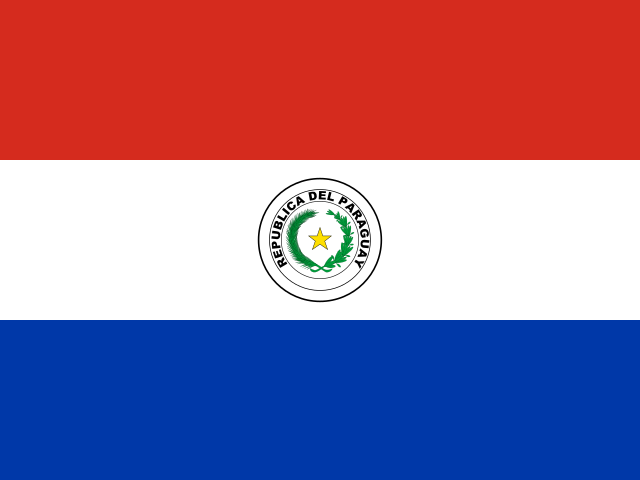
Overview
Paraguay, officially the Republic of Paraguay, is a landlocked country in central South America. Bolivia lies to its north and northwest, Brazil to the east and northeast, and Argentina along its southern and western sides. Despite having no coastline, it reaches the Atlantic through the Paraná–Paraguay Waterway, a river system of navigable channels that five countries share.
It is a unitary presidential republic made up of a capital district and seventeen departments. Asunción is both the capital and the largest city. Independence from Spain is dated to 1811.
Paraguay is a developing nation that sits 99th on the Human Development Index and, according to the source, has the seventh-highest GDP (PPP) per capita in South America. In 2024, its economy numbered among the quicker-expanding ones across the Western Hemisphere, with growth fueled by exports of beef and soybeans as well as by manufacturing and construction. The country ranks among the globe's foremost hydroelectricity exporters, and the Itaipu Dam, built on the Paraná River and shared with Brazil, is described as the third-largest hydroelectric facility in terms of energy output.
It is a founding member of Mercosur, the United Nations, the Organization of American States and the Lima Group. Luque, in the Asunción metropolitan area, hosts the headquarters of the South American Football Confederation. Ciudad del Este is the second-largest city and hosts many consulates-general.
Most of the roughly 6 million people are mestizo. Guaraní culture is very influential, and more than 90% of people speak Guaraní alongside Spanish, a rate of indigenous-language fluency the source calls the highest in Latin America. A 2014 Positive Experience Index based on global polling named Paraguay the world's happiest place, and in 2024 it placed 24th in the progress rankings of the World Happiness Report.
History
Before the Spanish arrived, the Guaraní had lived in eastern Paraguay for at least a thousand years. The Gran Chaco in the west was home to nomadic peoples, among whom the Guaycuru were most prominent. The Paraguay River roughly divided the farming Guaraní of the east from the nomadic and semi-nomadic groups of the west. The Mbayá, known for warrior traditions, were not fully pacified until the late 19th century.
Spanish conquistadors reached the region in the 1520s, with the lead giving 1524 as the date. On 15 August 1537, Juan de Salazar de Espinosa established Asunción, which grew into the hub of the Spanish colonial province of Paraguay and served as the earliest capital of the Río de la Plata Governorate. Jesuit missions, known as reductions, gathered Guaraní communities together, converted them to Christianity, and introduced them to European culture, while also protecting them from enslavement by Spanish settlers and Portuguese slave raiders. Once the Jesuits were expelled from Spanish territories in 1767, Paraguay turned into a colony that sat more and more on the margins.
Paraguay overthrew the local Spanish administration on 14 May 1811. José Gaspar Rodríguez de Francia, nicknamed El Supremo, ruled from 1814 until his death in 1840 with very little contact with the outside world, aiming at a utopian society inspired by Rousseau's Social Contract. He sharply reduced the power of the Catholic Church and the cabinet.
After a period of military juntas, Carlos Antonio López took power in 1841, modernised the country, opened it to foreign trade, signed a nonaggression pact with Argentina and formally declared independence in 1842. On his death in 1862 power passed to his eldest son, Francisco Solano López. The López regime was highly centralised in production and distribution.
The Triple Alliance War (Paraguayan War, 1864–1870) began after Brazil, allied with Argentina and Uruguayan Colorado rebels, invaded Uruguay to overthrow the Blanco government, an ally of López. Paraguay attacked Mato Grosso on 15 December 1864 and declared war on Argentina on 23 March 1865. The war was catastrophic: the country lost about half its prewar population and roughly 25–33% of its territory.
In 1904 the Liberal revolution ended Colorado rule and began an unstable era: between 1904 and 1954 there were thirty-one presidents, most removed by force. Liberal factional conflict led to the civil war of 1922–1923. A long-running border dispute with Bolivia over the Chaco erupted into the Chaco War (1932–1935); after heavy losses on both sides Paraguay prevailed and secured most of the disputed Chaco.
General Alfredo Stroessner took power in 1954 and, with the Colorado Party, ruled until 1989. His era brought some modernisation and economic expansion but also extensive human rights abuses and a poor environmental record. Paraguay took part in Operation Condor, and repression, threats and death squads were used. On 3 February 1989 Stroessner was overthrown in a military coup led by General Andrés Rodríguez, who started political, legal and economic reforms and rapprochement with the international community. Rural poor immediately occupied large areas of unused land: by mid-1990, about 19,000 families held about 138,000 ha.
In 2008, after about six decades of Colorado dominance, voters elected Fernando Lugo, a former Catholic bishop and liberation-theology adherent backed by the opposition Authentic Radical Liberal Party. He won with nearly 41% against almost 31% for Colorado candidate Blanca Ovelar, and took office on 15 August 2008, prioritising reduced corruption and inequality. It was described as the first constitutional, peaceful transfer of power to the opposition.
On 21 June 2012, after a clash that killed 17 people (eight police officers and nine farmers) during an eviction, the opposition-controlled lower house began impeachment proceedings against Lugo, giving him very little time to prepare a defence. The Senate removed him on 22 June 2012 and Vice President Federico Franco took over. Lugo's supporters called it a politically motivated coup, and UNASUR and several neighbouring governments considered it a coup d'état. The Organization of American States concluded it followed the constitution and was not a coup.
Horacio Cartes (Colorado) was president from August 2013 to 15 August 2018, followed by Mario Abdo Benítez (Colorado) until 2023. Santiago Peña of the Colorado Party won the May 2023 election and was sworn in on 15 August 2023.
Climate
Paraguay's climates are semi-arid, tropical and subtropical. Between October and March warm winds arrive from the Amazon Basin, while from May to August cold winds come from the Andes. With no mountain barrier, winds can reach about 161 km/h, and temperatures can change sharply within a short time; between April and September they sometimes fall below freezing. January is the hottest month, averaging about 28.9 °C daily.
Rainfall varies strongly. The far eastern forest belt gets about 170 cm a year, while the western Chaco usually gets no more than about 50 cm, with irregular rain that evaporates quickly.
Asunción (capital) has a humid subtropical climate: very hot, humid summers often reaching the mid-30s °C (approx.), mild winters with occasional cold snaps, and rain spread through the year (approx. 1,300–1,400 mm). Ciudad del Este, in the east near the Brazilian border, is also humid subtropical, slightly cooler and wetter than Asunción (approx.). Encarnación, in the south, is humid subtropical with cooler winters and occasional frost (approx.). Filadelfia, the Mennonite centre in the Chaco, is hot and semi-arid (approx.).
The country has six terrestrial ecoregions: the Alto Paraná Atlantic forests, Chaco, Cerrado, Humid Chaco, Pantanal and Paraná flooded savanna. Since the 1960s, close to 90% of the original forest has been lost, chiefly because agriculture and livestock farming have expanded, and some indigenous people have been pushed into large cities. The fauna includes coypu, as well as marsh deer, monkeys, armadillos, anteaters, otters, wild boars, tapirs and jaguars, along with ocelots and bats.
Government and politics
Paraguay is a representative democratic republic with a multi-party system and three separate branches. The President is both head of state and head of government and holds executive power alone. Legislative power sits with the two chambers of the National Congress. The judiciary consists of civil courts and tribunals and a nine-member Supreme Court of Justice, independent of the other branches. Since the end of the 1947 civil war the conservative Colorado Party has generally dominated politics.
Paraguay is a unitary state, not a federation. It has seventeen departments plus the capital district, and the country is split informally into the Occidental Region (Chaco: Boquerón, Alto Paraguay, Presidente Hayes) and the Oriental Region (all others and the capital district). Because the state is unitary, core powers such as taxation, the legal system, national health and education policy remain with the central government (approx., general knowledge). Departments are headed by elected governors with departmental councils, and municipalities elect mayors, but they have limited autonomy and budgets (approx.). Asunción, as a capital district, is not part of any department.
The president is commander-in-chief of the armed forces, which comprise an army, a navy (with naval aviation and marines) and an air force. One year of military service is compulsory for 18-year-old males (and 17-year-olds in the year they turn 18), and conscientious objection is allowed under Law 4013/2010. Paraguay cooperates with Argentina, Brazil and the United States on anti-terrorism and anti-narcotics efforts; the Regional Security Mechanism first met in Asunción in 2019 to address transnational crime in the triple-frontier region. It was ranked 73rd in the 2024 Global Peace Index.
Presidential elections are held every five years with no re-election (approx., general knowledge). Any elections after the retrieval date are not covered.
Economy
For many years the country's image was tied to illicit trade in electronics, weapons and drugs. This began to change in the 2000s with legal businesses such as soy, maize and beef. Central Bank data showed triangulation trade (China–Paraguay–Brazil), which Brazil often treats as smuggling, made up 22% of GDP in 2006 and 12% in 2016. The development strategy rests on exports and depends heavily on the Brazilian market, through three pillars: re-exports, hydroelectric surplus from Itaipu (mainly bought by Brazil) and maquilas (largely Brazilian-financed).
The economy grew rapidly from 2003 to 2013 and by an average of about 4% in the 2010s, led by soybeans. Growth did not cut poverty, which exceeded 26% in 2018 by official figures. The New York Times described Paraguay as one of the Latin American countries where the rich–poor gap widened most. The informal sector is large (re-exports, microenterprises, street vendors), so accurate measurement is hard. Companies pay little tax according to a 2018 ECLAC study, and fewer than 10% of workers took part in the pension system in 2005 (IMF).
Agriculture: Paraguay is the sixth-largest soybean producer, the second-largest stevia producer and the ninth-largest beef exporter. Other crops include maize, sugar cane, cassava, rice, wheat, oranges, yerba mate and sorghum; beef output was 481,000 tonnes in 2020. In 2019 almost 70% of soy and rice producers were Brazilians or their descendants (brasiguaios). Land ownership is highly concentrated: more than 80% of cultivable land is held by 2.6% of owners, and about 8 million hectares were allegedly granted illegally to regime supporters under Stroessner. Oxfam estimated 900,000 people were evicted from the countryside over ten years, and more than 130 peasant leaders have reportedly been killed since 1989. Heavy agrochemical use has drawn a 2019 UN Human Rights Committee ruling urging investigation.
Industry: the maquila law lets companies relocate with minimal tax rates, and industrial complexes are concentrated in the east. Manufacturing focuses on food and drink, along with wood, paper, hides, non-metallic minerals, edible oils, garments, organic sugar, meat processing and steel. Local firms meet about 70% of domestic pharmaceutical demand and have started exporting. Paraguay was seventh-largest producer of soybean oil in 2018 and ranked 103rd in the Global Innovation Index in 2025.
Trade hubs: Ciudad del Este is described as the world's third most important free commercial zone, after Miami and Hong Kong. The Central Bank of Paraguay is headquartered in Asunción's Carmelitas neighbourhood. The currency is the guaraní (approx.).
Energy: supply is about 76% renewable (40% hydropower, 36% biomass) with 24% petroleum derivatives. Installed capacity is 8,110 MW and output was 63 billion kWh in 2016 against domestic consumption of about 15 billion kWh; the surplus is sold to Brazil, Argentina and Uruguay, which the source says makes Paraguay the world's largest net electricity exporter. Itaipu and Yacyretá (approx.) are the two big binational projects.
Transport: in 2019 there were 78,850 km of roads, 10,372 km paved. The Bioceanic Corridor will cross northern Paraguay linking Brazil, Argentina and northern Chile ports and opening the Chaco; 275 km from Carmelo Peralta to Loma Plata opened in February 2022. Route 2 from Asunción to Ciudad del Este (linking to the Brazilian port of Paranaguá) is being duplicated, with nearly 100 km done by January 2022. The 1,600 km Paraguay–Paraná waterway gives river access to the ocean, and Asunción is a main port. Guaraní International Airport is a key cargo hub.
Indigenous social conditions are poor: in 2017, 66.2% of indigenous people lived in poverty, about three times the national average. Indigenous homes with electricity rose from 31.2% to 66.7% and running water from 15.1% to 25.3% compared with 2012.
Demographics and urbanization
The 2022 census counted 6,109,944 people. Population is very uneven: most live in the east near Asunción, which holds about 10% of the national total (the capital city alone; the wider metro is far larger), while the Chaco, about 60% of the territory, has under 4% of the population. About 63% are urban, making Paraguay one of South America's less urbanised countries.
Largest cities (approx.): Asunción about 0.5 million in the city and roughly 2–3 million in the greater metro including Luque, San Lorenzo, Lambaré and Fernando de la Mora; Ciudad del Este about 0.3 million in the metro; Encarnación about 0.1–0.2 million; Pilar and Luque are smaller regional centres.
No official ethnicity data exist, since the census does not ask about race except for indigenous status. Most people are traditionally considered mestizo. In 2022, indigenous people were 2.3% of the population, belonging to 17 ethnolinguistic groups. There are about 8,000 Afro-Paraguayans (0.13%).
Paraguay has long received immigrants, especially after the war's demographic collapse: Argentines (the largest group), Brazilians, Germans, Italians, Spanish, Slavs, Koreans, Chinese, Japanese, Arabs, Bolivians and others. About 25,000 German-speaking Mennonites live in the Chaco, and German settlers founded towns such as Hohenau, Filadelfia, Neuland, Obligado and Nueva Germania. Slavic settlers arrived in the 1920s–30s in Itapúa, Misiones and Ñeembucú. The Bruderhof, pacifists, arrived in 1941 after leaving England.
Languages: Spanish and Guaraní are both official. Guaraní is spoken by over 90% (about 5.8 million) and Spanish by about 87% (2015), though Spanish is favoured in government, business, media and education. Portuguese is spoken by about 10%, mostly near the Brazilian border. About 19 other indigenous languages are spoken, some endangered (Guana, Ayoreo, Ishir). English proficiency is in the global top 50 and third in South America after Argentina and Uruguay.
Religion (2002 census): 89.9% Catholic, 6.2% Evangelical Protestant, 1.1% other Christian, 0.6% indigenous religions. There is a sizeable Muslim community in Alto Paraná from Lebanese immigration, and a Mennonite community in Boquerón.
Education: literacy is about 94.8% for men and 93.18% for women. Primary school attendance for ages 6–12 is about 98%; primary schooling is free, compulsory and nine years, with three years of secondary. There are 59 accredited universities (CONES), the main ones in Asunción: National University of Asunción (public, 1889), Autonomous University of Asunción (private, 1979), Universidad Católica Nuestra Señora de la Asunción, Universidad Americana and Universidad del Pacífico (1991). Education takes 3.53% of GDP.
Health: life expectancy is 73.4 years (2024), infant mortality 15 per 1,000 (2023) and maternal mortality 84 per 100,000 live births (2014–2021). Public health spending is 4.63% of GDP (2023).
Capital city
Asunción sits on the Paraguay River's eastern bank, close to the Argentine border, in the country's eastern region. Established on 15 August 1537, it served as the initial seat of government for the Governorate of the Río de la Plata. The city forms a capital district that stands apart from the country's departments. Roughly 0.5 million people (approx.) live in the city itself, while the wider metropolitan area, which extends into adjacent towns of the Central Department, holds around 2–3 million (approx.).
Climate (approx.): humid subtropical, with hot, humid summers often above 35 °C and mild winters with occasional cold spells.
It is the political, administrative, economic and cultural centre: seat of the presidency, National Congress and Supreme Court, the Central Bank headquarters in the Carmelitas neighbourhood, a main river port, and the Guaraní International Airport, an international cargo hub. All the main universities are in Asunción. Nearby Luque hosts the South American Football Confederation.
Asunción is also the largest city and the main economic centre, though Ciudad del Este, the second-largest city on the Brazilian border, is a major commercial and free-trade hub and hosts many consulates-general. The country has a single capital.
About this summary
Approx. general-knowledge facts: metro populations, city climates, capital-city details, recent economic and political context.