Overview
Papua New Guinea (PNG) occupies the eastern half of the island of New Guinea, together with many offshore islands, in Melanesia in the southwestern Pacific. Its only land neighbour is Indonesia, to the west. By sea it also borders Australia to the south and the Solomon Islands to the east. The capital is Port Moresby. The country covers about 462,840 km2, made up of a large mainland and hundreds of islands.
It is a Commonwealth realm with a Westminster-style system. A governor-general represents the monarch, a prime minister leads the government, and the unicameral National Parliament holds legislative power. Members of Parliament also serve as provincial leaders. Independence from Australia came on 16 September 1975.
The population is overwhelmingly rural, with only about 14% living in urban centres in 2023. The constitution explicitly protects traditional communities and lifestyles. Official estimates put the population near 11.8 million, but a satellite-based estimate suggested about 17 million, so the true figure is uncertain.
The country has about 840 known languages, more than any other country. English and Tok Pisin serve as common languages. A large majority of people are Christian, and a constitutional amendment in March 2025 recognised Christianity as the state religion.
Mountainous terrain explains much of the rural and fragmented settlement pattern. The land holds roughly 5% of all known species. The economy depends heavily on natural resources, and nearly 40% of people are subsistence farmers who live largely outside the cash economy. Ties to Australia remain close, and links with Asia and the wider Pacific are growing.
History
Modern humans reached the New Guinea region, Australia and the Bismarck Archipelago about 42,000 to 45,000 years ago. Bougainville was settled by about 28,000 years ago and Manus by about 20,000 years ago. These were among the earliest human migrations out of Africa, and the populations stayed relatively isolated for most of prehistory. Rising seas cut New Guinea off from Australia about 10,000 years ago.
Ships from China and Southeast Asia probably made occasional visits. The Portuguese explorer António de Abreu was the first European to reach the island. The sweet potato, brought by Portuguese traders to the Moluccas, probably reached what is now PNG in the 17th or 18th century. It spread from the southern coast to the highlands and became a staple food.
In 1884 the eastern half of New Guinea was split between German New Guinea in the north and British New Guinea in the south. The British part passed to Australia in 1902 and became the Territory of Papua. Australia occupied German New Guinea in World War I and then ran it under a League of Nations mandate.
In World War II Japanese forces tried to take Port Moresby, advancing overland in mid-1942 along the Kokoda Track. Australian forces fell back almost to the city, then counter-attacked from September, helped substantially by local soldiers and helpers. Australian and American forces also repulsed a Japanese attack at Milne Bay. Allied forces fully recaptured Papua and New Guinea by 1944. The campaign killed about 216,000 Japanese, Australian and U.S. servicemen. The war suspended civil government, brought many people into contact with the wider world, and helped spread Tok Pisin and Hiri Motu.
New Guinea became a UN trust territory under Australia in 1946. In 1949 Papuans became Australian citizens and the two territories were combined as the Territory of Papua and New Guinea. A Legislative Council was created in 1951, and village councils spread from 1949. Aerial surveys in the 1950s found more inhabited highland valleys, and some groups stayed uncontacted until the 1960s and 1970s. Highland administration led to a large expansion of coffee growing. Pangu Pati, the first political party, formed before the 1968 election.
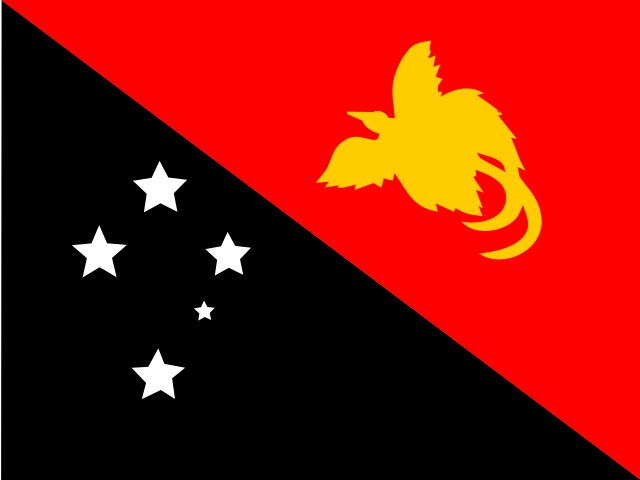
Rio Tinto began mining exploration on Bougainville in 1964, and the Bougainville Copper mine started despite resistance from some landowners. Bougainvilleans are culturally closer to the Solomon Islands than to the rest of the territory, and the resistance became tied to demands for autonomy. In 1971 the territory was renamed simply Papua New Guinea and its flag and emblem were adopted. Michael Somare became Chief Minister after the 1972 election, and self-government began in late 1973. The kina was introduced in April 1975.
The push for independence came largely from Australia's Whitlam government rather than from strong local demand, and national identity was weak. Bougainville declared its own independence on 1 September 1975, and other regional movements also emerged. Independence was nevertheless set for 16 September 1975, with Somare as first Prime Minister.
After independence most Australian officials left with little handover training, and the civil service lost efficiency. Governments changed by constitutional means. Somare was ousted by a no-confidence vote in 1980 (replaced by Julius Chan), returned after the 1982 election, and lost another such vote in 1985. A 1976 agreement settled the first Bougainville secession bid, and power was devolved to the 19 provinces. Highland tribal fighting grew in the 1970s, a state of emergency was declared there in 1979, and gang violence led to one in Port Moresby in 1984. Provincial governments were reformed in 1995.
A new uprising on Bougainville began in 1988. After the mine closed in May 1989 the Bougainville Revolutionary Army declared independence, and the conflict became a complex civil war. The 1997 Sandline affair over hired mercenaries brought down the national government. New Zealand-mediated talks produced a ceasefire in January 1998, and the Bougainville Peace Agreement of 2001 granted greater autonomy and promised a future referendum.
The Ok Tedi mine opened in 1982. Debt and weak finances led to a kina devaluation and float in 1994 and an emergency World Bank loan in 1995. Political reforms after 1999 created party funding, penalties for party hopping, and a shift from first past the post to the Limited Preferential Vote. Two new provinces, Hela and Jiwaka, were approved in 2009.
In 2011 a constitutional crisis pitted Peter O'Neill, chosen by Parliament, against Somare, whom the Supreme Court deemed still in office. The 2012 elections went ahead, O'Neill was re-elected PM, and the dispute was settled. LNG exports began in 2014. The 2015 Bougainville Mining Act gave Bougainville control of mining and gave customary landowners a veto. O'Neill returned after the 2017 election but resigned in May 2019 amid scandals, and James Marape replaced him.
A non-binding independence referendum in Bougainville on 23 November 2019 returned 98.31% in favour. Marape's PANGU Party won the most seats in the 2022 election. A March 2025 constitutional amendment recognised Christianity as the state religion.
Climate
PNG lies in the tropics, just south of the equator, within the Tropical Warm Pool where sea temperatures stay mostly above 28 °C. The climate is generally tropical but varies locally with terrain. Temperature broadly follows altitude. Coastal areas average highs near 32 °C and lows near 23 °C. Inland highlands average highs near 26 °C, and very mountainous areas near 18 °C. Above about 2,100 metres, night frosts are common and daytime highs rarely exceed 22 °C.
Winds blow generally from the southeast from May to October and from the northwest from December to March. Rainfall varies widely. The Port Moresby area sits in a rain shadow and gets under 1,000 mm a year, while some highland areas get over 8,000 mm. Some areas have a dry spell from May to November, while others have rain more evenly through the year. Lowland humidity averages about 80%. Cyclones occasionally hit in the December to March wet season, and El Niño, the monsoon and convergence zones all affect rainfall. The Papuan Peninsula is milder than coasts further west.
Port Moresby (approx.) has a hot tropical savanna climate with a distinct dry season, with highs around 30 to 32 °C year-round and rain concentrated roughly from December to April. Lae (approx.) on the north coast is hot, humid and very wet. Mount Hagen (approx.) in the highlands is cooler, with mild days and cool nights because of its altitude of roughly 1,700 metres. Madang and Wewak (approx.) on the north coast are hot and wet. Rabaul (approx.) in East New Britain is also hot and humid.
Natural hazards include earthquakes, tsunamis, volcanic eruptions, floods, landslides and droughts, because the country sits on the Pacific Ring of Fire with 14 known active volcanoes. Rising sea levels threaten some communities, and people may soon need to leave places such as the Carteret Islands in Bougainville.
The country is megadiverse, holding about 5% of known species, perhaps a third of them found nowhere else. Its forests form the third-largest contiguous rainforest area in the world, and it has at least 13,840 km2 of coral reef in the Coral Triangle. Nearly a quarter of rainforest was damaged or destroyed between 1972 and 2002.
Government and politics
PNG is a Commonwealth realm with Charles III as king. The governor-general represents him and is elected by the National Parliament. Parliament elects the prime minister, who is then appointed by the governor-general. The other ministers form the National Executive Council, which acts as the cabinet. Parliament sits for up to five years and has 118 seats: 96 for districts and 22 for province-level electorates (20 provinces, the National Capital District and the Autonomous Region of Bougainville). The members for the 22 province-level seats serve as provincial governors.
Elections use the Limited Preferential Vote, in which voters rank at least three candidates. Elections and changes of government have continued since independence, and overall results are accepted even when individual seats are contested. Parties are not ideologically distinct and mostly reflect alliances among members. Every government since 1972 has been a coalition, and party switching ('yo-yo' politics) makes coalitions unstable. Votes of no confidence are common, and only two prime ministers have served a full term from one election to the next. Policy has nevertheless stayed fairly stable.
Voting often follows tribal lines, intimidation and violence are common, and winners are sometimes elected with under 10% of the vote. Each MP controls discretionary Rural Development Funds for their constituency, which is a source of corruption and makes MPs seen as responsible for local services. Corruption is widespread, partly linked to wantok kinship obligations. Media is generally free but weak, and litigation is common.
PNG is a unitary state, though power is widely devolved. Its 22 province-level divisions comprise 20 provinces, the Autonomous Region of Bougainville, and the National Capital District. Beneath them lie 89 districts and more than 300 urban and rural Local-Level Government areas. Four regions also exist, but they serve no administrative function. Each provincial government is made up of the national MPs elected from that province. Taxes can be raised by provinces themselves, which also hold a measure of authority over education, health and development. Local governments operate alongside traditional tribal leaders. Their sizes vary widely, with the six most populous accounting for half of the national population.
Bougainville has special status. Under the 2001 peace agreement it has greater autonomy than other provinces, and since 2015 it controls mining, with minerals belonging to customary landowners. It runs an hour ahead of the rest of the country. The 2019 referendum was non-binding, and the further process is a matter between the Bougainville and national governments. About 97% of land is customary land held by communities, with much of it unregistered. Only citizens can hold freehold title.
Foreign policy seeks good relations with Australia, Indonesia and the Solomon Islands while building links in Asia. Australia is the most consistent aid provider and offers security assistance, and China is a growing source of infrastructure investment. PNG recognises Indonesian control of Western New Guinea. It is a founding member of the Melanesian Spearhead Group, an ASEAN observer since 1976, and a member of the Commonwealth, the Pacific Islands Forum, APEC, the Non-Aligned Movement and the UN.
Violence against women is among the highest in the world, with nearly 60% of women and girls aged 15 to 49 reporting physical or sexual violence. Sorcery accusations still lead to killings, with an estimated 50 to 150 alleged witches killed yearly. Homosexual acts are prohibited by law. Tribal fighting in the highlands has become deadlier with firearms, and raskol gangs operate in urban and rural areas. The Royal Papua New Guinea Constabulary is underfunded and troubled by corruption and political interference.
Economy
The IMF classes PNG as a developing economy. It depends on natural resources, with investment concentrated in mining and oil, while most labour works in agriculture. In 2018 resource extraction made up about 28% of GDP. In 2019 real GDP growth was 3.8% and inflation 4.3%. The currency is the kina, regulated by the Bank of Papua New Guinea. Formal employment is low, and the minimum wage has fallen in real terms since independence.
Extractive resources account for 86% of exports. Main exports are gold, copper, cobalt, nickel, oil and LNG. The largest mine is a private gold mine on Lihir Island, followed by the state-run Ok Tedi mine and the Porgera gold mine. LNG exports began in 2014, though new projects have been delayed by revenue-sharing disputes.
Agriculture supplies about 85% of jobs, although it is not the largest sector by output. Nearly 40% of people are subsistence farmers. Sweet potato, taro and sago are key crops. Exports of copra, rubber, tea, cocoa and coffee have not grown, but palm oil is a growing source of income. PNG produces about 1.6% of global palm oil and 1% of global coffee. Forestry and timber are important, but up to 70% of logging may be illegal. Marine fisheries supply around 10% of the global tuna catch.
Terrain makes transport difficult, so air travel is the most reliable option. There are five highways, only two reaching the interior, and over 500 airstrips, mostly unpaved. Of 22 international ports, Lae is the largest and handles about half of international cargo. Renewables supply two-thirds of electricity, partly from the Sirinumu and Yonki dams. Sewage treatment is limited even in the capital. Housing quality is low: in 2016 about 55% of urban homes had electricity against about 10% of rural homes. Piped water reaches over half of urban homes and about 15% of rural ones.
About 97% of land is customary and held by communities, with registration efforts having limited success. Poverty is most common in rural areas. Debt rose after LNG revenues fell short of expectations, and as of 2019 PNG's HDI was the lowest in the Pacific.
Demographics and urbanization
PNG is one of the most heterogeneous nations in the world. A 2020 UN estimate gave 8.95 million, and the government put the 2021 population at 11.8 million. The census was deferred in 2020/2021. A December 2022 UN-linked satellite study suggested about 17 million, but in July 2023 the UN revised its estimate to 11.8 million. International migrants were about 0.3% of the population in 2015.
Only about 14% of people lived in urban areas in 2023, and the urban share has changed little since independence. The Highlands hold 43% of the population, the northern mainland 25%, the southern region 18% and the Islands region 14%. Most people live in customary communities, often villages under 300 people with dispersed gardens and homes. Port Moresby is the biggest city (approx. 400,000 to 500,000 people). Other larger settlements are Lae (approx. 100,000 to 150,000), Mount Hagen, Madang and Wewak (each approx. tens of thousands).
The population is young: in 2011 the median age was under 22 and 36% were under 15. The total fertility rate was 4.4 in 2016. Life expectancy in 2019 was 63 for men and 67 for women. Health infrastructure is poor, HIV/AIDS is common, and cholera and tuberculosis outbreaks have occurred. There were 0.61 doctors per 10,000 people in 2023. The literacy rate was 63.4% in 2015, and church institutions provide much education.
About 840 languages are known, the most of any country, with over 820 indigenous ones. Most have fewer than a thousand speakers. Enga is the largest indigenous language, with about 200,000 speakers. English is the language of commerce and education, and Tok Pisin is the main lingua franca. Hiri Motu and sign language also have national recognition, but no law proclaims official languages. Many local languages are declining.
In the 2011 census 95.6% identified as Christian. Catholics were 26.0%, Evangelical Lutherans 18.4%, Seventh-day Adventists 12.9%, Pentecostals 10.4% and the United Church 10.3%. Many people blend Christianity with traditional practices. Christian fundamentalism has grown, and a March 2025 amendment recognised PNG as a Christian country.
Capital city
Port Moresby lies on the southern coast of the Papuan Peninsula, on the Gulf of Papua, and is the national capital and the biggest city. Its population is approx. 400,000 to 500,000. It forms its own province-level unit, the National Capital District, whose governor sits in Parliament.
The climate is hot and tropical with a dry season. It sits in a rain shadow and gets under 1,000 mm of rain per year, much less than most of the country. Highs are around 30 to 32 °C (approx.).
It is the seat of Parliament, the governor-general and the National Executive Council, and the main centre of government, business and diplomacy. It was a target of the 1942 Japanese advance along the Kokoda Track and in 1984 had a state of emergency over gang violence. Tok Pisin has increasingly displaced Hiri Motu there.
Port Moresby is the main administrative and commercial city. Lae, on the north coast, has the country's biggest port, handling about half of international cargo, so it is the key industrial and trade-logistics hub. Mining and resource projects are in other regions. There is only one capital, and no road link joins it to the highlands towns or Lae in a simple way, so air travel is vital.
About this summary
Approximate general-knowledge facts: capital-city details, city climates, urban populations, recent economic and political context, and the status of the Bougainville process after 2019.