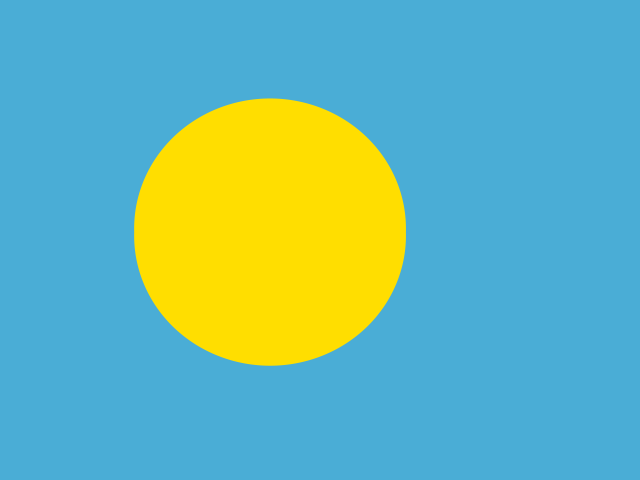
Overview
Palau, officially the Republic of Palau, is a small island country in the Micronesia subregion of Oceania, in the western Pacific Ocean. It is made up of roughly 340 islands forming the western end of the Caroline Islands chain. The central and eastern Carolines belong to the Federated States of Micronesia.
The total land area is about 466 square kilometers (180 sq mi), which makes Palau one of the smallest countries in the world. Its sea neighbors are the Federated States of Micronesia to the east, Indonesia to the south, the Philippines to the northwest, and open international waters to the north.
In terms of government, Palau operates as a presidential republic that is tied to the United States through free association. The Compact of Free Association makes the US responsible for defense, and it also supplies funding along with access to some social services. Palau's currency is the US dollar.
The economy rests mainly on tourism (especially diving and snorkeling), subsistence farming and fishing, and foreign aid is a large part of national income. Palauan culture blends Micronesian, Melanesian, Asian and Western influences. Palauan and English are the two official languages.
History
Austronesian peoples, most likely arriving from what is now the Philippines or Indonesia, settled Palau thousands of years ago, between the 3rd and 2nd millennia BCE. Spanish ships sighted outlying islands such as Sonsorol as early as 1521, during the Magellan expedition.
In December 1696 a group of Caroline Islanders stranded on Samar in the Philippines described their homeland to the Bohemian missionary Paul Klein, who drew the first European map of the islands. The map and his letter stirred considerable interest in Europe. Three Jesuit attempts to reach Palau from the Philippines (1700, 1708, 1709) failed, and a Jesuit expedition led by Francisco Padilla first visited on 30 November 1710.
British traders became regular visitors in the 18th century. In 1783 the East India Company ship Antelope was wrecked off Ulong Island, which led to Prince Lee Boo's visit to London. Spanish influence grew in the 19th century, and Palau was part of the Spanish East Indies, administered from the Philippines.
After Spain lost the Spanish–American War in 1898, it sold the islands to Germany in 1899, and they were administered as part of German New Guinea. After World War I the League of Nations placed them under the Japanese-ruled South Seas Mandate.
In World War II the US captured Palau from Japan in 1944 after the costly Battle of Peleliu, in which more than 2,000 Americans and about 10,000 Japanese died, followed by the Battle of Angaur. In 1947 Palau became part of the US-administered Trust Territory of the Pacific Islands, established under UN Security Council Resolution 21.
In the late 1970s the districts of Palau and the Marshall Islands voted against joining the Federated States of Micronesia. Palau chose a separate path in 1978, approved its own constitution, and became the Republic of Palau on 1 January 1981. The 1981 constitution was the world's first nuclear-free constitution, and its restrictions delayed agreement on the compact because the US wanted the option to operate nuclear-propelled vessels and store nuclear weapons there.
Palau signed the Compact of Free Association with the US in 1982, and it entered into force on 1 October 1994, ending the trusteeship. Palau was the last part of the Trust Territory to gain independence. It joined the United Nations in December 1994 (General Assembly Resolution 49/63, 15 December 1994).
Later milestones: the Micronesia Challenge in 2005; the world's first shark sanctuary in 2009; the Rock Islands Southern Lagoon named a UNESCO World Heritage Site in 2012; the protection of 80% of its waters in 2015; and the Palau Pledge, an eco-promise stamped in passports, in 2017. Palau withdrew from the Pacific Islands Forum in February 2021 after a dispute over the election of the forum's secretary-general.
Climate
Palau has a tropical rainforest climate. The annual mean temperature is about 28 °C (82 °F), average humidity is about 82%, and rainfall is heavy all year, averaging about 3,800 mm (150 in). Rain is more frequent from June to October, but sunshine is still plentiful.
Palau lies on the edge of the typhoon belt. Tropical disturbances form nearby most years, but strong cyclones are rare; Mike, Bopha and Haiyan are the only systems recorded as striking as typhoons. The islands are also exposed to earthquakes and volcanic activity in the wider region.
Koror, the main city, and Ngerulmud, the capital, share this same hot, humid, wet climate with little seasonal temperature variation (approx.), since the islands are small and close together.
Environmental concerns include rising sea levels, which threaten low-lying land, coastal vegetation, agriculture and an already limited water supply. Other problems are illegal dynamite fishing, inadequate solid waste facilities in Koror, sand and coral dredging in the lagoon, and wastewater treatment. A database estimate puts per-person carbon dioxide emissions at about 60 tonnes in 2019, among the highest in the world and mostly from transport.
Palau has a long conservation record, including the Ngerukewid Islands Wildlife Preserve (1956), the 2009 shark sanctuary covering about 600,000 km² of ocean, and the Micronesia Challenge. Saltwater crocodiles live in the mangroves and parts of the Rock Islands, with a conservation program running since the 1990s.
Government and politics
Palau is a democratic republic with a 1981 constitution. The President is both head of state and head of government. Legislative power rests with the bicameral Palau National Congress, and the judiciary is independent of the executive and legislature.
Palau has sixteen states (called municipalities until 1984). Koror is by far the largest and hosts most of the population; the Rock Islands have historically belonged to Koror State. The Southwest Islands, about 604 km from the main group, form the states of Hatohobei and Sonsorol, where Sonsorolese and Tobian are official. Angaur has its own language arrangements, with Japanese formally recognized in the constitution though no longer spoken. States have their own governments and local powers, while the national government handles foreign affairs, the main laws and national services (approx., detailed division of tax, health and education powers is not given in the source).
Under the Compact of Free Association, Palau conducts its own foreign relations but has no military of its own; the US is responsible for defense and was granted military access for 50 years. The US Coast Guard patrols Palau's waters and the US Navy presence is minimal. Palau agreed to host a US Air Force over-the-horizon radar station costing well over $100 million, expected to be operational in 2026. Compact programs are overseen by the US Department of the Interior's Office of Insular Affairs, and Palau has US ZIP codes and regular US mail.
Palau's own Division of Marine Law Enforcement patrols its roughly 600,000 km² exclusive economic zone, using two long-range patrol boats, the Kedam and the Remeliik II, based in Koror.
Palau often votes with the US at the UN General Assembly. It has close ties with Japan, which funded the Koror–Babeldaob Bridge, and with Taiwan, which supports its presence at international forums. Palau is a member of the Nauru Agreement on fisheries management and signed the UN Treaty on the Prohibition of Nuclear Weapons in 2017.
Commentators differ on how fully sovereign Palau is. Some argue that heavy reliance on US aid and defense under the compact raises questions about sovereignty, though Palau is not officially a protectorate. Others, such as Islands Society president Michael Walsh, describe Palau as a successful example of state-building in the Indo-Pacific.
Economy
The economy is based mainly on tourism, subsistence agriculture and fishing. Tourism centers on scuba diving and snorkeling around reef walls and World War II wrecks, with the Rock Islands Southern Lagoon a major draw. Business and tourist arrivals numbered 65,558 in fiscal year 2025. In April 2022 Palau launched Ol'au Palau, a responsible tourism program.
The government is the largest employer and depends heavily on US financial assistance. Per capita income is about twice that of Micronesia as a whole, and the outlook for tourism has been helped by growing air travel in the Pacific Rim and rising prosperity in East Asia.
Palau's ship registry is tiny (under 0.001% of the world commercial fleet) yet accounted for almost 60% of last-voyage flags in 2019, suggesting some shipping firms use it to avoid end-of-life responsibilities.
Taxes: income tax has three progressive brackets of 9.3%, 15% and 19.6%; corporate tax is 4%; a 10% broad-based Goods and Services Tax was introduced on 1 January 2023; there are no property taxes. The currency is the US dollar.
In November 2006 Pacific Savings Bank went bankrupt, affecting 641 depositors; compensation came from the balance of a Taiwanese loan to the government.
Demographics and urbanization
Palau's population is about 21,947 (2025). Roughly 73% are native Palauans of mixed Melanesian and Austronesian descent. Filipinos are the largest Asian group and second largest ethnic group, and there are notable Chinese and Korean communities, plus Bangladeshi and Nepalese workers and professionals who arrived mostly in the late 20th century. Smaller groups include people of Japanese ancestry, Europeans and Americans.
The population is highly urban in practice (approx. 80% or more): about two-thirds live on Koror island, and the rest are mainly on Babeldaob, Peleliu and Angaur, with very small communities on Kayangel and the Southwest Islands. Koror is the largest city, with roughly 11,000 to 14,000 people (approx.); Ngerulmud is far smaller.
Palauan and English are official. Sonsorolese and Tobian are recognized as national languages and are official in their states, and English is a core school subject and widely used as a second language. A local English dialect influenced by Philippine English is developing.
By the 2020 census, 46.9% were Roman Catholic, 25.9% Protestant (mainly evangelical), 5% Seventh-day Adventist, 5.1% Modekngei (a blend of Christianity, traditional religion and fortune telling), 4.9% Muslim (including about 400 Bengali Muslims), 0.9% Latter-day Saints and 11.4% other.
Healthcare is centered on the 80-bed Belau National Hospital. Many specialties are unavailable locally, so patients are sent to Taiwan, the Philippines or Hawaii, and visiting American specialists perform some procedures. Certain emergencies, such as some brain hemorrhages, require airlift to Taiwan.
Capital city
The official capital is Ngerulmud, in Melekeok State on Babeldaob, the largest island. It is a small, purpose-built government center (approx. a few hundred residents) and hosts the legislature and main government offices.
The capital differs from the main economic and population center. Koror, on Koror island to the south and linked to Babeldaob by the Japanese-funded Koror–Babeldaob Bridge, is the largest city and the commercial hub, with the main businesses, hotels, the hospital and the maritime enforcement base (approx. for its role as the commercial center).
Ngerulmud and Koror share the same tropical rainforest climate: about 28 °C average, heavy rain year-round, higher rainfall from June to October, and high humidity. Typhoons are rare but possible.
In short, Ngerulmud is the political capital, while Koror serves as the economic and tourism center and the main place where residents and expats live and work (approx.).
About this summary
Capital-city details (Ngerulmud's size and role, Koror's role as the economic hub), city climates, and approximate urbanization and recent-economy context come from general knowledge and are marked approx.