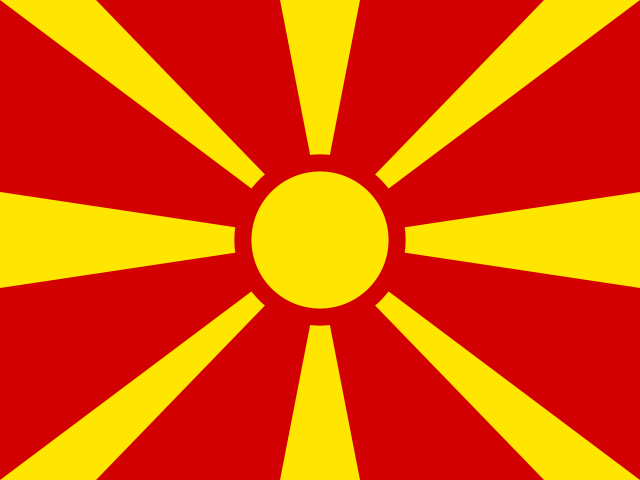
Overview
North Macedonia, officially the Republic of North Macedonia, is a landlocked country in Southeastern Europe. Its neighbours are Serbia and Kosovo on the north and northwest, Albania on the west, Bulgaria on the east and Greece on the south. The territory makes up roughly the northern third of the wider geographical region called Macedonia.
The population was about 1.84 million at the 2021 census. Skopje, the capital and largest city, holds around a quarter of all residents. Ethnic Macedonians (a South Slavic people) are the majority, and Albanians are a large minority at around a quarter of the population. Smaller groups include Turks, Roma, Serbs, Bosniaks and Aromanians.
The country peacefully left Yugoslavia in 1991 and joined the United Nations in 1993. It has been a NATO member since March 2020 and a European Union candidate since 2005. It is also a member of the Council of Europe, OSCE, CEFTA, BSEC, the WTO and the World Bank.
The World Bank classes it as an upper-middle-income country. It has a Human Development Index rank of 68th and relatively low income inequality. The state provides social security, universal health care and free primary and secondary schooling.
History
In antiquity, most of the present territory matched the regions of Paeonia (with royal seats first at Bylazora, near today's Sveti Nikole, and later Stobi, near Gradsko) and Pelagonia. Illyrian tribes such as the Dardani and Enchelae lived in the northwest and southwest. The Persian Empire subdued much of the area in the late 6th century BC, and it was absorbed by the kingdom of Macedonia by the mid-4th century BC.
Rome created its province of Macedonia in 146 BC. Under Diocletian the province was split, and Macedonia Salutaris (also called Macedonia Secunda), with Stobi as capital, covered Paeonia and Pelagonia and thus most of the modern country. The Scupi area (near today's Skopje) belonged to Dardania in the province of Moesia.
Slavic tribes, accompanied by Pannonian Avars, settled the Balkans including this area by the late 6th century AD, probably mixing with local populations. Around 680 a Bulgar leader named Kuber settled a mixed Christian group in Pelagonia. For centuries the region was contested between the Byzantine and Bulgarian empires, then passed to the Serbian Empire in the mid-14th century.
The Ottoman Empire ruled from the late 14th century for about five centuries, largely within the Rumelia Eyalet, whose later capital was Manastir (today's Bitola). Autonomist movements aiming at an autonomous Macedonia arose in the late 19th century, including the revolutionary organisation later known as IMRO.
After the Balkan Wars of 1912-1913 most of the territory went to Serbia under the 1913 Treaty of Bucharest, while the Strumica area went to Bulgaria (and was transferred to Serbian Macedonia in 1919). During the First World War Bulgaria occupied most of the area from 1915, and afterwards it returned to Belgrade as part of the Kingdom of Serbs, Croats and Slovenes (later Yugoslavia). In the interwar period policies of Serbianisation were pursued. In the Second World War Bulgaria and Italian-occupied Albania divided the region (1941-1945).
In December 1944 the anti-fascist assembly ASNOM proclaimed the People's Republic of Macedonia within federal Yugoslavia. The Macedonian alphabet was codified by ASNOM linguists. The 1963 Skopje earthquake killed over 1,000 people and heavily damaged the capital.
Independence is celebrated on 8 September, marking the 1991 referendum for leaving Yugoslavia. 2 August (Ilinden Uprising anniversary) is the Day of the Republic. Bulgaria was the first state to recognise the country, on 15 January 1992. Greece objected to the name, imposing a trade embargo in 1994-95, and an Interim Accord followed in 1995.
From February to August 2001 government forces fought ethnic Albanian insurgents mainly in the north and west. A NATO monitoring force oversaw the ceasefire. The Ohrid Agreement devolved more political power and cultural recognition to Albanians, while the insurgents disarmed and separatist demands were dropped.
From 2006, and especially after the 2008 NATO non-invitation, the VMRO-DPMNE government pursued the so-called 'Antiquisation' policy, with statues and renamed infrastructure referencing Alexander the Great and Philip of Macedon, which Greece saw as provocative.
In August 2017 a friendship treaty was signed with Bulgaria. Under the 2018 Prespa agreement with Greece the country agreed to become the Republic of North Macedonia and to stop public use of the Vergina Sun, while keeping the demonym 'Macedonian'. Parliament ratified the deal with 69 votes. A non-binding September 2018 referendum saw 91% in favour but only 37% turnout, below the 50% threshold. The name change took effect in February 2019 and NATO accession was completed in March 2020, making it the 30th member.
The EU approved opening accession talks in March 2020, but in November 2020 Bulgaria blocked the negotiating framework, citing implementation of the 2017 treaty, hate speech, minority claims and disputes over history and identity. The veto drew criticism from observers and intellectuals in both countries. Talks officially began in July 2022 after parliament passed a French proposal, amid opposition protests. The 2023 European Commission report named unfulfilled constitutional changes as the main obstacle. In September 2024 the EU decoupled Albania from North Macedonia on the accession path, and Albania began negotiating first chapters separately in October 2024.
Climate
The country has four seasons, with warm, dry summers and moderately cold, snowy winters. Temperatures can range from about -20 °C in winter to 40 °C in summer. Winters are shaped by northern winds, and summers by subtropical air from the Aegean and the Middle East.
Three main climate zones exist: mildly continental in the north, temperate Mediterranean in the south (the Vardar and Strumica valleys around Gevgelija, Valandovo, Dojran, Strumica and Radoviš), and mountain climate at altitude. The warmest places are Demir Kapija and Gevgelija, where July and August often exceed 40 °C.
Annual precipitation ranges from about 1,700 mm in the western mountains to about 500 mm in the east and the Vardar valley. This allows crops such as wheat, maize, potatoes, poppies, peanuts and rice.
Skopje (approx.) has a climate between humid subtropical and continental: hot, dry summers often reaching the mid-30s °C, and cold winters with freezing nights, some snow and occasional fog or air pollution. Bitola and Ohrid (approx.) are somewhat cooler and wetter, with Ohrid moderated by its lake. Gevgelija and the south are the hottest.
The terrain is rugged: Mount Korab (2,764 m) on the Albanian border is the highest peak. Lakes Ohrid, Prespa and Dojran lie on the southern borders. The region is seismically active. Rivers drain to three basins: Aegean (87% of the territory, mainly the Vardar), Adriatic (Black Drin, about 13%) and Black Sea (tiny). Flora includes roughly 3,700 plant species, and fauna includes bears, wolves, wild boar, chamois and deer. The country has four national parks.
Government and politics
North Macedonia is a parliamentary democracy. The unicameral Assembly (Sobranie) has 120 members elected for four-year terms. The president, elected for five-year terms and limited to two, is mostly ceremonial but is commander-in-chief and heads the State Security Council. Real executive power sits with the prime minister, who chooses the ministers. The courts are independent, headed by the Supreme Court, Constitutional Court and the Republican Judicial Council, with judges appointed by the Assembly.
The state is unitary, not federal. Local self-government is exercised by 80 municipalities (reduced from 84 after 2004 and 2013 changes; earlier there were 123 from 1996). Municipalities handle local matters and can set up cooperation with neighbours, while core areas such as law, taxation, defence and national policy remain with the central government. The eight statistical regions (Eastern, Northeastern, Pelagonia, Polog, Skopje, Southeastern, Southwestern, Vardar) exist only for legal and statistical purposes. Skopje is governed as the 'City of Skopje', a distinct unit of local self-government made up of ten municipalities.
The main political divide runs along ethnic lines between parties of the Macedonian majority and the Albanian minority. After the 2001 conflict, the Ohrid Agreement set power-sharing arrangements, and 2004 legislation gave greater local autonomy to Albanians where they predominate. In municipalities where at least 20% of residents belong to another community, that language is also used officially at local level.
VMRO-DPMNE under Nikola Gruevski won the 2006 elections. In June 2017 Zoran Zaev of the Social Democratic Party became prime minister, ending 11 years of Gruevski-led rule. Gordana Siljanovska-Davkova became the first female president in 2024, and Jovan Mitreski became Assembly president in 2024. Hristijan Mickoski is prime minister following the 2024 elections (approx.; the source dates his term differently).
In foreign policy the priority is EU and Euro-Atlantic integration. The country is a member of the IMF (1992), WHO, EBRD, Council of Europe (1995), OSCE (1995), WTO (2003), CEFTA (2006) and NATO (2020), and an EU candidate since 2005. The army has about 8,000 active personnel and 4,850 reservists (2024), with a defence budget of about US$275 million (2023). It has been all-volunteer since conscription ended in 2007, and has deployed under NATO, EU or UN missions in Afghanistan, Bosnia, Iraq, Kosovo and Lebanon.
The country is party to the European Convention on Human Rights, and the constitution guarantees basic rights. Human rights groups have reported concerns including intimidation of activists and journalists and police abuse allegations in the early 2000s.
Economy
The economy is open, with trade above 90% of GDP. It has undergone significant reform since independence and was ranked fourth among reformers by the World Bank in 2009. Growth has been steady but slow since 1996. A flat income tax was introduced in 2006 (12% in 2007 and 10% from 2008) to attract foreign investment.
GDP per capita is among the lowest in Europe: about US$9,157 at purchasing power parity in the source figures, and 36% of the EU average in PPS terms in 2017. Unemployment fell from 37.2% in 2005 to 27.3% in early 2015 (it has fallen further since, approx.). The poverty rate was 22% in 2006, the grey economy is estimated near 20% of GDP, and corruption and weak legal effectiveness limit development. A large share of citizens (72%) say they manage on household income only with difficulty.
As of 2013 manufacturing, mining and construction made up 21.4% of GDP, trade, transport and accommodation 18.2% and agriculture 9.6%. Foreign investment has brought in many automotive suppliers, such as Johnson Controls, Lear, Visteon, Kostal, Gentherm, Dräxlmaier, Amphenol and others, often in technological-industrial development zones.
In 2014 the top exports were chemicals and related products (21.4%) and machinery and transport equipment (21.1%). Main imports were manufactured goods by material (34.2%), machinery and transport equipment (18.7%) and mineral fuels (14.4%). About 68.8% of trade was with the EU (Germany 23.3%, UK 7.9%, Greece 7.3%, Italy 6.2%) and almost 12% with western Balkan states.
In the 1990s the Yugoslav wars and sanctions on Serbia (60% of Yugoslav-era markets) and the Greek embargo of 1994-95 damaged the economy, and the 1999 Kosovo war and 2001 crisis added instability. Greece later became a key partner, with companies owning assets such as the Okta refinery, and employing around 20,000 people. Other partners include Germany, Italy, the US, Slovenia, Austria and Turkey.
Tourism accounted for 6.7% of GDP in 2016 and the country had about 1.18 million arrivals in 2019. Visitors come from Turkey, Serbia, Greece, Bulgaria, Poland and Western Europe. About 60% of 2017 tourism went to Skopje and the southwest. Main draws are the lakes (Ohrid, Prespa, Dojran), mountains (16 peaks above 2,000 m), rural and cultural tourism.
Transport: roads total about 10,591 km (about 6,000 km paved, 2019). The railway network is 922 km, with the main line from the Serbian border via Kumanovo, Skopje, Veles and Gevgelija to the Greek border, and a link toward Bulgaria. There are two international airports: Skopje International and Ohrid St. Paul the Apostle. Water transport is limited to tourist lake traffic. The Vardar corridor connects Greece with Central Europe. The currency is the Macedonian denar (approx. 61.5 per euro, pegged).
Demographics and urbanization
The 2021 census counted 1,836,713 people, with density of about 72 per km2, average age 40.1 and 598,632 households averaging 3.1 members. Women are 50.4% of the population.
Ethnic Macedonians are the largest group, followed by Albanians (about a quarter, concentrated in the northwest and west) and Turks (about 70,000 by census, with unofficial estimates of 170,000-200,000). Roma, Serbs, Bosniaks and Aromanians are also present, and some estimates put Roma at up to 260,000.
Urbanization is about 59% (approx.). About a quarter of the population lives in the Skopje area. Other main cities (approx. city populations): Kumanovo about 100,000, Bitola about 70,000, Prilep about 65,000, Tetovo about 50,000-ish (with a larger urban area), Ohrid about 40,000 and Veles, Štip and Strumica roughly 40,000-50,000 each. Many people have also emigrated for work abroad.
Macedonian (Eastern South Slavic, mutually intelligible with Bulgarian) is the official language, and Albanian is co-official nationally since 2019. Census speakers: Macedonian 1,344,815, Albanian 507,989, Turkish 71,757, Romani 38,528, Serbian 24,773, Bosnian 8,560, Aromanian 6,884. English is widely understood among younger urban residents (approx.).
Religion: Eastern Orthodox 46.1% (mostly the Macedonian Orthodox Church, which declared autocephaly in 1967 and was recognised by other Orthodox churches from 2022), other Christians 13.9% and Muslims 32.2%. The country has one of Europe's higher Muslim shares. There is a Macedonian Byzantine Catholic Church of about 11,000 adherents and a small Protestant community (Methodists are the oldest). The Jewish community numbers about 200, mostly in Skopje, after the Holocaust destroyed most of the pre-war 7,200.
Higher education: five state universities (Ss. Cyril and Methodius in Skopje, St. Clement of Ohrid in Bitola, Goce Delčev in Štip, State University of Tetovo, and St. Paul the Apostle University in Ohrid) plus private institutions such as the European University, the South East European University and the Slavic University. The country ranked 63rd in the 2025 Global Innovation Index.
Capital city
Skopje is the capital and largest city, in the north of the country on the upper Vardar river, in a valley between mountains. It has about 500,000-600,000 residents in the city proper (approx.), a quarter of the national population in the wider area, and is governed as the City of Skopje, ten municipalities. The constitution names it as capital.
It has a continental climate with Mediterranean influence (approx.): hot, dry summers, cold winters with some snow, and winter air pollution. It is lower and warmer than the mountains but colder in winter than the south.
Skopje is the political, administrative, economic and cultural centre. Government, parliament, the Constitutional Court and the main universities are here, as are the National and University Library, most major businesses and the main international airport. It is also the main economic city, so the capital and economic centre coincide, and the country has a single capital.
Skopje was heavily damaged by the 1963 earthquake (over 1,000 dead) and rebuilt with international help, then again reshaped in the 2010s by the 'Skopje 2014' project of statues and neoclassical-style buildings (approx.). The old Ottoman bazaar and the Stone Bridge remain notable. Roughly 60% of tourism visits go to Skopje and the southwest. Rail links run to Serbia, Greece and Bulgaria, and the Skopje International Airport serves the capital.
About this summary
Some details come from general knowledge: recent political events, city populations and climates, capital-city details, and the economy and EU-path status in recent years (all approx.).