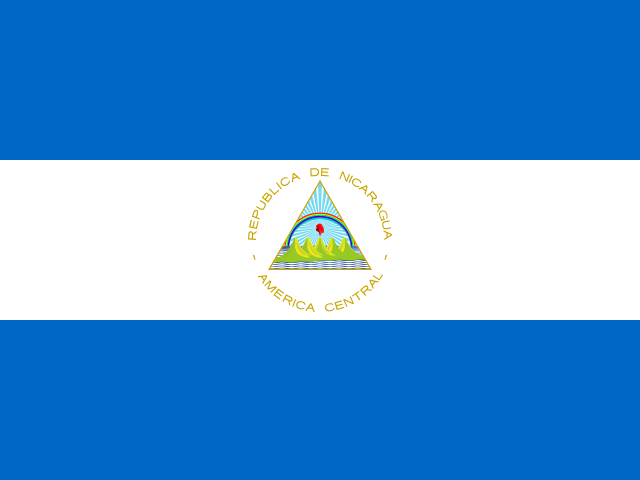
Overview
Nicaragua, officially the Republic of Nicaragua, lies in Central America and covers roughly 130,000 square kilometers, making it the largest country in the region by area. Its population is about 7.1 million (2026 figure in the source), placing it third in Central America by population after Guatemala and Honduras.
It is bordered by Honduras to the north, Costa Rica to the south, the Caribbean Sea to the east and the Pacific Ocean to the west. It also has maritime borders with El Salvador and Colombia. The capital and largest city is Managua, with about 1.05 million people in the city proper (2020 figure).
Spanish is the official language. On the Caribbean coast (Mosquitia), indigenous languages, English-based creoles and English are also spoken. The country has a mixed cultural heritage with a strong literary tradition, including the poet Rubén Darío.
Nicaragua is nicknamed the land of lakes and volcanoes and also the breadbasket of Central America because of its fertile soil and arable land. It holds the Bosawás Biosphere Reserve, described as the second-largest tropical rainforest in the Americas. Warm weather, biodiversity and active volcanoes make it a growing tourist destination.
Politically, the country is nominally a unitary presidential republic, yet Daniel Ortega's rule since 2007 has brought serious democratic backsliding. Since the 2021 election, many observers have characterized it as an authoritarian dictatorship. It is a developing nation with one of the lowest GDP per capita figures in Latin America and the Caribbean, and in 2025 the Corruption Perceptions Index placed it second-most corrupt in Latin America, behind only Venezuela.
It is a founding member of the United Nations and belongs to the Non-Aligned Movement, the Bolivarian Alliance for the Peoples of Our America (ALBA) and the Community of Latin American and Caribbean States.
History
Paleo-Indians lived in the area as early as about 12,000 BCE. In later pre-Columbian times the peoples of Nicaragua belonged to the Intermediate Area between Mesoamerican and Andean cultural zones. The central region and Caribbean coast were home to Macro-Chibchan-language groups such as the Miskito, Rama, Mayangna and Matagalpa, while the west hosted the Nahua (Nicarao), Chorotega and Subtiaba (Maribios).
Christopher Columbus reached the Mosquito Coast in 1502 on his fourth voyage. The Spanish returned about 20 years later: Gil González Dávila entered the southwest in 1522, and Francisco Hernández de Córdoba founded León and Granada in 1524. Granada is described in the source as the oldest colonial city in the Americas. From 1527 to 1821 Nicaragua was a province within the Captaincy General of Guatemala.
The Act of Independence of Central America in September 1821 ended Spanish rule. Nicaragua briefly became part of the First Mexican Empire, then joined the United Provinces of Central America in 1823, and became a fully independent republic in 1838. The early decades were marked by a long contest between the Liberal elite based in León and the Conservative elite based in Granada. (Approx.: the capital was later placed in Managua as a compromise between the two cities.)
The Caribbean coast followed a separate path as an independent kingdom (Mosquitia) under British protection from the 17th century until the 1860 Treaty of Managua, which brought it into union with Nicaragua. The northernmost part went to Honduras under the Wyke-Cruz Treaty of 1859.
In 1909 the United States backed rebels against President José Santos Zelaya, citing the executions of 500 revolutionaries (including two Americans), disputes over a possible canal and Zelaya's regulation of foreign access to resources. Zelaya resigned. U.S. military involvement continued, with Marines present for much of the period until 1933. A 1927 U.S.-brokered pact created the Guardia Nacional to replace them.
Anastasio Somoza García rose through the Guardia Nacional, deposed President Sacasa and took the presidency on 1 January 1937 after a rigged election. The Somoza family ruled, with interruptions, for about 43 years in a hereditary dictatorship. A devastating earthquake in 1972 and perceived corruption fed discontent.
The Sandinista National Liberation Front (FSLN) was founded in 1961 by Carlos Fonseca and others, inspired by the earlier figure of Sandino. Its ranks swelled after the 1972 earthquake. The Sandinistas overthrew the Somoza regime in July 1979 and governed through the 1980s.
In response, rebel groups known as the Contras formed. The Reagan administration authorized CIA funding, weapons and training for them, and they operated from bases in Honduras and Costa Rica. Historians have criticized the Contras for serious abuses against civilians. The U.S. also mined the port of Corinto, an act the International Court of Justice found unlawful, and imposed a trade embargo. The Sandinistas were also accused of abuses, including executions of Miskito people. About 30,000 people died in the war. The Iran-Contra affair involved covert arms sales to fund the Contras after Congress banned such funding. In 1986 the ICJ ruled in Nicaragua v. United States that the U.S. owed reparation.
Daniel Ortega won the 1984 election. In 1990 a coalition led by Violeta Chamorro defeated him, making her the first woman president, and she inherited an economy in ruins. Arnoldo Alemán (PLC) won in 1996, and Enrique Bolaños in 2001. Alemán was later convicted of embezzlement and corruption, and a political standoff against Bolaños in 2003-2004 ended without his removal after regional and international pressure.
In 2006 Ortega returned to the presidency with about 38% of the vote after an electoral law change lowered the threshold for avoiding a runoff. He was re-elected in 2011 with about 62%. A 2014 constitutional change allowed indefinite re-election, and he won again in 2016 (reported 72%, with opposition claims of heavy abstention and limited observation). Abortion was banned with no exceptions in 2006.
In April 2018 protests against pension reform grew into nationwide anti-government demonstrations. Independent groups documented dozens of deaths and hundreds wounded, and repression of dissent followed. Ortega won a fourth term in 2021 in an election described by the OAS, the U.S. and the EU as a sham. Nicaragua broke ties with Israel in October 2024.
In January 2025 a constitutional reform extended the presidential term from five to six years, moving the next election from November 2026 to November 2027, and created a co-presidency with Vice President Rosario Murillo. On 19 July 2026 Ortega announced that elections would no longer be held, which effectively cancelled the 2027 vote. The United States condemned this. Murillo later said the remarks were taken out of context and elections would still occur but based on national sovereignty. How this develops is not covered here.
Climate
Nicaragua has a tropical climate with a dry season from roughly November to April and a rainy season from May to October. The Pacific lowlands (tierra caliente, below about 610 m) are hot all year, with daily highs of about 29 to 32 °C and 1,000 to 1,500 mm of rain a year.
The central highlands (tierra templada, about 610 to 1,500 m) are milder, with highs of about 24 to 27 °C and a longer, wetter rainy season. Cloud forests and coffee cultivation are found here.
The Caribbean lowlands are hot, humid and rainy, covering about 57% of the territory with tropical rainforest and large rivers. Bluefields and Puerto Cabezas are the main coastal towns.
Managua, on the shore of Lake Managua, has a tropical savanna climate: hot throughout the year (approx. highs of 30 to 35 °C, hottest just before the rains), a dry season from November to April, and a wet season from May to October. León and Granada, also in the Pacific lowlands, are similarly hot, with Granada slightly moderated by Lake Nicaragua. Highland towns such as Estelí, Matagalpa and Jinotega (approx.) are noticeably cooler.
Natural hazards include volcanic eruptions and frequent earthquakes, since Nicaragua hosts much of the Central American Volcanic Arc and has 21 active volcanoes under monitoring. Earthquakes have nearly destroyed Managua more than once. (Approx.: hurricanes also periodically affect the Caribbean coast in the Atlantic season.)
Government and politics
Constitutionally Nicaragua is a unitary presidential republic in which the president is head of state and government. In practice, since Daniel Ortega's election in 2006, democratic norms have eroded. The FSLN dominates, opposition candidates and activists have been arrested, independent media have been repressed, and most government jobs de facto require FSLN membership. V-Dem describes the country as an electoral autocracy.
Ortega won third and fourth terms in 2016 and 2021 amid credible reports of fraud, intimidation and arrests of opposition leaders, with independent observers barred. The OAS, U.S. and EU called the 2021 vote a sham.
Constitutional amendments in 2025 defined the state as revolutionary and socialist, made the FSLN flag a national symbol, labeled opponents of the constitution's principles as traitors to the homeland, created a co-presidency (Ortega and Murillo) able to coordinate the legislature, judiciary and executive, extended presidential terms to six years, set up a voluntary civilian auxiliary police, and limited speech and religious practice deemed to violate public order. The OAS and opposition figures criticized the reform as illegitimate and as eliminating checks and balances.
Administratively the country is unitary, divided into 15 departments and two self-governing autonomous regions on the Caribbean coast (North Caribbean Coast, RACCN, and South Caribbean Coast, RACCS), which were created in the 1980s to give Black and indigenous communities limited self-rule. These are subdivided into 153 municipalities. Because the state is unitary, the sub-national units have limited powers compared with a federal system; the autonomous regions have a degree of self-government in local and cultural matters. (Approx.: key policy areas such as taxation, law, health and education are largely set nationally.)
The armed forces (army, navy and air force) have roughly 14,000 active personnel, with a military budget of about 0.7% of expenditures as of 2006. The National Police function separately and at times alongside the military. A U.S. State Department report cited in the source says corruption is endemic in law enforcement and the judiciary. Nicaragua's homicide rate was about 11 per 100,000 in 2021, among the lowest in Central America.
In foreign policy Nicaragua pursues an independent line. It has territorial disputes with Colombia (San Andrés and Providencia archipelago and Quitasueño Bank) and with Costa Rica (San Juan River). It voted against condemning Russia's 2022 invasion of Ukraine. Human rights have been rated not free since 2019.
Economy
Nicaragua is one of the poorest countries in the Americas, ahead only of Haiti in nominal GDP per capita. GDP (PPP) was estimated at about US$56.7 billion in 2023. Agriculture was 15.5% of GDP in 2020, the highest share in Central America, and remittances exceed 15% of GDP, at nearly a billion dollars a year. The economy contracted by 3.9% in 2019 amid the political crisis.
Agriculture employs about 29% of the workforce. Coffee is a leading crop, with nearly two-thirds grown in the northern highlands around Estelí. Tobacco exports (leaf and cigars) are about US$200 million a year. Bananas and sugarcane are grown near Corinto, and newer crops include peanuts, sesame, melons and onions. Cocoa is notable: Nicaragua is Central America's largest cocoa producer, with 10,000 to 14,000 tonnes a year, mostly fine-flavor and grown by small farmers. Cotton output has declined since 1985.
Fishing (shrimp and lobster, processed at Puerto Cabezas, Bluefields and Laguna de Perlas), gold mining (under 1% of GDP, with active mining around Bonanza) and logging contribute, though logging is increasingly restricted. The maquila (assembly) sector slowed in the 2000s with Asian competition. The minimum wage is among the lowest in the Americas, and the informal sector is large. Wealth has traditionally been based on land, and a small upper class holds much economic and political power.
Infrastructure was heavily damaged in the 1980s and transport remains inadequate in places, though a road linking Nueva Guinea and Bluefields was completed in 2019. Hydroelectric projects such as Centroamérica on the Tuma River support power supply, and the country aims for a high share of renewable energy. A long-discussed interoceanic canal has been promoted by Ortega as a route to economic independence, but construction has not started.
In the World Bank ranking Nicaragua placed 123rd of 190 for ease of starting a business, and it ranked 130th on the 2025 Global Innovation Index. It is a member of ALBA. (Approx.: the currency is the córdoba, and the country belongs to the Central American Free Trade Agreement with the U.S.)
Tourism became the second-largest industry by 2006, passing one million visitors in a year for the first time in 2010. Main attractions are the colonial cities León and Granada, Masaya, San Juan del Sur, Ometepe Island, Mombacho and other volcanoes, Apoyo Lagoon, the Corn Islands, surfing, ecotourism and volcano activities such as sand-boarding at Cerro Negro. About 60,000 U.S. citizens visit each year, and roughly 5,300 U.S. citizens live in the country.
Demographics and urbanization
Nicaragua has about 7.1 million people (2026). The source gives a 58% urban share as of 2013 and a growth rate of 1.5%. The birth rate was 17.7 per 1,000 and the death rate 4.7 per 1,000 as of 2017. The Pacific lowlands hold over half the population, while the Caribbean region (57% of the territory) is sparsely populated, with about 700,000 people in 2005 versus over 5 million in the Pacific, Central and North regions.
Ethnically, around 69% are mestizo, 17% white (mostly of Spanish descent, with German, Italian, English, Danish and French minorities), 9% Black and other, and 5% indigenous. Genetic studies show mixed European, African and indigenous ancestry in varying proportions. Black Creoles, English-speaking and descended from escaped or shipwrecked slaves, live mainly on the Caribbean coast, along with Garifuna and Miskito Sambu communities. Indigenous groups include the Miskito, Mayangna, Ulwa, Rama and Matagalpa.
Managua is the largest city, with about 1.04 million in 2016 and about 1.06 million in 2020. (Approx. other cities: León about 200,000 to 220,000, Masaya, Matagalpa, Estelí and Chinandega each roughly 100,000 to 200,000, Granada about 120,000, Bluefields about 50,000 to 60,000 by municipality.)
Immigration is small, with the foreign-born population at 1.2% in 2005. There are communities of Middle Eastern descent (about 30,000) and Chinese (about 12,000). A growing expatriate community, mostly business people, investors and retirees from the U.S., Canada, Taiwan and Europe, has settled mainly in Managua, Granada and San Juan del Sur.
Emigration is large: one in six Nicaraguans live in the United States or Costa Rica, and others in Spain, Canada, and elsewhere, including El Salvador.
Spanish is universal, with regional variation (for example s-to-h pronunciation). On the Caribbean coast, Miskito is the most widely spoken indigenous language, along with Mayangna, Ulwa, Rama, Garifuna and English-based Miskito Coast Creole. Nicaraguan Sign Language emerged in the 1970s and 1980s and is of special interest to linguists.
Catholicism is traditionally the majority religion, but practicing Catholics are declining while evangelical Protestant groups and the LDS Church (about 96,000 members) have grown. Anglican and Moravian communities are strong on the Caribbean coast. The Ortega government has been in open conflict with the Catholic Church, including arrests of clergy such as Bishop Rolando Álvarez. La Purísima in early December is the major popular religious festival.
Adult literacy was 78.0% in 2005, the lowest in Central America, although a 1980 Sandinista literacy campaign cut illiteracy from 50.3% to 12.9%. Primary education is free, and private (often religious) schools have stronger English programs. The government guarantees universal free health care, but quality is uneven in remote rural and Atlantic regions. Gender equality is ranked high regionally (fifth globally in the World Economic Forum's 2020 report), though discrimination against LGBTQ people is common.
Capital city
Managua is the national capital and largest city, on the southern shore of Lake Managua in the Pacific lowlands. It had about 1.06 million people in the city proper in 2020 (approx. 1.5 to 1.1 million depending on metro definition, with the wider metro area somewhat larger).
The climate is tropical savanna: hot all year (approx. highs of 30 to 35 °C), a dry season from November to April and a rainy season from May to October. The city is exposed to earthquakes, which have nearly destroyed it more than once, notably in the 1972 earthquake that badly damaged the center and contributed to the fall of the Somoza regime.
Managua is the seat of government, with the presidency, National Assembly and ministries, and it is also the country's main economic and commercial center, with most services, industry and the principal airport (approx.). It is the only major capital-level center, so the political and economic capitals coincide. The colonial cities of León and Granada are the historic and tourism-focused rivals, with León historically the Liberal center and Granada the Conservative center.
Managua is also a main base for expatriates, together with Granada and San Juan del Sur. Its cultural life includes the festival of Santo Domingo in August, when processions cross the city.
About this summary
Some history details (colonial era, 19th-century conflicts, Somoza era), metro and city populations, city climates and capital-city details, and recent economic figures are filled from general knowledge and are approximate.