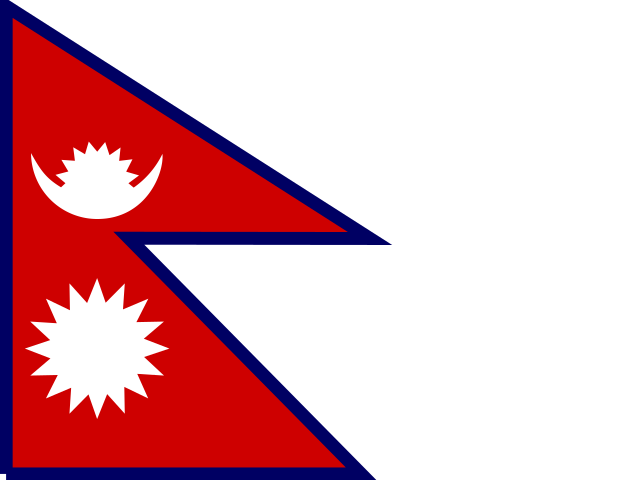
Overview
Nepal, formally the Federal Democratic Republic of Nepal, is a landlocked South Asian country squeezed between Tibet (China) to the north and India on its other three sides. It sits mostly in the Himalayas, with a thin strip of the Indo-Gangetic Plain in the south. A narrow stretch of Indian territory (the Siliguri Corridor) separates it from Bangladesh, and the Indian state of Sikkim separates it from Bhutan.
The landscape ranges from fertile lowland plains through forested hills to high peaks. Eight of the ten tallest mountains on Earth are in Nepal or on its border, including Mount Everest, the planet's highest point above sea level at 8,848.86 m. Kathmandu is both the capital and the largest city.
Nepal is multi-ethnic, multilingual, multi-religious and multicultural. Nepali is the official language. The state is a secular federal parliamentary republic under a constitution adopted in 2015, with seven provinces.
In foreign policy Nepal stresses neutrality, sovereignty and multilateral cooperation. It joined the United Nations in 1955 and signed friendship treaties with India (1950) and China (1960). It is a founding member of SAARC, whose permanent secretariat is in Kathmandu, and also belongs to the Non-Aligned Movement and the Bay of Bengal Initiative (BIMSTEC).
History
Human settlement in Nepal goes back roughly 30,000 years, according to the oldest archaeological evidence. Around 600 BC, small kingdoms and clan confederations formed in the southern lowlands of Nepal and northern India. One of them, the Shakya polity, produced the prince who became Gautama Buddha (traditionally 563–483 BC). Over the following centuries Nepal became known as a place of spirituality and refuge, helped carry Buddhism to East Asia through Tibet, and preserved Hindu and Buddhist manuscripts. By about 250 BC the southern areas were under the influence of the Maurya Empire.
In the 11th century a powerful Khas empire arose in western Nepal, reaching parts of western Tibet and Uttarakhand in India. By the 14th century it had broken into loosely linked small states known as the Baise rajyas (22 states). The Khas language, later called Nepali, spread widely and became the lingua franca of Nepal and neighbouring parts of India.
Nepal Mandala, a prosperous confederacy of the Newars, had its center in the Kathmandu Valley. Traders from the valley held sway over the Himalayan stretch of the ancient Silk Road, and over time the region cultivated its own distinctive art and architecture.
In the mid-18th century Prithvi Narayan Shah, king of Gorkha, set out to unify the region. He secured the neutrality of neighbouring hill kingdoms and, after hard fighting including the Battle of Kirtipur, took the Kathmandu Valley in 1769. Gorkhali control eventually stretched from Kumaon and Garhwal in the west to Sikkim in the east. A dispute with Tibet over mountain passes brought in the Qing emperor, and the Anglo-Nepalese conflict ended with the Treaty of Sugauli, after which Nepal kept its independence as a buffer between British India and imperial China. It was never colonised.
In 1846 factional strife in the royal court led to the Kot massacre, in which several hundred princes and officials were killed. Jung Bahadur Rana (Bir Narsingh Kunwar) emerged on top and founded the Rana dynasty. The king became a figurehead and the hereditary post of prime minister became the real centre of power. Rana rule lasted until 1951.
By the late 1940s pro-democracy movements opposed the Ranas. Helped by India and King Tribhuvan, the Nepali Congress ended the Rana regime in 1951 and set up parliamentary democracy. In 1960 King Mahendra ended the experiment and introduced the party-free panchayat system, which banned parties and jailed or exiled politicians. It modernised the country and built infrastructure but restricted freedoms and imposed heavy censorship. The People's Movement of 1990 forced King Birendra to accept constitutional reform and multi-party democracy.
In 1996 the Maoist party began an armed campaign to replace the monarchy with a people's republic, starting a civil war that killed more than 16,000 people. In 2001 King Birendra and Crown Prince Dipendra died in a palace massacre carried out by Dipendra, and Birendra's brother Gyanendra took the throne and later assumed full executive power. The Maoists joined mainstream politics after the peaceful democratic revolution of 2006.
Nepal turned into a secular federal republic on 28 May 2008, which brought the world's last Hindu monarchy to an end. The country then endured ten years of instability and held two constituent assembly elections. Its new constitution was finally promulgated on 20 September 2015 and established seven provinces.
In September 2025 large protests over a social media ban and economic inequality turned into rioting that killed or injured dozens, damaged Parliament and other buildings, and led Prime Minister K. P. Sharma Oli to resign and take refuge with the army. The army took charge of nationwide security and held talks with protest leaders, who chose former chief justice Sushila Karki as interim prime minister. According to the source, Balen Shah became Prime Minister on 27 March 2026 after his party won the 2026 general election.
Climate
Nepal's climate follows altitude. There are five zones: tropical and subtropical below 1,200 m, temperate from 1,200 to 2,400 m, cold from 2,400 to 3,600 m, subarctic from 3,600 to 4,400 m, and arctic above 4,400 m. The country has five seasons: summer, monsoon, autumn, winter and spring. The Himalayas shield Nepal from cold Central Asian winter winds and mark the northern edge of the monsoon system.
The country has three physical belts. Himal, the northern snowy mountain zone, holds the highest peaks. Pahad, the hills, run from about 800 to 4,000 m and shift from subtropical conditions below 1,200 m to alpine above 3,600 m. Terai, the southern plain, is subtropical to tropical and is fed by the Koshi, Narayani and Karnali rivers. Snow occasionally falls above about 2,500 m in the hills in winter.
The monsoon brings heavy rain, and floods and landslides each year cause deaths, damage farmland and disrupt transport. The Indian plate keeps pushing north at about 50 mm a year, so earthquakes are a major hazard. The east gets more rain and is richer in wildlife than the drier west.
Kathmandu (about 1,300 m) has a mild temperate-subtropical climate (approx.): warm, wet monsoon summers, dry and pleasant autumns and springs, and cool winters with chilly nights, around 2–3°C at the coldest and rarely any snow. Pokhara (about 800 m) is warmer and notably wetter (approx.), with very heavy monsoon rainfall because of the nearby Annapurna range. Terai cities such as Biratnagar, Birgunj and Nepalgunj are hot and humid in summer, often above 35–40°C (approx.), with mild winters and foggy mornings.
Air pollution is a serious issue, and Nepal has consistently ranked among the more polluted countries, with the Kathmandu Valley especially affected in the dry season (general knowledge).
Government and politics
Nepal is a federal parliamentary republic with a multi-party system under the 2015 constitution. The President appoints the leader of the majority party (or coalition) in the House of Representatives as Prime Minister, who forms a council of ministers holding executive power. Parliament has two chambers: the 275-member House of Representatives, elected under a mixed system for five years, and the 59-member National Assembly, a permanent house elected by provincial electoral colleges in which a third of members change every two years on six-year terms.
The judiciary is a single, unified, three-tier system: the Supreme Court, seven High Courts (one per province) and 77 district courts. Municipalities may convene local judicial bodies to settle minor disputes and issue non-binding verdicts in cases without actionable crime; district courts can guide or overrule them. The Supreme Court is the final interpreter of law and can direct parliament to amend or pass laws.
Power is split among three levels. The federal government handles national matters. Seven provinces, each with an elected unicameral Westminster-style legislature, have their own governments, and each contains 8 to 14 districts. Below them are 753 local units: 6 metropolitan, 11 sub-metropolitan and 276 municipalities (293 urban in all) plus 460 rural municipalities, divided into 6,743 wards. Local governments have executive and legislative power and limited judicial powers within their areas. Some powers are exclusive to a level and others are shared among federal, provincial and local governments. District coordination committees, made up of the district's local elected officials, play only a very limited role. (The detailed allocation of tax, health, education and policing powers is not described in the source; broadly, local units handle services such as basic health and schooling, and the federal level keeps defence, foreign affairs and major taxes — general knowledge, approx.)
Politics: the House of Representatives includes six parties: the Rastriya Swatantra Party, Nepali Congress, CPN (UML), Nepali Communist Party, Shram Sanskriti Party and Rastriya Prajatantra Party. The Janata Samajbadi Party and Rastriya Janamorcha sit in the National Assembly. CPN (UML) is regarded as leftist and the Nepali Congress as centrist. The first elections under the new constitution were in 2017. The 2022 election produced a hung parliament and a coalition under Pushpa Kamal Dahal in December 2022; K. P. Sharma Oli was sworn in for a fourth time on 15 July 2024. Following the 2025 unrest, an interim government led by Sushila Karki took office, and Balen Shah became Prime Minister on 27 March 2026 after his party's landslide in the 2026 general election.
Law: the constitution is the supreme law, backed by civil and criminal codes and procedure codes. The death penalty has been abolished. Some provisions remain discriminatory, such as for foreign nationals married to Nepali citizens, and paternal lineage is required in legal documents. Many laws are poorly enforced. Nepal Police is the main law enforcement body, with the paramilitary Armed Police Force handling crowd control and internal security, and an independent anti-corruption body (the Commission for the Investigation of Abuse of Authority). The intentional homicide rate was about 2.16 per 100,000 in 2016, though police data shows rising crime. Nepal ranked 76th of 163 in the 2019 Global Peace Index, and its passport has regularly been ranked among the weakest.
Foreign relations: Nepal follows neutrality and non-alignment and has relations with 167 countries and the EU. Its 1950 treaty with India allows an open border with free movement, and Indians may live and work in Nepal. India is the largest trading partner and supplies all of Nepal's oil and gas, though the two have territorial disputes. Nepal follows the One China policy, joined the Belt and Road Initiative, and citizens of both countries may cross up to 30 km without a visa. Nepal has contributed more than 119,000 personnel to 42 UN peacekeeping missions since 1958, and Gurkha soldiers have served in the Indian and British armies for about 200 years.
Military: the President is supreme commander of the Nepali Army, which has fewer than 100,000 volunteer personnel and mostly ground infantry. Military spending in 2018 was about $398.5 million (about 1.4% of GDP). The army is used for securing key assets, anti-poaching patrols, disaster relief and construction projects.
Economy
Nepal is among the least developed countries. In the source, GDP for 2019 was about $34.2 billion and per capita income about $1,004. The labour force is about 16.8 million. By sector, services account for roughly 58% of GDP, agriculture 28% and industry 15%, yet agriculture employs about 76% of workers, services 18% and manufacturing and crafts 6%. Only about 28% of arable land was irrigated in 2014, leaving farming heavily dependent on the monsoon.
Remittances were about US$8.1 billion in 2018, roughly 28% of GDP, mostly from largely unskilled workers in Malaysia and the Middle East. Main crops include rice (paddy), maize, wheat, millet, barley, oilseed, potato, pulses, sugarcane, jute, tobacco, milk and buffalo meat. Key industries are tourism, carpets, textiles, cigarettes, cement, bricks and small mills.
Trade liberalisation began in 1985 and sped up after 1990; Nepal joined the WTO on 23 April 2004. More than 60% of trade is with India. Exports include ready-made garments, carpets, pulses, handicrafts, leather, medicinal herbs and paper products. The main export markets are the EU (46%), the US (17%) and Germany (7%), while imports come from India (47.5%), the UAE (11%), China (11%), Saudi Arabia and Singapore, and include machinery, fertiliser, electronics, petroleum products, gold and clothing. Inflation was 4.5% in 2019, and reserves were US$9.5 billion in July 2019 (7.8 months of imports). The rupee is pegged to the Indian rupee at 1.6. The 2019/20 government budget was about $13.7 billion; development spending is largely funded by foreign aid and often falls short of targets. Aid donors include the UK, India, Japan, the US, the EU, China, Switzerland and Scandinavian countries.
Extreme poverty (below US$1.90 a day) fell from 15% in 2010 to 9.3% in 2018, although about 32% still live on US$1.90–3.20 a day. The top 10% of households hold about 39% of wealth and the bottom 10% about 2.6%. Landlocked, rugged terrain, few natural resources, poor infrastructure, weak governance after 1950 and the civil war have held back growth. Debt bondage persists in the western hills and Terai, with an estimated 234,600 people affected in 2016, according to the Global Slavery Index. In 2022, Nepal restricted imports of non-essential goods after foreign currency reserves fell, and COVID-19 cut tourism income and remittances.
Tourism employs over a million people and contributes about 7.9% of GDP. International arrivals passed one million in 2018 for the first time, not counting Indians arriving by land. Main attractions include Pokhara, the Annapurna trekking circuit and four UNESCO World Heritage Sites: Lumbini, Sagarmatha National Park, the Kathmandu Valley (seven monuments listed together) and Chitwan National Park. Most mountaineering income comes from Everest. Nepal opened to Westerners in 1951 and became a hippie-trail destination in the 1960s and 70s. Growth is limited by infrastructure bottlenecks and problems at Nepal Airlines; home-stay tourism has had some success.
Demographics and urbanization
Nepal's 2021 census counted about 29.5 million people, up from about nine million in 1950. Density is about 198 people per km², the annual growth rate has slowed to 0.92%, and there are about 95.6 males per 100 females. The population descends from several migrations from India, Tibet, Central Asia and Yunnan, and the country has 125 ethnic groups speaking 123 mother tongues.
Nepal is among the least urbanised countries yet one of the fastest urbanising. The source gives about 18.3% urban in 2014; the share is higher now (approx. 20–25%, with the 2021 census counting a much larger share in municipalities). Most people still live in the central hills and valleys, with growing migration to the Terai; the high mountains are sparsely populated. Urbanisation is stronger in central and eastern Nepal than in the west.
Largest cities: Kathmandu (approx. 1 million in the city, about 3 million in the valley, approx.), Pokhara (approx. 600,000), Lalitpur (approx. 300,000), Bharatpur (approx. 350,000), Biratnagar (approx. 250,000) and Birgunj (approx. 250,000), plus Dharan, Hetauda and Nepalgunj. Congestion, pollution and water shortages are major problems, most of all in the Kathmandu Valley.
Languages (2021 census, mother tongue): Nepali 44.9%, Maithili 11%, Bhojpuri 6.2%, Tharu 5.9%, Tamang 4.9%, Bajjika 3.9%, Awadhi 3%, Nepal Bhasa 3% and Magar 2.8%. Nepali is written in Devanagari and is the common language across groups. Maithili, Awadhi and Bhojpuri are spoken in the Terai, and Tibetan varieties in the high Himalaya.
Religion (2011 census): Hinduism 81.3%, Buddhism 9%, Islam 4.4%, Kirant 3.1%, Christianity 1.4%, nature worship 0.5%. Nepal is constitutionally secular, though the constitution does not grant a right to convert others, and a stricter anti-conversion law passed in 2017. Religious tolerance is generally high.
Education and health: literacy rose from 54.1% (2001) to 65.9% (2011). Primary net enrolment reached 97% by 2017, but secondary is below 60% and tertiary about 12%. Nepal has eleven universities and ranked 107th in the 2025 Global Innovation Index. Life expectancy is about 71 years (2017), up from 35 in 1950. Infant mortality is 32.2 per 1,000 and maternal mortality 229, but child malnutrition is still high. Toilet access reached 99% in 2019.
Refugees and migrants: Nepal hosts refugees, about 20,800 in late 2018, mostly Tibetans (64%) and Bhutanese (31%). India reports about 600,000 of its citizens in Nepal; Indians need no permit to live and work there. Tens of thousands of Nepali students leave each year, and half never return.
Capital city
Kathmandu lies in the Kathmandu Valley in the central hills, at roughly 1,300 m. The city has about 1 million residents (approx.), with a valley urban area of around 3 million (approx.). It is Nepal's capital and largest city, nicknamed the City of temples, and is the cultural and economic heart of the country. It is also the seat of government and of the SAARC secretariat. Nepal has a single capital and Kathmandu is also the main economic centre.
The valley was the home of the Newar Nepal Mandala and a trading hub on the Himalayan Silk Road. Seven monument groups in the valley form one UNESCO World Heritage Site. The Pashupatinath Temple on the Bagmati River is a major Hindu complex with public cremation ghats that attract many visitors. Tribhuvan International Airport, the main gateway, is in the city (general knowledge).
Climate (approx.): mild highland subtropical, with warm monsoon summers (about 28–30°C highs, heavy rain from June to September), dry, clear autumns and springs, and cool winters with highs near 18–20°C and lows of about 2–5°C. Congestion, air pollution and water shortages are serious problems for the fast-growing city. Lalitpur, adjoining the city to the south, is also a large city in the same urban area.
About this summary
Capital-city details, metro and city populations, city climates, and some recent economic and political context are from general knowledge and approximate. Urbanization has been updated beyond the source's 2014 figure.