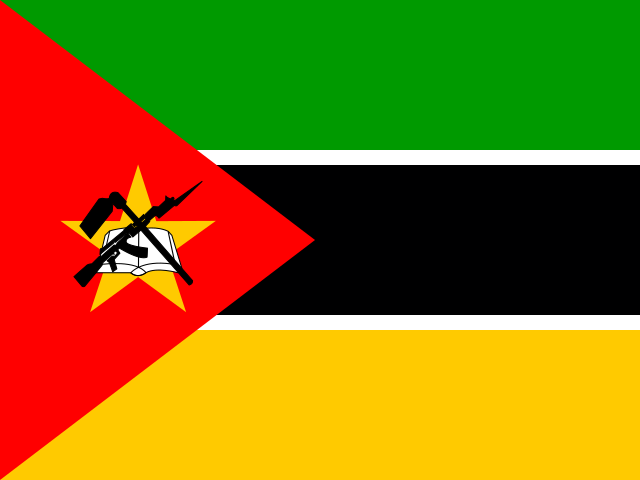
Overview
Mozambique, officially the Republic of Mozambique, lies on the southeast coast of Africa. The Indian Ocean forms its eastern edge. Tanzania is to the north, Malawi and Zambia to the northwest, Zimbabwe to the west, and Eswatini and South Africa to the south and southwest. Across the Mozambique Channel to the east lie the Comoros, Mayotte and Madagascar.
The capital and largest city is Maputo, in the far south. Portuguese is the only official language, though more than 2,000 ethnic groups are counted and Glottolog lists 46 languages, including Mozambican Sign Language. The population is overwhelmingly Bantu.
The economy rests mainly on fishing and agriculture, with growing food and beverage, chemicals, aluminium and oil and gas activity, and an expanding tourism sector. Growth was strong after 2001, but since 2014/15 household consumption has fallen and inequality has risen sharply. The country remains one of the poorest in the world by income, human development and life expectancy.
Since the first multiparty elections in 1994 the country has been a relatively stable presidential republic, though a low-intensity insurgency continues in the far north, in areas where Islam is the dominant faith.
History
Bantu-speaking peoples arrived in what is now Mozambique from as early as the 4th century BC, with larger waves between the 1st and 5th centuries AD moving through the Zambezi valley onto the plateau and coast. They brought farming, cattle herding and iron smelting and smithing.
From the late first millennium AD, Indian Ocean trade reached as far south as present-day Vilankulo, shown by the ancient port of Chibuene. From the 9th century, port towns grew along the East African coast, largely self-governing and part of the emerging Swahili culture. Urban elites often adopted Islam to ease trade. By the 15th century Sofala, Angoche and Mozambique Island were regional powers, and traders from Somalia, Ethiopia, Egypt, Arabia, Persia and India visited.
Mozambique Island, which gave the country its name, is a tiny coral island in Mossuril Bay on the northern Nacala coast. Europeans first explored it in the late 15th century. Vasco da Gama's voyage in 1498 brought the Portuguese, who began gradual colonisation and settlement in 1505 and ruled for over four centuries.
As anti-colonial ideas spread across Africa, clandestine movements formed. They argued that development policy mainly served the Portuguese population and neglected African communities, which also suffered discrimination. The independence war ran from 1961 to 1974, and FRELIMO took control after about ten years of sporadic fighting, helped by the 1974 Carnation Revolution in Portugal that ended the Estado Novo regime.
Most of the roughly 250,000 Portuguese left within a year, some expelled and some fleeing possible reprisals. Mozambique became independent on 25 June 1975 as the People's Republic of Mozambique.
President Samora Machel set up a one-party Marxist state backed by Cuba and the Soviet Union. From 1977 to 1992 a civil war pitted the anti-communist RENAMO rebels against FRELIMO. Rhodesia and later apartheid South Africa backed RENAMO, while FRELIMO sheltered the ANC and ZANU. Sabotage, failed central planning, nationalisations and the exodus of Portuguese brought economic collapse, a wrecked infrastructure and widespread famine.
The government often could not control territory outside urban areas, and RENAMO held up to 50% of rural areas in several provinces. Both sides committed mass human rights violations. The government executed tens of thousands and sent many to re-education camps where thousands died. RENAMO once proposed a secession deal creating a Republic of Rombesia, which FRELIMO refused. An estimated one million Mozambicans died, 1.7 million fled to neighbouring states and millions more were displaced. Between 300,000 and 600,000 died of famine.
On 19 October 1986 Machel died with 33 others when his plane crashed in the Lebombo Mountains in South Africa. A Soviet minority report to the UN-linked Margo Commission suggested the plane was lured off course by a false navigation beacon.
His successor Joaquim Chissano moved from Marxism to capitalism and opened peace talks. The 1990 constitution created a multiparty system, a market economy and free elections, and the 'People's Republic' name was dropped. The war ended in October 1992 with the Rome General Peace Accords, mediated first by the Christian Council of Mozambique and then by the Community of Sant'Egidio, with UN peacekeepers supervising.
Elections have been held since 1994. FRELIMO won under Chissano, with RENAMO led by Afonso Dhlakama as the opposition. The source says the first elections were widely accepted as free and fair, but that growing evidence points to fraud in all elections since 1999, and to assassinations and imprisonment of opponents. In 1995 Mozambique joined the Commonwealth, then the only member never part of the British Empire. By mid-1995 over 1.7 million refugees had returned, part of the largest repatriation in sub-Saharan Africa.
An insurgency began in October 2017 in the northern province of Cabo Delgado, started by the local group Ahlu Sunna Wal Jamaah and later aligned with Islamic State as IS-Mozambique Province.
Climate
Mozambique's climate is tropical and shifts with altitude, with rains falling between October and March and drier conditions lasting from April through September. The coast receives the heaviest rainfall, while the north and south get less. Yearly precipitation falls between roughly 500 and 900 mm, with an average near 590 mm. During the rainy months, cyclones occur frequently.
Maputo, the capital in the south, averages roughly 13 to 24 °C in July and 22 to 31 °C in February. Approx.: it has a subtropical to tropical coastal climate with hot, humid, rainy summers and mild, drier winters.
Other major cities include Beira, Nampula, Tete, Quelimane, Chimoio, Pemba, Inhambane, Xai-Xai and Lichinga. Approx.: Beira, Quelimane, Pemba and Inhambane on the coast are hot and humid with a distinct wet season. Tete in the Zambezi valley is very hot, especially before the rains. Nampula and Lichinga are inland and cooler, with Lichinga on the highlands being the coolest of these.
Severe weather is a recurring risk. In 2019 cyclones Idai and Kenneth struck, the first time two cyclones hit the country in one season. In February and March 2023 Tropical Cyclone Freddy hit twice, affecting over 22,000 houses, flooding 60 health units and damaging 1,265 km of roads, as well as tens of thousands of hectares of crops.
The Zambezi divides the country into two topographic regions. North of it, a narrow coastal strip rises to hills, low plateaus and rugged highlands (Niassa, Namuli or Shire, Angonia, Tete and the Makonde plateau) covered with miombo woodland. South of it the lowlands are broader, with the Mashonaland plateau and the Lebombo Mountains in the far south. Five main rivers drain the country, the Zambezi being the largest. Notable lakes are Niassa (Malawi), Chiuta, Cahora Bassa and Shirwa.
The region's fauna numbers roughly 740 bird species, of which 20 face global threats, along with more than 200 mammal species; among these are the critically endangered Selous' zebra and Vincent's bush squirrel. The conservation network comprises three game reserves, three frontier conservation areas, six nature reserves, seven national parks, and thirteen forest reserves.
Government and politics
The president is head of state, head of government and commander-in-chief, and is directly elected for five years by run-off voting. The president appoints the prime minister, who chairs the council of ministers, advises the president and coordinates the other ministers. The 250-member Assembly of the Republic is elected for five years by proportional representation. The judiciary has a Supreme Court plus provincial, district and municipal courts.
Administratively there are ten provinces and one capital city, Maputo, with provincial status. The provinces contain 129 districts, subdivided into 405 administrative posts headed by secretaries and then localities, the lowest level of central state administration. There are also 53 municipalities. The source describes a largely centralised structure in which localities are the lowest tier of central administration; it does not detail which powers (tax, health, education, law) provinces hold, so that division is not covered here.
The Defence Armed Forces (FADM) were created in August 1994 after the Rome accords by merging government FPLM forces with RENAMO fighters under UN supervision, with an army, air force and navy. They were historically small and underfunded. After the Cabo Delgado insurgency began in 2017 the government used private military contractors, then accepted the SADC Mission in Mozambique (SAMIM). Because regional deployments were slow and costly, it shifted toward bilateral help, notably Rwandan forces from July 2021, which secured key maritime infrastructure and counterinsurgency zones in the north. The insurgents have targeted towns, civil infrastructure and the large offshore LNG projects on the Afungi peninsula.
Foreign policy is described as increasingly pragmatic, built on good relations with neighbours and ties with development partners. Mozambique joined the World Bank and IMF in 1984 and the Commonwealth in 1995, and is a member of the Non-Aligned Movement, African Union, SADC, the Organisation of Islamic Cooperation and the Community of Portuguese Language Countries, of which it was a founding member and first president. Relations with Portugal remain important because Portuguese investors are prominent. Scandinavian countries replaced Soviet support as aid donors, and Italy retains a profile from its role in the peace process.
Same-sex sexual activity has been legal since 2015, though discrimination against LGBT people is described as widespread.
Economy
Mozambique is among the poorest and least developed countries in the world, despite average GDP growth of about 8% a year between 1994 and 2006 and 6 to 7% from 2006 to 2011. Since 2014/15 household consumption has fallen sharply and inequality has risen. The IMF classifies it as a heavily indebted poor country. The World Bank praised its 'blistering' growth in 2007, and a joint donor-government study called it an aid success story, though a 2006 survey found three-quarters of Mozambicans felt no better off over five years.
The currency is the metical; in October 2023 one US dollar was roughly 64 meticals. US dollars, South African rand and euros are widely accepted in business. The minimum legal salary is about US$60 a month. As an SADC member it takes part in a free trade protocol to cut regional tariffs.
In 2013 about 80% of people worked in agriculture, mostly small-scale subsistence farming limited by poor infrastructure, markets and investment. In 2012 over 90% of arable land was still uncultivated. Since 2009 more Portuguese have immigrated because of Portugal's weak economy.
Reforms privatised over 1,200 mostly small state enterprises, with preparations for telecoms, energy, ports and railways, often via a strategic foreign investor. Customs duties were cut and a value-added tax was introduced in 1999.
Corruption scandals have shaken the economy. Anti-corruption laws were proposed in 2011, several bills passed in 2012, two former ministers were convicted of graft, and Transparency International once ranked the country 116th of 178. A 2005 USAID report called the scale of corruption alarming.
Natural gas is a major prospect. Anadarko and Eni discovered the Mamba South field in 2010 to 2011 in the Rovuma Basin off Cabo Delgado, with about 4,200 billion cubic metres of estimated reserves. The Mozambique LNG Project raised $19 billion in 2019, with most of it awarded to TotalEnergies. LNG exports were scheduled to begin in 2024. The source does not confirm the outcome, and the insurgency has threatened these projects.
Tourism draws on beaches, wildlife and heritage: the Quirimbas Islands, Bazaruto archipelago, diving in Inhambane Province (whale sharks and manta rays) and parks such as Gorongosa.
Transport: over 30,000 km of roads, much of it unpaved, with traffic driving on the left. Maputo has the international airport, plus 21 other paved airports and over 100 unpaved airstrips, and there are 3,750 km of navigable inland waterways. Railways (about 3,123 km as of 2005) run from the ports of Beira, Nacala and Maputo to Malawi, Zambia, Zimbabwe, Eswatini and South Africa. These networks link only via neighbouring countries. They were sabotaged in the civil war and are being rehabilitated under the state authority Portos e Caminhos de Ferro de Moçambique.
Water and sanitation are weak: in 2011 about 51% had improved water and 25% adequate sanitation. About 62% of the population lives in rural areas.
Demographics and urbanization
The population is about 34.8 million (2024 estimate), growing about 2.96% a year. Per the source, about 62% live in rural areas (a 2007 figure for the water strategy), so the country is mostly rural. Zambezia and Nampula are the most populous provinces, with about 45% of the population.
Bantu peoples make up 97.8%, with the rest of Portuguese ancestry, mixed Euro-African (mestiço) or Indian. About 45,000 people of Indian descent live there, and Chinese community estimates were 7,000 to 12,000 as of 2007. About 360,000 people of Portuguese heritage lived there at independence, and many left. Makua (about four million) dominate the north, Sena and Shona (Ndau, Manyika) the Zambezi valley, and Tsonga the south. Others include Makonde, Yao, Swahili, Tonga, Chopi and Nguni.
Largest cities, approx.: Maputo with roughly 1.1 million in the city proper and about 2 to 3 million in the wider metro; Matola (next to Maputo) about 1 million; Nampula about 750,000 to 1 million; Beira about 500,000 to 600,000. Other major cities are Tete, Quelimane, Chimoio, Pemba, Inhambane, Xai-Xai and Lichinga.
Fertility was 5.9 children per woman in a 2011 survey (6.6 rural, 4.5 urban).
Portuguese is official and spoken by 50.3% of people, and about half of Maputo speaks it as a native language. Major local languages include Makhuwa, Tsonga, Sena, Chichewa and Swahili, with Swahili and Kimwani on the northern coast, Makonde and Yao inland, Shona varieties near Zimbabwe, and Ronga around Maputo.
Religion: the 2007 census found 59.2% Christian, 18.9% Muslim, 7.3% other beliefs (mainly animism) and 13.9% none. A 2015 survey found 30.5% Catholic, 19.3% Muslim and 44% Protestant groups. USCIRF estimates for 2018 were 28% Catholic, 18% Muslim, 15% Zionist Christian, 12% Protestant, 7% other and 18% none. Muslims are concentrated in the north. A small Jewish community exists in Maputo.
Health indicators are weak: about 3 physicians per 100,000 people in the early 21st century, infant mortality of 100 per 1,000 births (2005), under-5 mortality of 147 per 1,000, and maternal mortality of 550 per 100,000 births (2010). Official HIV prevalence among ages 15 to 49 was 11.5% in 2011, and the source notes higher rates in the southern provinces and Maputo city.
Capital city
Maputo is the capital and largest city, in the far south near the South African and Eswatini borders on the Indian Ocean coast. It has provincial status as a 'capital city' separate from the ten provinces. The population is approx. 1.1 million in the city, with a larger metro area including Matola.
Climate: in July, temperatures typically run from about 13 to 24 °C, while February averages roughly 22 to 31 °C. The year divides into a rainy period lasting October through March and a drier stretch spanning April to September. Cyclones pose a regional risk during the rainy months. Approx.: summers are hot, humid and bring most of the rainfall, whereas winters are mild.
Role: Maputo is the political centre and, approx., also the main economic, commercial and cultural city, and it is the site of the country's international airport. The source lists Maputo as capital and largest city, so the capital and main economic city coincide. Approx.: the port and rail lines to South Africa (Ressano Garcia) and Eswatini support trade.
About half of Maputo's residents speak Portuguese as a native language, and the city has Catholic, Muslim and small Jewish communities. It is an archdiocese seat. HIV prevalence has been higher in Maputo city and the southern provinces. The capital is far from the northern regions affected by insurgency, which the source notes.
About this summary
Approximate general-knowledge facts: capital-city population, city climates, and capital-city details such as its economic role and setting. Other city populations are also approximate.