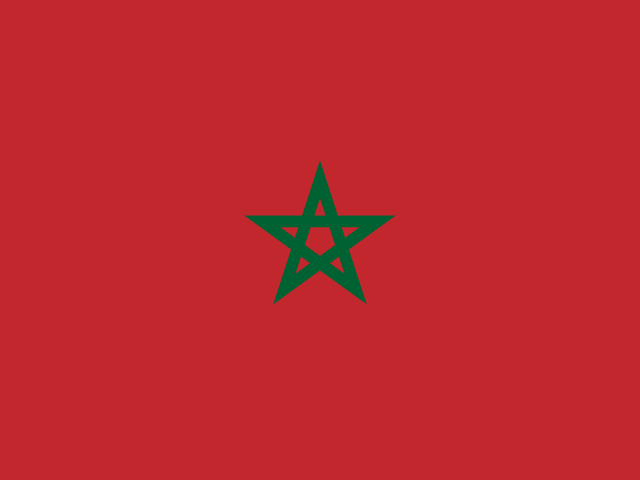
Overview
The Kingdom of Morocco sits in the Maghreb, in the northwest corner of Africa. It has both a Mediterranean coast in the north and an Atlantic coast in the west. Its land neighbours are Algeria to the east and the disputed territory of Western Sahara to the south, which Morocco administers in large part. It also borders the Spanish-controlled enclaves of Ceuta, Melilla and Peñón de Vélez de la Gomera, which it claims along with some small Spanish-held islands. Morocco says it shares a border with Mauritania through Western Sahara. The population is roughly 37 million. Rabat is the capital and Casablanca is the largest city.
People have lived in the area for hundreds of thousands of years. The Moroccan state dates its origins to the Idrisid dynasty, founded by Idris I in 788, and it is often described as one of the world's oldest continuously existing states, although its historical borders differed from today's. The Almoravid and Almohad Berber dynasties of the 11th and 12th centuries took Morocco to its peak as a regional power, ruling the Maghreb and much of southern and eastern Iberia. The Alawi dynasty, in power since 1631, is among the oldest reigning royal houses in the world. France and Spain imposed protectorates in 1912, and Morocco became independent again in 1956 under Mohammed V.
Since independence Morocco has been fairly stable. It is considered a middle power and belongs to the Arab League, the Arab Maghreb Union, the Union for the Mediterranean and the African Union. It has a high Human Development Index ranking by African standards, and in 2025 the African Development Bank described it as Africa's leading industrial economy. It is a unitary monarchy with an elected two-chamber parliament, but the king keeps wide powers over the military, foreign policy and religion. The Economist Democracy Index classes it as a hybrid regime.
Islam is the official and overwhelmingly dominant religion. Arabic and Berber (Amazigh) are the official languages. The Moroccan Arabic dialect, Darija, is the everyday lingua franca. French remains widely used in business and administration. Moroccan culture blends Arab, Berber, Andalusian and African influences.
Morocco treats Western Sahara as its Southern Provinces. Spain withdrew in 1975, and a guerrilla war followed involving Morocco, Mauritania and the Polisario Front, which seeks independence. Mauritania dropped its claim in 1979. A UN-monitored ceasefire began in 1991 but sovereignty is still unresolved. Morocco controls roughly two-thirds of the territory, and mediation has not broken the deadlock.
History
Early history: Humans have lived in what is now Morocco since the Paleolithic. Homo sapiens fossils from Jebel Irhoud on the Atlantic side have been dated to about 315,000 years ago. Hominin fossils from Thomas Quarry I in Casablanca, published in 2026, extend evidence of hominin presence to roughly 773,000 years ago, close to the root of the Homo sapiens lineage.
Islamic era: The Muslim conquest of the Maghreb, begun in the mid-7th century, was completed under the Umayyad Caliphate by 709. It brought Islam and the Arabic language, and began a long period of Arab migration that changed the region's demography. Morocco was first a sub-province of Ifriqiya, run by governors answering to Kairouan. The Berber peoples adopted Islam but kept much of their own identity. The Idrisid dynasty, founded by Idris I in 788, is the usual starting point for the Moroccan state.
Dynasties: Later dynasties included the Almoravids and Almohads, both Berber, who reached the height of Moroccan power in the 11th and 12th centuries and ruled southern and eastern Iberia as well as the Maghreb. In the 15th and 16th centuries Portugal took some coastal territory and the Ottomans pressed from the east, yet the Marinids and Saadis resisted, and Morocco was the only North African state to avoid Ottoman rule. The Saadis conquered the Songhai Empire in the late 16th century. The Alawi dynasty took power in 1631 and over the next two centuries widened diplomatic and trade ties with the West. Morocco was the first country to recognise US sovereignty, in 1777.
Colonial period: European interest grew from the 19th century. France was interested from about 1830, partly to secure Algeria's border. A dispute over Ceuta led to a Spanish war in 1860, and Spain gained a larger Ceuta and another enclave. Spain set up a coastal protectorate in 1884. In 1904 France and Spain agreed spheres of influence. The Algeciras Conference of 1906 settled a German-triggered crisis, and the Agadir Crisis of 1911 raised tensions again. The Treaty of Fez in 1912 made Morocco a French protectorate, set off riots in Fez, and gave Spain a protecting role in the north and far south. Tangier became an international zone. The sultan stayed as formal sovereign with limited authority.
Under the protectorate, tens of thousands of colonists arrived. Some bought rich farmland, others developed mines and ports. Resident-General Marshal Hubert Lyautey admired Moroccan culture, kept a joint Moroccan-French administration and built a modern school system. Moroccan troops served in the French army in both world wars and in Spanish forces in the Spanish Civil War. Slavery was abolished in 1925. From 1921 to 1926 Abd el-Krim led a rebellion in the Rif that established the Republic of the Rif. Spain lost more than 13,000 soldiers at Annual in 1921 alone and used aerial bombing and mustard gas. Franco-Spanish forces crushed the revolt by 1927. Casualties were about 52,000 on the Spanish-French side and roughly 10,000 Rifians.
Independence: The Istiqlal (Independence) Party was founded in 1943 and supplied most of the nationalist leadership. Nationalists lobbied internationally, especially at the United Nations. France exiled Sultan Mohammed V to Madagascar in 1953 and installed the unpopular Mohammed Ben Aarafa, which fuelled resistance, including violence in Oujda. Mohammed V returned in 1955, talks followed, and independence from France came in March 1956. Spain gave up its northern protectorate a month later but kept Ceuta and Melilla, which Morocco still claims. Ifni was returned in 1969.
Reign of Hassan II: Mohammed V became king in 1957. Hassan II succeeded him on 3 March 1961. The first general elections were held in 1963, but Hassan declared a state of emergency and suspended parliament in 1965. Attempts to topple him failed in 1971 and 1972. A truth commission set up in 2005 confirmed nearly 10,000 cases of abuse during his reign, from death in detention to forced exile, and recorded about 592 killed. The 1963 Sand War with Algeria over border claims ended with a peace agreement in February 1964, though relations stayed tense.
Western Sahara: The Polisario movement formed in 1973 to seek an independent state. In November 1975 Hassan called the Green March, in which roughly 350,000 civilians were reported to take part. Spain then agreed to hand the territory to joint Moroccan-Mauritanian control, over Algerian objections. Morocco and Mauritania divided it, and Mauritania withdrew in 1979. Fighting with the Polisario was a heavy financial burden. Morocco left the Organisation of African Unity in 1984 after the Sahrawi Arab Democratic Republic was admitted. Diplomatic relations with Algeria resumed in 1988. A UN-monitored ceasefire began in 1991, and a proposed referendum was never held.
Recent decades: Political reforms in the 1990s created a two-chamber legislature and brought Morocco's first opposition-led government in 1998 under Abderrahmane Youssoufi. Hassan II died in 1999 and his son Mohammed VI succeeded him, described as a cautious moderniser who introduced economic and social liberalisation. Morocco presented an autonomy plan for Western Sahara to the UN in 2007; the Polisario rejected it. Security forces cleared a protest camp in Western Sahara in 2010, which sparked unrest in El Aaiún. A 2002 dispute with Spain over the island of Perejil was settled with US mediation.
Arab Spring and after: Protests in 2011-2012 called for political reform and a constitution limiting royal powers. In July 2011 voters approved by a large majority a reformed constitution proposed by the king. The moderate Islamist Justice and Development Party won the most seats in the next election, and Abdelilah Benkirane became head of government. Some demonstrators kept pressing for deeper reform. In 2017 Morocco rejoined the African Union. In December 2020 Morocco agreed to normalise relations with Israel in a joint declaration with the United States and Israel, and the US backed Morocco's position on Western Sahara. The agreement drew criticism after the 2023 Gaza war, and Foreign Minister Nasser Bourita said keeping ties does not mean endorsing Israeli actions. Algeria cut diplomatic relations with Morocco on 24 August 2021.
A 6.8-magnitude earthquake on 8 September 2023 killed more than 2,800 people. Its epicentre was about 70 km southwest of Marrakesh. In 2025 protests arose amid high youth unemployment (35.8% by official figures), corruption allegations and anger over inequality.
Climate
Morocco has a wide range of climates, mostly hot-summer Mediterranean and hot desert. The cold Canary Current along the Atlantic coast and the mountain ranges produce varied vegetation, from forests in the northern and central mountains to steppe and desert in the east and south. Forest covers about 12% of the land and arable land about 18%. The northern half has a fairly European-style climate.
Mediterranean zone: Along the northern coast and part of the Atlantic coast, summers are hot and dry, with average highs of about 29 to 32 °C. Winters are mild and wet, with daily averages of about 9 to 11 °C. Rainfall is about 600-800 mm in the west and 350-500 mm in the east. Tangier, Tétouan, Al Hoceima, Nador and Safi are in this zone.
Atlantic (oceanic) cities: Rabat, the capital, Casablanca, the largest city, Kénitra, Salé and Essaouira have cooler summers, with highs around 27 °C and around 21 °C in Essaouira. Winters are mild to chilly and wet. Annual rainfall is about 400-700 mm. Rabat and Casablanca are mild year round, with winter lows typically around 8 to 10 °C (approx.).
Inland continental cities: Fès, Meknès, Chefchaouen, Beni-Mellal and Taza have hotter summers and colder winters. Summer highs are usually 32 to 36 °C and can reach 40 °C in heat waves, while nights are cooler. Winter frost is common between December and February and snow is occasional. Fès recorded −8 °C in winter 2005. Rainfall is about 500-900 mm.
Mountain and highland areas: In the colder mountain towns of Khenifra, Imilchil, Midelt and Azilal, summers are hot and winters cold with heavy snow. In the alpine parts of the Middle and High Atlas, around Ifrane, Azrou and Boulmane, winters are long and snowy and summer highs barely exceed 30 °C. Oukaimeden and Mischliefen have ski resorts.
South and east: Agadir, Marrakesh and Oujda have a semi-arid climate with 200-350 mm of rain a year and Mediterranean-style seasons. Marrakesh is hot in summer, often above 35 °C (approx.), with cool winter nights. South of Agadir and east of Jerada the climate becomes arid and desert, with Saharan dunes, rocky plains and oases.
Weather swings: Sirocco winds from the east can raise temperatures by 7-8 °C, while cold damp air from the northwest can lower them by the same amount. These episodes usually last two to five days. Climate change is expected to affect Morocco widely, and the 2019 Climate Change Performance Index ranked it second for preparedness.
Biodiversity: Morocco belongs to the Mediterranean basin, a conservation hotspot, and has six terrestrial ecoregions. About 454 bird species are recorded. The Barbary lion is extinct in the wild (the last was shot in 1922), the Atlas bear is extinct and the Barbary leopard is critically endangered. The Barbary macaque is under pressure from trade and habitat loss. Illegal wildlife trade remains widespread.
Government and politics
Morocco is a unitary state with a monarchy, a parliament and a nominally independent judiciary. After the 2011 reforms the king kept fewer executive powers and the prime minister gained more. The king is also Amir al-Mu'minin (Commander of the Faithful), chairs the Council of Ministers, names the prime minister from the party with the most seats, appoints ministers on the prime minister's advice, and is commander-in-chief. He can issue dahirs with the force of law and dissolve parliament after consulting the prime minister and the Constitutional Court president. The Makhzen system, the traditional royal power network, limits parliament's real power.
Parliament has two chambers. The House of Representatives has 395 members elected for five years: 305 from multi-seat constituencies and 90 from national lists for women and youth. The House of Councillors has 120 members serving six years: 72 elected regionally, 20 from trade unions, 8 from professional organisations and 20 from wage-earners. Parliament's powers, widened by reforms in 1992, 1996 and 2011, cover budgets, bills, questioning ministers and inquiries, and the lower house can bring down the government by a no-confidence vote. The Constitutional Court reviews laws, elections and referendums.
Elections: Turnout was about 50.35% of registered voters in 2021. A general election took place on 23 September 2026, and Fatima Ezzahra El Mansouri was appointed prime minister on 29 September 2026, the first woman in that role.
Sub-national structure: Morocco is divided into 12 regions, subdivided into 62 provinces and 13 prefectures. The regions are Tanger-Tétouan-Al Hoceima, Oriental, Fès-Meknès, Rabat-Salé-Kénitra, Béni Mellal-Khénifra, Casablanca-Settat, Marrakesh-Safi, Drâa-Tafilalet, Souss-Massa, Guelmim-Oued Noun, Laâyoune-Sakia El Hamra and Dakhla-Oued Ed-Dahab. The last three cover Western Sahara wholly or partly. Since the state is unitary, regions are administrative and elected bodies that operate under national law. Regional bodies take part in electing the House of Councillors, but defence, foreign policy, religion, and the main lines of tax, justice, health and education policy are set nationally. The source gives no detailed split of regional powers. Special jurisdictions include Western Sahara, which Morocco administers as its Southern Provinces under a contested status, and the Spanish enclaves, which Morocco claims but does not control.
Democracy ranking: The 2025 Economist Democracy Index classes Morocco as a hybrid regime, 91st globally and second in the MENA region. It notes democratic backsliding since 2011.
Foreign relations: Morocco belongs to the UN, African Union, Arab League, Arab Maghreb Union, Organisation of Islamic Cooperation, Non-Aligned Movement and CEN-SAD. It has close ties with the West. France and Spain are leading trade partners, creditors and investors, and the EU supplies about 73.5% of foreign investment against 19.3% from the Arab world. The US designated it a major non-NATO ally in 2004. The border with Algeria has been closed since 1994.
Western Sahara: The UN mission MINURSO was tasked with organising a referendum on independence or integration. The Polisario Front, which runs the Sahrawi Arab Democratic Republic from Tindouf in Algeria, controls a mostly uninhabited strip. Morocco proposed autonomy in 2007, backed by the US, France and Spain, and the Security Council has urged direct talks. In 2020 the US became the first Western country to back Morocco's claim. Some scholars say Morocco is colonising the territory. In November 2020 the Polisario ended the 1991 ceasefire. The Polisario is reported to have a militia of about 5,000.
Military and security: The Royal Armed Forces include the Army, Navy, Air Force, Royal Guard, Royal Gendarmerie and Auxiliary Forces. Internal security is generally effective and political violence rare, the main exception being the 2003 Casablanca bombings that killed 45.
Human rights: Under Hassan II, the Years of Lead included forced disappearances, killings of opponents and secret detention sites such as Tazmamart. Mohammed VI set up the Equity and Reconciliation Commission to examine them. Human Rights Watch reported in 2016 restrictions on expression, association and assembly, and prosecutions over criticism of the king. Homosexual acts and extramarital sex are illegal, with penalties of six months to three years. Proselytising for religions other than Islam can bring up to 15 years. Violence against women and harassment are criminalised. Undermining the monarchy is an offence.
Economy
Morocco has a liberal, market-based economy and has privatised some state sectors since 1993. It is described as the sixth-largest economy in Africa by GDP (PPP), and the source describes it as the fifth largest economy in Africa in nominal terms. In 2025 the African Development Bank called it Africa's leading industrial economy, ahead of South Africa. Growth ran at about 4-5% a year from 2000 to 2007, and the share of workers in agriculture fell between 2000 and 2019 as industry grew. The currency is the Moroccan dirham (MAD).
Tourism: Tourism is a key sector. Morocco received a record 14.5 million international arrivals in 2023, with receipts of MAD 104.7 billion. Nearly 16 million tourists visited by November 2024, contributing about 7% of GDP. About 60% come for culture and heritage. Most visitors are European, with the French nearly 20%. Agadir is the main beach resort with a third of bed nights. Casablanca is the main cruise port. Marrakesh draws visitors to sites such as the Majorelle garden. Trekking in the Atlas and Rif is growing fast, and desert tourism is being developed.
Infrastructure: In 2019 Morocco ranked 32nd for roads, 16th for sea, 45th for air and 64th for rail in the Global Competitiveness Report, the best infrastructure ranking in Africa. The government invested over $15 billion in 2010-2015. Tanger-Med is the largest port in Africa and the Mediterranean, with capacity above 9 million containers, and serves as a logistics hub inside the Tangier free economic zone. Africa's first high-speed railway, linking Tangier and Casablanca, opened in 2018 and is the first phase of a planned 1,500 km network, with an extension to Marrakesh planned. Plans to 2030 include 3,380 km of expressway and 2,100 km of highway.
Energy and water: About 56% of electricity came from coal in 2008. Energy demand is expected to rise about 6% a year between 2012 and 2050, so the country is developing solar power, including the Noor plants, with Nor II set at 400 MW, and considering natural gas. It aims eventually to export power to Europe. Per-capita renewable water fell from about 2,560 m³ in 1960 to about 620 m³ in 2020. Wastewater treatment is low, with only 13% of collected wastewater treated, and a national sanitation programme aims to improve it.
Cannabis and trade: Cannabis has been grown in the Rif since the 7th century. It made up about 0.57% of GDP in 2002, and a French report said about 80% of hashish consumed in Europe came from the Rif. Morocco is also a transit point for South American cocaine heading to Western Europe.
Science and technology: Morocco ranked 67th in the 2025 Global Innovation Index, up from 75th in 2020. It has three technoparks, in Rabat, Casablanca and Tangier. Patent filings grew 167% during 2015-2019. The King Mohammed VI Green City near Mohammed VI University is a smart-city project. About 34.5 million people, roughly 90.7% of the population, used the internet in January 2024. Research spending was targeted to rise from 0.73% of GDP in 2010 to 2% by 2030.
Demographics and urbanization
Population: The 2024 census counted about 36.8 million people, up from 11.6 million in 1960. About 50.3% are male and 49.7% female. Roughly 95% of people live on the fertile northern and central coastal plains, according to the source, and the Sahara in the southeast is sparsely populated. Most cities lie north of the High Atlas. Morocco is approximately 65% urban (approx.).
Largest cities: The 2014 census recorded Casablanca, Rabat, Fès, Marrakesh, Meknès, Salé and Tangier among the cities with over 500,000 people (Rabat is the capital). Approximate metro populations: Casablanca about 3.5 to 4 million, Rabat-Salé about 2 million, Fès about 1.3 million, Marrakesh about 1.1 million, Tangier about 1.2 million (all approx.).
Ethnicity: Society is mainly Arab and Berber (Amazigh), with ethnic identity closely tied to language and culture. The state does not collect ethnic data. Estimates put Berbers at 35-60% and Arabs at 44-60%. Morocco has the largest Berber population of any country. Berber groups include Rifians, Central Atlas Amazigh and Shilha, mostly in rural mountains. There are also Haratin, Sahrawis and Gnawa, and Moriscos descended from Muslims expelled from Iberia. About 84,000 immigrants lived in Morocco in 2014, mostly of French origin, followed by West Africans and Algerians.
Diaspora: Over a million people of Moroccan descent live in France, about 700,000 in Spain, 360,000 in the Netherlands and 300,000 in Belgium, with other communities in Italy, Canada, the US and Israel.
Religion: About 99% are Muslim (Pew, 2010), nearly all Sunni. Christians number about 40,000 foreign residents and about 25,000 citizens by one estimate, mostly in Casablanca, Tangier, Marrakesh and Rabat. The Jewish community fell from about 265,000 in 1948 to about 3,500 in 2022. The Baháʼí community is 350 to 400 people.
Languages: Arabic is spoken by 92.7% and Berber languages by 24.8% (Tashelhit 14.2%, Central Atlas Tamazight 7.4%, Tarifit 3.2%), per the 2024 census. About 80.6% call Arabic their mother tongue and 18.9% a Berber language. French is used in business, media and government and taught in all schools, and about 10.4 million people spoke it in 2010. English is the first choice of foreign language among educated youth. Spanish is spoken in the north, with about 1.7 million proficient speakers.
Education: Education is free and compulsory through primary school. Literacy was 75.2% in 2024 and youth literacy 98.4%. Leading institutions include Mohammed V University in Rabat, Al-Akhawayn University in Ifrane (English-language), the Hassan II Agriculture and Veterinary Institute and Mohammed VI Polytechnic University. The al-Qarawiyin in Fez, founded in 859, is considered by some, including UNESCO, the oldest university in the world.
Health: In 2025, 85% of Moroccans had health insurance, up from 15% in 2004. Infant mortality is 15 per 1,000 births (2024) and maternal mortality is 70 per 100,000 (2023). Life expectancy is about 74 years. Health spending was 5.9% of GDP in 2014, and there were 6.3 physicians per 10,000 people in 2016.
Capital city
Rabat is on the Atlantic coast beside the Bou Regreg river, directly across from its twin city Salé. The Rabat-Salé urban area has about 2 million people (approx.), and the wider Rabat-Salé-Kénitra region is much larger. The city has a mild Atlantic climate, with warm dry summers around 26 to 28 °C and mild wet winters (approx.), and about 400 to 700 mm of annual rain.
Role: Rabat is the political and administrative capital. It hosts the king's official residence, parliament, government ministries and foreign embassies. It is also a major academic centre, home to Mohammed V University, the country's largest, and the Hassan II Agriculture and Veterinary Institute. The first Moroccan technopark opened there in 2005. The Rabat Jewish community has about 100 members, and many foreign Christians live in the city.
Capital versus economic centre: Rabat is not the main economic city. Casablanca, about 90 km south, is the largest city, the major port and the commercial hub, and has a technopark and a large cruise port. The high-speed Al Boraq rail line connects Rabat and Casablanca with Tangier. Morocco has a single capital, although the royal court also uses other historic imperial cities such as Fès, Marrakesh and Meknès (approx.).
About this summary
Approximate general-knowledge facts: metro populations, city climates, capital-city details and a few recent economic and tourism figures.