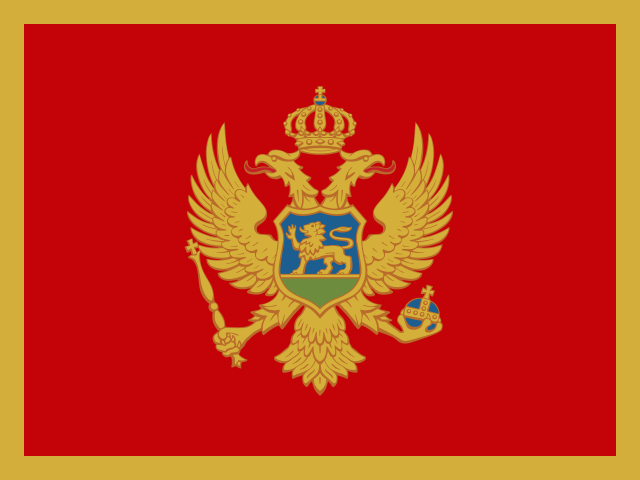
Overview
Montenegro is a small country in Southeastern Europe on the Balkan Peninsula, with a coast on the Adriatic Sea. It covers about 13,883 km2 and is divided into 25 municipalities. The 2023 census counted about 624,000 citizens.
Its land neighbours are Serbia (northeast), Bosnia and Herzegovina (northwest), Kosovo (east), Albania (southeast) and Croatia (the stretch next to the Bay of Kotor). Podgorica is the capital and largest city. Cetinje, the Old Royal Capital, is the cultural centre and the seat of the president.
The terrain runs from a narrow Adriatic coastal strip through a high karst plateau to some of the most rugged mountains in Europe. The Durmitor, Prokletije and Orjen massifs are the best known. Montenegro has five national parks (Durmitor, Biogradska Gora, Lovćen, Lake Skadar and Prokletije), and protected areas cover about 9% of the country. It is also a European biodiversity hotspot.
Montenegro has an upper-middle-income, mostly service-based economy that is in late transition to a market system. It uses the euro unilaterally. It belongs to the UN, NATO (since June 2017), the WTO, the OSCE, the Council of Europe and CEFTA, and it has been negotiating EU accession since 2012.
History
Antiquity: The area was part of Illyria and inhabited by Illyrians. The Roman Republic conquered the Illyrian kingdom in the Illyro-Roman Wars and folded the region into the province of Illyricum, later split into Dalmatia and Praevalitana.
Middle Ages: Slavic peoples arrived in the 6th and 7th centuries. Three principalities then covered the territory: Duklja in the south, Travunia in the west and Raška (Rascia) in the north. Duklja broke away from Byzantine rule in 1042 and expanded into Rascia and Bosnia. It was recognised as a kingdom and peaked under Mihailo (1046-1081) and Constantine Bodin (1081-1101). After Bodin's death (1101 or 1108) civil wars set in and its power declined. The Principality of Zeta emerged in the 14th and 15th centuries.
Venetian and Ottoman rule: From 1392 the Republic of Venice held parts of the territory, including Budva and the Bay of Kotor, and installed governors who involved themselves in local politics. Venetian control lasted until its fall in 1797. Large areas came under the Ottoman Empire from 1496 to 1878. Montenegrin clans kept an unusual degree of autonomy, and the name Montenegro was first used for the country in the late 15th century. Semi-autonomy under the House of Petrović-Njegoš began in 1696, at first as a theocracy and later as a secular principality.
Independent principality and kingdom: On 1 May 1858 a Montenegrin army of about 7,500 under Mirko Petrović beat about 15,000 Ottoman troops at Grahovac. This pushed the Great Powers to fix the border with the Ottoman Empire and effectively acknowledged Montenegrin independence. Montenegro also won at Vučji Do. Its independence was formally recognised at the Congress of Berlin in 1878, and it became a kingdom in 1910.
Yugoslav era: After World War I Montenegro became part of the Kingdom of Serbs, Croats and Slovenes, first as the Oblast of Cetinje (1922, with the coastal areas around Budva and the Bay of Kotor added). In 1929 it joined the larger Zeta Banovina of the Kingdom of Yugoslavia, one of nine banovinas. In April 1941 Axis powers occupied Yugoslavia, and Italy set up a puppet Kingdom of Montenegro. On 13 July 1941 an uprising began that some historians call the first armed uprising in occupied Europe. Montenegro was later a republic of socialist Yugoslavia.
FR Yugoslavia and independence: After the SFRY dissolved in 1992, Montenegro stayed with Serbia in a smaller Federal Republic of Yugoslavia. In the 1992 referendum 96% backed the federation, but opposition parties boycotted it and turnout was about 66%. On 21 May 2006 an independence referendum drew 86.5% turnout. About 55.5% voted yes (230,661 votes) and 44.5% no (185,002 votes). That cleared the required 55% threshold by only about 2,300 votes. International observers reported an active, generally peaceful campaign. Parliament declared independence on 3 June 2006, and Montenegro joined the UN on 28 June 2006 as its 192nd member.
Đukanović era: Since the breakup of Yugoslavia, Milo Đukanović dominated politics as four-time prime minister and twice president, and he led the ruling Democratic Party of Socialists (DPS), in power from 1991. Critics accuse him of building a clientelist, authoritarian system tied to organised crime. In 2015 the OCCRP named him 'Person of the Year in Organized Crime'. Large-scale privatisations enriched people close to him. The north had 36.6% unemployment against 3.9% on the coast, and about a quarter of the population lived below the poverty line (2018). A 2011 law rehabilitated the Royal House of Montenegro and gave it limited symbolic roles. In October 2016, on election day, authorities said they had prevented a coup attempt. In 2017 fourteen people, including two Russian nationals and opposition leaders Andrija Mandić and Milan Knežević, were indicted over it.
Recent years: Montenegro joined NATO on 5 June 2017. Đukanović won the April 2018 presidential election, and anti-corruption protests began in February 2019. A December 2019 Law on Religion, which moved pre-1918 church property from the Serbian Orthodox Church to the state, set off large protests. Freedom House labelled Montenegro a hybrid regime in 2019-2020. In the 2020 election the opposition won more votes than the DPS for the first time in three decades. That government was toppled by a no-confidence vote in February 2022, the first successful one in the country's history. In September 2022 six Russian diplomats were expelled in a spy investigation.
In March 2023 Jakov Milatović of the Europe Now movement beat Đukanović in the presidential run-off. Europe Now won the most seats in the June 2023 parliamentary election, and Milojko Spajić became prime minister on 31 October 2023, leading a coalition of pro-European and pro-Serb parties. In June 2024 Parliament adopted a resolution on Jasenovac. Croatia criticised it, and tension between the two countries rose. In 2024 Montenegro was one of 22 countries scoring under 5 on the Global Hunger Index.
Climate
Montenegro has distinct climate zones. The narrow coast has a Mediterranean pattern of hot, dry summers and mild, wet winters. The interior is more continental, and the high mountains are cold and snowy in winter. The western mountain slopes are very humid and were heavily glaciated in the last ice age.
Podgorica (capital, low-lying, approx. 40 m above sea level): hot summers with frequent highs above 30 °C and sometimes near 40 °C, and mild winters with occasional frost. Rain is heavy, mostly in autumn and winter (approx. 1,600 mm a year).
Coastal cities such as Bar, Budva, Kotor, Herceg Novi and Ulcinj: warm to hot, sunny summers, mild winters, and a bathing season that runs from late spring into autumn. The Bay of Kotor area gets very heavy rain (the Orjen/Krivošije area is among the wettest in Europe, approx.).
Highland towns such as Nikšić, Cetinje and Žabljak (Durmitor): cooler summers and cold winters with substantial snow. Žabljak, at about 1,450 m, is a mountain and ski base. Cetinje, on a karst plateau, is cooler and wetter than the coast.
Geographic extremes: the karst plateau mostly lies near 1,000 m, and the lowest segment is the Zeta valley at about 500 m. Peaks reach 2,522 m at Bobotov Kuk (Durmitor) and 2,534 m at Zla Kolata (Prokletije), now measured as the highest point.
Government and politics
Montenegro is a parliamentary representative democratic republic. Its constitution was adopted on 19 October 2007 by a two-thirds supermajority and proclaimed on 22 October. It describes the state as civic, democratic and ecological, with social justice. The party system is multi-party, and every government since 2006 has been a coalition of at least three parties.
The president is head of state, directly elected for five years. The role is largely representative: promulgating laws, calling parliamentary elections, nominating a prime minister and constitutional court judges for Parliament to approve, granting amnesties, and sitting on the Supreme Defence Council. Jakov Milatović has held the post since May 2023. The official residence is in Cetinje. The prime minister leads the government, which sits mainly in Podgorica, and is the most politically powerful office.
Parliament is unicameral, based in Podgorica, with 81 deputies elected by proportional representation (D'Hondt method). It appoints the government and all court judges, passes laws and the budget, and can remove the government by a simple-majority no-confidence vote. Milojko Spajić's government took office after the June 2023 election, with confidence and supply support from the ZBCG group.
The judiciary has Basic Courts, High Courts, an Appellate Court, Administrative Courts and a Supreme Court as the top court. A separate Constitutional Court reviews laws and public acts. Judges are appointed on the Judicial Council's recommendation and serve until age 67, and Parliament appoints an Ombudsman for six years. Discrimination based on sexual orientation and gender identity is banned in key areas, and same-sex couples have been able to register a Life Partnership since 15 July 2021.
Center-periphery structure: Montenegro is a unitary state, not a federation. It is split into 25 municipalities (opština), each with several towns. The country also has three statistical regions (Northern, Central, Coastal), but these have no administrative function. National bodies set tax policy, healthcare, justice and education policy, and the interior ministry runs police services. Municipalities handle local matters such as urban planning, local utilities, local transport, and some local taxes and fees (approx.). Municipal Communal Police enforce local rules, while the national Police Directorate handles crime and public order. Cetinje holds a special status as the Old Royal Capital (approx.).
Security: the armed forces have an army, a navy and an air force, with the president as commander-in-chief. The National Security Agency handles counterintelligence, and an EU agreement from July 2023 lets Frontex staff support border police. Montenegro ranked 35th on the 2024 Global Peace Index.
Democratic quality: Freedom House called Montenegro a hybrid regime in 2019 and 2020, citing state capture and abuse of power, while Economist Democracy Index ranks it as a 'flawed democracy' (as of 2024). International IDEA rates it mid-range, with weaknesses on corruption and judicial independence.
Foreign policy: EU integration has been the main priority since independence. As of 2024 all 33 negotiating chapters were open and three were provisionally closed. President Milatović said in 2023 he expected membership around 2027 or 2028. In April 2026 EU ambassadors in Brussels approved starting preparations for the accession treaty. No later outcome is covered here.
Economy
The economy is mostly service-based and in late transition to a market system. In 2019 the IMF put nominal GDP at about $5.4 billion, and purchasing-power GDP at about $12.5 billion (about $20,100 per person). In 2018 GDP per person was about 48% of the EU average (Eurostat). Montenegro ranked 64th in the 2025 Global Innovation Index, up from 75th in 2023.
The country joined CEFTA in 2007 and has had a free trade agreement with EFTA since 2012. It uses the euro unilaterally, so the Central Bank of Montenegro is outside the eurosystem.
Regional gaps are wide: unemployment was 36.6% in the north and 3.9% on the coast in 2018 (source figures), and about a quarter of people lived below the poverty line.
Tourism is a pillar. In 2022 about 2.1 million visitors stayed 12.4 million nights. Most come from Serbia, Bosnia and Herzegovina, Kosovo and Russia. The 295 km coast has about 72 km of beaches (Jaz, Mogren, Bečići, Sveti Stefan, Velika Plaža) and old towns such as Kotor, Perast, Budva, Herceg Novi and Ulcinj. Besides tourism, energy, metals, agriculture and construction matter (approx.).
Infrastructure: there are no full-standard motorways, and building them is a national priority. European routes E65 and E80 pass through. The main railway is Belgrade-Bar. The Nikšić-Podgorica line took passengers again in 2012, and the Podgorica-Shkodër line is not in use. The two international airports are Podgorica and Tivat. The Port of Bar is the main seaport (capacity over 5 million tonnes a year) but runs below capacity. A plan for an LNG terminal at Bar was announced in 2023.
Demographics and urbanization
The 2023 census counted 623,633 citizens, and the source gives 633,158 as the municipal total. No ethnic group holds a majority. Montenegrins are 41.1%, Serbs 32.9%, Bosniaks 9.45%, Albanians 4.99% and Russians 2.01%. Roma, Croats, Ukrainians, Belarusians and Turks are also present.
Languages: Montenegrin is the official language, and Serbian, Bosnian, Albanian and Croatian are recognised in official use. The standard forms of Montenegrin, Serbian, Bosnian and Croatian are mutually intelligible. Serbian is the native language of 43.18% and Montenegrin of 34.52%. Bosnian is spoken by 6.98%, Albanian by 5.25% and Russian by 2.36%.
Religion: Eastern Orthodoxy is followed by about 71.1% of the population, roughly 90% of them in the Serbian Orthodox Church. The rest belong to the Montenegrin Orthodox Church, formed in 1993 and unrecognised by other Orthodox churches. Islam is followed by about 19% (mostly Sunni), and Montenegro has one of the higher shares of Muslims in Europe. A 2012 protocol recognised Islam officially, covering halal food in public institutions, headscarves, and Friday prayer time off. A small Catholic community of mainly Albanians and some Croats exists (Archdiocese of Antivari and Diocese of Kotor). Religion and state are separate.
Urbanization and where people live (approx.): roughly two-thirds of the population is urban. Most people live in the Central Region around Podgorica and along the coast, while the mountainous north is more sparsely populated and has lost people.
Largest cities (approx., municipal populations): Podgorica about 180,000; Nikšić about 60,000; Bijelo Polje about 45,000; Bar about 40,000; Herceg Novi about 30,000; Budva about 25,000; Kotor about 22,000; Cetinje about 14,000. Coastal towns swell in summer with tourists and seasonal workers.
Capital city
Podgorica is the capital and largest city. It lies in the Central Region on the Zeta plain, where the Morača and Ribnica rivers meet, roughly 60 km inland from the Adriatic. It has about 150,000 to 180,000 residents (approx.), the largest concentration of people in the country.
Climate (approx.): hot summers with highs often above 30 °C, mild winters, and heavy rain in autumn and winter. It is one of the warmest places in Montenegro.
Role: Podgorica is the political capital and also the main economic and administrative centre. The government, Parliament and most ministries, big companies, banks, the university and the main airport are here. It has the country's main business and commercial scene, and it is the main base for expats and foreign offices.
Cetinje, the Old Royal Capital, is the cultural centre. It is the president's official residence and has historic royal and cultural institutions, and it has a special status as Prijestonica (approx.). It has about 14,000 residents (approx.), so the political functions are split between Cetinje (head of state) and Podgorica (government and Parliament). Cetinje is not the main economic city.
Getting around: Podgorica Airport serves international flights, and the Belgrade-Bar railway runs through it, with the line to Nikšić carrying passengers since 2012. The coast (Kotor, Budva, Bar) is within roughly an hour or two by road, and Tivat Airport is the other international airport.
About this summary
Approximate city populations, urbanization rate, city climates, municipal competences and capital-city details come from general knowledge. Some economic context and the 2020s political overview are also partly general knowledge.