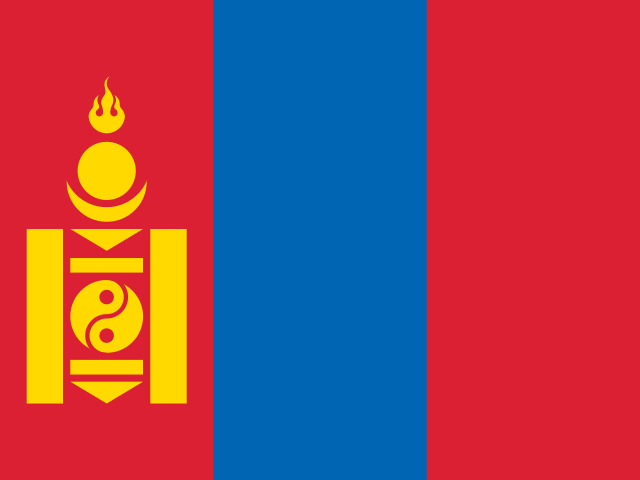
Overview
Mongolia is a landlocked country in East Asia, wedged between Russia to the north and China to the south. Its area is about 1.56 million square kilometers, which the source describes as the 18th-largest in the world and the second-largest landlocked country after Kazakhstan.
With about 3.5 million people, it is described as the most sparsely populated sovereign state in the world (leaving out Western Sahara). The land forms much of the Mongolian Plateau: grassy steppe, mountains in the north and west, and the Gobi Desert in the south.
Ulaanbaatar is both capital and largest city, home to roughly half of all Mongolians. About 30% of people are nomadic or semi-nomadic, and horse culture is still central to national identity.
Mongolia is a member of the United Nations, the Asia Cooperation Dialogue, the G77, the Asian Infrastructure Investment Bank and the Non-Aligned Movement, and is a NATO global partner. It joined the World Trade Organization in 1997.
The country is nicknamed the Land of the Eternal Blue Sky because it enjoys more than 250 sunny days a year.
History
Human presence is very old. Cave paintings at Khoit Tsenkher Cave in Khovd Province, about 20,000 years old, show mammoths, lynx and Bactrian camels, earning it the nickname the Lascaux of Mongolia. Neolithic farming settlements (about 5500-3500 BC) came before the arrival of horse-riding nomadism, which shaped Mongolian history from then on.
Over the centuries nomads formed large confederations with common institutions such as the khan, the kurultai (supreme council), left and right wings, an imperial guard and a decimal military system. The Xiongnu, united by Modu Shanyu in 209 BC, were the first; they were such a threat to the Qin dynasty that it built the Great Wall. Later powers on the territory included the Xianbei, Rouran, the First and Second Turkic Khaganates and the Uyghur Khaganate.
In 1206 Temüjin, who had united the Mongol tribes, took the title Genghis Khan. His campaigns created the Mongol Empire, the largest contiguous land empire in history, reaching from eastern Europe to Korea and from Siberia to the Gulf of Oman and Vietnam. His grandson Kublai Khan conquered China proper and founded the Yuan dynasty.
Following the Yuan's expulsion from China, the Mongols continued to govern their homeland under the name Northern Yuan. For centuries afterward, the region was torn by factional conflict, especially between the Genghisids and the Oirats, and it also endured a number of invasions from the Ming. Early in the 16th century, the Mongol groups were brought back together by Dayan Khan and his khatun, Mandukhai, and Tumen Zasagt Khan carried that work of unification forward.
Tibetan Buddhism spread in the 16th century. The Qing dynasty absorbed Mongolia in the 17th century. Outer Mongolia had relative autonomy under hereditary Genghisid khanates, and the Jebtsundamba Khutuktu held great de facto authority. The Manchu banned mass Chinese immigration, helping Mongols preserve their culture. The Tea Road through Siberia was the main trade route. By the early 20th century almost one-third of adult men were Buddhist monks.
When the Qing fell in 1911, Mongolia under the Bogd Khaan declared independence, though the Republic of China regarded Mongolia as its own territory. Actual independence from China was achieved in 1921, after which the country became a Soviet satellite.
In 1924, after the Bogd Khaan died, the Mongolian People's Republic was established. Khorloogiin Choibalsan rose to power in 1928, collectivized livestock, destroyed Buddhist monasteries and carried out Stalinist purges. In the late 1930s almost all of more than 700 monasteries were closed and at least 30,000 people were killed, including about 18,000 lamas. The number of monks fell from 100,000 in 1924 to 110 in 1990.
A referendum on 20 October 1945 produced (by official figures) 100% support for independence, following Soviet conditions set at Yalta. Mongolia and China recognized each other on 6 October 1949. The Republic of China vetoed Mongolia's UN admission in 1955, its only use of the veto; Mongolia finally joined the UN on 27 October 1961, together with Mauritania. Yumjaagiin Tsedenbal led from 1952 for more than 30 years until his retirement in 1984, when Jambyn Batmönkh replaced him.
A peaceful Democratic Revolution in January 1990 brought a multi-party system and a market economy. A new constitution in 1992 dropped 'People's Republic' from the country's name. The early transition was rocky, with high inflation and food shortages. Non-communist parties first won in the 1993 presidential and 1996 parliamentary elections.
Climate
Mongolia has an extreme continental climate: high, cold and windy, with long, cold winters and short summers in which most precipitation falls. In winter the Siberian Anticyclone dominates, cold air pools in valleys and basins, and January averages in places fall as low as about -30 °C, while mountain slopes are milder because of temperature inversion.
Ulaanbaatar has an annual mean of about -1.3 °C, which the source describes as the world's coldest capital city. Summers in much of the country are hot.
Precipitation is highest in the north (about 200-350 mm a year, with far-northern Bulgan Province around 600 mm) and lowest in the south (about 100-200 mm). The recorded extremes are 622 mm in Bulgan forests and 42 mm in the Gobi.
A mild microclimate exists in central and eastern Arkhangai and northern Ovorkhangai, shaped by the Khangai Mountains; in Tsetserleg January days often reach 0 to 5 °C. Occasional zud events, harsh winters in which many livestock die, can cause economic upheaval for the pastoral population.
Other towns such as Darkhan and Erdenet in the north share the same cold continental pattern (approx., general knowledge), and the Gobi south has hot summers and very dry conditions.
Government and politics
Mongolia is a semi-presidential representative democratic republic. Voters elect the president directly, and they also directly choose the members of the unicameral State Great Khural, which has 126 seats and four-year terms. The prime minister, who leads the executive, is appointed by the president, and the cabinet is put forward by the president on the prime minister's proposal.
The president can veto laws, which parliament can override by a two-thirds majority, and appoints judges and ambassadors. Candidates must be native-born, at least 45 and resident for five years, and the president must suspend party membership. Ukhnaagiin Khürelsükh of the Mongolian People's Party became the sixth democratically elected president in June 2021.
The main parties are the Mongolian People's Party (MPP; called the MPRP from 1924 to 2010) and the Democratic Party. The MPP governed from 1921 to 1996, in a one-party system until 1990. The Democratic Party was founded in 2000 and dominated 2012-2016. The MPP won landslides in 2016 and 2020. Electoral reforms in 2023 added proportional representation and expanded parliament; in 2024 the MPP's supermajority shrank to a slim majority and the Democratic Party and three other parties hold almost half the seats. Since 2024 there have been three prime ministers and three MPP-led coalition governments; the source lists Nyam-Osoryn Uchral as prime minister since March 2026. Freedom House considers Mongolia free, while V-Dem described it as autocratizing in 2024.
Sub-national structure: Mongolia is made up of 21 provinces (aimags), and these are further split into 330 districts (sums). The capital, Ulaanbaatar, has its own separate administration as a municipality holding provincial status. How tax, health, law or education responsibilities are shared between the different levels is not described in the source; the system is generally considered unitary (approx., general knowledge).
The judiciary has three tiers: first-instance courts in each provincial district and Ulaanbaatar district, appellate courts for each province and the capital, and the Supreme Court as final court for non-constitutional matters. A separate constitutional court handles constitutional questions. A Judicial General Council nominates judges, who are confirmed by parliament and appointed by the president. Arbitration centers offer alternative dispute resolution.
Foreign relations center on Russia and China, on which Mongolia is economically dependent. China takes about 78% of exports and supplies about 36% of imports, with Russia supplying about 29%. Mongolia pursues a third neighbor policy for ties beyond these two, and tries to stay out of US-China confrontation. A Power of Siberia 2 gas pipeline partnership with China and Russia is under discussion. Mongolia has been in the Forum of Small States since 1992, sent troops to Iraq, Afghanistan, Sierra Leone and Chad, and became an OSCE Asian partner in 2004.
Economy
The economy has long rested on herding and agriculture, but mining of copper, coal, molybdenum, tin, tungsten and gold now drives industrial output. Mining is about 21.8% of GDP and agriculture about 16%, with trade, transport, storage and real estate also important. Mongolia produces about one-fifth of the world's raw cashmere. The informal economy is estimated at at least one-third of the official one.
The Asian Development Bank reports that in 2022, 27.1% of the population fell under the national poverty line, while per-capita GDP stood at roughly $12,100. In 2023, real GDP expanded by 7%, driven by record coal output destined for China, and inflation eased in early 2024. As coal prices fall, the IMF anticipates the current account will swing back to a substantial deficit; the World Bank points to inflation, softer demand from China and fiscal risks.
Minerals make up more than 80% of exports. Mining provided 24% of government revenue in 2018, with about 3,000 licenses issued. The Oyu Tolgoi copper and gold mine (Rio Tinto and Ivanhoe agreement, 2009) targets 500,000 tons of copper a year. Tavan Tolgoi holds over six billion tonnes of coal; international partnerships failed in 2011 and 2015 and an IPO was cancelled in 2020. A 233-km rail link to China opened in September 2022.
The Mongolian Stock Exchange (1991, Ulaanbaatar) is among the world's smallest, with 180 listed companies and about US$3.2 billion market capitalization in 2024. Mongolia ranked 81st in the IFC ease of doing business scoring and 78th in the 2025 Global Innovation Index.
Mongolia relies on imports for 98% of its fuel supply, and it is currently constructing its first oil refinery. For transport, the Trans-Mongolian Railway runs from Ulan-Ude in Russia, passing through Ulaanbaatar, and ends at Erenhot in China. Chinggis Khaan International Airport lies roughly 52 km south of Ulaanbaatar and offers direct flights to South Korea, China, Hong Kong, Thailand, Japan, Russia, Germany and Turkey, with MIAT serving as the national airline. The country has around 4,800 km of paved roads, while many of its overland routes remain unimproved. Postal services are handled by Mongol Post along with 54 other licensed operators.
Demographics and urbanization
According to the National Statistics Office, Mongolia's population in 2024 stood at 3,544,835, a figure that counts citizens residing overseas. The same source reports that 71.2% of people live in urban areas and that 51% are women. Data from 2020 show that Ulaanbaatar housed 47.6% of residents, while 21.4% lived in Darkhan, Erdenet, aimag and sum centers, or other permanent settlements, and rural areas accounted for 31.0%.
Fertility fell from about 7.33 children per woman in 1970-75 to about 2.1 in 2000-05, then rose to about 2.5-2.6 by around 2020. The first 20th-century census (1918) counted 647,500 people.
About 95% are ethnic Mongols, of whom 86% are Khalkha; others include Oirats and Buryats. Turkic peoples (Kazakhs, Tuvans) are about 4.5%, concentrated in the west, with small Russian, Chinese, Korean and American communities.
Largest cities: Ulaanbaatar (well over 1.5 million, approx.), with Darkhan and Erdenet the other main urban centers (each roughly 100,000 or less, approx.).
Mongolian (Khalkha dialect) is the official language; Oirat, Buryat and Khamnigan are related varieties, Kazakh is the majority language in Bayan-Ölgii and Tuvan is spoken in Khövsgöl. Cyrillic is the main script, and both Cyrillic and the traditional Mongolian script were used for official documents from 2025. English has largely replaced Russian as the leading foreign language; it was declared the first foreign language in 2023 and is taught from third grade. Korean is popular because many Mongolians work in South Korea.
Religion (2020 census, ages 15+): Buddhist 51.7%, non-religious 40.6%, Muslim about 3.2% (mainly Kazakhs). Shamanism persists, and Christianity grew from four people in 1989 to around 40,000 by 2008 per the Barnabas Fund.
Education: literacy was below 1% before the socialist period and illiteracy was virtually eliminated by 1952, partly via seasonal boarding schools. Schooling is 12 years, and almost three in five young people enroll in university. Student numbers rose six-fold between 1993 and 2010.
Capital city
Ulaanbaatar is the capital and largest city, in north-central Mongolia, and is administered as a municipality with provincial status. Its population is roughly half of the national total, so on the order of 1.7 million people (approx.). The source says 47.6% of Mongolians lived there in 2020.
Its annual mean temperature is about -1.3 °C, described as the world's coldest capital. Winters are very cold and dry, and summers are short and warm with most rain (approx., general knowledge for seasonal detail).
It is the political, economic and cultural center; the Mongolian Stock Exchange (founded 1991) is here, as are the national government and parliament. There is a single capital, and Ulaanbaatar is also the main economic city.
Transport: the Trans-Mongolian Railway passes through it, and Chinggis Khaan International Airport lies about 52 km to the south. Paved roads link it to the Russian and Chinese borders and run east and west. Rapid in-migration has brought pressures such as winter air pollution (approx., general knowledge).
About this summary
Capital-city details (metro population, city climate, districts, airport and transport context) and some broader context such as regional cities are from general knowledge and approximate.