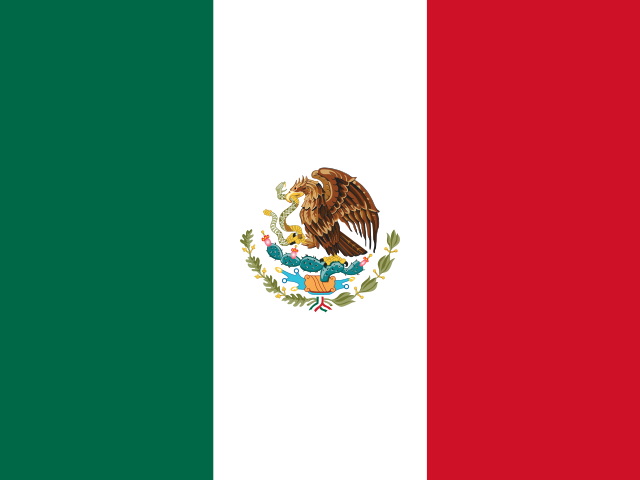
Overview
Mexico, officially the United Mexican States, is a country in southern North America and the northernmost country of Latin America. It borders the United States to the north and Guatemala and Belize to the southeast. Its coasts face the Pacific Ocean and Gulf of California to the west, and the Gulf of Mexico and Caribbean Sea to the east and southeast.
The country covers about 1,972,550 km2 (761,610 sq mi), which the source describes as the thirteenth-largest in the world. Its population is around 131 million (about 130.9 million in a 2026 National Population Council estimate), and it has the largest number of native Spanish speakers of any country.
Mexico is a federal republic with a presidential system. It is described as a newly industrialized, developing country, with an economy of about 13th place in the world by both nominal GDP and purchasing power parity. It is classed as a regional or middle power and increasingly sees itself as an emerging power.
The country is one of 17 megadiverse nations and has a very large number of UNESCO World Heritage Sites: the most in the Americas and seventh worldwide, according to the source. It is also a major tourist destination, with about 42.2 million international arrivals in 2022, making it the sixth most-visited country that year.
Poverty, systemic corruption and crime remain widespread. The source reports roughly 127,000 deaths since 2006 from the ongoing conflict between drug trafficking syndicates.
Mexico belongs to the UN, the G20, the OECD, the WTO, APEC, the Organization of American States, CELAC and the Organization of Ibero-American States. It is also part of the informal Coffee Club and holds observer status at the Council of Europe.
History
The earliest human artifacts in the area are stone tool chips from the Valley of Mexico, dated to roughly 10,000 years ago. The wider lead text notes human presence from at least 11,500 BC, with some less securely dated sites proposed as far back as 28,000 BC. Maize, tomato and beans were domesticated here, creating agricultural surpluses that allowed a shift from hunter-gatherers to settled farming villages from around 5000 BC. Mesoamerica is counted as one of the six independent cradles of civilization, and its societies included the Olmecs, Maya, Zapotecs, Teotihuacan and Purépecha.
Spain established Caribbean colonies in 1493 and learned of Mexico through the Juan de Grijalva expedition of 1518. Hernán Cortés founded Veracruz in 1519, beginning the conquest of the Aztec Empire. With an indigenous alliance, the Spanish took Tenochtitlan in 1521 and built Mexico City on its ruins. For about 300 years the territory was the colony of New Spain, a silver-mining powerhouse and a hub between Europe and Asia, and it produced one of the world's largest multiracial populations.
Napoleon's 1808 invasion of Spain shook the empire. In 1810 the priest Miguel Hidalgo y Costilla issued the Cry of Dolores, commemorated each 16 September as independence day. Hidalgo was executed in 1811. The war of independence lasted 1810–1821 and ended Peninsular rule. The First Mexican Empire soon collapsed into the short-lived First Republic, and the first decades after independence were unstable. Central America separated peacefully in 1821, and Texas broke away and was annexed by the US in 1845. This led to the Mexican–American War, in which Mexico lost nearly half its territory in 1848. The Gadsden Purchase was the last loss of territory.
Once Santa Anna had been toppled, liberals put through La Reforma and the Constitution of 1857. These measures divided Church from State, abolished the special privileges (fueros) held by the Church and the military, required the sale of Church lands and indigenous communal lands, and brought education under secular control. Conservatives responded with the Reform War (1858–61). French intervention came next and created the Second Mexican Empire, headed by Maximilian I of Habsburg, whom republican forces under Benito Juárez eventually overthrew.
The long dictatorship of Porfirio Díaz modernized the country but caused severe social unrest, and his government favored selective European immigration and persecuted some indigenous groups. A fraudulent 1910 election set off the Mexican Revolution (1910–20). Díaz resigned in May 1911 and Madero was elected that autumn. A military coup in February 1913, backed by the US administration of Taft, overthrew Madero, who was murdered by agents of General Victoriano Huerta. The revolution produced the Constitution of 1917.
From 1920 to 1946, revolutionary generals held the presidency, including Obregón, Calles, Lázaro Cárdenas and Ávila Camacho. They incorporated workers, peasants and others into a single party founded in 1929 by Calles, later the Institutional Revolutionary Party (PRI). Obregón was assassinated in 1928 after winning re-election, which triggered a succession crisis. Calles stayed influential during the Maximato (1929–34) until Cárdenas expelled him. Cárdenas implemented social reforms and in 1938 expropriated the oil industry, leading to the state company Pemex. Mexico was a significant US ally in World War II.
From 1946, with Miguel Alemán as first civilian president of the post-revolutionary era, Mexico pursued the 'Mexican miracle' of industrialization and urbanization, which also widened the gap between urban and rural areas. The Green Revolution in crop production began in the Yaqui Valley. Unrest before the 1968 Olympics in Mexico City ended in the Tlatelolco Massacre, which killed an estimated 300–800 protesters. PRI rule became authoritarian during the Dirty War. In 1968 Mexico also signed the Treaty of Tlatelolco, renouncing nuclear weapons.
In the 1980s the PRI's dominance began to crack, starting with a PAN governor in Baja California. The 1988 election, won narrowly by Carlos Salinas amid fraud allegations, prompted protests in Mexico City. Mario Vargas Llosa called the PRI a 'perfect dictatorship' in 1990. Salinas pursued neoliberal reforms and NAFTA took effect on 1 January 1994, the same day the Zapatista Army of National Liberation launched an armed uprising in Chiapas that later became a non-violent opposition movement. After the assassination of PRI candidate Luis Donaldo Colosio, Ernesto Zedillo took office and faced the peso crisis, which needed a roughly $50 billion IMF-backed rescue.
Since 2018, Morena has led the government, and it won a second term in the 2024 general election. The first judicial elections took place in 2025. The V-Dem report identified democratic backsliding beginning around 2019.
Climate
Mexico has one of the world's most varied climates because of its size and terrain. The Tropic of Cancer splits it into a cooler temperate north and a tropical south. North of the line, winters are cooler. South of it, temperatures stay fairly constant through the year and vary mainly with elevation. The source lists seven major climate types: warm sub-humid on coasts up to about 900 m, mostly in the south; dry and desert climates across the northern half; temperate humid and sub-humid zones above about 1,800 m in central Mexico; and cold climates at around 3,500 m and above. Most of the country is temperate to dry.
Rain arrives mainly from May to August from maritime air masses. The north is dry with sporadic rainfall, while parts of the tropical southern lowlands receive more than 2,000 mm a year. Northern cities such as Monterrey, Hermosillo and Mexicali often reach 40 °C or more in summer, and the Sonoran Desert can reach 50 °C or more.
Southern lowlands up to about 1,000 m, the southern coastal plains and the Yucatán Peninsula have yearly average temperatures of roughly 24–28 °C, with only about a 5 °C gap between winter and summer. Low-lying areas north of the Tropic are hot and humid in summer but average lower yearly temperatures of roughly 20–24 °C because of milder winters.
Hazards include tsunamis on the Pacific coast and serious summer and autumn hurricanes on both coasts (except the south coast of the Bay of Campeche and northern Baja California). The country is also prone to volcanism, with the highest peaks in the Trans-Mexican Volcanic Belt, including Pico de Orizaba (5,700 m) and Popocatépetl (5,462 m).
From general knowledge (approx.): Mexico City sits at about 2,240 m and has a mild highland climate with warm days, cool nights and a wet season from roughly May to October. Guadalajara, also on the central plateau, is warm and has a similar summer rainy season. Monterrey is hot in summer and cooler in winter. Cancún and the Yucatán coast are tropical and hurricane-exposed. These city descriptions are approximate.
Climate change is raising temperatures, shifting rainfall, intensifying hurricanes and raising sea levels on the coasts. This threatens water resources and agriculture, especially smallholder farming of maize and coffee, and affects health, migration and biodiversity.
Government and politics
Mexico is a federation with a representative, democratic, republican government under the 1917 Constitution. The Constitution sets three levels of government: the federal Union, state governments and municipal governments. The system has three branches: executive, legislative and judicial.
The Congress of the Union, a two-chamber body, serves as the federal legislature. Its powers include enacting federal law, declaring war, levying taxes, and giving approval to the national budget and to international treaties, as well as confirming diplomatic appointments. The Chamber of Deputies consists of 500 members. Of these, 300 win seats by plurality vote in single-member districts, while the other 200 come through proportional representation using closed party lists drawn up across five constituencies. The Senate totals 128 members. Sixty-four are chosen by plurality in pairs, with two for each state and two for Mexico City; 32 are allotted to the parties that finished second in each contest, one per state and one for Mexico City; and the remaining 32 are elected by proportional representation from national lists.
The President of the United Mexican States is head of state and government and commander-in-chief of the armed forces. The President appoints the Cabinet and other officers, enforces the law and may veto bills.
The highest court is the Supreme Court of Justice, with nine members elected by popular vote (from candidates pre-selected by Congress) for a single twelve-year term. The first such judicial election took place in 2025. The court interprets laws and judges cases of federal competency. Other judicial bodies include the Federal Electoral Tribunal, collegiate, unitary and district tribunals, and the Judicial Disciplinary Tribunal.
Historically dominant parties are the PRI (founded 1929, catch-all, near-hegemonic for decades), the conservative PAN (1939) and the left-wing PRD (1989). The left-wing populist National Regeneration Movement (Morena) has governed since 2018 and won a second term in the 2024 general election. The V-Dem report found democratic backsliding from around 2019.
Mexico is a union of 31 free and sovereign states plus Mexico City. Each state has its own constitution, congress and judiciary, and voters elect a governor for six years and a unicameral state congress for three-year terms. States are divided into municipalities, the smallest administrative unit, each governed by an elected municipal president (mayor). The source does not detail which taxes, health, education or law powers are held by each level beyond these structures, and the Congress holds federal taxing and lawmaking power.
Mexico City is a special division belonging to the federation as a whole rather than to any state. Formerly the Federal District, it dropped that name in 2016 and has been moving toward greater autonomy as a federal entity with its own constitution and congress.
Foreign policy is directed by the President through the Ministry of Foreign Affairs. Under Article 89, Section 10 of the Constitution, principles include respect for international law, sovereignty, non-intervention, peaceful dispute resolution and collective security. The Estrada Doctrine has complemented these since the 1930s. Mexico is a founding member of the UN, OAS, OEI, OPANAL and CELAC. It joined the OECD in 1994 and was the only Latin American member until Chile joined in 2010. It belongs to the G20 and, with other countries, the Coffee Club, which seeks UN Security Council reform.
The Secretariat of National Defense administers the Army (including the Air Force) and the Navy. Approximately 220,000 personnel served in 2024 (160,000 Army, 10,000 Air Force, 50,000 Navy including about 20,000 marines). The National Guard, formed in 2019 from the disbanded Federal Police and military police, acts as a gendarmerie under military command with roughly 110,000 personnel. Military spending was around 0.6% of GDP in 2023. Mexico has historically stayed neutral in international conflicts except World War II, and it signed the UN Treaty on the Prohibition of Nuclear Weapons.
Economy
As of April 2026, Mexico had the 13th-largest economy by purchasing power parity (about US$3.5 trillion) and a GDP per capita of about US$26,643. The World Bank reported its gross national income as the second highest in Latin America after Brazil, at about US$1.8 trillion. International organizations classify it as upper middle income.
Manufacturing is central. Mexico has a large electronics industry, ranked sixth after China, the US, Japan, South Korea and Taiwan, and is the second-largest electronics exporter to the US ($71 billion in 2011). It produces more automobiles than any other North American nation. General Motors, Ford and Chrysler have operated there since the 1930s, and Volkswagen and Nissan since the 1960s. In Puebla about 70 part-makers cluster around Volkswagen, and Kia (2016, Nuevo León) and Audi (Puebla) opened plants. In 2006, trade with the US and Canada made up almost half of exports and 45% of imports.
Remittances from Mexicans working in the US are a major source of foreign income, after dipping in the 2008 recession and during COVID-19.
Poverty and inequality remain significant. CONEVAL reported poverty rising from 44.5% to 46.2% between 2008 and 2010. INEGI reported in 2025 that poverty fell from 41.9% in 2018 to 29.6% in 2024, with extreme poverty down from 7% to 5.3%, while the share lacking healthcare access rose from 16.2% to 34.2%; some specialists doubt the accuracy of these rates. Using the OECD's relative poverty line, 20% lived in poverty in 2019. Mexico has the second-highest income inequality in the OECD, after Chile, though this has been falling: the bottom 10% hold 1.4% of resources and the top 10% hold 36%. Social spending is about a third of the OECD average and infant mortality is about three times the OECD average. A 2008 report put average urban income at $27,000 versus $8,000 in nearby rural areas.
The daily minimum wage was set at 315.04 pesos (about US$17.20) for 2026, and 440.87 pesos in the northern border zone. It was 88 pesos in 2018.
Telecoms were long dominated by Telmex, privatized in 1990. Other operators include Axtel, Maxcom, Alestra, Marcatel and AT&T Mexico. About 81% of households have internet and 81% of people over age six have a mobile phone, with around 97 million mobile lines. Landline penetration is low (52%) because of mountainous terrain. The sector is regulated by Cofetel, and satellites are run by Satmex.
Energy is run by the state-owned Federal Commission of Electricity (CFE) and Pemex. Pemex handles oil and gas exploration through to petrochemicals, with sales of about US$86 billion a year. Mexico is the sixth-largest oil producer (3.7 million barrels per day), with 7 refineries in the country (the newest built in 2022) and one in the US. Oil was 62% of exports in 1980 but only 7% by 2000.
Hydropower from 60 plants provides about 12% of electricity, including the 2,400 MW Manuel Moreno Torres Dam. Mexico has high solar potential, and the Villanueva solar park in Coahuila (828 MW, opened 2019) is described as the largest in the Americas. Laguna Verde in Veracruz is the single nuclear plant, and Oaxaca hosts Latin America's largest wind farm. Fossil fuels still supply most energy. Mexico is among the top 15 greenhouse gas emitters and has pledged a 35% cut by 2030 (40% with external support) and net zero by 2050.
The National Autonomous University of Mexico (UNAM), officially established in 1910, is a leading institution in science, medicine and engineering.
Demographics and urbanization
Mexico's population was estimated at about 130.9 million in 2026. It has been the most populous Spanish-speaking country since at least the 1970s. The population was just over 13 million in 1900, fell by about 1 million in the revolution decade, and then grew at over 3% a year from 1950 to 1980. It rose from 70 million in 1982 to 123.5 million in 2017. Life expectancy rose from 36 years in 1895 to 75 in 2020.
About 76.8% of Mexicans live in urban areas. In 2020 there were 48 metropolitan areas, home to roughly 53% of the population. Greater Mexico City had 21.8 million people (about 18% of the country). The next largest were Greater Monterrey (5.3 million), Greater Guadalajara (5.2 million), Greater Puebla (3.2 million) and Greater Toluca (2.3 million).
People of mixed ancestry (mestizos) form the most prominent group, though the category is subjective and cannot be measured precisely. The 2020 census found 19.4% identified as indigenous and 6.1% spoke an indigenous language. Afro-Mexicans were 2.04%, and Asians and Middle Easterners about 1% each. Social stratification and racism persist, with lighter skin favored by middle- and upper-class groups. Article 2 of the Constitution, amended in 1992, defines Mexico as pluricultural, and the 1996 San Andrés Accords granted autonomy and rights to indigenous peoples.
Spanish is the de facto national language. The federal government recognizes 68 linguistic groups and 364 varieties of indigenous languages, with about 8.3 million speakers in 2015. Nahuatl has over 1.7 million speakers, Yucatec Maya nearly 850,000, Tzeltal and Tzotzil around half a million each, and Mixtec and Zapotec about 500,000 each.
In 2019 an estimated 11.7 million Mexicans lived abroad, 98–99% in the US, with large communities around Los Angeles, Chicago, Houston and Dallas–Fort Worth. More than 16 million Mexicans migrated to the US between 1965 and 2015, and about 37.2 million US residents (11.2%) reported full or partial Mexican ancestry. Outside the US, top destinations are Canada, Spain and Germany.
Mexico has not historically been a mass-immigration destination. About 1.2 million foreigners lived there in 2020 (up from nearly 1 million in 2010), and 68,000 new immigrants were officially recorded in 2021. The largest group is from the US (about 900,000), making Mexico the top destination for US citizens abroad. Others come from Guatemala (54,500), Spain (27,600), Colombia (20,600), Argentina (19,200) and Cuba (18,100). Actual numbers may be higher because of unauthorized migration. Lebanese-descended and German-born Mennonite communities have had a notable cultural influence.
Capital city
Mexico City is the capital and largest city, built on the ruins of Aztec Tenochtitlan in the Valley of Mexico after 1521. It is a special federal entity not belonging to any state, formerly the Federal District, and has been moving toward its own constitution and congress. The source gives the Greater Mexico City metro population as 21.8 million in 2020, about 18% of Mexico's population, making it one of the world's largest metropolitan areas.
It was the capital of New Spain and is today the seat of the federal government and the national political centre. It also hosted the 1968 Summer Olympics.
From general knowledge (approx.): the city proper has roughly 9 million residents. It sits at about 2,240 m in a highland basin with a mild climate, warm days, cool nights and a rainy season from roughly May to October. It is also a major economic, financial and cultural centre and the country's main economic city, home to leading institutions such as UNAM. Mexico does not have separate capitals, and the political and main economic city are the same.
About this summary
Capital-city details (climate, role, approximate population, districts) and some city climates come from general knowledge and are approximate. Metro populations beyond the source and a few recent-context items are also approximate.