Overview
Mauritania, officially the Islamic Republic of Mauritania, lies in the Maghreb part of West Africa. The Atlantic Ocean forms its western edge. Western Sahara lies along its north and northwest, Algeria touches the far northeast, Mali wraps the east and southeast, and Senegal sits to the southwest.
The country covers roughly 1,030,000 km2 (about 400,000 sq mi). Around 90% of the land lies in the Sahara, and the source describes about three-quarters of it as desert or semidesert. The source calls it the 11th-largest country in Africa and the 28th-largest in the world by land area.
The lead gives a population of about 5.4 million, while the demographics section gives about 4.6 million for 2021. Most people live in the milder south. Roughly a third of them live in Nouakchott, the capital and largest city, on the Atlantic coast.
The name comes from the Latin Mauretania, an ancient region in the Maghreb that lay well to the north of today's country. Berbers were present in the area by around the 3rd century CE. Arab tribes arrived from the late 7th century and brought Islam, Arab culture and the Arabic language. France colonized the territory in the early 20th century as part of French West Africa, and independence came in 1960.
Since independence there have been repeated coups and spells of military rule. General Mohamed Ould Abdel Aziz took power in the 2008 coup and later won the 2009 and 2014 presidential elections. General Mohamed Ould Ghazouani succeeded him after the 2019 elections, which the source describes as the first peaceful transfer of power since independence.
Despite plentiful natural resources the country remains poor, and its economy rests mainly on agriculture and fishing. It belongs to the Arab League. Arabic is the official language, and Pulaar, Soninke and Wolof are national languages. Islam is the state religion and nearly everyone is Sunni Muslim.
Society is multiethnic: the Haratin are about 40% of the population, the Bidhan about 30%, and the remaining 30% are various sub-Saharan groups. The country has a poor human rights record, especially over the persistence of slavery. The 2023 Global Slavery Index estimates about 149,000 people in slavery, or 32 per 1,000 inhabitants.
History
Early inhabitants included Niger-Congo-speaking peoples and the Bafour. The Bafour were among the first Saharan peoples to give up nomadic life for mainly farming, and they later moved south as the Sahara gradually dried out. Berber groups displaced them, arriving between roughly the 3rd and 7th centuries. Many Berber tribes claim Yemeni or other Arab origins, though the source says there is little evidence for this.
From the late 19th century France claimed the lands of present-day Mauritania, starting around the Senegal River and moving north. In 1901 Xavier Coppolani took charge of the French effort. By allying with Zawaya tribes and pressuring the Hassane warrior nomads, he extended French rule over the Mauritanian emirates. From 1903 and 1904 French forces occupied Trarza, Brakna and Tagant, while the northern emirate of Adrar resisted longer.
Mauritania became independent in 1960. In 1964 President Moktar Ould Daddah, originally installed with French backing, adopted a new constitution that made the country a one-party state under his Parti du Peuple Mauritanien. He argued that the country was not ready for Western-style multiparty democracy. He was re-elected in uncontested votes in 1976 and 1978 and was ousted in a bloodless coup in July 1978.
In 1976 Mauritania and Morocco annexed Western Sahara. The International Court of Justice had found that earlier legal ties of either country were not enough to override the UN decolonization declaration. After military losses to the Polisario Front, which was heavily armed and backed by Algeria, Mauritania withdrew in 1979.
The first military government, led by Mustafa Ould Salek, could not build a firm power base or end the conflict with the Polisario and soon fell. It was replaced by the Military Committee for National Salvation, whose strongman Colonel Mohamed Khouna Ould Haidallah gave up all claims to Western Sahara. That brought peace with the Polisario and better relations with Algeria, but relations with Morocco suffered.
In December 1984 Colonel Maaouya Ould Sid'Ahmed Taya deposed Haidallah. He kept tight military control but eased the political climate. He moderated the earlier pro-Algerian stance and restored ties with Morocco in the late 1980s, deepening them in the late 1990s and early 2000s as he sought Western and Western-aligned Arab support. Since the 1980s Mauritania has held a strictly neutral position on Western Sahara. During his rule the Mauritania–Senegal Border War also took place.
On 3 August 2005 a coup led by Colonel Ely Ould Mohamed Vall ended Taya's 21 years in power. The officers, including members of the presidential guard, took key points in Nouakchott while Taya was away at the funeral of Saudi King Fahd. No lives were lost, and the officers called themselves the Military Council for Justice and Democracy.
The first fully democratic presidential election was held on 11 March 2007. It completed the handover from military to civilian rule and was the first multi-candidate presidential vote since independence. Sidi Ould Cheikh Abdallahi won in a second round.
On 6 August 2008, a day after 48 lawmakers of the ruling party resigned in protest at his policies, the head of the presidential guard took over the palace in Nouakchott. The army surrounded key government sites, including state television, after the president dismissed senior officers, one of them the guard's commander. The president, Prime Minister Yahya Ould Ahmed Waghef and Interior Minister Mohamed Ould R'zeizim were arrested. General Mohamed Ould Abdel Aziz, a former army chief of staff, coordinated the coup.
The new regime faced international isolation, sanctions and cancelled aid projects. At home it banned demonstrations and cracked down on opposition activists. Pressure eventually led to Abdallahi's release into house arrest in his home village, and the new government cut relations with Israel. In spring 2009 the junta reached an understanding with some opposition figures and international actors, and Abdallahi resigned under protest. Abdel Aziz was elected civilian president on 18 July 2009 with 52% of the vote.
Many of Abdallahi's former supporters called the result a political ploy and rejected it, but Western, Arab and African countries largely accepted it, lifted sanctions and resumed relations. In February 2011 the Arab Spring reached Mauritania, with thousands marching in the capital. In November 2014 the country was invited as a guest to the G20 summit in Brisbane.
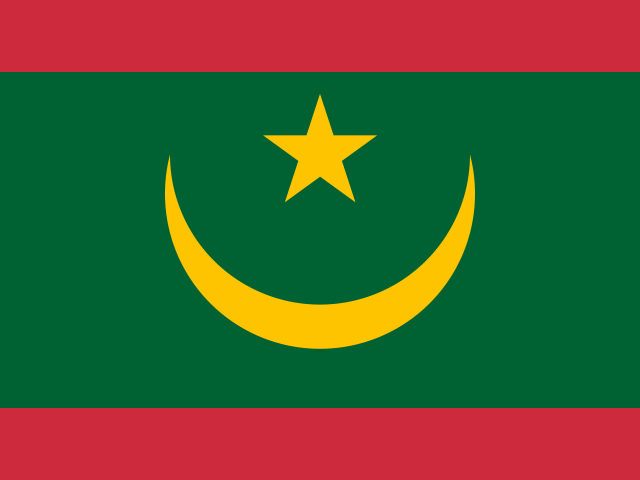
A referendum in 2017 abolished the Senate, and on 5 August 2017 the national flag was changed by adding two red stripes, symbolizing sacrifice and defence. The source also mentions an allegation that in late 2018 Mauritania bribed members of the European Parliament, including Antonio Panzeri, but the text is cut off at that point. Ghazouani won the 2019 elections, and was re-elected on 29 June 2024.
Climate
Roughly 90% of the country is in the Sahara, so most of it is hot and arid. Rainfall follows bands running east to west. Traces of tropical forest appear along the Senegal River, brush and savanna cover the southeast, and the center and north are sandy desert. Severe, prolonged drought has pushed the desert outward since the mid-1960s.
Terrain shapes local conditions: plateaus such as the Adrar (up to about 500 m), shifting dunes (ergs), clay plains (regs), and the Empty Quarter (El Djouf) in the northeast. Spring-fed oases sit at the foot of some escarpments. The highest point is Kediet ej Jill, near Zouîrât, at about 915 m.
The source names seven ecoregions: Sahelian Acacia savanna, West Sudanian savanna, Saharan halophytics, West Saharan montane xeric woodlands, and three more, which are the Atlantic coastal desert and the North and South Saharan steppe and woodlands. To the north, up to roughly 19° N, the land falls in the Palearctic realm, while the Afrotropical realm occupies the area south of that line. Numerous Palearctic birds spend the winter here. Coastal and marine habitats are protected in Banc d'Arguin National Park, and the northern part of the Senegal River delta is covered by Diawling National Park.
City climates below are approximate and come from general knowledge. Nouakchott has a hot desert climate with very little rain, mostly in late summer, and is moderated somewhat by the Atlantic. Nouadhibou on the northern coast is cooler and drier, with sea fog and steady winds. Inland Atar and Zouîrât are very hot in summer and cooler at night in winter. Kaédi and Rosso in the Senegal River valley are hot, with a short summer rainy season, and Néma in the southeast is hot Sahel with summer rains.
Government and politics
Mauritania is a semi-presidential republic. The president is elected directly by absolute majority, with a second round if needed, for a five-year term that can be renewed once. The president appoints the prime minister. The latest presidential election was on 29 June 2024, and Mohamed Ould Ghazouani won re-election.
Parliament now has one chamber, the 176-seat National Assembly, whose members serve five years and are elected from single-seat constituencies. The Senate (56 members) was abolished after a 2017 referendum that President Abdel Aziz called when the Senate rejected his constitutional proposals.
The Armed Forces include an army, navy, air force, gendarmerie and presidential guard. The National Guard and national police report to the Interior Ministry. Military spending was about 3.9% of GDP in 2018. The source names Ba Ousmane as defence minister and General Mohamed Val Ould Rayess Rayess as army chief of staff, and notes involvement in the Western Sahara War, the border war with Senegal and Operation Enduring Freedom – Trans Sahara. The 2024 Global Peace Index placed the country 95th of 163.
Administration is modeled on the French system. The Ministry of Interior oversees regional governors and prefects, and the country is split into 15 regions (wilaya), which include the capital district, subdivided into 44 departments (moughataa). Power is tightly concentrated in the central executive. National and municipal elections since 1992 have brought only limited decentralization, so the sub-national level has little independent authority over tax, health, law or education beyond what the central government delegates. The capital district of Nouakchott is the one special jurisdiction mentioned in the source.
Economy
Despite abundant natural resources, GDP is low. Most people still rely on agriculture and livestock, even though recurrent droughts in the 1970s and 1980s pushed most nomads and many subsistence farmers into cities.
Iron ore is the main export, at almost 50% of total exports. Gold and copper companies are opening mines inland, including Firawa, and gold output in 2015 was 9 metric tons. Fishing is also a core sector. The first deepwater port, near Nouakchott, opened in 1986.
Drought and economic mismanagement have built up foreign debt. In March 1999 the government agreed an enhanced structural adjustment facility of $54 million with a joint World Bank–IMF mission. Privatization remains a major issue, and the source says the 4–5% annual growth target was unlikely to be met.
Oil was found in 2001 in the offshore Chinguetti field. The source calls the country Africa's newest, if small-scale, oil producer, says the long-term effect is hard to predict, and notes possible inland reserves in the Taoudeni Basin where harsh conditions would make extraction costly. The UNDP supports blue-economy and green-energy work to create jobs, especially for young people and women, who are underrepresented in the job market.
Demographics and urbanization
The source gives about 4.6 million people for 2021, while the lead cites 5.4 million. Roughly a third live in Nouakchott. Most of the rest live in the south, in the Senegal River valley and the Sahelian belt, since the north and center are largely desert. The source gives no urbanization rate, but it notes that droughts moved many nomads and farmers into cities.
The main groups are the Bidhan (white Moors, of mixed Arab-Berber descent) at about 30%, the Haratin (black Moors, believed descended from ancient Saharans) at about 40%, and sub-Saharan groups at about 30%, including the Halpulaar (Fulbe), Soninke, Bambara and Wolof. Most people speak Hassaniya Arabic.
Nouakchott is the largest city by a wide margin, with roughly a million or more people (approx.). Nouadhibou on the northern coast is the next major city, followed by smaller towns such as Rosso, Kaédi, Atar, Zouîrât and Kiffa (approx., each well below 150,000 people).
Nearly 100% of the population is Muslim, mostly Sunni, and the Sufi Tijaniyah and Qadiriyyah orders are influential here and in neighboring countries. About 4,500 Catholics are served by the Diocese of Nouakchott, founded in 1965 and mostly made up of foreign residents, and Christians overall were estimated at 10,000 in 2020. Religious freedom is severely restricted, and the source says apostasy and atheism are punishable by death. A law passed on 27 April 2018 made death mandatory for blasphemous speech or sacrilegious acts, removing the option of prison for those who repent.
Arabic is the official language. Hassaniya, the local spoken variety, contains many Berber words and differs a lot from Modern Standard Arabic. Pulaar, Soninke and Wolof are national languages. French no longer has official status but is still common in administration, schools, media and business.
Health indicators are weak. Life expectancy at birth in 2011 was roughly 61 years, and infant mortality stood at around 60 per 1,000 live births. Early in the 2000s, the country had 11 doctors for every 100,000 inhabitants, and public health spending in 2004 amounted to about 2% of GDP. Women have high rates of obesity, which is partly due to traditional beauty ideals, among them the force-feeding custom known as leblouh.
In schools, since 1999 the first year of primary school has been taught in Modern Standard Arabic, French begins in the second year and is used for science subjects, and English is spreading. The University of Nouakchott and other institutions exist, but most highly educated Mauritanians studied abroad. The country ranked 131st of 139 in the 2025 Global Innovation Index.
Human rights concerns in the source include reported torture and impunity among security forces (Amnesty International, the US State Department and a UN expert), discrimination, female genital mutilation, child marriage, child labor, trafficking and political marginalization of southern ethnic groups. Homosexuality is illegal and a capital offense.
Slavery persists despite being outlawed, rooted in a historical caste system with descent-based slavery. Those enslaved are generally darker-skinned Haratin owned by lighter-skinned Moors, though it also exists among sub-Saharan groups. France declared it ended in 1905 with little effect, a presidential decree nominally abolished it in 1981, and a criminal law against owning slaves came only in 2007. The 2010 US State Department report said no cases had been successfully prosecuted. A 2012 CNN documentary estimated 10% to 20% of the population lived in slavery, an estimate several academics consider too high, while the 2023 Global Slavery Index estimate is about 149,000.
Capital city
Nouakchott is the capital and largest city, on the Atlantic coast in the western part of the country. Roughly a third of Mauritanians live there, and it is the seat of the presidency, the National Assembly and the ministries. The coup events of 2005 and 2008 centered on the presidential palace and state buildings in the city.
Its population is roughly a million or more (approx.), swollen by rural migration after the droughts of the 1970s and 1980s. The climate is hot desert with very little rain, falling mostly in late summer, with the Atlantic moderating temperatures and bringing steady winds and dust (approx.).
The city was a planned capital built around the time of independence, and it hosts the University of Nouakchott and the Catholic diocese created in 1965. It is the political center and also the main economic and cultural hub. The country's first deepwater port opened near Nouakchott in 1986. Nouadhibou is a separate economic center for fishing and iron-ore shipping (approx.), but the country has a single capital.
About this summary
Approximate city populations, city climates and capital-city details (port, role, planning history) come from general knowledge, as does the name of the currency. The source's own population figures conflict, so both are shown.