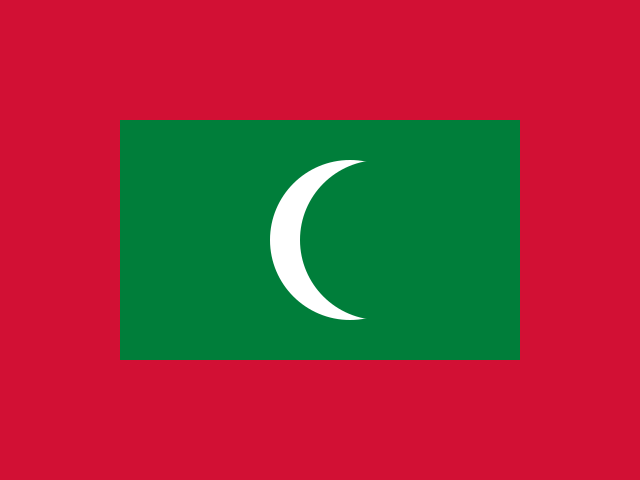
Overview
The Maldives, officially the Republic of Maldives, is an island nation in the Indian Ocean, southwest of India and Sri Lanka and roughly 750 km from the Asian mainland. It is counted as part of South Asia. Its territory is a string of 26 natural atolls reaching across the equator, from Ihavandhippolhu Atoll in the north to Addu Atoll in the south.
It is the smallest country in Asia by land, with only about 298 sq km of dry land scattered across around 90,000 sq km of ocean, which makes it one of the most spatially dispersed states in the world. The 2022 census counted 515,132 people, so it is also among the most densely populated countries. Average natural ground level is only about 1.5 m above sea level and the highest natural point is about 2.4 m (some sources give a higher figure for Mount Villingili), making it the lowest-lying country on Earth.
Malé is both the capital and the most populated city. The islands have been settled for more than 2,500 years. Arab visitors were documented from around 947 CE, Islam arrived in the 12th century, and a sultanate then developed with trading and cultural links to Asia and Africa. The country became a British protectorate in 1887, gained independence in 1965 and turned into a republic in 1968.
Tourism is now the leading industry, with fishing second. The Maldives ranks 'high' on the Human Development Index, has an upper-middle income economy according to the World Bank, and has a per capita income well above other SAARC members. It belongs to the UN, the Commonwealth, the Organisation of Islamic Cooperation and the Non-Aligned Movement, is a founding member of SAARC, and is a Dialogue Partner of the Shanghai Cooperation Organisation. It left the Commonwealth in October 2016 amid pressure over human rights and democratic backsliding and was readmitted on 1 February 2020.
History
Written records and legend point to kingdoms in the islands by the 6th–5th century BCE, and the country has a documented history of over 2,500 years. The Mahāvaṃsa (c. 300 BCE) mentions migrants from Sri Lanka. Because cowrie shells are thought to have come from the Maldives, historians suspect people lived there during the Indus Valley era. Artefacts also show that Hinduism was present before Islam.
A Buddhist period of about 1,400 years followed, probably beginning around the 3rd century BCE in the time of Emperor Ashoka. It shaped the foundations of Maldivian culture: the language, early scripts, architecture, ruling institutions and customs all trace back to this Buddhist kingdom.
Dhovemi, the final Buddhist king, embraced Islam in 1153 (or 1193) and adopted the name Sultan Muhammad al-Adil. His conversion ushered in a succession of six Islamic dynasties, which ruled up to 1932, the year the sultanate turned elective. According to tradition, a visitor from Morocco, Abu al-Barakat Yusuf al-Barbari, was responsible for convincing him. Up until 1965, the sultan's official title was Sultan of Land and Sea, Lord of the twelve-thousand islands.
The Portuguese set up a small garrison and trading post in 1558, run from Goa. Their attempts to impose Christianity under threat of death led to a revolt under Muhammad Thakurufaanu al-A'uẓam and his brothers, who drove the Portuguese out about fifteen years later; the event is marked as National Day (Qaumee Dhuvas). The islands later came under British influence and became a protectorate in 1887.
An agreement signed on 26 July 1965 ended British control of defence and external affairs, and the islands became independent. In November 1967 parliament voted 40 of 44 for a republic, and a referendum on 15 March 1968 backed it with 93.34%. The republic was declared on 11 November 1968, ending a monarchy of about 853 years, with Ibrahim Nasir as president.
The first resort, Kurumba, opened on 3 October 1972, and the first accurate census in December 1977 counted 142,832 people. After political infighting, the exile of prime minister Ahmed Zaki in 1975, the closure of the British airfield at Gan and a collapse in dried-fish exports, Nasir fled to Singapore in 1978.
Maumoon Abdul Gayoom was president for 30 years from 1978, winning six elections without opposition. He prioritised the poorer islands and tourism grew, but critics called him an autocrat who limited freedoms. Coup attempts in 1980, 1983 and 1988 failed. In November 1988 about 80 mercenaries seized the airport at Malé, and Indian paratroopers airlifted in (Operation Cactus) restored order within hours, with the Indian Navy capturing the hijacked freighter MV Progress Light.
The Indian Ocean tsunami of 26 December 2004 caused damage estimated at over US$400 million (about 62% of GDP). 102 Maldivians and 6 foreigners reportedly died, fourteen islands were fully evacuated, six were destroyed and 21 resort islands had to close. The lack of a continental shelf lessened the waves, which peaked at about 4.3 m.
Reform movements grew, and Mohamed Nasheed founded the Maldivian Democratic Party in 2003. A new constitution was approved in 2008 and Nasheed won the first direct presidential election. His government introduced goods taxation for the first time, cut many import duties and launched universal health insurance (Aasandha) and welfare benefits. After unrest and a police and army mutiny, Nasheed resigned in February 2012 and Vice-President Mohamed Waheed Hassan Manik took over. Nasheed was later convicted of terrorism and sentenced to 13 years, a trial widely seen as flawed and political.
The 2013 election was contested: the Supreme Court annulled a first round that Nasheed had led, and Abdulla Yameen won the re-run. His term saw an assassination attempt in 2015, removals and arrests of vice-presidents, a state of emergency and a crackdown on opponents; the UN human rights chief described the 2018 situation as an assault on democracy.
Ibrahim Mohamed Solih won the 2018 election and took office in November 2018. Yameen was jailed for money laundering in November 2019, upheld in January 2021, but the Supreme Court overturned the conviction in November 2021. In the 2023 runoff Mohamed Muizzu of the People's National Congress beat Solih with 54% and was sworn in on 17 October 2023. He is widely seen as pro-China, and relations with India cooled. In 2024 Yameen was freed from an 11-year sentence and the High Court ordered a new trial.
Climate
The Maldives has a tropical monsoon climate (Köppen Am) and is hot and often humid all year because of its very low elevation. Two seasons dominate: a drier season tied to the northeast monsoon (roughly December to March) and a wet season tied to the southwest monsoon, which arrives around the start of June and lasts to the end of November, bringing strong winds and storms. The shift between them occurs in April and May.
Annual rainfall averages about 254 cm in the north and 381 cm in the south, and the monsoon influence is stronger in the north, while the south is more affected by equatorial currents. Average highs are about 31.5 °C and lows about 26.4 °C.
Malé, the capital and main city, has a tropical monsoon climate with warm temperatures year-round (approx. 26–32 °C), a drier season roughly from January to March and heavier rain between May and November. Addu City in the far south is wetter and more equatorial (approx.), while Kulhudhuffushi in the north has a more pronounced monsoon pattern (approx.).
Sea level rise is the central environmental threat. More than 80% of the land lies less than one metre above sea level, and the IPCC has warned that at current rates the islands could become uninhabitable by 2100. Researchers have rated the Maldives among the island nations most endangered by flooding as a share of population, and a 2022 swell event suggested extreme floods may become more frequent. A University of Plymouth study in 2020 suggested islands can build up their own elevation through sediment movement, though sea walls may hinder this. Nasheed's 2008 idea of buying land abroad never went ahead; successive governments chose seawalls and new artificially raised islands.
Coral reefs have suffered: the 1998 El Niño warming killed about two-thirds of reefs, and a severe bleaching event in 2016 killed up to 95% of coral around some islands. Other issues include poor waste disposal and sand theft. Much waste from Malé and nearby resorts goes to Thilafushi, an industrial island created on a reclaimed lagoon in the early 1990s. The country has 31 protected areas and rich marine life, including over 2,000 fish species, 187 coral species, whale sharks and nesting sea turtles.
Government and politics
The Maldives is a presidential constitutional republic. The president is head of state, head of government and commander-in-chief, appoints a cabinet that the People's Majlis approves, and serves a five-year term. The Majlis is a unicameral parliament with five-year terms and seats allocated by atoll population. Mohamed Muizzu has been president since November 2023 (sworn in 17 October 2023 per the source's history section). In the April 2024 parliamentary election his PNC won 66 seats and allies nine more, giving a super-majority of 75 of 93 seats, enough to amend the constitution.
The current constitution was ratified on 7 August 2008, replacing the 1998 text. It created an independent judicial commission and independent bodies for elections and anti-corruption, trimmed presidential powers and strengthened parliament.
The country is divided into 21 administrative divisions: 17 administrative atolls and the cities of Malé, Addu, Fuvahmulah, Thinadhoo and Kulhudhuffushi. Each atoll has an elected Atoll Council and each island an elected Island Council. The state is unitary, with local councils handling local administration under national law, while taxation, defence, foreign policy and the legal framework remain national. Atolls are known by code letters (such as Haa Alif) as well as geographic names, which often confuses outsiders.
Law is based on the principles of Islam. The constitution states that no law contrary to Islam can apply, and judges must consider Sharia where the constitution and statutes are silent. Islam is the official religion, open practice of other faiths is forbidden, and non-Muslims cannot become citizens. A penal code that incorporates Islamic law principles took effect on 16 July 2015. Same-sex relations are illegal, though tourist resorts typically operate as exceptions in practice.
Human rights are contested: Freedom House rated the country 'Partly Free' in its 2011 report, and a US State Department report in 2012 cited corruption, lack of religious freedom, abuse and unequal treatment of women as key problems.
In foreign affairs the Maldives is a founding member of SAARC, joined the Commonwealth in 1982, left in 2016 and returned in February 2020. It is the official progress monitor of the Indian Ocean Commission and has close ties with Seychelles and Mauritius. Its government banned Israeli passport holders in June 2024. The Maldives National Defence Force (including a Coast Guard) is responsible for security and for patrolling the exclusive economic zone, and India cooperates on radar coverage. The country signed the UN treaty on the Prohibition of Nuclear Weapons in 2019.
Economy
The islands once exported cowrie shells, which served as an early form of international currency, and for this reason Arab traders referred to them as the 'Money Isles' starting in the 2nd century CE. Today, a cowry serves as the emblem of the Maldives Monetary Authority. During the 1970s and 1980s the country counted among the 20 poorest in the world, depending on fisheries and on trade in coir rope, ambergris and coco de mer. Growth was made possible by liberalising reforms in the 1980s, which included removing import quotas and opening the economy to the private sector.
Tourism got its start in 1972 with the opening of the Bandos and Kurumba resorts. Between 1972 and 2007, the count of resorts grew from 2 to 92. The sector contributes roughly 28% of GDP and more than 60% of foreign exchange receipts, while import duties together with taxes linked to tourism supply over 90% of the revenue the government collects from taxation. In 2019, more than 1.7 million visitors arrived. Each resort sits on its own island, and only around 200 islands have residents.
Fishing was the sole economic basis for centuries and remains a main occupation. Mechanisation of the dhoni in 1974, a cannery at Felivaru in 1977 and opening the EEZ to fisheries boosted output. As of 2010, fisheries provided over 15% of GDP and employed about 30% of the workforce, ranking second to tourism as a foreign-exchange earner. Agriculture and manufacturing are minor, limited by scarce land and labour.
Visitors need no pre-arrival visa if they hold a passport valid for at least one month, a full itinerary with confirmed return tickets and accommodation booking, proof of funds, and a Traveller Declaration form filed within 96 hours of arrival; Israeli passports are refused. Most arrive at Velana International Airport on Hulhulé Island next to Malé, linked by the Sinamalé Bridge. Gan Airport in Addu has some international service. Between islands people travel by domestic flight, seaplane (Twin Otters operated by TMA and Manta Air), speedboat, scheduled ferry or traditional dhoni. Maldivian, Villa Air and Manta Air run domestic flights, with about 18 airports in the country.
The economy is heavily exposed to tourism demand and to the cost of imported food and goods. Public debt and reliance on foreign finance have been recurring concerns (approx., general knowledge).
Demographics and urbanization
The population was 515,132 in the 2022 census, made up of 382,639 resident Maldivians and 132,493 resident foreigners (about 26% of the total). The largest migrant groups were Bangladeshi (56.4% of migrants), Indian (24.9%), Sri Lankan (8.6%), Nepali (3.9%), Indonesian (1.7%) and Filipino (1.3%).
Maldivians (Dhivehin) are the only major ethnic group, sharing the Dhivehi language and culture and are mainly Indo-Aryan with Middle Eastern, South Asian, Austronesian and African ancestry. The small Giraavaru community has been absorbed. Social ranking is not rigid; historically there was a distinction between nobles (bēfulhu) and commoners, and the elite is concentrated in Malé.
Population doubled between the 1970s and 1978, growth peaked at 3.4% in 1985, and it fell to 1.9% by 2000. Life expectancy rose from 46 years in 1978 to the mid-to-high 70s (77 in 2011), and adult literacy is about 99%.
Urbanisation is strongly tied to Malé: about 41% of residents lived in the capital in 2022, up from 27% in 2000. The rest live on around 200 inhabited islands, with other towns including Addu City (Hithadhoo), Fuvahmulah and Kulhudhuffushi (all of them roughly 10,000–40,000 people, approx.). Greater Malé including Hulhumalé and Villingili has roughly 250,000 people (approx.).
Dhivehi is the official and national language, written in the right-to-left Thaana script, with older scripts Eveyla akuru and Dhives Akuru. English is widely spoken, used as a teaching medium at secondary and tertiary level and in tourism, and Arabic is taught in schools and mosques.
Sunni Islam is the state religion and citizens are legally required to follow it; independent studies in 2020 put Christians at about 0.29% of the population.
Education includes the Maldives National University (named in 2011) and the Islamic University of Maldives (2015), plus vocational, teacher and hotel-training institutes. Government scholarships go to high-performing year 12 graduates.
Health outcomes for children and adults are strong relative to income, but reproductive health rights rate 'very bad' per the Human Rights Measurement Initiative. Health care is unequal between the capital and outer islands, and malnutrition is an issue because imported food is expensive. In May 2021 the Maldives had the world's fastest-growing COVID-19 outbreak, driven by the Delta variant.
Capital city
Malé, traditionally called the 'King's Island', sits in the central part of the archipelago in the Kaafu Atoll area and was the seat of the ancient royal dynasties. It is the capital and the most populated city. It is a very small, extremely dense island of only a few square kilometres (approx.), with roughly 130,000–150,000 people in the city and around 250,000 in the greater Malé area including Hulhumalé and Villingili (approx.). About 41% of the national population lived there in 2022.
Malé has a tropical monsoon climate with hot, humid weather all year, typical highs of about 30–32 °C and lows near 26 °C (approx.), a wetter southwest monsoon season from about May to November and a drier season from about January to March.
It is the political, administrative, financial and commercial centre, and the country's social elite is concentrated there. Government, the Majlis, main businesses and the biggest share of services are based in Malé. The Hukuru Miskiy (Friday Mosque), originally built in 1153 and rebuilt in 1658, and the tomb of Abu al-Barakat Yusuf al-Barbari are among its historic sites.
Velana International Airport on neighbouring Hulhulé Island is the main gateway and is connected to Malé by the Sinamalé Bridge. Waste from Malé is mainly sent to the artificial island of Thilafushi.
The capital is also the main economic and population centre, though the biggest export earner, tourism, takes place largely on resort islands elsewhere in the archipelago. There is a single capital and no separate economic capital.
About this summary
Includes approximate general-knowledge facts on Malé's metro population and climate, capital-city details, recent economic figures and the Hulhumalé and Thilafushi areas.