Overview
Liberia is a West African country on the Atlantic coast, with Sierra Leone to the northwest, Guinea to the north and Ivory Coast to the east. It covers roughly 111,000 km2 (about 43,000 sq mi) and has around 5.5 million people. English is the official language, and many indigenous languages are spoken alongside it. Monrovia is the capital and largest city.
The country's origins lie in a 19th-century scheme run by the American Colonization Society, which encouraged free and freed Black Americans to resettle in Africa. Between 1822 and 1861, over 15,000 African Americans and 3,198 Afro-Caribbeans moved there. These settlers developed an Americo-Liberian identity and ruled over the indigenous population. Independence was declared on July 26, 1847; the United States only recognized it on February 5, 1862.
Liberia is regarded as the first African republic and Africa's oldest continuously independent country. It escaped the European Scramble for Africa. Firestone's rubber investment in the 1920s reshaped the economy, and American investment during World War II improved infrastructure. Under President William Tubman, Liberia became a founding member of the League of Nations, the United Nations and the Organisation of African Unity.
A 1980 coup ended Americo-Liberian rule and brought Samuel Doe, the first indigenous leader, to power. Two civil wars (1989-1997 and 1999-2003) killed about 250,000 people (roughly 8% of the population) and shrank the economy by around 90%. A 2003 peace agreement led to elections in 2005, and the country has been relatively stable since. Mining has been a major economic driver since the 1960s, and it has brought concerns about deforestation, pollution and labor conditions.
History
Stone Age tools show that humans have lived in West Africa for a very long time. The coast later known as the Pepper or Grain Coast has been home to Niger-Congo-speaking peoples since at least the 12th century. Mande-speaking groups moved in from the north and east, pushing smaller groups such as the Dei, Bassa, Kru, Gola and Kissi toward the Atlantic. The decline of the Mali Empire (1375) and the Songhai Empire (1591), together with desertification inland, drove further migration to the wetter coast.
From 1461 to the late 17th century, Portuguese, Dutch and British traders operated posts and bartered goods along the coast. The Portuguese called it Costa da Pimenta (Pepper Coast), later the Grain Coast because of melegueta pepper grains.
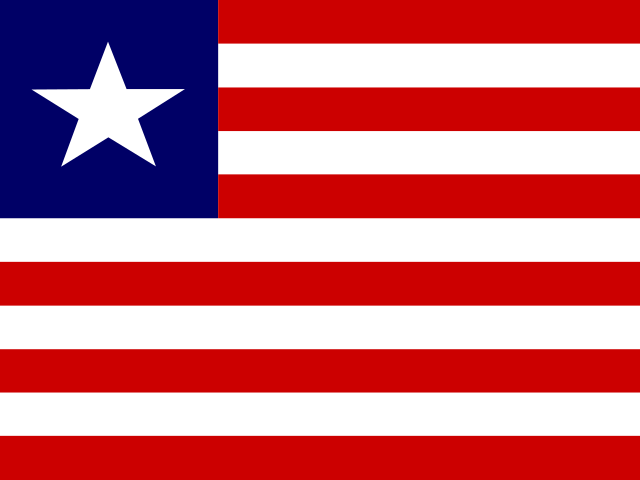
In the United States, a Back-to-Africa movement sought to settle free and formerly enslaved Black Americans in Africa, partly because of racial discrimination at home. Settlers sent by the American Colonization Society arrived from 1822 and gradually formed the Americo-Liberian elite. On July 26, 1847 they issued a Declaration of Independence and a constitution modeled on US political principles. The 11-striped flag was adopted on August 24. The United Kingdom was first to recognize the new republic; the US waited until 1862, after Southern states seceded.
In the early 1900s the export trade and merchant class largely collapsed, and the country sank into economic insignificance, though some trade with Germany continued. Firestone began major rubber operations in the 1920s, changing the economy and workforce. During World War II Liberia supported the US war effort and received significant American investment in infrastructure. President William Tubman then promoted economic and political change and raised the country's international profile.
On April 12, 1980, Master Sergeant Samuel Doe of the Krahn ethnic group led a coup that killed President William R. Tolbert Jr. Most of Tolbert's cabinet and other Americo-Liberian officials were executed, and the People's Redemption Council took charge. Doe, a Cold War ally of the West, received substantial US funding while critics condemned corruption and repression. After a 1985 constitution, he won elections widely condemned as fraudulent. A failed coup by Thomas Quiwonkpa on November 12, 1985 led to harsh reprisals against Gio and Mano people in Nimba County.
Charles Taylor's National Patriotic Front of Liberia launched an insurrection in December 1989, starting the First Liberian Civil War. Doe was captured and executed in September 1990. The rebels split into factions, and an ECOWAS monitoring group intervened militarily. Roughly 60,000 to 80,000 Liberians died in 1989-1997 and about 700,000 were displaced into neighboring countries by 1996. A 1995 peace deal led to Taylor's election as president in 1997.
Because blood diamonds and illegal timber were used to bankroll the Revolutionary United Front in Sierra Leone, Taylor's rule turned Liberia into a pariah state. In 1999, LURD rebels struck from the northwest and set off the Second Liberian Civil War; in 2003, a separate group called MODEL launched its own offensive from the southeast. Peace negotiations opened in Accra in June 2003, the same time the Special Court for Sierra Leone indicted Taylor. Rebels then assaulted Monrovia, and heavy pressure from abroad and at home, including the Women of Liberia Mass Action for Peace, pushed Taylor to step down in August 2003. He then left for exile in Nigeria, and a peace agreement was reached that same month.
A UN mission arrived from September 2003 and an interim government took office that October. The 2005 elections were widely seen as the freest and fairest in the country's history, and Ellen Johnson Sirleaf became Africa's first elected female president. Taylor was later transferred to the Special Court for trial in The Hague. A Truth and Reconciliation Commission was set up in 2006, July 26 was proclaimed National Independence Day in 2011, and Leymah Gbowee received the 2011 Nobel Peace Prize for her peace work. Sirleaf was re-elected in 2011.
George Weah, a former footballer, took the oath of office as president on January 22, 2018, in what was the first fully democratic handover of power in 74 years. In the closely fought 2023 presidential race, however, opposition figure Joseph Boakai beat Weah, and Boakai was inaugurated on January 22, 2024.
Climate
Liberia has a hot, humid equatorial climate, especially in the south. Heavy rain falls from May to October, with a short lull from mid-July to August. From November to March dry, dust-laden harmattan winds blow inland. Cape Mount near the Sierra Leone border receives the most precipitation.
Monrovia, the capital, has a tropical monsoon climate (approx.): very wet, with some of the heaviest rainfall of any capital city in the world during the rainy season, and temperatures typically around 24-31°C all year. Other coastal towns such as Buchanan and Harper are similarly hot and humid (approx.). Inland towns such as Gbarnga and Sanniquellie in the north are also hot and rainy, with somewhat greater seasonal variation and cooler highlands near Mount Nimba (approx.).
The landscape runs from coastal plains with mangroves and swamps to a rolling plateau and low mountains in the northeast. Mount Wuteve (1,440 m) is the highest point wholly in Liberia, while Mount Nimba (1,752 m) on the Guinea and Ivory Coast border is higher. The Cavalla River (about 510 km) is the longest river; the St. Paul, St. John and Cestos also flow to the Atlantic.
Liberia is highly vulnerable to climate change, including extreme weather, coastal effects of sea level rise and changing water availability, with expected impacts on agriculture, fisheries and forestry. Rubber, palm oil and mining have driven deforestation, biodiversity loss and water pollution. The country holds about 40% of the remaining Upper Guinean rainforest and is a biodiversity hotspot. In 2014 Liberia and Norway agreed a deal ending logging in exchange for $150 million in development aid.
Government and politics
Liberia is a unitary constitutional republic and representative democracy modeled on the US system, with three branches. The president is head of state, head of government and commander-in-chief, and is elected with the vice president for a six-year term by majority vote in a two-round system, with a limit of two terms. The president appoints cabinet members, judges and other officials and can sign or veto bills.
The bicameral Legislature has a 73-seat House of Representatives (six-year terms, seats apportioned by census among the 15 counties with at least two each) and a 30-seat Senate (two per county, nine-year terms). The vice president presides over the Senate. The Supreme Court has five members led by the Chief Justice, appointed by the president and confirmed by the Senate, serving until age 70. The legal system blends Anglo-American common law with customary law; informal traditional courts persist in rural areas, and trial by ordeal remains common despite being outlawed.
Power is highly centralized. Liberia is divided into 15 counties, 90 districts and clans. County superintendents are appointed by the president. Constitutionally required elections for chiefs at county and local level have not been held since 1985. There is no uniform framework for local governments: cities, townships and a borough were each created by specific acts, so their structures and duties vary. Counties do not control their own taxation, health or law the way federal states do; these are national functions.
The True Whig Party dominated from 1877 to 1980. Over 20 parties were registered in 2011, largely built around personalities and ethnic groups. V-Dem 2023 ranks Liberia 65th among electoral democracies worldwide and 9th in Africa. Corruption is described as endemic; in a 2010 survey 89% of respondents reported paying a bribe to officials.
The Armed Forces of Liberia number about 2,010 active personnel (2023), with a small coast guard, and were rebuilt from 2005 with US support. Liberia has contributed peacekeepers to UN and ECOWAS missions. The national police has a history of corruption, and sexual violence is a serious problem. Same-sex relations are illegal. Relations with neighbors have normalized since the wars, and China is an important partner in reconstruction.
Economy
Liberia is one of the world's poorest countries, with formal employment around 15%. The Liberian dollar and the US dollar are both legal tender; the US dollar was the sole currency from 1943 to 1982. GDP per capita peaked in 1980 at US$496, then collapsed after the coup and civil war, with GDP falling an estimated 90% from 1989 to 1995. The economy has long relied on aid, foreign investment and natural resource exports such as iron ore, rubber and timber.
After 2003, growth accelerated, reaching 9.4% in 2007. Inflation hit 17.5% in 2008. Debt relief from 2007 to 2010 cut external debt from about $4.5 billion to about $223 million. Liberia joined the WTO in 2016. Obstacles include a small domestic market, poor infrastructure, high transport costs, weak regional trade links and heavy dollarization. In September 2024 the IMF board approved an arrangement of about $210 million.
Foreign direct investment relative to GDP is among the highest in the world, with about $16 billion since 2006, including concessions to ArcelorMittal, BHP and Sime Darby. Palm oil firms have been accused of displacing communities. Firestone has run the world's largest rubber plantation at Harbel since 1926 and was the largest private employer in 2015 (8,000+ staff). Liberia has the second-largest ship registry in the world, with about 3,500 vessels, roughly 11% of the global fleet.
Agriculture is mostly subsistence farming (upland rice, cassava, vegetables), while palm oil and rubber are plantation-based. Liberia imports about 90% of its rice. Iron ore dominated exports from 1960 to 1980 (over 60% of export earnings) until war halted mining. Gold, diamonds and iron ore are the core minerals, and the sector accounted for about 11% of GDP in 2013. Mining protests over pay and conditions continue, including a March 2024 protest at Kinjor with injuries and deaths. Diamond exports were banned by the UN from 2001 to 2007 and timber sanctions applied from 2003 to 2006.
Infrastructure is limited. The state-owned Liberia Electricity Corporation runs a small grid almost entirely in Greater Monrovia, and most power comes from private generators. Electricity cost was among the world's highest (US$0.54/kWh in 2013). The Mount Coffee hydropower plant (80 MW) was restored in 2018, and Liberia imports power through the West African Power Pool. Offshore oil exploration began with licensing rounds from 2004. Radio is the main medium for public communication, and about 65% of people have mobile service.
Demographics and urbanization
The 2017 census counted 4,694,608 people (the population is now estimated around 5.5 million). Montserrado County, home to Monrovia, had 1,118,241 residents and the Greater Monrovia District 970,824. Nimba County is next, with 462,026. Monrovia is a primate city, more than four times the size of all county capitals combined (2008 census). Liberia has had one of the world's highest growth rates, and in 2010 about 43.5% of people were under 15. Urbanization is roughly 55% (approx.), with most urban dwellers in Greater Monrovia, followed by towns such as Gbarnga, Buchanan, Kakata, Ganta and Harper (smaller, each well under 100,000 approx.).
About 95% of Liberians belong to 16 officially recognized indigenous groups, including the Kpelle (over 20%, the largest, mainly in Bong County), Bassa, Mano, Gio/Dan, Kru, Grebo, Krahn, Vai, Gola, Mandingo, Mende, Kissi, Gbandi, Loma, Dei and Belleh. Americo-Liberians and Congo people each make up about 2.5%. Lebanese, Indian and other West African merchants form a notable business community, and citizenship is traditionally limited to people of Black African descent.
English is the official language and lingua franca, with Liberian English creole and around 27 indigenous languages in the Mande, Kru, Mel and Grebo groups. In 2008, 85.6% were Christian (mainly Protestant), 12.2% Muslim (mostly Mandingo and Vai), 0.5% followed traditional religions and 1.5% had none. Many people also take part in the Poro and Sande secret societies. Freedom of religion is constitutional, though Liberia is considered Christian in practice.
Literacy was about 60.8% in 2010. Schooling is nominally compulsory from ages 6 to 16 but is poorly enforced, with shortages of schools and trained teachers. The University of Liberia in Monrovia (opened 1862) is the oldest and largest university; Tubman University (2009) is the second public university. Public universities abolished undergraduate tuition in 2018.
Life expectancy was about 64.4 years in 2020, fertility 5.9 births per woman, and maternal mortality high (1,072 per 100,000 in 2017). TB, malaria and diarrheal diseases are widespread. About 95% of health facilities were destroyed by 2003, and in 2008 there was only one doctor per 100,000 people. The 2014 Ebola outbreak caused thousands of deaths. Food insecurity is high: a 2025 survey found only 2.4% of children aged 6-23 months receive a minimum acceptable diet and 8.5% of under-fives suffer acute malnutrition.
Capital city
Monrovia is the capital and largest city, on the Atlantic coast at the mouth of the St. Paul River in Montserrado County, the country's smallest but most populous county. The Greater Monrovia District had about 970,000 residents in 2017; the wider metropolitan area is roughly 1.5 million (approx.). It is a primate city, over four times the size of all county capitals combined.
Monrovia is the seat of the executive, legislature and Supreme Court, and is also the main economic center, with the main port, most of the grid electricity, the national hospital (John F. Kennedy Medical Center) and the University of Liberia (founded 1862). It is therefore both the political and the principal economic and cultural city; Liberia has no separate capital. The national police academy lies in Paynesville City, within the metro area.
Its climate is tropical monsoon (approx.): hot all year, typically around 24-31°C, with extremely heavy rain from May to October and a short dip in July-August, and a drier season with harmattan dust from November to March. Roads and services are strained, and flooding in the rainy season is common (approx.).
About this summary
Capital-city details (Monrovia's approx. metro population, climate, institutions), city climates, and approx. recent economic and political context are from general knowledge.