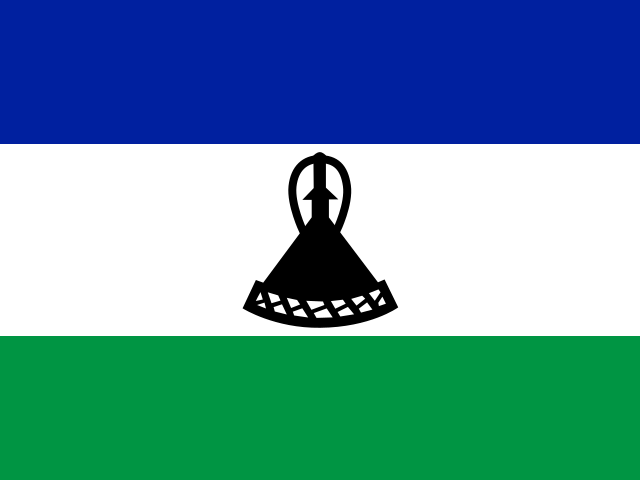
Overview
Lesotho, officially the Kingdom of Lesotho, is a landlocked country in Southern Africa. It is completely surrounded by South Africa and, at roughly 30,355 km2, is the largest of the three sovereign enclaves in the world (the others being Vatican City and San Marino). It is the only enclave outside Europe and the only one that is not a microstate.
The country sits in the Maloti Mountains and is the only independent state whose entire territory lies above 1,000 m. Its lowest point, about 1,400 m, is described as the highest lowest point of any country. Population is about 2.3 million, and the capital and largest city is Maseru.
Almost everyone (about 99.7%) belongs to the Basotho ethnic group, which makes the country unusually homogeneous. Official languages are Sesotho, English, IsiXhosa and SiPhuthi. It is a lower middle income country with serious socioeconomic problems, yet adult literacy is among the highest in Africa (81% as of 2021).
Lesotho belongs to the United Nations, the Non-Aligned Movement, the Commonwealth, the African Union and the Southern African Development Community.
History
The Basotho state took shape in the early 1820s under Moshoeshoe I, the son of a minor chief of the Bakoteli lineage. He founded a separate clan and gained chiefly status around 1804. From about 1820 to 1823 he and his people settled on Butha-Buthe Mountain, where they united with former rivals to resist the upheavals of the Lifaqane, associated with Shaka's rule (1818 to 1828). The kingdom is dated to 1822 or 1824 in different passages of the source.
Its later development was shaped by rivalry between British and Dutch-descended colonists, who spread out from the Cape Colony after Britain took it in 1795, and by the Orange River Sovereignty and Orange Free State. Moshoeshoe invited French missionaries of the Paris Evangelical Missionary Society (Arbousset, Casalis and Gosselin), who settled at Morija. Between 1837 and 1855 they developed written Sesotho and printed works in the language. Casalis also served as translator and foreign-affairs adviser and helped obtain firearms against the Griqua and encroaching Europeans.
Boer trekkers began claiming land on the western borders from 1838. After a treaty with Cape Governor Sir George Napier and a skirmish with Boers in 1848, Basotho forces defeated a British force in 1851. Another British attack was repelled in 1852, a diplomatic settlement followed, and the Batlokoa were beaten in 1853. Britain withdrew in 1854. Wars with the Boers (the Free State–Basotho War, from 1858) cost the western lowlands. Moshoeshoe appealed to Queen Victoria, and Basutoland became a British protectorate in 1868.
The 1869 Aliwal North treaty fixed the borders and cut the kingdom to about half its earlier size. Administrative functions moved from Moshoeshoe's capital at Thaba Bosiu to the police camp at Maseru, and administration passed to the Cape Colony in 1871. Moshoeshoe died on 11 March 1870. Cape rule (1871 to 1884) caused resentment and led to the Basuto Gun War of 1880 to 1881. In 1884 Basutoland became a Crown colony with Maseru as capital, governed by a governor while chiefs held effective local power. A railway linked Maseru to South Africa's network in 1905.
Independence came on 4 October 1966, creating the Kingdom of Lesotho. The Basotho National Party (BNP) governed until January 1970, when it lost the first general election (23 seats to 36 for the Basotho Congress Party, BCP). Prime Minister Leabua Jonathan refused to hand over power and jailed BCP leaders. The BCP's armed wing, the Lesotho Liberation Army, waged a guerrilla campaign, and in the 1980s government forces attacked and killed some perceived opponents.
A 1986 coup removed Jonathan. The Transitional Military Council gave executive powers to King Moshoeshoe II, who was forced into exile in 1987 after proposing a constitution giving him more power than the junta accepted; his son became Letsie III. Junta leader Justin Lekhanya was ousted in 1991 and Elias Ramaema handed power to an elected BCP government in 1993. Moshoeshoe II returned in 1992 as a private citizen.
In August 1994 Letsie III staged a military-backed coup against the BCP government after it declined to reinstate his father. SADC mediation restored the government, and Letsie III abdicated in 1995 in favour of his father. Moshoeshoe II died on 15 January 1996 when his car left a mountain road, and Letsie III again became king and remains so.
In 1997 the BCP split; Ntsu Mokhehle formed the Lesotho Congress for Democracy (LCD), and Pakalitha Mosisili succeeded him as leader and won the 1998 election. Opposition protests peaked in August 1998, and SADC troops from Botswana and South Africa intervened. Fighting and rioting left much of Maseru in ruins and Mafeteng and Mohale's Hoek lost over a third of their commercial property by the time forces left in May 1999.
An Interim Political Authority created in December 1998 designed a mixed system: the 80 constituency seats were kept and 40 proportional seats were added. The LCD won the May 2002 election with 54% of the vote, with irregularities alleged. On 30 August 2014 an alleged abortive military coup forced Prime Minister Thomas Thabane to flee to South Africa for three days.
Thabane resigned on 19 May 2020 after being named a murder suspect in the killing of his ex-wife, and economist Moeketsi Majoro succeeded him. Lesotho reported its first COVID-19 case on 13 May 2020, the last African nation to do so. Majoro resigned in 2022 after a no-confidence vote. Sam Matekane was sworn in as prime minister on 28 October 2022 after his Revolution for Prosperity (RFP), formed that year, won the 7 October election and a coalition was formed.
In 2025 US tariffs hit the textile industry hard: orders were cancelled, factories closed, thousands lost their jobs (many of them women), and the government declared an economic emergency. The tariff was reduced to 15% on 1 August 2025.
Climate
Because of its altitude, Lesotho is cooler year-round than other places at similar latitude (28° to 31°S). Most rain falls as summer thunderstorms, and the wet season runs from October to April. From December to February most of the country gets over 100 mm a month, while June is driest with under 15 mm in most areas. Annual rainfall ranges from about 500 mm to 1,200 mm depending on elevation.
Maseru and the surrounding lowlands can reach about 30 °C in summer. Winter lows can fall to about -7 °C in the lowlands and -18 °C in the highlands. Snow is more common in the highlands between May and September, and higher peaks may see snow at any time of year. Maseru has a mild-temperate to subtropical highland climate with hot summers and cold, dry, frosty winter nights (approx.). Johannesburg, in neighbouring South Africa, is similarly cool and highland-like (approx.).
Periodic drought is a recurring hazard for a mostly rural, subsistence-farming population, and some farming practices worsen it. A 2007 drought led to a UN recommendation to declare an emergency. The 2018/2019 rains started a month late with rainfall 55% to 80% below normal, and a 2019 assessment projected about 487,857 people needing humanitarian help and 640,000 facing food insecurity between July 2019 and June 2020. Drought also drives migration to towns and to South Africa. Roughly 12% of the land is arable and highly vulnerable to erosion, with an estimated 40 million tons of soil lost yearly.
Lesotho has about 339 bird species, 17 reptile species and many mammals, with alpine flora. The Katse Botanical Gardens hold medicinal plants and a seed bank. Three ecoregions occur: Drakensberg alti-montane grasslands and woodlands, Drakensberg montane grasslands, and Highveld grasslands.
Government and politics
Lesotho is a parliamentary constitutional monarchy. King Letsie III is head of state with a largely ceremonial role and no executive authority. The prime minister, Sam Matekane, is head of government and holds executive power. The Revolution for Prosperity leads a coalition in the National Assembly, the lower house. The Senate has 22 hereditary principal chiefs and 11 appointees of the king acting on the prime minister's advice. Since 2002 the Assembly has combined 80 constituency seats with 40 proportional seats.
The constitution provides for an independent judiciary: the High Court, Court of Appeal, Magistrate's Courts and traditional courts, mainly in rural areas. All but one Court of Appeal justice are South African jurists. There are no jury trials. The constitution protects freedoms of speech, association, press, assembly and religion.
Lesotho has a dual legal system. General law blends Roman-Dutch civil law and English common law and operates independently of South Africa, whose decisions are only persuasive. Customary law is codified in the Laws of Lerotholi (from a council appointed in 1903) and is applied by local customary courts. The Court of Appeal is the final appellate forum.
Sub-national structure is administrative rather than federal: 10 districts, each led by a district administrator and with a district capital called a camptown. They are split into 80 constituencies containing 129 local community councils. Tax, health, education and law-making are national responsibilities, with districts and councils carrying out administration locally and traditional chiefs retaining local roles (approx.). There are no special autonomous jurisdictions.
Political stability has been fragile. Scholars such as Jeffrey Herbst argue that the colonial-era state structure has kept governments weak. In 2010 a People's Charter Movement petitioned for integration with South Africa, which South Africa rejected; an African Union report urged economic integration without suggesting annexation. After Thabane's 2020 resignation a South African minister floated a confederation with Eswatini and South Africa. Majoro left office in 2022. Critics say corruption persists, and a protest by about 40,000 garment workers saw excessive force that killed two protesters.
Foreign policy: Lesotho belongs to SADC and the Southern African Customs Union, the UN, AU, NAM and Commonwealth. It has ties with the UK, Germany, the US and other Western states. It switched recognition to Taiwan in 1990 and later restored ties with China, recognises the State of Palestine, and recognised Kosovo from 2014 to 2018. It opposed apartheid and sheltered South African refugees, and signed the UN nuclear weapons prohibition treaty in 2019.
Security: the Lesotho Defence Force handles defence and internal security. The Lesotho Mounted Police Service, in existence under various names since 1872, handles policing with specialist units. The Lesotho National Security Service is the intelligence agency, set up in modern form by the 1998 Act and answerable to the government.
Economy
The economy rests on agriculture, livestock, manufacturing and mining, and depends on worker remittances and Southern African Customs Union receipts. Most people practise subsistence farming, and almost half earn income from informal crop or livestock activity. The western lowlands are the main farming zone. Other major employers are the clothing industry, mining in South Africa and the government. The share living below US$1.25 a day (PPP) fell from 48% to 44% between 1995 and 2003.
Under the African Growth and Opportunity Act, Lesotho became sub-Saharan Africa's largest garment exporter to the US, supplying brands such as Levi Strauss, Gap and Wal-Mart. Sector employment passed 50,000 (mostly women) in 2004, then fell to about 45,000 by 2011 amid competition, while remaining the largest formal employer. In 2007 textile workers earned about US$103 a month on average, with a US$93 minimum wage. The industry runs the ALAFA programme against HIV/AIDS. Exports were about US$487 million in 2008.
Water and diamonds are key resources. The Lesotho Highlands Water Project, begun in 1986 under the Lesotho Highlands Development Authority, transfers water from the Orange River system to South Africa's Free State and the Johannesburg area. Its first phase made Lesotho almost self-sufficient in electricity and earned about US$70 million in 2010 from electricity and water sales.
Diamonds come from the Letšeng, Mothae, Liqhobong and Kao mines, together expected to yield about 240,000 carats worth US$300 million in 2014. Letšeng, discovered in 1957 by geologist Peter Nixon, averaged about US$2,172 per carat, described as the world's richest mine by price per carat. Diamond exports reached US$230 million in 2010 to 2011. Famous finds include the 601-carat Lesotho Brown (1967) and the 603-carat Lesotho Promise (2006).
The economy moved from subsistence toward lower middle income through resource and manufacturing exports. The global crisis hurt textile exports, diamond prices, SACU revenue and remittances, and GDP growth slowed to 0.9% in 2009. Lesotho ranked 132nd in the 2025 Global Innovation Index.
The currency is the loti (plural maloti), at par with and interchangeable with the South African rand, within the Common Monetary Area with Eswatini, Namibia and South Africa. In April 2025 the US announced a 50% tariff on Lesotho, justified by claims that Lesotho taxes US goods at nearly 100%, which many observers consider unfounded because tariffs are set centrally by SACU and imports from the US are marginal. Factories closed, and the tariff was cut to 15% on 1 August 2025.
Demographics and urbanization
The population is about 2.28 million (approx. 2.3 million), roughly 25% urban and 75% rural, with urban population growing around 3.5% a year. About 60% are aged 15 to 64. Most people live in the western lowlands and foothills (approx.), where the capital and main towns lie. Maseru is the largest city, with a metro area of roughly 330,000 to 400,000 people (approx.). Other notable towns include Teyateyaneng, Mafeteng, Hlotse (Leribe) and Mohale's Hoek (approx.), each with well under 100,000 residents (approx.).
About 99.7% identify as Basotho, a Bantu-speaking group with subgroups including the Bafokeng, Batloung, Baphuthi, Bakuena, Bataung, Batšoeneng and Matebele. About 1% are Europeans, Asians and Xhosa. Lesotho is among the few African states that are nation states with one dominant ethnic group and language.
Over 95% are Christian (2011 estimate): Catholics 49.4%, Protestants 18.2%, Pentecostals 15.4%, Anglicans 5.3%, other Christians 1.8%. Non-Christian religions account for 9.6% and the non-religious 0.2% (figures as given in the source).
Literacy is high: about 85% of women and 68% of men over 15, helped by education spending above 12% of GDP. Education is not compulsory, but free primary education is being phased in. About 3.4% of the population used the internet per the ITU figure cited in the source (dated), and usage is likely much higher now (approx.).
Health is a major challenge. Lesotho is classed as Low Human Development (rank 168 of 193), with life expectancy of 50.3 years for men and 55.9 for women in 2022. Adult HIV prevalence was 23.6% in 2018, second-highest in the world, and 22.8% among ages 15 to 49 in 2021. Tuberculosis incidence is the highest in the world, and WHO data show the highest age-standardized suicide rate since 2018. Around 4% reported a disability in the 2006 census, though the real share is probably closer to 15%, and people with disabilities face barriers to education, health care and jobs.
Gender-based violence is serious: the UN reported the highest recorded rape rate in 2008 (91.6 per 100,000), and one study found 61% of women had experienced sexual violence. The Married Persons Equality Act 2006 abolished husbands' marital power. The 2020 Gender Gap Report ranked Lesotho 88th.
Capital city
Maseru is the capital and largest city, in the western lowlands on the border with South Africa, near the Caledon River (approx.). It began as a British police camp on the northwest border after 1869 and became capital of the Crown colony in 1884, taking over functions from Thaba Bosiu. A railway line connected it to South Africa's network in 1905. Much of it was damaged in the 1998 unrest.
Its population is roughly 330,000 to 400,000 in the urban area (approx.). The climate is in the lowlands band: summers up to about 30 °C, cold winters with frost and lows around -7 °C at times, and most rain from October to April in thunderstorms (approx. for the city, from lowland figures in the source).
Maseru is the political, administrative and main commercial centre. It hosts the royal palace, parliament and government ministries, and the seat of the Catholic archbishop. It is also the country's main economic city, home to the bulk of formal business, retail and services (approx.), with textile factories nearby. Lesotho has a single capital, and it coincides with the main economic city. Thaba Bosiu, Moshoeshoe's historic capital, lies nearby and is important culturally (approx.).
About this summary
Capital-city details (Maseru population, climate, role), recent economic context and some city populations are approximate and drawn from general knowledge.