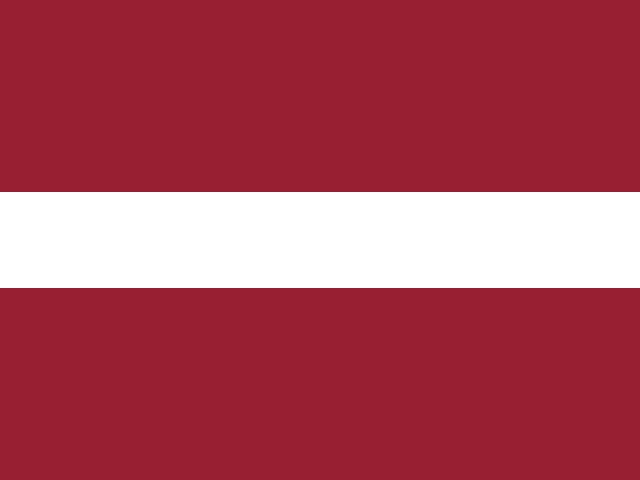
Overview
Latvia is a Baltic country in northern Europe, on the eastern shore of the Baltic Sea. Estonia lies to its north and Lithuania to its south, while Russia and Belarus lie along its eastern and southeastern borders. It also has a sea boundary with Sweden across the Baltic. The country covers roughly 64,500 square kilometres and has about 1.83 million inhabitants.
The capital and largest city is Riga. Latvians make up about 65.5% of the population and speak Latvian, a Baltic language. Russians are the largest minority at close to a quarter of residents, and about 37.7% of people report Russian as their mother tongue.
After centuries under German, Swedish, Polish-Lithuanian and Russian rule, independence was proclaimed on 18 November 1918. The state was occupied and annexed by the Soviet Union in 1940, then taken by Nazi Germany in 1941, then retaken by the USSR in 1944, and stayed a Soviet republic for about 45 years. Full independence returned on 21 August 1991, and Latvia is today a unitary parliamentary republic.
Latvia is a high-income developed economy and ranks 39th on the Human Development Index. It belongs to the EU, the Eurozone, NATO, the Council of Europe, the UN, the OECD, the OSCE, the IMF, the WTO, the Council of the Baltic Sea States, the Nordic-Baltic Eight and the Nordic Investment Bank.
The landscape is mostly low and flat, with forests covering about 56% of the land, more than 12,500 rivers, over 2,000 lakes and nearly 500 km of largely undeveloped coastline. Latvia is part of the Schengen Area and adopted the euro on 1 January 2014.
History
Ancestors of the Latvians, speakers of Baltic languages, settled the eastern Baltic coast around 3000 BC and traded local amber for precious metals along routes reaching Rome and Byzantium. By about 900 AD the area was home to four Baltic tribes (Curonians, Latgalians, Selonians and Semigallians) and the Finnic-speaking Livonians. In the 12th century the territory held a number of lands with their own rulers, such as Koknese, Jersika and Tālava.
Closer integration with Europe came in the 12th century, when missionaries sent by the pope sailed up the Daugava, though the locals were slow to convert. German crusaders ruled much of the territory from the early 13th century, with their influx growing in the second half of that century.
After the Livonian War (1558–1583), Livonia, covering northern Latvia and southern Estonia, came under the Polish–Lithuanian Commonwealth. Gotthard Kettler, last master of the Livonian Order, founded the Duchy of Courland and Semigallia, a vassal state with considerable autonomy. Swedish rule followed in parts of the region.
The Great Northern War (1700–1721) was devastating: up to 40% of Latvians died of famine and plague, and about half of Riga's residents were killed by plague in 1710–1711. The Treaty of Nystad in 1721 gave Vidzeme to Russia. Latgale passed to Russia in 1772, and the Duchy of Courland was also annexed by Russia, so that all Latvian lands were in the Russian Empire by the end of the 18th century.
World War I devastated the area. After the Russian Revolution, the Treaty of Brest-Litovsk and the armistice of 11 November 1918, the People's Council of Latvia proclaimed independence on 18 November 1918, and Kārlis Ulmanis became prime minister. In 1934 Ulmanis led a coup and established an authoritarian regime.
On 24 August 1939 the Molotov–Ribbentrop Pact placed Latvia in the Soviet sphere of influence. Most Baltic Germans were resettled to Germany. In October 1939 Latvia had to accept a mutual assistance pact allowing 25,000–30,000 Soviet troops on its soil. After staged elections, the Soviet Union incorporated Latvia on 5 August 1940 as the Latvian SSR. In under a year before the German attack, at least 34,250 Latvians were deported or killed.
German troops had occupied Riga by 29 June 1941, and Latvia was then governed as part of Reichskommissariat Ostland. Latvian auxiliary units participated in the Holocaust. Roughly 30,000 Jews were shot during the autumn of 1941, and in November and December 1941 about 30,000 more people taken from the Riga ghetto were murdered in the Rumbula forest. On 13 October 1944 Soviet forces retook Riga, and they reoccupied the whole country in 1944–1945, which brought additional deportations and forced collectivisation.
Under Soviet rule Russian was favoured in official use, minority schools were closed, and large numbers of workers, officials and military families arrived from Russia and other republics. Around 400,000 settlers came by 1959, when ethnic Latvians had fallen to about 62% of the population. Moscow built advanced industry in Latvia, including the RAF minibus factory in Jelgava, electrical works in Riga and chemical plants in Daugavpils, Valmiera and Olaine. Population peaked in 1990 at just under 2.7 million.
Under glasnost, the first large demonstrations took place at the Freedom Monument in Riga in 1987. The Popular Front of Latvia emerged in 1988, the pre-war flag returned, and in 1989 the USSR Supreme Soviet declared the Baltic occupation unlawful. Pro-independence candidates won a two-thirds majority in the March 1990 elections, and on 4 May 1990 the Supreme Council adopted the Declaration on the Restoration of Independence. Soviet forces tried unsuccessfully to overthrow the authorities in January 1991. Full independence was restored on 21 August 1991 after the failed Moscow coup.
Citizenship was restored only to those who were citizens in 1940 and their descendants, so many ethnic non-Latvians became non-citizens. In 2015 there were 290,660 non-citizens, about 14.1% of the population, and they cannot vote in parliamentary elections. Children born after 1991 to stateless parents are entitled to citizenship. The Saeima was re-elected in 1993, Russian troops left in 1994, and the Skrunda-1 radar closed in 1998.
Latvia joined NATO and the EU in 2004, signed Schengen in 2003 (implemented from 21 December 2007) and joined the Eurozone in 2014. Vaira Vīķe-Freiberga served as president from 1999 to 2007. The Riga shopping centre roof collapse in November 2013 killed 54 people, the country's worst disaster since independence. Edgars Rinkēvičs was elected president in May 2023, and the Istanbul Convention was ratified in November 2023. Relations with Russia worsened sharply after February 2022.
Climate
Latvia has a temperate climate, described by various sources as humid continental (Köppen Dfb) or oceanic (Cfb). The coast, especially the west of the Courland Peninsula, is more maritime with cooler summers and milder winters, while the east is more continental with warmer summers and harsher winters. The terrain is flat, so altitude hardly changes the climate.
There are four seasons of roughly equal length. Winter runs from mid-December to mid-March, averaging about −6 °C, with steady snow cover, short days and cold spells that can reach around −30 °C. Summer lasts from June to August, averaging about 19 °C with cool nights and occasional heat up to about 35 °C. Spring and autumn are fairly mild. 2019 was the warmest year on record.
Major cities: Riga on the Gulf of Riga has a humid continental climate with moderating sea influence (approx. January averages slightly below freezing, July around 17–19 °C). Daugavpils in the southeast is more continental, with colder winters and warmer summers. Liepāja and Ventspils on the Baltic coast have milder winters and cooler summers, and Jūrmala has a similar seaside climate (approx.).
Nature: forests cover 56% of the land, farmland 29% and mires 9.9%. Latvia has four national parks (Gauja, Ķemeri, Slītere and Rāzna), and nationally protected areas cover about 20% of the land. The highest point is Gaiziņkalns at 311.6 m.
Government and politics
Latvia is a unitary parliamentary republic under its Constitution. The unicameral Saeima has 100 members elected by proportional representation with a 5% threshold, normally for four-year terms. It adopts budgets, appoints and oversees the government, and can force out a minister or whole cabinet by a no-confidence vote.
The president, mainly a ceremonial and constitutional figure, is elected by the Saeima every four years and nominates a prime minister, whose cabinet needs a confidence vote. Coalition governments are the norm, often minority governments. After the October 2022 election, Krišjānis Kariņš led a coalition until he resigned on 14 August 2023. Evika Siliņa then became prime minister on 15 September 2023, leading a coalition of New Unity, the Union of Greens and Farmers and The Progressives. Edgars Rinkēvičs is president (since 2023). Later elections are not covered here.
Because the state is unitary, power sits mainly at the national level: legislation, taxation, justice and foreign and defence policy are national. Local governments handle local services under national law. The country has 43 local government units: 36 municipalities (novadi) and 7 state cities (valstspilsētas) with their own councils: Daugavpils, Jelgava, Jūrmala, Liepāja, Rēzekne, Riga and Ventspils.
Four historical-cultural regions (Courland, Latgale, Vidzeme, Zemgale) are recognised in the constitution but have no governing powers. Five planning regions, created in 2009 for balanced development, also match the statistical regions. There are no federal-style autonomous territories.
Foreign policy centres on EU and NATO membership and Baltic and Nordic-Baltic cooperation. Latvia held the EU Council presidency in the first half of 2015, hosted the 2006 NATO Summit and hosts the EU's BEREC body. In January 2023 it withdrew its ambassador from Russia and expelled Russia's ambassador.
The armed forces have been fully professional and contract-based since 2007. The 2022 law raises defence spending gradually towards 2.5% of GDP. Freedom House and the US State Department report that human rights are generally respected, though about 206,000 non-citizens cannot vote in parliamentary or municipal elections. Same-sex marriage is constitutionally barred, but civil unions are recognised.
Economy
Latvia is a high-income, market-based economy that joined the WTO in 1999, the EU in 2004 and the euro on 1 January 2014. Privatisation is almost complete, with only a few large state companies left, and the private sector produced about 70% of GDP by 2006.
After fast consumption- and credit-driven growth in the 2000s, a property bubble (prices up 150% from 2004 to 2006) burst in 2008–09. GDP fell about 18% in the first quarter of 2009, and unemployment rose from 5.4% in late 2007 to over 22% in 2010. A recovery followed through 'internal devaluation', and real GDP grew 5.5% in 2011. Unemployment fell to about 9.3% in 2014 and 6.5% in 2019, when GDP at current prices reached about €30.5 billion (up from €23.7 billion in 2014).
Since 2010, a Golden Visa scheme has offered residence permits for investments of at least €250,000 in property or in a company with at least 50 employees and €10 million annual turnover. The economy is supported by services, transport and logistics, forestry and wood processing, food and agriculture, with Soviet-era industry partly remaining.
Transport is around 14% of GDP. The main ports are Riga, Ventspils, Liepāja and Skulte; about half of cargo was crude oil and oil products, and Russian transit has fallen since 2022. Riga International Airport is the busiest in the Baltics, with 7.8 million passengers in 2019 and 80+ direct destinations. airBaltic is the national carrier. Railways total about 1,860 km, mostly on the Russian 1,520 mm gauge, and the standard-gauge Rail Baltica link was planned for completion around 2026 (status approx.). The road network includes about 1,675 km of main roads, and the A1 is part of the E67 route.
Energy: three large hydroelectric plants on the Daugava (Pļaviņas 908 MW, Rīga 402 MW and Ķegums-2 248 MW), plus wind, biogas and biomass. A 2022 plan envisages about €1 billion in wind farms adding roughly 800 MW. The Inčukalns underground gas store is one of Europe's largest and the only one in the Baltics.
R&D policy aims at a knowledge-based economy, with strengths in organic and medical chemistry, genetic engineering, physics, materials science and IT. Latvia was ranked 41st in the 2025 Global Innovation Index.
Demographics and urbanization
Latvia has about 1.83 million people, down from the 1990 peak of just under 2.7 million. The total fertility rate in 2023 was about 1.36, well below replacement. Life expectancy was about 73.2 years in 2013 (68.1 male, 78.5 female), and the country has an unusually low male-to-female ratio (about 0.85 males per female in 2015).
About 65.5% of residents are ethnic Latvians (2025), 24.1% Russians, 2.9% Belarusians, 2.9% Ukrainians, 1.9% Poles and 1.1% Lithuanians. The Latvian share was 77% in 1935 and 52% in 1989. In Daugavpils and Rēzekne Latvians are a minority, and in Riga they are slightly under half.
Urbanization is roughly two-thirds (approx. 68–69%), with about a third of the population in and around Riga (metro approx. 0.9–1 million). Other main cities are Daugavpils (approx. 80,000) and Liepāja (approx. 65,000), followed by Jelgava, Jūrmala, Ventspils and Rēzekne.
Latvian is the sole official language. Livonian is protected by law and Latgalian is protected as a historical variant of Latvian. Russian is the main minority language (37.7% mother tongue in 2023). A 2012 referendum on making Russian a second official language was rejected by 74.8%. Russian-language instruction was phased out, with schools required to teach only in Latvian, a transition completed by September 2025. English is widely used in business and tourism. Russian nationals who renounced Latvian status face an A2 Latvian test for residence renewal.
Christianity accounts for about 79%, led by Lutherans (about 709,000 in 2011), Catholics (about 500,000) and Orthodox (about 370,000). Around 21% have no religious affiliation. The Orthodox Church was legally separated from Moscow's influence in September 2022.
Key universities are the University of Latvia, Riga Technical University, Latvia University of Life Sciences and Technologies, Riga Stradiņš University and Daugavpils University. Healthcare is a universal system funded mainly by taxes, but it is among the lowest-ranked in Europe because of long waits and limited access to new medicines.
Capital city
Riga lies on the Gulf of Riga, where the Daugava River meets the Baltic Sea, in the centre-north of the country. It has about 600,000 residents (approx.), with a metro area of roughly 0.9–1 million. Ethnic Latvians make up slightly less than half of its population.
Riga is the capital, the largest city and a state city with its own council. It is the political centre, hosting the Saeima, the government and the presidency, and also the main economic, transport and cultural centre. Riga International Airport, the port, the main rail hub and most big universities are there. Latvia has a single capital, and it is also the main economic city.
Riga has a humid continental climate moderated by the sea: cold, snowy winters with averages slightly below freezing, mild to warm summers around 17–19 °C in July, and rain through the year (approx.).
Riga hosts 37 foreign embassies and 11 international organisations, along with the Nordic Council of Ministers office and the BEREC regulator. The city has hosted the 2006 NATO Summit, the annual Riga Conference and the 2013 Northern Future Forum. Its historic centre is a UNESCO World Heritage Site (approx.). The Freedom Monument is the symbol of independence, and Riga was the site of the large demonstrations of 1987.
About this summary
Capital-city details (Riga population, metro size, city climate, economic role), populations of other cities, and a few recent economic and security context points are approximate and drawn from general knowledge.