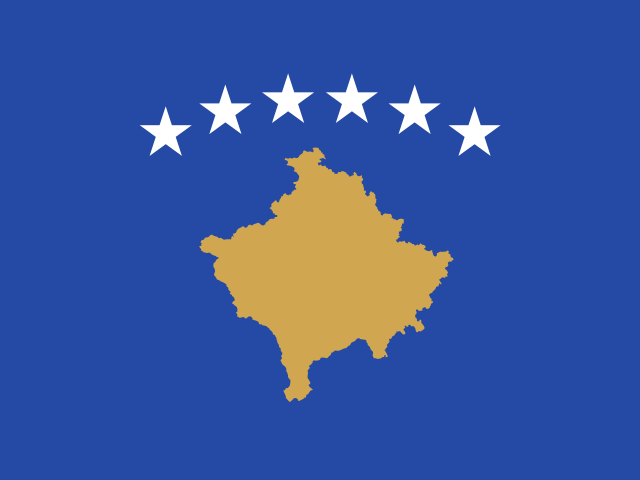
Overview
Kosovo, officially the Republic of Kosovo, is a small landlocked country in the centre of Southeast Europe. Its neighbours are Albania in the southwest, Montenegro in the west, Serbia along the north and east, and North Macedonia in the southeast. It covers about 10,887 km2 and had a 2024 census population of 1,585,566.
About 92% of residents are ethnic Albanians. The terrain mixes high plains, rolling hills and mountains, with peaks above 2,500 m. The climate is mainly continental, with Mediterranean and Alpine influences. Pristina is the capital and most populous city; other major urban centres are Prizren, Ferizaj, Gjilan and Peja.
Kosovo declared independence from Serbia on 17 February 2008. Its status remains contested: the source reports recognition by roughly 110 to 118 UN member states depending on the date and count, with some states having withdrawn recognition. Serbia does not recognise it as a sovereign state and claims it as the Autonomous Province of Kosovo and Metohija, though it accepted the authority of Kosovo's institutions under the 2013 Brussels Agreement. Russia and China do not recognise Kosovo, while the US, UK and France do. Kosovo is not a UN member.
Kosovo is a developing, upper-middle-income economy. It belongs to the IMF, World Bank Group, EBRD, Venice Commission and the International Olympic Committee, and has applied to join the Council of Europe, UNESCO and Interpol. It submitted a formal EU membership application in December 2022.
History
Kosovo's strategic position and natural resources supported settlement from the Stone Age, and hundreds of archaeological sites are known; excavations since 2000 have uncovered many more. It was the core territory of the Dardani, an Illyrian people recorded from the 4th century BC, who formed the Kingdom of Dardania, probably centred near Ulpiana (near modern Lipjan).
Under Rome, the west belonged to Praevalitana (conquered 168 BC), while most of the territory was in Dardania, which kept independence until annexed in 28 BC under Augustus. Under Diocletian, Dardania became a full province. Later Kosovo was a frontier zone of the Roman and then Byzantine Empire, facing raids from the 4th century and Slavic migrations in the 6th and 7th centuries. Control passed between the Byzantines and the First Bulgarian Empire. Place-name evidence suggests Albanian was probably spoken there before the Slavic settlement.
In the 13th century Kosovo became part of the medieval Serbian state, which hosted the Serbian Patriarchate. The Battle of Kosovo in 1389, between the Ottomans under Murad I and a Christian coalition led by Prince Lazar, left both sides with heavy losses and Serbia short of manpower; it is regarded as a defining moment. Dynasties, chiefly the Branković, ruled for much of the following period, until the Ottomans fully conquered the area after the Second Battle of Kosovo. Ottoman rule lasted almost five centuries, to 1912.
In the 19th century nationalism grew across the Balkans. The League of Prizren, formed in 1878, sought autonomy and cultural rights for Albanians within the Ottoman Empire and was dissolved in 1881; Kosovo was a centre of the Albanian national movement and the Albanian revolts of 1910 and 1912. After the Balkan Wars (1912 to 1913) Kosovo passed to the Kingdom of Serbia.
After World War II the Autonomous Region of Kosovo and Metohija took shape in 1945 within Yugoslavia, with final demarcation in 1959. Tensions between the Albanian population and the Yugoslav authorities were significant. In 1989 Serbian president Slobodan Milošević sharply curtailed Kosovo's autonomy; Kosovo Albanians responded with civil disobedience and parallel structures in education, health care and taxation. This ended in the Kosovo War of 1998 to 1999 and the withdrawal of the Yugoslav Army.
On 10 June 1999 UN Security Council Resolution 1244 placed Kosovo under the UN Interim Administration Mission (UNMIK) and authorised the NATO-led KFOR. Estimates of Serbs who left range from 65,000 to 250,000. Unrest in 2004 killed 11 Albanians and 16 Serbs and injured about 900 people. The OSCE supervised the first Assembly elections in November 2001, and Ibrahim Rugova became president.
UN-backed status talks led by Martti Ahtisaari began in 2006. His 2007 proposal of supervised independence failed to win Russian backing at the Security Council, and a later EU, US and Russia troika effort did not produce agreement. Kosovo declared independence on 17 February 2008.
In 2010 the International Court of Justice issued a non-binding advisory opinion that the declaration did not violate international law. In April 2013 the EU-brokered Brussels Agreement gave the Serb minority arrangements such as its own police and court of appeal. In 2023 the leaders of Serbia and Kosovo met in Brussels and Ohrid on an EU-backed normalisation deal. Protests and violent incidents in 2021 to 2023 caused deaths on both sides and injured 30 NATO peacekeepers; the vehicle registration plate dispute that drove them ended on 1 January 2024 when each side recognised the other's plates.
Climate
Most of Kosovo has a continental climate with Mediterranean and Alpine influences. The mean annual temperature is about 9.5 °C, with July averaging around 19 °C and January around -1.3 °C. Annual precipitation ranges from about 600 to 1,300 mm and is spread through the year.
The Kosovo Plain and Ibar Valley in the northeast are drier (about 600 mm), with colder winters and very hot summers. The Metohija basin in the southwest is somewhat wetter (about 700 mm), with warmer summers and heavy winter snow. The Accursed Mountains, Šar Mountains and Kopaonik have an Alpine climate with 900 to 1,300 mm of precipitation, short cool summers and cold winters. The far south near Albania is the warmest area.
Among cities, Pristina on the Kosovo Plain has a continental climate with cold, sometimes snowy winters and warm summers (approx.). Prizren, in the south, is milder and was one of the few stations with a January average above 0 °C. Peja and Gjakova lie in the western Metohija basin with Mediterranean influence and heavy winter snow in the area. Ferizaj and Gjilan, in the south and east, share the continental pattern (approx.).
Forests cover at least 39% of the territory. Biodiversity is protected in two national parks (Bjeshkët e Nemuna and Sharr Mountains), eleven nature reserves and 103 other protected areas, with about 1,800 recorded vascular plant species and 255 bird species. Environmental problems include air and water pollution, waste and climate vulnerability (droughts, floods, fires). Kosovo is not a party to the UNFCCC or the Paris Agreement, but in 2023 set a voluntary goal of cutting greenhouse gas emissions by about 16.3%, as part of a carbon-neutrality aim for 2050.
Government and politics
Kosovo is a multi-party parliamentary republic. The 120-seat Assembly holds legislative power, and the government, led by a prime minister elected by parliament, holds executive power. The president is head of state, elected by the Assembly for five years by a two-thirds majority of all deputies, with mainly representative duties and some roles in foreign affairs and appointments. Ten seats are guaranteed for Serbs and ten for other minorities, who are also guaranteed places in government.
The judiciary follows a civil law system with a Supreme Court, a Constitutional Court, regular, administrative and criminal courts and independent prosecutors, administered by a judicial council in Pristina. The EU rule-of-law mission EULEX still operates, mainly in a monitoring role; the International Civilian Office closed in 2012. A 2023 Gallup report placed Kosovo among the top ten countries for perceived safety and law enforcement. Corruption and organised crime are described as major problems.
Kosovo is divided into seven districts and 38 municipalities. Municipalities are the local government level and handle local services, while national policy, taxation, defence and foreign affairs are central. Municipalities with large minorities can grant official status to Turkish, Bosnian or Romani, and Turkish is official in Prizren. Until the Brussels Agreement, North Kosovo was in practice largely run by Serbian or Serbia-funded parallel institutions. The Pristina district is the largest, with about 2,470 km2 and 511,307 people.
In foreign affairs, Kosovo is recognised by around 110 to 118 UN members (counts differ by date), including 22 of 27 EU states, and has applied for EU membership. Citizens have had visa-free Schengen access for up to 90 days since 1 January 2024. The Kosovo Security Force, over 5,000 members in 2023, was converted into an army by legislation in December 2018, while KFOR (headquarters at Camp Bondsteel near Ferizaj) remains under its UN mandate.
Economy
Kosovo has a transitional, services-led economy. Services make up about 54% of GDP and 56.6% of employment, industry 37.3% of GDP and about 24.8% of jobs, and agriculture 6.6% of GDP but 18.7% of the workforce. GDP has mostly grown since 2008, inflation has been low, and growth has come mostly from trade, retail and construction. The economy depends heavily on diaspora remittances, foreign investment and other inflows. In 2018 the IMF reported about one-sixth of people below the poverty line and one-third of working-age people unemployed, the highest in Europe.
The euro is the official currency. Main trading partners are Albania, Italy, Switzerland, China, Germany and Turkey. Kosovo is in CEFTA and has free-trade agreements with Albania, Croatia, Bosnia and Herzegovina and North Macedonia.
Resources include lead, zinc, silver, nickel, cobalt, copper, iron and bauxite, and large lignite reserves (described as the fifth largest in the world). Electricity relies heavily on lignite plants, with efforts to add renewables such as wind farms at Bajgora and Kitka. In 2019 Kosovo and Albania agreed a joint energy bloc. Farmland covers 53% of the territory and forest 41%. Wine comes mainly from Rahovec, with exports to Germany and the US.
Tourism features mountains, lakes (Batllava, Ujmani) and the Brezovica ski resort, plus Pristina, Prizren, Peja and Gjakova. Roads are the main transport mode. The R7 motorway links Kosovo toward Durrës in Albania, and the R6 links Pristina to the North Macedonian border at Hani i Elezit (completed 2019). Trainkos runs trains from Pristina to Peja and to Skopje. Pristina International Airport is the only international airport and handled about 4.08 million passengers in 2024.
Demographics and urbanization
The 2024 census counted 1,585,566 people. Population peaked at about 2.2 million in 1998 (estimate) and fell after the war and emigration. Life expectancy in 2023 was about 79.7 years and fertility about 1.88 children per woman.
Roughly 92% are Albanian, followed by Serbs (2.3%), Bosniaks (1.7%), Ashkali and Balkan Egyptians (1.7%), Turks (1.2%), and smaller Romani and Gorani groups. Serbs live mainly in the north and in places such as Gračanica and Štrpce, Turks are a local majority in Mamusha, Bosniaks are concentrated in Prizren, and Gorani in Dragash. Albanian is spoken by over 92%. Relations between Albanians and Serbs remain strained, and Roma, Ashkali and Egyptian communities face discrimination.
About 93.5% of people are Sunni Muslim, 2.3% Eastern Orthodox and 1.8% Roman Catholic. Kosovo is a secular state with guaranteed religious freedom.
Urbanization is roughly 50 to 55% (approx.). The Pristina region is the most populated, with around 510,000 people in the district. Approximate city populations: Pristina about 200,000 to 230,000, Prizren about 90,000 to 100,000, Ferizaj, Gjilan and Peja each roughly 60,000 to 100,000 (approx.).
Education is mostly public and run by the Ministry of Education, with schooling in Albanian, Serbian, Bosnian, Turkish and Croatian; Kosovo students have scored poorly on PISA. Health care has primary, secondary and tertiary levels, with seven regional hospitals and the University Clinical Centre in Pristina. Kosovo ranked 29th of 143 in the World Happiness Report 2024.
Capital city
Pristina is the capital and largest city, in the east-central Kosovo Plain, and is the seat of the Assembly, government, presidency and courts. Its population is approx. 200,000 to 230,000 in the city and somewhat more in the wider urban area. The Pristina district has over 500,000 residents.
Its climate is continental: cold winters with some snow and warm summers (approx.). Pristina is the political, economic and cultural centre, home to the University of Pristina, the University Clinical Centre and the country's only international airport, southwest of the city. The R6 motorway runs to the North Macedonian border near Skopje, about 20 km beyond it.
Pristina is also the main economic city, so Kosovo has no separate economic capital. The seat of foreign embassies and international bodies, it is where the Ministry of Foreign Affairs is based. Prizren, Peja and Gjakova are the other main historic and tourist centres.
About this summary
Capital-city details (Pristina population, climate, role), approximate city populations, GDP and income-level context, and recent political developments are from general knowledge and marked approx.