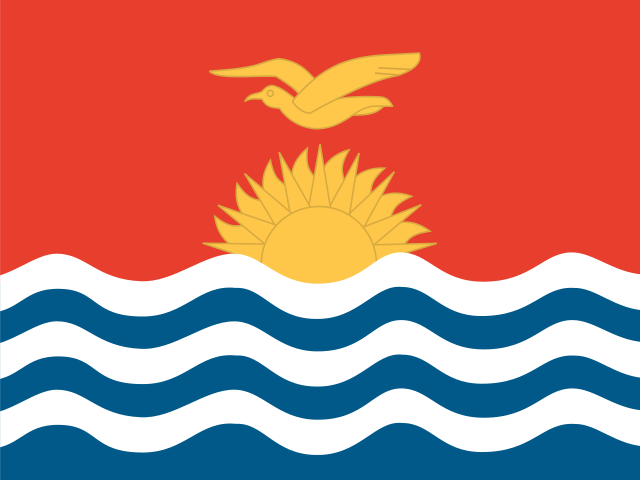
Overview
Kiribati, officially the Republic of Kiribati, is a Pacific island country made up of 32 atolls and reef islands plus one raised coral island, Banaba. Its land area is only about 811 km2, yet the islands are scattered across roughly 3.44 million km2 of ocean. The country spans the equator and the 180th meridian, and it covers parts of both Micronesia and Polynesia.
In 1995 Kiribati moved the International Date Line far to the east so the whole country would share one calendar day. As a result, the Line Islands, including Kiritimati, sit in UTC+14, the most advanced time zone on Earth.
The permanent population is just over 138,000 according to the 2026 census, and more than half of the people live on Tarawa. The I-Kiribati are a Micronesian people who speak Gilbertese; English is the other official language. Emigrant communities exist in New Zealand (probably the largest and still growing), Australia, the Solomon Islands (resettlement on Ghizo and Wagina), the United Kingdom and the United States.
Kiribati became independent from the United Kingdom on 12 July 1979 and joined the United Nations in 1999. It is also a member of the Commonwealth, the Pacific Community, the IMF, the World Bank and the Alliance of Small Island States.
It is one of the least developed countries in the world. The economy leans on fishing licence fees, copra, subsistence farming, aid and remittances. The islands lie only a metre or two above sea level, so sea-level rise, storm surges, drought and water shortages are central national concerns, and climate diplomacy is a pillar of its foreign policy.
History
The islands have been settled by Austronesian-speaking peoples since sometime between about 3000 BC and 1300 AD. Later voyagers from Samoa, Tonga and Fiji brought some Polynesian and Melanesian cultural elements, and around the 14th century Fijian, Samoan and Tongan arrivals added to the mix. Intermarriage and frequent sailing between islands produced a fairly uniform culture.
European ships called in the 17th and 18th centuries, followed by whalers, traders and missionaries. Blackbirding (coercive labour recruitment) took more than 9,000 workers abroad between 1845 and 1895, and most never returned. The American Board of Commissioners for Foreign Missions arrived on Abaiang in 1857, the London Missionary Society worked in the southern Gilberts from 1870, and Catholic missionaries established themselves from the 1880s.
A 1886 Anglo-German agreement placed the Gilberts and Banaba in the British sphere. In 1892 local leaders agreed to a British protectorate over the Gilbert and Ellice Islands. Banaba was added in 1900 after phosphate was discovered there, and its mining produced significant revenue for the colonial administration. The islands became the Gilbert and Ellice Islands crown colony in 1916, the northern Line Islands were added in 1919 and the Phoenix Islands in 1937. Colonial management in the early 1900s, particularly under Resident Commissioner William Telfer Campbell, drew criticism, including allegations of forced labour.
In 1902 the Pacific Cable Board laid a trans-Pacific telegraph cable via Fanning Island (Tabuaeran), completing the All Red Line. Sovereignty over some Phoenix and Line islands was contested with the United States until it was settled by a treaty of friendship signed in 1979.
During World War II Japan occupied Butaritari, Tarawa and other northern Gilbert islands from 1941 to 1943. The Battle of Tarawa in November 1943 was among the bloodiest in US Marine Corps history. Banaba was bombed and occupied in 1942, and nearly all the Gilbertese there were massacred by Japanese forces. After the war most Banabans were relocated to Rabi Island in Fiji, which Britain bought for the purpose in 1942.
In the late 1950s and early 1960s Christmas Island (Kiritimati) was used by the US and UK for nuclear weapons tests, including hydrogen bombs. Internal self-rule began around 1967. The Ellice Islands separated in 1976 and became Tuvalu in 1978.
Kiribati became an independent republic on 12 July 1979. The name is the Gilbertese rendering of Gilberts and was chosen to include Banaba, the Line Islands and the Phoenix Islands. The first post-independence election was in 1982, and a no-confidence vote forced another in 1983. A 1988 announcement planned to move about 4,700 people from the crowded main group to less populated islands. Teburoro Tito became president in 1994 and was re-elected in 1998; in 2003 he was removed by a no-confidence vote, and Anote Tong won the July 2003 election, then served until 2016 after re-election in 2007 and 2011.
In 1995 the country shifted the Date Line eastward, enabling it to claim the first dawn of the third millennium. A 2002 law allowing the government to close newspaper publishers was controversial. Tong warned repeatedly about climate change, said in 2008 that the country had reached a point of no return, and in 2012 to 2014 the government bought land on Vanua Levu in Fiji (about 5,460 acres for A$9.3 million) as a possible future refuge.
Taneti Maamau became the fifth president in March 2016 and won a second term in June 2020. He was regarded as pro-China, and in September 2019 Kiribati switched diplomatic recognition from Taiwan to the People's Republic of China. In November 2021 the government announced it would open the Phoenix Islands protected area to commercial fishing, and a constitutional crisis in 2022 began with the suspension of all five major judges. Strict border limits kept COVID-19 essentially out until January 2022.
Kiribati confirmed in January 2023 its intention to rejoin the Pacific Islands Forum, ending a two-year split, and signed the High Seas Treaty on 9 December 2025.
Climate
Kiribati has a tropical rainforest climate, with warm temperatures close to 30 °C all year. From roughly April to October northeasterly winds predominate and conditions are stable; the wet season (te Auu-Meang) runs from November to April and brings westerly gales and heavier rain. A fairer, drier period runs from about May to November.
Rainfall varies greatly: roughly 3,000 mm per year in the north of the Gilbert group and around 500 mm in the south, where prolonged droughts are common. Cyclones rarely form or pass along the equator, though distant storms have caused damage, such as flooding and seawall destruction from Cyclone Pam in March 2015.
Tarawa, the capital and main urban area, is hot and humid year-round (approx. daily highs around 31 °C and lows around 25 to 26 °C), with a wetter period from about November to April. Kiritimati in the Line Islands is also hot and tropical but generally drier than the northern Gilberts (approx.).
Land rises only one to two metres above sea level. Two small uninhabited islets, Tebua Tarawa and Abanuea, disappeared underwater in 1999. The IPCC projects about 50 cm of sea-level rise by 2100, with a risk of soil salinisation and flooding at king tides. A 2010 study found the urbanised islands Betio, Bairiki and Nanikai grew in area, but the authors stressed that land height had not changed and the atolls remain very vulnerable.
Soils are thin and calcareous, and fresh water depends on fragile freshwater lenses beneath the atolls. Wildlife is limited: about 75 bird species (the Bokikokiko is endemic to Kiritimati), few land mammals and rich marine life with 600 to 800 inshore and open-ocean fish species and roughly 200 coral species.
Government and politics
Kiribati is a parliamentary democratic republic under the constitution of 12 July 1979. The president (te Beretitenti) is head of state and head of government, elected directly by voters from three or four candidates nominated by parliament from among its members. The president may serve up to three four-year terms and stays a member of parliament. The cabinet consists of the president, the vice-president and 13 ministers appointed by the president, all of whom are MPs.
Parliament is the unicameral Maneaba ni Maungatabu (House of Assembly) with four-year terms. It includes a nominated representative of the Banaban community on Rabi Island in Fiji, a special arrangement set by the constitution. The attorney general sat ex officio until 2016. Suffrage is universal from age 18. Parties exist but are loosely organised, and opposition groups often form around specific issues; main parties include Boutokaan Kiribati Moa and Tobwaan Kiribati.
The judiciary consists of the High Court (in Betio) and the Court of Appeal, with judges appointed by the president. The constitution guarantees judicial independence, but the 2022 suspension of the five most senior judges triggered a constitutional crisis.
Power is shared with local government rather than with large provinces. Each of the 21 inhabited islands has an elected island council, with two exceptions: Tarawa Atoll has three councils (Betio Town Council, Teinainano Urban Council for the rest of South Tarawa, and Eutan Tarawa Council for North Tarawa), and Tabiteuea has two. Councils prepare their own revenue and spending estimates and are largely free of central control. Statistically the country is split into five districts (Northern, Central and Southern Kiribati, South Tarawa, and Line and Phoenix). The three island groups (Gilbert, Phoenix, Line) have no administrative function. National matters such as foreign policy, defence, major taxation and justice remain with the central government, while councils handle daily local affairs.
Banaba is a special case: it is now only sparsely populated, and most of its people live on Rabi Island in Fiji, yet they have a voice in parliament. Kanton is the sole inhabited island in the Phoenix Islands, and the group has no parliamentary representation. Five of the Line Islands are also without residents. Law enforcement is handled by the Kiribati Police Service, which additionally performs paramilitary duties, since the country has no standing army.
In foreign policy Kiribati works closely with Australia, New Zealand, Japan and Fiji, the first three being the main aid providers. In September 2019 it switched recognition from Taiwan to the People's Republic of China; Beijing opened an embassy in Tarawa in 2020 (as described in the source). Australia and New Zealand maintain high commissions. The US has talked since 2022 of opening an embassy, and the one responsible for Kiribati is in Suva, Fiji. Kiribati is active on climate issues through AOSIS, the Climate Vulnerable Forum and COP processes, and hosted the Tarawa Climate Change Conference in 2010. Japan leased land on Kiritimati for a spaceport project in 1999, which was cancelled in 2003. The next general and presidential election timing is not covered here.
Economy
Natural resources are scarce in Kiribati. Phosphate mining on Banaba came to an end around the time of independence, so production and exports now rest mostly on copra and fish. Among the sovereign states of Oceania, its GDP is the smallest, and the country is designated a least developed country. Its domestic currency is the Australian dollar.
Income comes largely from abroad: fishing licence fees from foreign fleets, development aid, remittances from seafarers trained at the Marine Training Centre and from other overseas workers, and a small amount of tourism. Most manufactured goods and many staple foods are imported. Major donors have included Australia, Taiwan, New Zealand, the World Bank, the Asian Development Bank, Japan and the EU. Government jobs, trade stores and small cooperative-style businesses employ many people on Tarawa, and the government pays benefits to the unemployed on Tarawa and to the elderly.
Over 80 percent of the population takes part in farming or fishing. Coconut, pandanus and breadfruit are the main plants, and traditional babai (giant swamp taro) is cultivated; the soil is poor, so many vegetables are imported. Seaweed farming (introduced from the Philippines in 1977), pearl oysters and shellfish matter locally, while tuna (skipjack and yellowfin) is the main catch. Kiribati is also a notable exporter of hand-caught ornamental fish, mainly from Kiritimati, where the flame angelfish dominates; about 110,000 fish were exported in 2005.
A sovereign wealth fund, the Revenue Equalization Reserve Fund, was created in 1956 from phosphate earnings. It stood at about US$400 million in 2008, and its value fell from A$637 million in 2007 to A$570.5 million in 2009 because of the global financial crisis, Icelandic bank exposure and government drawdowns. A 2011 IMF report estimated growth of 1.75 percent in 2010. ANZ operates branches and ATMs.
Transport: domestic carriers Air Kiribati and Coral Sun Airways are based at Bonriki International Airport on Tarawa and serve the Gilbert and Line islands but not Banaba or the Phoenix group. Fiji Airways links Nadi, Kiritimati (Cassidy International Airport) and Honolulu.
Demographics and urbanization
The November 2020 census counted 119,940 people, and the 2026 census reports just over 138,000 permanent residents. About 90 percent live in the Gilbert Islands, and roughly 53 percent of that group's population lives on South Tarawa. South Tarawa had around 69,710 people in 2024 (estimate), up from 17,921 in 1978. Betio is the biggest township; Bikenibeu and Teaoraereke are other large settlements. Outer-island villages traditionally have between 50 and 3,000 people.
Urbanisation is mainly migration into South Tarawa, which is among the densest places in the Pacific, though without high-rises. The urban share of the national population is roughly 55 to 60 percent (approx.). Kiritimati is the main centre in the Line Islands (approx. several thousand residents).
The I-Kiribati are Micronesian, a sub-group of the Austronesian peoples, with some historic Polynesian admixture, and are fairly homogeneous in appearance and traditions. Gilbertese is the main language and English is also official, but English is used mostly in Tarawa. Gilbertese has many loanwords, such as kamea for dog.
Religion (2020 census): Roman Catholic 58.9 percent, Kiribati Uniting Church 21.2 percent, Kiribati Protestant Church 8.4 percent, Latter-day Saints 5.6 percent, Baháʼí 2.1 percent and Seventh-day Adventist 2.1 percent, with smaller groups making up the rest.
Health: only around 66 percent of people have access to clean water, and poor sanitation drives diarrhoea, dysentery and skin and eye infections. Smoking is very common (about 54 to 57 percent), and diabetes-related amputations have risen sharply. Life expectancy is about 67 to 68 years (64.3 for men, 69.5 for women), and infant mortality is about 41 per 1,000 live births; tuberculosis affects about 365 per 100,000 each year. Cuban doctors, who arrived in 2006, have helped lower infant mortality.
Education: primary school is free and compulsory for nine years from age six. Structure: preschool, primary (Classes 1 to 6), junior secondary (Forms 1 to 3) and senior secondary (Forms 4 to 7). Thirteen high schools are run by churches. Tertiary options include the University of the South Pacific campus at Teaoraereke, the Kiribati Institute of Technology, the Marine Training Centre, the Kiribati School of Nursing, the Fisheries Training Centre and the Teachers College; many students study in Fiji, and medical students go to Australia, New Zealand or Cuba.
Capital city
The capital is Tarawa, an atoll in the Gilbert Islands. In practice, the capital functions are on South Tarawa, a chain of islets joined by causeways that make up about half of the atoll's land. Government offices are concentrated at Bairiki, with Betio, Bikenibeu and Teaoraereke as other major urban centres. South Tarawa had about 69,710 people in 2024 (estimate), more than half of Gilbert Islands residents.
Climate: hot and humid year-round, with highs around 31 °C (approx.), a wetter season from November to April and a drier one from May to October, and with occasional droughts. The atoll is only a metre or two above sea level, so it is exposed to king tides, storm surges and freshwater shortages. Climate adaptation work has focused on Tarawa, including water supply management, mangrove planting and coastal protection.
Roles: Tarawa is the political and administrative centre and also the main economic hub, with ports, the Bonriki international airport, the main hospital, schools and most formal-sector jobs (approx.). Betio holds the High Court and the main prison, plus the Marine Training Centre, and was the site of the 1943 battle. It is also the main cultural centre, though traditional culture is strongest on outer islands. Kiribati has a single capital, and Tarawa is also its main economic city, with Kiritimati a smaller regional centre in the Line Islands.
About this summary
Capital-city details (climate, role, institutions), approximate economic figures such as currency and GDP context, and recent political context are drawn from general knowledge and marked approx.