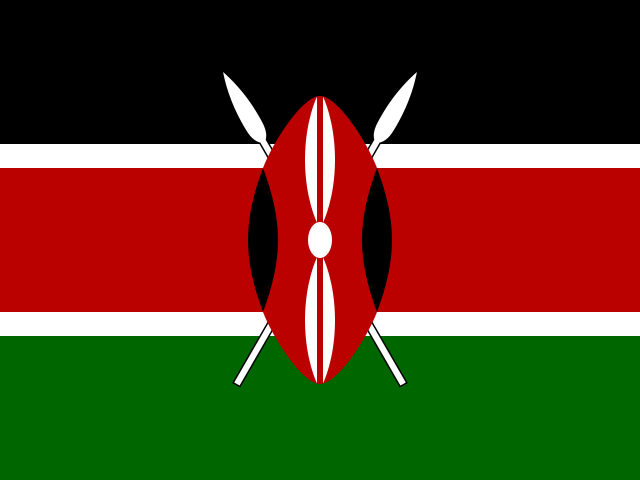
Overview
Kenya, officially the Republic of Kenya, is an East African country on the Indian Ocean. It covers about 580,000 km2 and, by the source's mid-2026 estimate, has roughly 54 million people, which places it among the larger African populations.
Nairobi is both the capital and the largest city. Mombasa, the oldest city and a port on Mombasa Island, comes next in the source's description, followed by other major cities such as Kisumu, Nakuru and Eldoret.
Going clockwise from the northwest, Kenya borders South Sudan, Ethiopia, Somalia, the Indian Ocean, Tanzania, and Lake Victoria and Uganda.
The landscape is varied: snow-capped peaks on Mount Kenya (Batian, Nelion, Point Lenana) with forests and fertile farmland around them, dry and semi-arid zones, and true deserts such as the Chalbi and Nyiri.
Kenya is a presidential representative democratic republic. It belongs to the UN, the Commonwealth, the World Bank, the IMF, the WTO, COMESA and the International Criminal Court, and is a major non-NATO ally of the United States.
Its economy is the largest in East and Central Africa, with Nairobi acting as a regional commercial hub. Gross national income per person is about US$2,110, making it a lower-middle-income country. Agriculture, especially tea, coffee and cut flowers, and services such as tourism are the main drivers. Kenya is in the East African Community; Africa is its largest export market, followed by the European Union.
History
Kenya has one of the richest records of human origins. Homo habilis and Homo erectus lived there in the Pleistocene. In 1984 Richard Leakey, helped by Kamoya Kimeu, found the Turkana Boy, a roughly 1.6-million-year-old Homo erectus skeleton at Lake Turkana. Koobi Fora has also yielded abundant fossils.
Later inhabitants were hunter-gatherers comparable to today's Hadza. Cushitic speakers settled the lowlands between about 3200 and 1300 BC. Nilotic-speaking pastoralists moved in from present-day South Sudan from around 500 BC, and Bantu-speaking people settled the coast and interior between about 250 BC and 500 AD.
The coast hosted ironworking, farming, fishing and trading communities that formed early city-states, collectively called Azania. The Swahili people were of mixed African and Asian (notably Persian) ancestry, according to DNA evidence. Mombasa, Malindi and Zanzibar traded with Arabs from around the 1st century CE and with Persia, Arabia and India. In the 15th century the Portuguese writer Duarte Barbosa described Mombasa as a busy port with a good harbour. European contact began around 1500 with the Portuguese.
In the 18th and 19th centuries the Maasai moved into the central and southern Rift Valley plains, coming from north of Lake Turkana. The Nandi resisted them, while the Taveta withdrew to the forests of Kilimanjaro's eastern edge.
Germany set up a protectorate over the Sultan of Zanzibar's coastal possessions in 1885, and the Imperial British East Africa Company arrived in 1888. The Heligoland–Zanzibar Treaty avoided rivalry, and Germany handed its holdings to Britain in 1890.
The Nandi Resistance (1890–1906), led by Orkoiyot Koitalel Arap Samoei together with the Kipsigis, was the longest military challenge to British colonial rule in East Africa. Guerrilla tactics and sabotage of the Uganda Railway delayed British control for almost two decades. The Nandi were the first group placed in a native reserve. Many Indian workers came to build the railway.
The British protectorate was established in 1895 and the Kenya Colony began in 1920. Mombasa was capital of the British East Africa Protectorate from 1889 to 1907.
From October 1952 to December 1959 Kenya was under a state of emergency because of the Mau Mau rebellion, which was mainly Kikuyu, Embu and Meru. Over 11,000 fighters were killed, along with about 100 British troops and 2,000 Kenyan loyalist soldiers. Atrocities occurred on both sides, including the Lari and Hola massacres.
In a 1962 referendum in the Northern Frontier Districts, 86% of Somalis in Kenya wished to join Somalia, but the British rejected the result.
The first direct elections for African Kenyans to the Legislative Council were held in 1957. Jomo Kenyatta's KANU formed the government, and independence came on 12 December 1963. The republic was proclaimed on 12 December 1964, with Kenyatta as first president. Corruption became widespread under his rule, and his family acquired large amounts of land, angering landless Kenyans.
Daniel arap Moi succeeded Kenyatta. He ran unopposed in 1979, 1983 (snap election after a failed air force coup on 2 August 1982) and 1988 under the single-party constitution. Kenya returned to multiparty politics in 1991 after 26 years of one-party rule. The 1992 election, held on 29 December after delays, was marked by intimidation of opponents.
Moi's plan to be succeeded by Uhuru Kenyatta failed, and Mwai Kibaki of the National Rainbow Coalition won the presidency in 2002.
Climate
Kenya lies between 5°N and 5°S and has a tropical climate on the coast, a temperate climate inland and arid conditions in the north and northeast. Sunshine is plentiful all year, and nights and early mornings are cool at higher inland elevations.
The long rains fall from March/April to May/June and the short rains from October to November/December. Rain is often heavy and tends to come in the afternoon and evening. Climate change is lengthening the short rains, which has caused floods, and has made droughts nearly annual instead of about every ten years, as in the 2008–09 drought. February and March are the hottest months and July to mid-August the coolest.
Major cities (approx., general knowledge): Nairobi, at about 1,700 m, is mild and fairly cool, with daytime highs in the mid-20s °C and cool nights. Mombasa on the coast is hot and humid, around 30 °C most of the year, with a long rainy season in April to June. Kisumu on Lake Victoria is warm and humid with frequent afternoon thunderstorms. Nakuru and Eldoret are in the highlands and are cooler and temperate.
Wildlife habitats, including Tsavo and the Masai Mara, are extensive. The Big Five (lion, leopard, buffalo, rhinoceros, elephant) occur in Kenya. The migration of more than a million wildebeest and 200,000 zebras crosses the Mara River, mostly between June and September, and is listed among the Seven Natural Wonders of Africa. Kenya's 2019 Forest Landscape Integrity Index score was 4.2/10.
Government and politics
Kenya operates as a multi-party presidential representative democratic republic, with the president serving as both head of state and head of government. The National Assembly and the Senate hold legislative authority. The judiciary is formally independent, but worries about executive meddling have been voiced, particularly during Moi's time in office.
The 2002 election was judged free and fair by most observers and moved power peacefully from KANU to NARC. Free primary education followed, and secondary tuition was heavily subsidised from 2008. Under the new constitution, Uhuru Kenyatta won the March 2013 election with 50.51% of the vote. His December 2014 security laws amendment was criticised by opposition politicians, rights groups and several Western governments, and was passed in the National Assembly amid acrimony.
The country has 47 semi-autonomous counties, each headed by a governor, as the first-order divisions. Counties are divided into constituencies, an electoral subdivision (210 before 2013, with a boundaries commission recommending 80 more), and the smallest units are locations, each with a state-appointed chief. The source does not detail which powers counties hold, but it notes that county governments run health spending and public hospitals alongside national government. There is no special jurisdiction described in the source.
Transparency International ranked Kenya 137th of 180 in 2019, scoring 28/100, indicating high perceived corruption. An independent Ethics and Anti-Corruption Commission has been established.
The Kenya Defence Forces (army, navy, air force) were set up under Article 241 of the 2010 Constitution, and the president is commander-in-chief. They take part in peacekeeping, though serious allegations of human rights violations and corruption in procurement have been made.
In foreign relations, ties with Somalia have been tense although there has been some military coordination against Islamist insurgents. Kenya has good relations with the UK, which trains infantry in the Rift Valley through BATUK, and is described as one of the most pro-American nations in Africa. Barack Obama visited in July 2015.
On human rights, homosexual acts are illegal and typically punishable by up to 14 years in prison. A KNCHR report documented extrajudicial killings by police.
Economy
Kenya has the largest economy in East Africa and is a regional transport and financial hub. Growth has come from transport infrastructure and information technology investment, and the financial sector is diversified, with high financial inclusion. The Nairobi Securities Exchange is ranked 4th in Africa by market capitalisation, and the Central Bank of Kenya supervises banking. Safaricom emerged from privatisation of the former post and telecommunications company.
Gross national income per person is about US$2,110. HDI is 0.628 (medium), ranked 143 of 193 in 2023. In 2022, 25.4% lived on under $2.15 a day, and 25.4% were multidimensionally poor. Kenya ranked 92nd in the 2017 World Bank ease of doing business. FDI stock in 2022 was US$10.4 billion, about 9.5% of GDP.
Services and telecommunications dominate output. Agriculture contributes around a fifth of GDP and employs a large share of workers (the source gives figures of about 30% and 75% in different passages). Industry and manufacturing are about 16% of GDP. Textiles worth over $400 million are exported under AGOA.
Agriculture's main cash crops are tea, horticulture and coffee. Tea, coffee, sisal, pyrethrum, corn and wheat grow in the highlands; livestock in the semi-arid north and east; coconuts, pineapples, cashews, cotton and sugarcane in the lowlands. Food staples such as maize vary sharply with weather, and drought sometimes requires food aid. Poor transport isolates arid areas. Drought-tolerant pigeon peas have helped farmers in dry areas.
Tourism contributes about 6% of the economy and is the third-largest source of foreign exchange after remittances and agriculture. Attractions include 60 national parks and reserves, the Masai Mara migration, Swahili Coast beaches, Mombasa, Malindi and Lamu, Mount Kenya, the Rift Valley and tea plantations at Kericho. Germany and the UK send the most tourists.
Kenya, Tanzania and Uganda re-established the East African Community in 1996 and signed a Customs Union Agreement in 2004. Kenya is usually classed as a frontier market.
Demographics and urbanization
The 2019 census counted 47,564,296 people, and a mid-2026 estimate is about 54 million. The population is young, with 73% under 30. Specific national urbanization data is not given in the source; roughly a third of Kenyans live in urban areas (approx., general knowledge).
Major urban centres are Nairobi (several million in the metro area, approx.), Mombasa (about 1 to 1.5 million, approx.), and Kisumu, Nakuru and Eldoret (each several hundred thousand, approx.). Nairobi contains Kibera, one of the world's largest slums, with estimates of 170,000 to one million residents. The UNHCR Dadaab camp in the north houses around 500,000.
Kenya has more than 120 ethnic categories in the 2019 census. About 60% of residents are Bantu and 30% Nilotic, with Cushitic, Arab, Indian and European minorities. The largest groups in 2019 were Kikuyu (8.1 million), Luhya (6.8 million), Kalenjin (6.4 million), Luo (5.1 million), Kamba (4.7 million), Somali (2.8 million), Kisii (2.7 million), Mijikenda (2.5 million), Meru (2.0 million), Maasai (1.2 million) and Turkana (1.0 million). The northeast is mainly Somali.
English and Swahili are official. English is widely used in commerce, schooling and government, and Kenya ranked 3rd in Africa on the English Proficiency Index. Sheng is an urban Swahili-English mix. 69 languages are spoken, mainly Bantu and Nilotic.
Religion: 85.5% Christian (33.4% Protestant, 20.6% Catholic, 20.4% Evangelical), 11% Muslim (concentrated on the coast and in the northeast), 0.7% indigenous beliefs, 1.6% nonreligious, and about 0.13% Hindu. Kenya has the world's largest number of Quakers, about 146,300.
Health: 2019/20 health spending was 4.8% of the national budget. Care is largely paid privately or through the National Health Insurance Fund and insurers. Public facilities range from community services to national referral hospitals (levels I to VI). Malaria, HIV/AIDS, pneumonia, diarrhoea and malnutrition are the main burdens. Life expectancy fell to about 55 in 2009, and infant mortality was around 44 per 1,000 in 2012.
Capital city
Nairobi is Kenya's capital and largest city, in the southern highlands (approx., general knowledge). Its metro population is roughly 5 million (approx.).
Climate (approx.): at about 1,700 m, it is mild, with warm days, cool nights, and rainy seasons in March to May and October to December.
Nairobi is the political capital, home to the national government, and the main commercial hub of East and Central Africa. It hosts the Nairobi Securities Exchange, the Kenya Innovation Week event and the only synagogue in the country. It is also the main economic city, and Mombasa is the principal port. Kibera is among its slums.
About this summary
Approximate general-knowledge facts: Nairobi and Mombasa metro populations, city climates, and capital-city details such as institutions and neighbourhoods.