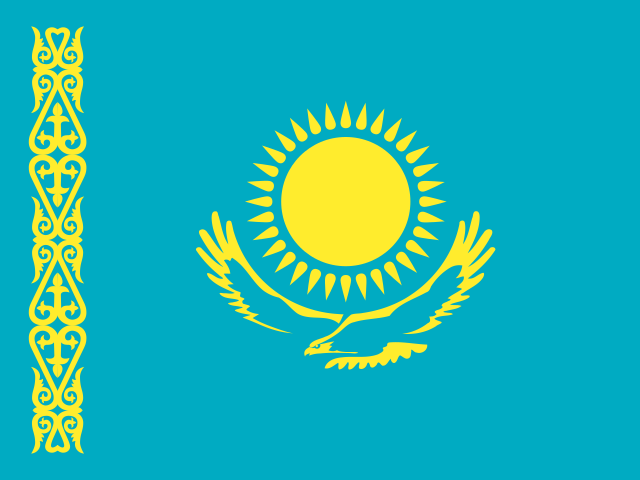
Overview
Kazakhstan, officially the Republic of Kazakhstan, is a landlocked country mostly in Central Asia, with a small part lying west of the Ural River in Eastern Europe. Its neighbours are Russia (north and west), China (east), Kyrgyzstan (southeast), Uzbekistan (south) and Turkmenistan (southwest), and it also has a shoreline on the Caspian Sea.
The capital is Astana. Almaty, the capital until 1997, is the largest city and the principal cultural and economic centre.
By land area it is the ninth-largest country in the world and the largest landlocked one, covering about 2.7 million square kilometres. Its population is roughly 20 to 21 million, so density is below 8 people per square kilometre, one of the lowest anywhere.
Ethnic Kazakhs are the majority and ethnic Russians a large minority. The state is officially secular; most people are Muslim and there is a sizeable Christian community.
Kazakhstan accounts for around 60% of Central Asia's GDP, mainly through oil and gas, and has large mineral wealth, including iron and silver. It has the highest Human Development Index ranking in its region. It is a unitary constitutional republic that is widely described as authoritarian, with incremental reforms since Nursultan Nazarbayev stepped down in 2019.
Kazakhstan belongs to many international bodies, among them the UN, WTO, WHO, CIS, Shanghai Cooperation Organization, Eurasian Economic Union, CSTO, OSCE, Organization of Islamic Cooperation and Organization of Turkic States. It has special guest status with the Parliamentary Assembly of the Council of Europe.
History
Humans have inhabited the area since the Paleolithic era. Horses were first domesticated, according to the prevailing view, by the Botai culture, which flourished from roughly 3700 to 3100 BC. The region formed an essential stretch of the Eurasian Steppe Route, an early precursor of the Silk Roads, and in ancient times nomadic Iranian peoples including the Saka, Massagetae and Scythians lived there.
Turkic-speaking groups spread across Central Asia mainly between the 5th and 11th centuries, gradually absorbing or replacing earlier Iranian-speaking populations. The Turkic Khaganate emerged in the mid-6th century, and in 630 the Eastern Turkic Khaganate was defeated by China.
In the 13th century the area was conquered by the Mongol Empire under Genghis Khan. The Golden Horde is seen in modern Kazakh historiography as the setting in which the Kazakh ethnic group formed and as part of the continuity of Kazakh statehood; some Russian historians also link early Kazakh state formation to it.
After the Golden Horde collapsed in the mid-15th century, Kerei and Janibek founded the Kazakh Khanate. In the early 16th century it grew into a nomadic power across the steppes east of the Caspian and north of the Aral Sea, reaching the upper Irtysh and the approaches to the Altai. By the 17th–18th centuries it was divided into three zhuzes (hordes): Senior, Middle and Junior.
In the early 1700s, Russia erected the Irtysh line to hold back Kazakh and Oirat raids. It was a chain of 46 forts and 96 redoubts, and it included Omsk (1716), Semipalatinsk (1718), Pavlodar (1720), Orenburg (1743) and Petropavlovsk (1752). In the 19th century, during the Great Game, Russian influence in Central Asia kept growing, and nominally, the whole of Kazakhstan had come under Russian control around the middle of that century.
After the 1917 revolution the Kazakhs, then called Kirghiz by Russia, briefly held the Alash Autonomy before Bolshevik rule took hold. The Kirghiz ASSR was created on 26 August 1920 within the RSFSR with its centre at Orenburg. It was renamed the Kazak ASSR in 1925 with its centre moved to Kyzylorda, and in 1927 to Alma-Ata. On 5 December 1936 it became the Kazakh SSR, a full union republic.
Forced collectivization and the repression of traditional elites in the late 1920s and 1930s caused famine and violence, with an estimated 1.5 million deaths between 1926 and 1939; thousands fled to China. Some of the Kazakh intelligentsia were executed. The republic also received exiles, prisoners and deportees, including about 400,000 Volga Germans in 1941 and later Greeks and Crimean Tatars, and hosted major Gulag camps such as ALZhIR near Astana.
World War II brought industrialization and mining, but the economy was still mainly agricultural in 1953. That year Khrushchev launched the Virgin Lands Campaign to turn pastureland into grain farmland, with mixed results. By 1959 Kazakhs were a minority at about 30% of the population, with Russians at 43%.
The Soviet nuclear test site near Semipalatinsk opened in 1947, the first Soviet bomb was tested there in 1949, and hundreds of tests continued until 1989, harming environment and health. A strong anti-nuclear movement arose in the late 1980s. In April 1961 Yuri Gagarin became the first human in space, launched from Baikonur.
In December 1986 young Kazakhs protested in Almaty (the Jeltoqsan riot) against replacing party leader Dinmukhamed Konayev with Gennady Kolbin from Russia; troops suppressed the unrest, several people died and many were jailed.
Kazakhstan declared sovereignty within the USSR on 25 October 1990 and, after the failed August 1991 Moscow coup, proclaimed full independence on 16 December 1991, the last Soviet republic to do so. Nursultan Nazarbayev led the country from independence until his resignation in 2019, and the capital moved from Almaty to Astana on 10 December 1997.
Climate
Kazakhstan has an extreme continental climate with cold steppe conditions: hot summers, cold winters, and precipitation ranging from arid to semi-arid, with particularly dry winters. Astana is described in the source as the second coldest capital city in the world, after Ulaanbaatar.
Terrain shapes local conditions. Covering roughly 804,500 km², the Kazakh Steppe takes up close to one third of Kazakhstan, and it ranks as the largest dry steppe region anywhere in the world. Mountains (the Tian Shan and the Altai) rise in the south and east, while deserts and oases are found in the south. In the central and southern areas, a number of rivers run dry during the summer.
Approx. city climates: Astana has very cold, windy winters (often well below −10 °C in midwinter) and warm summers. Almaty, at the foot of the Tian Shan in the south, is milder, with cold but less severe winters and hot summers. Shymkent in the south has hot, dry summers and cool winters. Aktobe and Karaganda in the north and centre have a harsh continental climate with long cold winters.
Wildlife includes ten nature reserves and ten national parks, among 25 conservation areas. Mammals include wolf, red fox, corsac fox, argali, Eurasian lynx, Pallas's cat and snow leopard; Przewalski's horse has been reintroduced. Endangered plants include wild apple (Malus sieversii) and several wild tulips. The Red Book lists 125 vertebrates and 404 plants, fungi, algae and lichens. A female Amur tiger was released into the Ile-Balkhash reserve on 31 July 2026, which the source describes as the species' return since 1948.
Among the country's notable geographic features are Lake Balkhash, Lake Zaysan, the Aral Sea, and the Ili, Irtysh, Ishim, Ural and Syr Darya rivers. The Aral Sea has shrunk to a small remnant of its former size, a change counted among the worst environmental disasters anywhere in the world. Charyn Canyon stretches about 80 km and lies roughly 200 km east of Almaty, with walls that rise 150–300 m.
Government and politics
Kazakhstan's official description is that of a secular, democratic, constitutional unitary republic. From 1991 until 2019 the country was run by Nursultan Nazarbayev, after which Kassym-Jomart Tokayev took over. The president serves as commander-in-chief and holds the power to veto laws. Government is headed by the prime minister, who leads a cabinet made up of three deputy prime ministers and sixteen ministers. Legislative authority rests with a single-chamber parliament, the Kurultai, which has 145 members.
Outside assessments are unfavorable. In 2020, Freedom House classed the country as a consolidated authoritarian regime and noted that its electoral framework fails to guarantee free and fair voting. The Economist Intelligence Unit likewise labeled it an authoritarian regime, placing it 128th out of 167 countries in 2020, and in 2024 V-Dem characterized it as an electoral autocracy.
Since Tokayev's election in June 2019 some reforms have been introduced. He set up a National Council of Public Trust, promoted a 'listening state' concept, cut the membership needed to register a party from 40,000 to 20,000, planned designated places for peaceful rallies, and toughened penalties for crimes against individuals. On 17 September 2022 he signed a decree limiting the president to a single seven-year term. Reforms also expanded parliament's powers at the president's expense, barred presidential relatives from government posts, restored the Constitutional Court, abolished the death penalty and aimed to give regions more decision-making power.
Administratively the country is a unitary state with seventeen regions (oblystar) and, separately, cities of republican significance. The regions are subdivided into 177 districts, which in turn have rural districts at the lowest level, covering villages and settlements without their own municipal government. The regional governor (äkim) is appointed by the president, and district äkims are appointed by regional äkims, so authority is largely delegated from the centre rather than held independently by the regions. The reform package aims to increase regional decision-making authority. The source gives no detailed breakdown of which regions control tax, health, law or education.
Special jurisdictions: Almaty, Astana and Shymkent are cities of republican significance, ranking equal to a region and not part of surrounding regions (Shymkent gained the status in June 2018). Baikonur is leased to Russia until 2050 for the cosmodrome, with Russia leasing about 6,000 km² around it. Municipalities exist at each level: cities of republican, regional and district significance are urban, and there are over two thousand villages and settlements (aul).
Foreign policy has been a 'multi-vector' approach since 1991, seeking good relations with Russia, China, the United States and the wider West. Kazakhstan belongs to the CIS, Shanghai Cooperation Organization, Economic Cooperation Organization, OSCE (chairing it in 2010), Turkic Council and OIC, and participates in NATO's Partnership for Peace. It was elected to the UN Human Rights Council in 2012 and to a non-permanent UN Security Council seat for 2017–2018. It has contributed observers to UN peacekeeping missions and sent humanitarian aid to Ukraine from 2014. In 1999 the Council of Europe Assembly said Kazakhstan could apply for full membership as it lies partly in Europe, but would not be granted any status until its democracy and human rights records improved.
Economy
GDP in 2018 came to roughly $179 billion, an increase of 4.5% that worked out to about $9,700 per person. Strong oil prices pushed annual growth between 8.9% and 13.5% from 2000 through 2007; the 2008 crisis cut it to 1–3%, and a recovery began in 2010. From 2014, expansion slowed as oil prices dropped and the Russo-Ukrainian War took its toll, and the currency lost 19% of its value in February 2014 and a further 22% in August 2015. Seven years ahead of schedule, Kazakhstan settled the entirety of its IMF debt, the first former Soviet republic to do so.
Crisis response in 2009 was a $21 billion stimulus (about 20% of GDP), including $4 billion for the financial sector; GDP shrank 1.2% in 2009 and grew 7.5% in 2011 and 5% in 2012. Fiscal policy has been conservative, with oil savings kept in a fund and the Samruk-Kazyna structure. Public debt rose from 8.7% of GDP in 2008 to 13.4% in 2013, and was 19.2% in 2019. The US granted market economy status in 2002, and in September 2002 Kazakhstan became the first CIS country with an investment-grade rating. It ranked 41st on the 2018 Economic Freedom Index.
Tax reforms: in 2003 VAT fell from 16% to 15%, the employer social tax from 21% to 20%, and personal income tax from 30% to 20%; in 2006 personal income tax became a flat 5% on dividends and 10% on other income. New land and customs codes followed in 2003. A pension system was created in 1998; assets were about $17 billion by January 2012, held in 11 savings funds and invested mostly in corporate and government bonds.
Natural resources play a central role. Since 1993, the extraction of oil, gas and minerals has drawn most of the more than $40 billion in foreign investment, and it makes up roughly 57% of industrial output (around 13% of GDP). By certain estimates, the country holds the world's second largest reserves of uranium, chromium, lead and zinc, ranks third in manganese and fifth in copper, and sits among the top ten for coal, iron and gold (64 tonnes of gold in 2015). Its proven oil and gas reserves are the 11th largest globally, it exports diamonds, and it possesses sizable phosphorite deposits. In 2013, it was accepted as EITI compliant.
Energy: crude and condensate output was 79.2 million tonnes in 2012, up from 51.2 million in 2003, and the source calls Kazakhstan the 19th largest oil producer. Proven recoverable reserves are about 4 billion tonnes. Major fields are Tengiz (about 7 billion barrels), Karachaganak (about 8 billion barrels plus gas) and Kashagan (7–9 billion barrels). State company KazMunayGas was created in 2002, and foreign firms such as Chevron, ExxonMobil, Agip, BG, Lukoil and Chinese companies are involved. Only three refineries (Atyrau, Pavlodar, Shymkent) exist, so much crude is exported to Russia. The 2013 Green Economy Plan targets 50% of energy from alternative and renewable sources by 2050.
Trade: Kazakhstan joined the WTO in 2015. In 2018 trade turnover was $93.5 billion, with exports of $67 billion (about 40% of GDP) and imports of $32.5 billion, covering about 800 products sold to 120 countries. Other exports include wheat, textiles, livestock and uranium.
Agriculture is about 5% of GDP. Over 80% of the area is agricultural land (more than 846,000 km²), of which 205,000 km² is arable and 611,000 km² pasture and hay. Main products are grain, potatoes, grapes, vegetables, melons, livestock, dairy, leather, meat and wool; major crops are wheat, barley, cotton and rice, and wheat is a leading export. Some wine is produced in the mountains east of Almaty. Soviet-era mismanagement left environmental problems.
Demographics and urbanization
Population was estimated at about 20.8 million in 2025, passing 20 million in September 2024 from about 17.3 million a decade earlier. It was 16.4 million at independence in 1991 and fell to 14.8 million by 2001, mostly through emigration of ethnic Russians. Fertility has stayed near replacement level (total fertility rate 2.53 in 2025), so the population is young: 29% are 14 or younger and 9% are 65 or older.
Ethnic groups as of 2026: Kazakhs 71.5%, Russians 14.4%, Uzbeks 3.4%, Ukrainians 1.8%, Uyghurs 1.5%, Tatars 1.1%, Germans 1.1%, plus Azerbaijanis, Dungans, Turks, Koreans, Poles and others. Many minorities such as Ukrainians, Koreans (Koryo-saram), Volga Germans, Chechens and Meskhetian Turks were deported to Kazakhstan under Stalin. In 1989 Russians were 37.8% of the population. Most of the roughly one million Germans and many Pontian Greeks later emigrated. Growth also comes from higher birth rates and the return of ethnic Kazakhs from China, Mongolia and Russia.
As of 2026, 63.6% of people live in urban areas. Major cities named in the source are Almaty, Astana, Shymkent, Aktöbe and Karagandy. Approx. populations: Almaty about 2.2 million in the city (more in the wider area), Astana about 1.4 million, Shymkent about 1.3 million, and Aktöbe and Karagandy roughly 500,000 each. Settlement is concentrated in the south, in Astana and in northern and central industrial cities, with large empty steppe and desert areas.
Languages: Kazakh is the state language and Russian has equal status as an official language, used routinely in business, government and between ethnic groups. By the 2021 census 80.1% proficiently spoke Kazakh and 83.7% spoke Russian, but only 49.3% of the population (63.4% of ethnic Kazakhs) used Kazakh daily. A 2015 announcement planned a switch from Cyrillic to the Latin alphabet for Kazakh by 2025. Uzbek, Ukrainian, Uyghur, Kyrgyz, Tatar and German are also spoken, and English and Turkish are popular among the young. Schooling is in Kazakh, Russian or both.
Religion (2021 census): 69.3% Muslim, 17.2% Christian, 0.2% other (mostly Buddhist and Jewish), 11.01% no answer and 2.25% atheist. The state is secular and the constitution guarantees religious freedom. Most Muslims are Sunni, mainly Hanafi. There are about 2,300 mosques, all affiliated with the Spiritual Association of Muslims of Kazakhstan, and unaffiliated mosques are reported to be closed. Orthodox Christians number about a quarter of the population, with 258 Orthodox churches, 93 Catholic churches and over 500 Protestant churches and prayer houses. Eid al-Adha and Orthodox Christmas are national holidays. Religious associations grew from 670 in 1990 to 4,170.
Education is universal and mandatory through secondary level and adult literacy is 99.5%. Stages are primary (forms 1–4), basic general (forms 5–9) and senior (forms 10–11 or 12), general or vocational, after one year of pre-school. Higher education includes bachelor's, Specialist's Diploma and master's levels, followed by postgraduate degrees. Kazakhstan ranked 25th of 127 countries in the 2024 Global Hunger Index with a low score of 5.3.
Capital city
Astana is the capital, in the north-central steppe. It replaced Almaty as capital on 10 December 1997. It has the status of a city of republican significance, equal to a region and independent of surrounding regions. Its population is approx. 1.4 million.
Its climate is strongly continental: the source calls Astana the second coldest capital in the world after Ulaanbaatar. Winters are very cold and windy, and summers are warm and dry. The Gulag camp ALZhIR for the wives of 'enemies of the people' was located outside Astana.
Astana is the seat of national government, including the presidency, cabinet and parliament. Almaty, in the far south-east near the Tian Shan, remains the largest city and the principal cultural and economic centre, so the political capital and the main economic city are different places. Almaty was the capital from 1927 under the Soviet republic until 1997, and also has city of republican significance status. Shymkent is the third city with the same status.
About this summary
Approx. general-knowledge facts: metro populations, city climates and capital-city details. Also some recent political context.