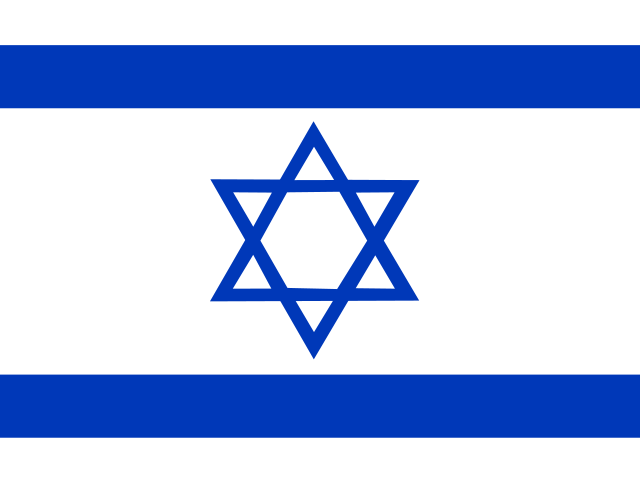
Overview
Israel, officially the State of Israel, sits in the Southern Levant in West Asia. Lebanon lies to the north, Syria to the northeast, Jordan and the West Bank to the east, and Egypt and the Gaza Strip to the southwest. It has a Mediterranean coast in the west and a short outlet on the Red Sea at the Gulf of Eilat in the south. Its eastern edge reaches the Dead Sea shore, the lowest point on the Earth's land surface.
Jerusalem is the seat of government and is proclaimed by Israel as its capital, though the status of East Jerusalem is disputed internationally and most countries keep embassies elsewhere (approx.). Tel Aviv is the largest urban area and the economic centre.
Israel is a parliamentary democracy with a single-chamber 120-seat Knesset. Its Basic Laws serve in place of a written constitution. It is a high-income economy and an OECD member since 2010, known for high-tech industry and the highest research and development spending relative to GDP in the world, according to the source. It is also widely believed to hold nuclear weapons. Hebrew, revived as a spoken language, is the main official language, and national culture blends Jewish traditions with Arab and other influences.
The Israeli–Palestinian conflict is unresolved and strongly contested. Israel's control of the West Bank, East Jerusalem and the blockade of Gaza has drawn heavy international criticism, including a 2024 advisory opinion of the International Court of Justice that the occupation violates international law. Many human rights groups and some UN officials describe Israeli policies as apartheid, a charge rejected by Israel and its main allies. The war in Gaza that followed the Hamas-led attacks of 7 October 2023 is described by some UN experts, scholars and rights organisations as genocide, while Israel and allies such as the United States deny this. This summary describes these disputes and does not cover developments after the retrieval date.
History
Human presence in the area is very old. The Ubeidiya site in the north shows early humans about 1.5 million years ago, and a roughly 200,000-year-old fossil from Misliya Cave on Mount Carmel is among the oldest modern human remains found outside Africa. The Natufian culture (c. 10,000 BCE) settled in villages before farming began.
From around 2000 BCE texts mention Canaan and the Canaanites, who lived in independent city-states. In the Late Bronze Age (1550–1200 BCE) much of Canaan was under Egyptian New Kingdom control, which collapsed with the wider Late Bronze Age crisis. Early Israelites are thought to have emerged from Semitic-speaking groups already living in the region. Later the kingdoms of Israel and Judah arose.
After Cyrus the Great took Babylon in 539 BCE, exiled Judeans were permitted to return, and the Second Temple was finished around 520 BCE under Achaemenid rule. Alexander the Great conquered the region in 332 BCE, and afterwards the Ptolemaic and Seleucid empires controlled it. Hellenisation caused tensions among Jews, and later the Hasmonean kingdom and Roman rule followed.
In the Byzantine period Christianity became the state religion, laws discriminated against Jews, and by the mid-5th century the area had a Christian majority. The Ottoman Empire took the region in 1516 and ruled it as part of Ottoman Syria for four centuries. Sephardic Jews fleeing Spain were invited to resettle Tiberias in 1561.
In the 19th century Jewish nationalism, together with European antisemitism, fed the Zionist movement. Britain backed a Jewish national home in the 1917 Balfour Declaration and then ruled Mandatory Palestine after World War I. Jewish immigration, especially in the years before and during the Holocaust, and Arab fears of displacement raised tensions.
On 29 November 1947 the UN General Assembly adopted Resolution 181, recommending separate Jewish and Arab states with Jerusalem under an international regime. The plan gave the Jewish state about 55% of the territory, though Jews were about a third of the population and owned roughly 7% of the land. Jewish leaders accepted it and Arab leaders rejected it, citing self-determination. A civil war followed. David Ben-Gurion declared the State of Israel on 14 May 1948, and armies from Egypt, Syria, Transjordan and Iraq entered the next day.
A ceasefire after about a year drew the Green Line. Jordan took the West Bank including East Jerusalem and Egypt held Gaza. Around 700,000 Palestinians fled or were expelled, the Nakba, while about 156,000 Arabs remained and became Israeli citizens. Israel joined the UN in May 1949.
Immigration was massive. The Jewish population grew from about 700,000 to 1.4 million in three years and reached about 2 million by 1958. About 1.15 million Jewish refugees arrived between 1948 and 1970, many from Arab and Muslim countries, and some lived in transit camps (ma'abarot) during a period of rationing. A reparations agreement with West Germany caused protests.
In 1956 Israel, with Britain and France, overran Sinai in the Suez Crisis before withdrawing under UN pressure. In the 1960s Israel captured Adolf Eichmann in Argentina; he remains the only person executed after conviction in an Israeli civilian court. In June 1967, after Egypt massed troops, expelled UN peacekeepers and closed the Red Sea to Israeli shipping, Israel struck first and in the Six-Day War captured the West Bank, Gaza, Sinai and the Golan Heights. East Jerusalem was folded into an enlarged Jerusalem.
The 1967–70 War of Attrition and Palestinian attacks followed, including the 1972 Munich Olympics massacre. On 6 October 1973 Egypt and Syria attacked in the Yom Kippur War; Israel repelled them but with heavy losses, and Prime Minister Golda Meir resigned. The 1977 election brought Menachem Begin's Likud to power. After Anwar Sadat's visit to the Knesset, the Camp David Accords (1978) and the Egypt–Israel peace treaty (1979) led to Israel returning Sinai in 1982.
Israel invaded southern Lebanon in 1978 and again in 1982, and held a buffer zone there until 2000. It destroyed Iraq's Osirak reactor in 1981. The 1980 Jerusalem Law and 1981 Golan Heights Law were declared void by the UN Security Council. Large waves of immigrants arrived, including Ethiopian Jews from the 1980s and, from 1990 to 1994, post-Soviet immigrants who raised the population by about 12%.
The First Intifada began in 1987. In 1993 Shimon Peres and Yasser Arafat signed the Oslo Accords, creating the Palestinian National Authority with limited self-rule, and in 1994 Israel and Jordan signed a peace treaty. Prime Minister Yitzhak Rabin was assassinated by a far-right Israeli in November 1995. Israel withdrew its settlers and forces from Gaza in 2005, and Hamas took control there in 2007, after which Israel and Egypt tightened a blockade.
The Abraham Accords of 2020 normalised ties with several Arab states. The Hamas-led attacks of 7 October 2023 triggered a major war in Gaza and regional escalation. Beyond the retrieval-date material, the course and outcomes of later events are not covered here.
Climate
Israel is small but varied, between temperate and tropical zones. The coast, including Tel Aviv and Haifa, has a Mediterranean climate with mild, rainy winters and long, hot, humid summers. Rain is rare from May to September.
Jerusalem sits in the hills at roughly 750 m above sea level, so it is cooler than the coastal areas; its summers are hot and dry, and its winters are cool, with snow falling at least once in most years. Beersheba and the northern Negev are semi-arid, with hot summers and cool winters. In the southern Negev, the Arabah, and Eilat on the Red Sea, the climate is desert-like: summers are extremely hot and dry, while winters are mild and bring only a few rainy days. Tirat Zvi recorded the country's highest temperature, 54 °C, in 1942.
Geography includes the coastal plain, the Galilee, Carmel and Golan highlands, the Jordan Rift Valley with the Sea of Galilee and the Dead Sea, and the Negev desert with its erosion cirques (makhtesh), the largest being Makhtesh Ramon at 38 km. Israel lies on the Dead Sea Transform fault, so seismic risk is notable. Destructive earthquakes strike about every 80 years, and many older buildings do not meet current standards.
Water is scarce, so Israel pioneered drip irrigation, desalination and recycling. Solar water heating is nearly universal. Forest cover rose from 2% in 1948 to 8.5% in 2016.
Government and politics
Israel is a parliamentary democracy with universal suffrage and proportional representation. The 120-member Knesset is elected on party lists with a 3.25% threshold, so coalition governments are the norm. The prime minister, normally the leader of the largest party or one who commands a majority, heads the government. The president is head of state with largely ceremonial duties. Elections are scheduled every four years but governments can fall earlier. Parties that deny Israel's existence as the state of the Jewish people may not run.
There is no single written constitution; the Basic Laws serve as one. They define Israel as a Jewish and democratic state. The 2018 Nation-State Basic Law characterises Israel as the nation state of the Jewish people, makes Hebrew the official language, gives Arabic an undefined special status and calls Jewish settlement a national interest. Critics see this as discriminatory, supporters see it as affirming national identity.
Israel is a unitary state, not a federation. It has six districts (Center, Haifa, Jerusalem, North, South, Tel Aviv) plus the Judea and Samaria Area in the West Bank, divided into 15 sub-districts and 50 natural regions. Districts are administrative; main powers over taxation, health, law and education sit with the national government. Local authorities (77 localities with city status in 2018) run municipal services such as local schooling, planning and waste. Health care is national, with universal coverage under a 1995 law funded by a health tax and delivered through health funds. Education is under a national ministry, with state secular, state religious, ultra-Orthodox and Arab school streams.
The 1950 Law of Return lets Jews immigrate and obtain citizenship. Others obtain citizenship by birth to a citizen parent or other legal routes. Israeli law does not recognise a separate Israeli nationality.
Special jurisdictions: East Jerusalem and the Golan Heights have been incorporated under Israeli law, with residents given permanent residency and the ability to apply for citizenship, but the UN Security Council calls these annexations null and void. The West Bank outside East Jerusalem is not annexed. Roughly 400,000 settlers there have Knesset representation and are subject to much of Israeli law, while Palestinians there live under Israeli military rule or, in much of the populated area, Palestinian Authority administration, and cannot become Israeli citizens. Gaza is treated as foreign territory under Israeli law, but the UN and many humanitarian bodies consider it still occupied because Israel controls its airspace, waters and crossings.
International views: the ICJ 2004 opinion on the West Bank barrier and 2024 advisory opinion found the occupation and settlements contrary to international law. UN Security Council Resolution 2334 (2016) calls settlements a flagrant violation. Amnesty International, Human Rights Watch, B'Tselem and some UN rapporteurs describe the situation as apartheid; Israel and allies such as the US reject this, and the ICJ did not rule on whether the discrimination amounts to apartheid.
Foreign relations: Israel has relations with about 165 UN members and 107 diplomatic missions. Six of 22 Arab League states have normalised ties. It remains formally at war with Syria and Lebanon, and Iran withdrew recognition after 1979. The US is its closest partner and the largest provider of military aid. Elections are held on a regular cycle; upcoming ones are scheduled and their result is not covered here.
Economy
Israel is a highly developed, innovation-led economy. The IMF estimated GDP at about USD 522 billion and GDP per capita at about USD 53,000 in October 2023. It joined the OECD in 2010 and has had one of the higher growth rates among developed economies in recent years. Reserves held by the Bank of Israel were about USD 201 billion and external debt is low.
Resources are limited, but agriculture and industry make the country largely food self-sufficient apart from grains and beef. In 2020 imports were about USD 96.5 billion and exports about USD 114 billion. Exports include machinery, software, cut diamonds, agricultural products, chemicals and textiles.
Israel is called the Start-Up Nation. It has the second-largest number of startups and third-largest number of NASDAQ-listed companies according to the source, and the highest R&D spending relative to GDP. It ranked 14th in the 2025 Global Innovation Index. Intel and Microsoft built their first overseas R&D centres there. Universities such as the Technion, Hebrew University, Tel Aviv University and Weizmann Institute rank high globally in several fields.
Water and energy: desalination supplies a large share of drinking water, and the Sorek plant is the largest seawater reverse osmosis facility in the world. Over 90% of homes use solar water heating. Offshore gas fields Tamar (production from 2013) and Leviathan (from 2019) support energy security.
Transport: about 19,200 km of paved roads, about 3 million vehicles, and 1,277 km of railway run by Israel Railways, with passengers rising from 2.5 million in 1990 to 53 million in 2015. Ben Gurion Airport is the main hub (over 21 million passengers in 2023), with Ramon and Haifa airports also operating. The main ports are Haifa, Ashdod and Eilat.
Tourism, especially religious tourism, is important; a record 3.6 million visitors came in 2017. The working week is Sunday to Thursday, with Friday a short day where it is worked. Housing is expensive, with around 150 salaries needed to buy an apartment and a shortage of about 200,000 homes in 2021. Wartime disruption since 2023 has affected the economy; details are not covered here (approx.).
Demographics and urbanization
The population was about 10.1 million in April 2025. Government figures that year recorded 72% Jews, 21% Arabs and 7% others, mostly non-Arab Christians and people with no religion listed. The country is the only one with a Jewish majority. Estimated 166,000 to 203,000 migrant workers also live there. About 93% of people live in urban areas, and most live along the coastal plain.
Among Jews, about 80% are Israel-born; around 44% descend from Ashkenazi (European and former Soviet) communities and most of the rest from Mizrahi and Sephardi communities from Arab and Muslim countries. About 300,000 Russian-origin immigrants are not Jewish by rabbinical law. Over 600,000 Israelis live beyond the Green Line, including about 400,000 in West Bank settlements and over 200,000 in East Jerusalem. Arabs, including East Jerusalem and the Golan, are about 21% of the population (roughly 2 million); about 90% live in 139 towns and villages mainly in the Galilee, Triangle and Negev.
Life expectancy is about 82 to 84 years. Israel has the highest fertility rate in the OECD and is the only member above replacement level.
Major metropolitan areas: Gush Dan (Tel Aviv area) about 3.85 million, Jerusalem about 1.25 million, Haifa about 0.92 million and Beersheba about 0.38 million. Jerusalem municipality has about 1.05 million residents, including East Jerusalem whose status is disputed. Tel Aviv city has about 495,000 and Haifa about 297,000. There are 16 cities with over 100,000 people. Bnei Brak is one of the world's most densely populated cities.
Languages: Hebrew is the main language; Arabic has special status and is the teaching language in Arab schools. Russian, Amharic and French are widely spoken, and English is widely understood and taught from elementary school.
Religion (2022 estimate): 73.5% Jewish, 18.1% Muslim, 1.9% Christian, 1.6% Druze, 4.9% other. Among Jews, a 2016 Pew survey found 49% secular, 29% traditional, 13% religious and 9% ultra-Orthodox. Israel has no official religion, though matters such as marriage are controlled by religious authorities.
Education: school is compulsory from ages 3 to 18 with Bagrut matriculation exams, literacy about 98% and about 49% of 25–64 year-olds with tertiary education (2015). There are nine public universities and 49 private colleges. Health care is universal under the 1995 law, and Israel spends a relatively low 7.3% of GDP on health with good outcomes.
Capital city
Jerusalem is the seat of the Knesset, government and Supreme Court, and Israel proclaims it the capital. East Jerusalem was occupied in 1967 and incorporated under Israeli law, which the UN Security Council considers null and void, and the city's final status is an issue in negotiations; Palestinians also claim East Jerusalem as a capital. Many countries have kept embassies in Tel Aviv, though a few have moved them (approx.).
The city lies in the Judean hills at about 750 m elevation, inland between the Mediterranean and the Dead Sea. The municipality has about 1.05 million residents in about 125 km², and the metropolitan area about 1.25 million. Including East Jerusalem, about 361,700 Arabs and 233,900 Jews lived there as of 2020.
Climate: warm to hot dry summers, cool wet winters (approx. 8 to 12 °C in January), and occasional snow most years.
Role: political and religious centre. The Old City holds the Western Wall, the Temple Mount (Al-Aqsa compound) and the Church of the Holy Sepulchre, sacred to Jews, Muslims and Christians. It hosts the Hebrew University and the National Library of Israel.
Jerusalem is not the main economic city. Tel Aviv and the Gush Dan metropolitan area (about 3.85 million) are the financial, technological and business centre, with Ben Gurion Airport nearby. Tel Aviv has a Mediterranean climate with hot humid summers and mild winters. Haifa is the main northern port city. Jerusalem is the largest municipality by population, while Gush Dan is the largest urban area.
About this summary
Some history from the 2000s onward, recent events, city climates, capital-city details and a few demographic and economic updates come from general knowledge and are approximate.