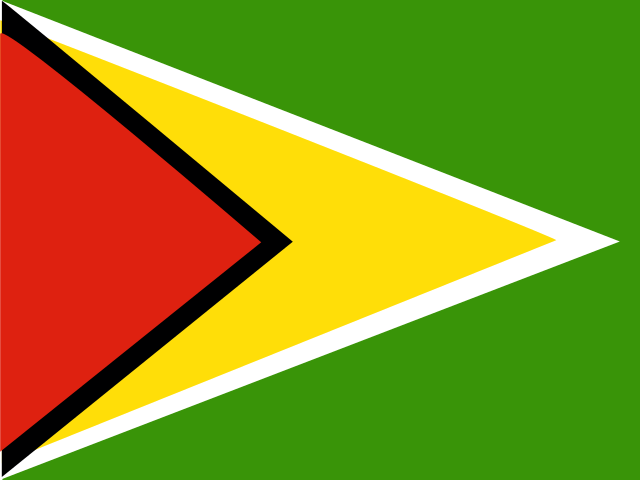
Overview
Guyana, officially the Co-operative Republic of Guyana, sits on the Atlantic coast of northern South America. Its neighbours are Suriname on one side, Brazil on its southern and southwestern flank, and Venezuela on the west. It belongs to the Guianas, the shield region known as the land of many waters. The capital and largest city is Georgetown.
Its land area is about 214,969 km2, and it has roughly 744,000 people, which makes it one of the least densely populated countries on Earth. English is the only official language, making Guyana unique among mainland South American countries. Most people speak Guyanese Creole, an English-based creole, in daily life, and many Indigenous people are bilingual in English and their own languages.
Culturally and politically Guyana belongs to the Commonwealth Caribbean and hosts the headquarters of CARICOM. It was a founding member of the Union of South American Nations in 2008. It contains part of the Amazon rainforest and has very high biodiversity.
Nine Indigenous nations live there: the Wai Wai, Macushi, Patamona, Lokono, Kalina, Wapishana, Pemon, Akawaio and Warao. Colonial history left a diverse population of Indian, African, Amerindian, Chinese, Portuguese, other European and mixed descent.
The economy has been transformed by offshore oil, discovered in 2015 with commercial production from 2019. Over 11 billion barrels of reserves have been found since 2017. By 2025 Guyana was the world's largest oil producer per capita, and its GDP per capita ranks among the highest in the Americas. Even so, in 2017 about 41% of people lived below the poverty line, and the World Bank (2023) notes that poverty persists and that managing rapid growth carries significant risks.
History
Indigenous peoples have inhabited the area for thousands of years. Many of them combined shifting agriculture with hunting, and they maintained far-reaching trade networks that moved goods such as blowpipes, curare and cassava graters. Historians believe the Lokono and Kalina originated in the South American interior and migrated northward, first into the Guianas and later onward to the islands of the Caribbean. The Lokono, who lived chiefly as farmers, hunters and fishermen, arrived on the islands ahead of the Kalina.
Columbus saw the coast during his third voyage in 1498, and in 1596 Sir Walter Raleigh produced a written description of it. The first European colonies were founded by the Dutch: Pomeroon (1581), Essequibo (1616), Berbice (1627) and Demerara (1752). On the coastal land, Dutch planters established sugar plantations that relied on enslaved Africans. Britain assumed control in 1796, following the French invasion of the Dutch Republic in 1795. Under the Anglo-Dutch Treaty of 1814, Demerara-Essequibo and Berbice were formally ceded to Britain, and in 1831 the two were combined as the single colony of British Guiana.
After emancipation in 1838 almost all freed people left the plantations, and indentured workers from India were brought in from 1838 until the system ended in 1917. Balatá (natural latex) tapping was once a significant industry, especially in the Kanuku foothills of the Rupununi.
Venezuela has claimed the land west of the Essequibo River since its own independence in 1824, as supposed heir to older Spanish claims. An international tribunal in 1899 (the Paris Arbitral Award) awarded most of the disputed land to British Guiana. Venezuela declared the award void in 1962, which led to the Geneva Agreement of 1966 involving Guyana, the United Kingdom and Venezuela.
Guyana became independent from the United Kingdom as a dominion on 26 May 1966 and a republic on 23 February 1970, staying in the Commonwealth. In October 1966 Venezuelan troops seized Ankoko Island, which has remained under Venezuelan occupation, with military installations and an airstrip built there.
Forbes Burnham of the People's National Congress took power after independence and became a repressive, authoritarian leader. Politics split along ethnic lines, with Afro-Guyanese backing Burnham's party and Indo-Guyanese backing Cheddi Jagan's People's Progressive Party, a pattern known as aapan jaat politics (roughly 'for your own kind'). Burnham nationalised large industries, including foreign-owned bauxite and sugar. In 1978, 918 people died in the Jonestown mass murder-suicide led by American cult leader Jim Jones in the northwest.
With help from former US president Jimmy Carter, free elections returned. On 5 October 1992 a new National Assembly was elected in the first internationally recognised free and fair vote since 1964, and Cheddi Jagan was sworn in as president on 9 October 1992, though the poll saw some violence. The PPP governed until 2015.
Major offshore oil reserves were found by ExxonMobil in 2015. David Granger became president in 2015 at the head of the APNU-AFC coalition. His government lost a no-confidence vote in December 2018, after which the election was delayed by litigation until 2 March 2020. Results were declared on 3 August 2020 and Irfaan Ali of the PPP/Civic became president. Venezuela held a referendum in December 2023 on annexing Essequibo, which passed with about 95% support but low turnout, and analysts said the results were doubtful. A Venezuelan military buildup on the border raised concerns of conflict. In September 2025 Ali was re-elected for a second term.
Climate
Guyana has a tropical climate that is hot and humid, moderated on the coast by the northeast trade winds. There are two rainy seasons: May to mid-August and mid-November to mid-January.
Georgetown, the capital, is on the Atlantic coast and has a tropical climate (approx.): temperatures around 24 to 31 °C all year, high humidity, and annual rainfall of about 2,300 mm, with the heaviest rain in May to July and again in December and January. New Amsterdam, on the Berbice River, has a similar coastal climate. Linden, an inland bauxite town on the Demerara River, is somewhat hotter and also very rainy (approx.). Lethem in the Rupununi savannah near the Brazilian border has a more pronounced dry season and is hot, with a wet season from about May to August (approx.).
The land divides into a fertile, marshy low coastal plain where most people live, a hilly white-sand and clay belt with most of the mineral deposits, dense forested highlands in the south, and savannah in the southwest and interior. Mount Roraima (2,772 m) on the Brazil-Guyana-Venezuela tripoint is the highest point; others include Mount Ayanganna (2,042 m) and Monte Caburaí (1,465 m). The tepuis are said to have inspired Arthur Conan Doyle's The Lost World. Kaieteur Falls is one of the world's most powerful waterfalls.
The longest rivers are the Essequibo (1,010 km), the Courentyne (724 km, forming the border with Suriname), the Berbice (595 km) and the Demerara (346 km). Shell Beach on the northwest coast is a major nesting area for sea turtles, mainly leatherbacks.
Over 80% of the country is forested, and over 70% of the natural habitat of the wider Guiana Shield remains pristine. Guyana has more than 225 mammal species, 900 bird species, 880 reptile species and over 6,500 plant species. Well-known species include the arapaima, giant anteater, giant otter, harpy eagle, jaguar and the hoatzin (the national bird). There are six ecoregions. The Konashen community-owned conservation area (over 4,000 km2, managed by the Wai Wai) was titled in 2004, and the Iwokrama forest is protected for sustainable use. Guyana and Norway have cooperated on green development since 2009, yet net forest loss rose from about 3,790 ha a year in 1990-2000 to about 8,420 ha a year in 2015-2025.
Government and politics
Guyana is a parliamentary representative democratic republic in a multi-party system. The president is both head of state and head of government. Executive power is held by the president and government, while legislative power is shared by the president and the National Assembly, which had 65 seats at the 2015 election. Politics has long been a source of tension, and elections have often brought riots. The two main parties are organised largely along ethnic lines and often clash over the allocation of resources.
Recent leaders: Donald Ramotar (PPP) won in 2011; David Granger (APNU-AFC coalition) became the eighth president in May 2015; Irfaan Ali (PPP/Civic) became the ninth president in August 2020 and was re-elected in September 2025. A Public Procurement Commission was created under a 2003 act but was only appointed in 2016.
Guyana is a unitary state, divided into 10 regions, which are in turn divided into 27 neighbourhood councils. Regions and councils handle local administration, but the main powers over taxation, law, health and education lie with the central government (approx.). There are no states with their own sovereignty. Nine Indigenous districts and villages have some community land titles and local councils, such as the Konashen Indigenous District (approx.). The Caribbean Court of Justice is the final court of appeal (approx. based on its 2018 ruling on cross-dressing).
Guyana is in two border disputes. Venezuela claims the land west of the Essequibo (which it calls Guayana Esequiba or the Reclamation Zone), and Guyana took the matter to the International Court of Justice in 2018, asking it to uphold the 1899 award. Venezuela argues that the 1966 agreement voided the award. The ICJ has found it has jurisdiction and the case is admissible, but a final decision is expected to take years. Suriname claims the area east of the Corentyne and the New River Triangle (Tigri area). A UN Convention on the Law of the Sea tribunal ruled on the maritime dispute with Suriname on 21 September 2007. Brazil and the US have signalled support for Guyana, and US Southern Command held air exercises with the Guyana Defence Force in December 2023.
Guyana joined the Organisation of American States in 1991. It signed the CARICOM Double Taxation Relief Treaty in 1994 and a FATCA Model 1 agreement with the US in 2014. The Guyana Defence Force works with Brazil on border security and with the US Army. Same-sex activity is illegal under inherited British-era law, with a penalty of up to life imprisonment that is not enforced; cross-dressing was decriminalised in 2018 by the Caribbean Court of Justice.
Economy
Main sectors are agriculture (rice and sugar), bauxite and gold mining, timber, seafood, and, increasingly, crude oil and gas. Gold output was about 14 tonnes in 2015.
Offshore oil production began in 2019 and has transformed the economy. Per World Bank estimates, real GDP grew 43.8% in 2024 and 15.4% in 2025. Oil output reached 261.1 million barrels in 2025, and the non-oil economy grew 14.3%, helped by agriculture, manufacturing, construction and public investment. The Natural Resource Fund held US$3.25 billion at the end of 2025. The World Bank lists overheating, falling oil prices and weaker competitiveness in non-oil sectors as main risks. GDP grew about 43% in 2020. Forest preservation has helped attract international aid via REDD+.
Economic history: Dutch and later British sugar plantations dominated, run by a small planter elite using enslaved and then indentured labour. After independence Forbes Burnham nationalised foreign bauxite firms (Reynolds Metals, Alcan) and sugar (GuySuCo). The economy then suffered from political instability, skilled-worker emigration, inexperienced management, ageing infrastructure and poor world markets, which raised debt. Growth recovered after 1999. Debt relief included US$329 million in 2003 on top of US$256 million in 1999 under the HIPC plan, about US$611 million of multilateral debt written off in 2006-07, and smaller cancellations by Japan, China (US$15 million in 2007) and Venezuela (US$12.5 million in 2008).
Tax: in 2007 a Value Added Tax replaced six taxes to ease collection and reduce evasion.
Transport: 187 km of railway used only for ore, about 7,969 km of roads (591 km paved), and 1,077 km of navigable waterways on the Berbice, Demerara and Essequibo. Ports are at Georgetown, Port Kaituma and New Amsterdam. There are two international airports, Cheddi Jagan International at Timehri and Eugene F. Correia International (formerly Ogle), plus about 90 airstrips. Traffic drives on the left.
Electricity: the state-owned Guyana Power and Light dominates. Installed capacity is about 226 MW, mostly diesel generators, despite large hydro and bagasse potential. Programmes aim to improve access in the hinterland.
Demographics and urbanization
About 744,000 people live in Guyana, and roughly 90% of them live on a narrow coastal strip 16 to 64 km wide that covers about 10% of the land. Urbanisation is only moderate, at about 27 to 28% (approx.), and much of the coastal population lives in villages and small towns rather than cities. The interior is sparsely settled.
Largest settlements (approx.): Georgetown, about 120,000 in the city proper and roughly 250,000 to 300,000 in the wider urban area; Linden, about 30,000; New Amsterdam, about 17,000; Lethem, a small frontier town of a few thousand.
Ethnic groups per the 2002 census: Indo-Guyanese 43.5%, Afro-Guyanese 30.2%, mixed 16.7%, Indigenous (Amerindian) 10.5%. Indigenous peoples are the majority in the southern interior. The nine Indigenous nations are the Akawaio, Lokono, Arekuna (Pemon), Carib (Karinya), Makushi, Patamona, Wai Wai, Wapichan and Warao. Afro-Guyanese descend mainly from West African groups; most Indo-Guyanese descend from North Indian indentured labourers (Bhojpur, Awadh), with a notable minority from Tamil Nadu and Andhra Pradesh. The two largest groups have experienced some racial tension.
Languages: English is official and used in education, government and media. Most people speak Guyanese Creole as a first language. A small minority of Amerindians speak Cariban languages such as Akawaio, Wai-Wai and Macushi. Older Indo-Guyanese speak Guyanese Hindustani.
Religion (2012): 64% Christian, 25% Hindu, 7% Muslim, 3% irreligious, 1% other. Some traditional African and Amerindian beliefs persist.
Health: life expectancy about 69.5 years (2020). A PAHO/WHO report using 2012 data ranked Guyana as having the world's highest suicide rate, 44.2 per 100,000. HIV prevalence was about 1.2% of adults in 2011.
Education: primary school became compulsory in 1876 and the government took over all schools in the 1960s. The University of Guyana was founded so students need not study abroad, and Texila American University (founded 2010) offers medical programmes. Literacy was estimated at about 96% in 1990 and 96.7% among 15-24 year olds in 2014, though functional literacy may be lower. Pupils sit the NGSA for secondary entry and the CXC at school end, with CAPE introduced. Access is harder in the hinterland, and a World Bank assessment found about half of teachers untrained.
Capital city
Georgetown lies on the Atlantic coast at the mouth of the Demerara River in the low coastal plain. It is the capital and largest city, with approx. 120,000 people in the city and roughly 250,000 to 300,000 in the wider urban area. It is known for its wooden colonial architecture, canals and sea wall (approx.).
Climate (approx.): tropical, hot and humid all year, with daily highs around 30 to 31 °C, lows near 23 to 25 °C, and two rainy seasons (May to mid-August and mid-November to mid-January) moderated by sea breezes.
Georgetown is the political, administrative, economic and cultural centre. It houses the government and National Assembly, the main port, and the University of Guyana. Georgetown is also the main commercial and economic city, so the capital and the main economic centre are the same place. The main international airport, Cheddi Jagan at Timehri, is about 40 km south, while Eugene F. Correia International (Ogle) is closer to the city (approx.). CARICOM's secretariat is based in Georgetown. Conservation International Guyana has an office there. Guyana has a single capital.
About this summary
Capital-city details (Georgetown population, climate, role), metro and town populations, city climates, and some recent economic and political context are from general knowledge and approximate.