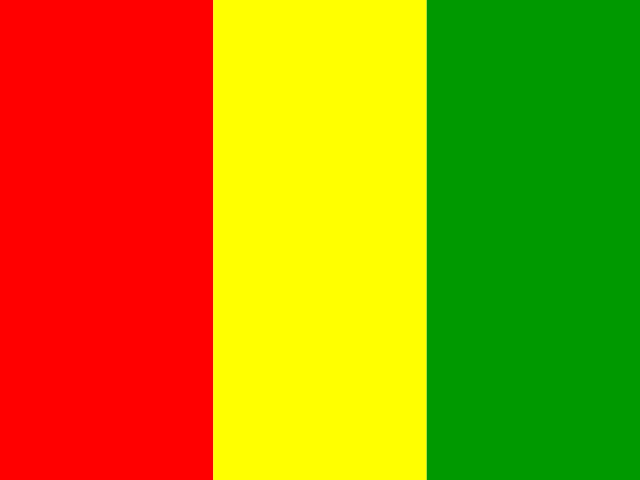
Overview
Guinea, officially the Republic of Guinea, is a coastal West African country on the Atlantic. Its neighbours are Guinea-Bissau and Senegal to the north and northwest, Mali to the northeast, Ivory Coast to the southeast, and Sierra Leone and Liberia to the south. It is often called Guinea-Conakry to separate it from Guinea-Bissau and Equatorial Guinea.
The 1 July 2025 census counted more than 17.5 million people on about 245,857 square kilometres, an area roughly comparable to the United Kingdom. The country became independent from France in 1958 and has a record of military takeovers. It held its first democratic presidential election in 2010.
Guinea belongs to the United Nations, ECOWAS, the African Union, the Organisation of Islamic Cooperation and La Francophonie. The African Union suspended it after the 2021 coup and reinstated it in January 2026. Muslims make up roughly 90% of the population according to the source lead.
Guinea has four natural regions: Maritime Guinea on the coast, the Fouta Djallon highlands (Middle Guinea), the savannah of Upper Guinea in the northeast, and forested Guinea in the southeast. More than 24 local languages are spoken, with Susu, Pular and Maninka the largest.
The economy relies on farming and mining. Guinea is described in the source as the world's second-largest bauxite producer, with diamonds and gold as well. In the most recent survey (2018), 66.2% of people were multidimensionally poor and another 16.4% were vulnerable to it.
History
Before colonial rule, the territory lay on the edge of a succession of West African empires. The Ghana Empire grew through trade and declined after Almoravid attacks; Islam arrived in the region in this period via North African traders. The Sosso state followed in the 12th to 13th centuries, then the Mali Empire, founded after Soundiata Keita beat the Sosso ruler Soumangourou Kante at Kirina around 1235. Mali's ruler Kankou Moussa made his pilgrimage to Mecca in 1324.
European traders were active on the coast from the 17th century. France began military penetration in the late 19th century and set up a colony on 17 December 1891. It took Timbo, the Fouta capital, in 1896, signed a treaty in 1897, and gained control of the area after defeating the forces of Samori Toure in 1898. Guinea became part of French West Africa.
In the referendum of 28 September 1958 offered by France's new Fifth Republic, Guinea voted overwhelmingly for immediate independence, which it declared on 2 October 1958. Women's organisations and protests against living conditions played a notable role in the independence movement. Sekou Toure led the new state.
In 1960 Toure made the Democratic Party of Guinea (PDG) the only legal party, and party and state were fused for 24 years. He was re-elected unopposed to four seven-year terms, and voters were offered a single list of PDG candidates for the National Assembly. On 22 November 1970 Portuguese forces from neighbouring Portuguese Guinea launched Operation Green Sea, a raid on Conakry with exiled Guinean opposition fighters, aimed partly at removing Toure because of his support for independence movements.
Toure died on 26 March 1984 after heart surgery in the United States. Hours before the PDG was due to choose a successor, Colonels Lansana Conte and Diarra Traore took power in a bloodless coup. Conte became president and denounced the previous government's human rights record. He stayed in power until he died on 23 December 2008.
Hours after Conte's death, Captain Moussa Dadis Camara seized power and headed a military junta. On 28 September 2009 soldiers attacked a crowd protesting his possible presidential run, killing 157 people and committing rape and mutilation, which led some foreign governments to withdraw support. On 3 December 2009 an aide shot Camara, who went to Morocco for treatment, and Sekouba Konate took over. A January 2010 agreement in Ouagadougou promised a return to civilian rule. After a disputed first round on 27 June 2010, a second round on 7 November was won by opposition leader Alpha Conde.
In 2013 protests over election transparency left nine dead and about 220 injured, and set off clashes between Malinke (who largely backed Conde) and Fula (who largely opposed him). Legislative elections were held on 24 September 2013, with Conde's RPG taking 53 of 114 seats and the opposition UFDG 37.
Ebola was reported in Guinea in March 2014; the first known case was a two-year-old boy in Meliandou who fell ill in December 2013. By 1 November 2015 Guinea had recorded 3,810 cases and 2,536 deaths. The disease spread to Sierra Leone and Liberia, and the WHO ended the international emergency in March 2016. Ebola re-emerged briefly in early 2021.
From October 2019, large protests opposed constitutional changes that let Conde seek a third term, and more than 800 people were reported killed in clashes. Conde won the 2020 election, which the opposition said was fraudulent, arguing that a March 2020 referendum reset the two-term limit.
On 5 September 2021 Lieutenant Colonel Mamady Doumbouya led special forces in a coup, announced the dissolution of the government and closed the borders. The UN, EU, African Union, ECOWAS and La Francophonie condemned it, and ECOWAS suspended Guinea. Doumbouya was sworn in as interim president on 1 October 2021.
Anti-government protests on 11 May 2023 left at least seven people dead from gunfire. Later that year, on 18 December 2023, an explosion at the main oil depot in Conakry killed 24 people, leading to fuel shortages and higher prices. Doumbouya did not meet his first deadline, set for the end of 2024, to begin a transition, and he subsequently pledged to hold a referendum and elections in 2025.
A constitutional referendum on 21 September 2025 produced a new constitution replacing the 2020 text. A presidential election was held on 28 December 2025 with nine candidates including Doumbouya. On 5 January 2026 the Supreme Court validated his win with 86.72% of the vote, and ECOWAS lifted Guinea's suspension.
Climate
Guinea has a tropical climate with a rainy season and a dry season, and the south and coast are far wetter than the north. Exact patterns vary by region, and figures below are approximate general knowledge.
Conakry on the Atlantic coast is hot and humid all year, with highs around 30 to 32°C. It has a very heavy monsoon-type rainy season from roughly May to October (several metres of rain a year, approx.) and a dry season from about December to April.
Labe and the Fouta Djallon highlands in Middle Guinea are cooler and more pleasant, with highs often in the high 20s °C and cooler nights. Kankan in Upper Guinea is a hotter savannah climate with a long dry season and hot spells before the rains. Nzerekore in the forest region is warm, humid and rainy for much of the year.
The geography ranges from coastal lowlands and mangroves to highlands and forested mountains. Mount Nimba (1,752 m) is the highest point, and the Niger, Gambia and Senegal rivers all rise in the Guinea Highlands. The country has five ecoregions, including Guinean montane forests, lowland forests, forest-savannah mosaic, West Sudanian savannah and mangroves. Malaria transmission occurs year-round, peaking from July to October.
Government and politics
Guinea is a republic on paper but has been run as a de facto military-led government since the 2021 coup. The president is directly elected for a five-year term, is both head of state and head of government, and appoints a cabinet (about 25 civilian ministers in the source). The legislature is a unicameral National Assembly and the highest court is the Supreme Court; the source says both were suspended after the 2021 coup. A new constitution was approved by referendum in September 2025. This summary does not cover any later elections or institutional changes beyond the dates stated.
Administration is highly centralised. The country has eight administrative regions, 33 prefectures, over 100 sub-prefectures, and local districts (communes in Conakry and other towns, quartiers in the interior). District-level leaders are elected, while the president appoints officials at all other levels. Regions and prefectures therefore act mainly as arms of the national government rather than holding independent powers over tax, health, law or education, which are set nationally. Conakry has the status of a special zone, which was enlarged before the 2025 census by transferring roughly 300,000 people from Kindia Region.
Politics has strong ethnic dimensions: Alpha Conde drew support from the Malinke, while the opposition was backed largely by the Fula, around a third of the population.
Guinea belongs to the UN, African Union, ECOWAS, La Francophonie, the Islamic Development Bank, the IMF, the World Bank and the African Development Bank. Foreign governments including the United States and China criticised the 2021 coup, and ECOWAS and the African Union applied sanctions threats and suspensions, since lifted in 2026.
The armed forces have five branches: army (about 15,000), navy (about 900), air force (about 700), the National Gendarmerie and the Republican Guard, under a Chairman of the Joint Chiefs who reports to the defence minister. The National Police also operates.
Human rights concerns include abuses by security forces and female genital mutilation, which affected more than 98% of women as of 2009 according to the source. Homosexuality is illegal.
Economy
Guinea's economy rests on agriculture and mining, with high poverty: 66.2% multidimensionally poor in 2018. Agriculture has employed a large share of the workforce (about 75% at one point). Rice is grown in flooded areas but domestic output does not cover demand, so rice is imported from Asia. Newer crops include apples, pears, grapes, pomegranates and hydroponic strawberries.
Guinea holds 25% or more of the world's known bauxite reserves (over 25 billion tonnes, possibly up to half in some estimates), plus more than 4 billion tonnes of high-grade iron ore, diamonds, gold and uranium. Gold output was about 17 tonnes in 2015. Bauxite and alumina are the main exports, and bauxite and alumina operations have historically supplied about 80% of foreign exchange.
Key bauxite operations: Compagnie des Bauxites de Guinee (CBG), owned 49% by the state and 51% by the Halco consortium (Alcoa, Rio Tinto, Dadco), exports about 14 million tonnes a year and has exclusive rights in the northwest through 2038. Compagnie des Bauxites de Kindia, a state-RUSAL venture, produces about 2.5 million tonnes, mostly exported to Russia and Eastern Europe. Alumina Compagnie de Guinee (the former Friguia) produced about 2.4 million tonnes of bauxite in 2004 and exports about 750,000 tonnes of alumina. Global Alumina and Alcoa-Alcan signed agreements for refineries with a combined capacity of about 4 million tonnes a year.
The Simandou iron ore deposit was the subject of a March 2010 preliminary agreement between Rio Tinto and Chinalco. In 2017 Britain's Serious Fraud Office opened an investigation into Rio Tinto's practices in Guinea. (Later developments at Simandou are not covered here.)
Offshore oil exploration began with a 2006 agreement with Hyperdynamics. The Sabu-1 well, drilled in 2012, was not judged commercially viable. Tullow Oil took 40% of the concession in 2012. No commercial oil production is described in the source.
Tourism centres on waterfalls in Lower and Middle Guinea, such as the Soumba cascade near Kindia, Voile de la Mariee near Dubreka, the Kinkon falls (about 80 m) in Pita, the Kambadaga falls, the Ditinn and Mitty falls in Dalaba, and the Fetore falls near Labe. Fuel shortages after the 2023 depot explosion pushed up prices and travel costs.
Demographics and urbanization
The 2025 census counted about 17.5 million people. The 2014 total fertility rate was estimated at 4.93 children per woman. Conakry is the most populous city and a hub of commerce, education and culture; it had 1,675,069 people in 2014 before its boundaries were enlarged. Urbanisation is roughly 38 to 40% (approx., general knowledge), with the population concentrated in Conakry and the coast, and in regional centres such as Kankan, Nzerekore, Kindia, Labe and Kissidougou. Approximate populations of regional cities are a few hundred thousand at most (approx.), and Coyah and Dubreka are suburban to Conakry.
About 24 ethnic groups live in Guinea: Fula (Fulani) 43.4%, mainly in the Fouta Djallon; Mandinka/Malinke 25.4%, mostly in the east around Kankan and Kissidougou; Soussou 17.2%, in the west near Conakry, Forecariah and Kindia; and about 16% others including Kpelle, Kissi and Toma. About 10,000 non-Africans lived in Guinea in 2017, mainly Lebanese, French and other Europeans.
The September 2025 constitution names Susu, Fulani, Malinke, Kissi, Kpelle, Toma, Landuma and Uanian as official languages alongside French; French was the sole official language after independence and stays the working language. A 2026 law promotes the N'Ko and Adlam scripts. In 2018 Pular was the first language of 33.9% of people, Maninka 29.4% and Susu 21.2%.
Religion (ARDA, 2023): 86.8% Muslim, 3.52% Christian and 9.42% animist. Most Muslims are Sunni of the Maliki school with Sufi influence. Ethno-religious fighting in Nzerekore in July 2013 left at least 54 dead.
Adult literacy was about 41% in 2010 (52% of men, 30% of women). Primary education is compulsory for six years, but attendance has been low and child marriage is widespread.
Health challenges include Ebola (2014 to 2016 and 2021), HIV (higher in urban areas, 5% in Conakry in earlier surveys), year-round malaria, and COVID-19 (13,722 confirmed cases and 81 deaths in 2020). Maternal mortality was 576 per 100,000 births in 2021, and under-five mortality is 146 per 1,000. A 2012 study found malnutrition rates of 34 to 40% by region.
Capital city
Conakry is the capital and largest city. It lies on the Atlantic coast on the Kaloum peninsula and the mainland strip behind it, in Maritime Guinea. It had 1,675,069 people in 2014 and has since been enlarged, absorbing about 300,000 people from Kindia Region, so the metro area is probably around 2 million or more (approx.). It is a special zone rather than part of an ordinary region. Suburban Coyah and Dubreka lie just outside it.
Its climate is hot, humid and tropical, with highs around 30 to 32°C all year and a very wet rainy season from about May to October (approx.), followed by a dry season.
Conakry is the political centre, home to the presidency and government, and also the main economic, commercial, educational and cultural hub. It hosts the main port, which handles mineral and import trade. The 2021 coup began with gunfire near the presidential palace in Conakry. In December 2023 an explosion at the main oil depot there killed 24 people and caused fuel shortages. Guinea has a single capital, and it is also the main economic city.
About this summary
Capital-city details (metro population, climate, role), city climates, major-city populations, and some economic and recent-political context come from general knowledge and are approximate.