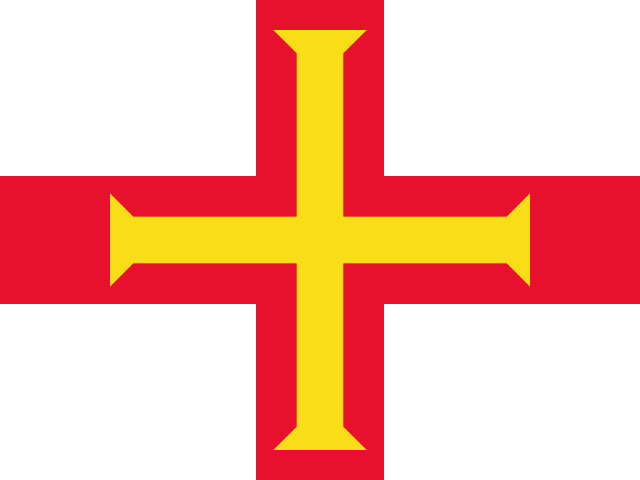
Overview
Guernsey is a self-governing island in the English Channel, roughly 43 km (27 miles) west of the Cotentin Peninsula in Normandy. It is the main island of the Bailiwick of Guernsey, which also includes Alderney, Herm, Jethou, Brecqhou and Sark, plus many islets and rocks. The bailiwick has about 63,950 inhabitants, nearly all of them on Guernsey itself, and the island covers roughly 62 square kilometres.
Guernsey is a Crown Dependency. It is not part of the United Kingdom, but the British government handles defence and most foreign relations. The British monarch is head of state, and the President of the Policy and Resources Committee serves as the de facto head of government. The parliament and government are the States of Guernsey. The island has ten parishes and one town, St Peter Port.
The economy is led by financial services, with tourism and farming behind it. Guernsey is also known for its cattle breed. Culture is strongly shaped by Britain: the currency is the pound sterling and English is the everyday language. Norman and French influences remain, notably the traditional language Guernésiais. The French writer Victor Hugo lived in exile on the island for fifteen years and wrote some of his best-known works there.
Guernsey was part of the Duchy of Normandy until 1204, when the Channel Islands stayed loyal to the English crown rather than going with mainland Normandy. It was occupied by Nazi Germany in the Second World War and liberated on 9 May 1945, a date marked each year as Liberation Day.
History
Around 6000 BC rising seas created the English Channel and cut the Norman promontories that became Guernsey and Jersey off from the European continent. Neolithic farmers settled the coasts from about 5000 BC and left the dolmens and menhirs still visible today. Finds of Roman-era pottery, including amphorae from the Herculaneum area and Spain, point to an extensive trading network across the region and beyond.
In 933 the Cotentin Peninsula and the Avranchin, which included the islands, came under the control of William I of Normandy. Guernsey and the other Channel Islands are the last remnants of the medieval Duchy of Normandy. Around 1030 a storm scattered the fleet of Robert, Duke of Normandy, and drove it down the Channel to Guernsey, where the Duke was taken in at St Michael's Abbey.
In 1204 the Channel Islands stayed with the English crown when mainland Normandy was lost, and in 1290 they were divided administratively, with Guernsey becoming part of the Bailiwick of Guernsey. In 1483 Pope Sixtus IV issued a bull granting the islands a Privilege of Neutrality, with excommunication threatened for anyone molesting islanders. A royal charter confirmed it in 1548. It lasted about another century, until William III of England abolished it because of privateering against Dutch ships.
Around the middle of the 16th century, Calvinist reformers arriving from Normandy left their mark on the island. During the Marian persecutions, three women who became known as the Guernsey Martyrs were executed by burning because of their Protestant faith, and the infant son of one of them died in the flames as well. Bailiff Hellier Gosselin gave the order to burn the child, and he later left the island as public outrage mounted.
During the English Civil War Guernsey mostly sided with Parliament, though there were a few Royalist uprisings in the southwest and Castle Cornet was held by the Governor, Sir Peter Osborne, and Royalist troops. Castle Cornet surrendered in December 1651 with full honours of war, the last Royalist outpost in the British Isles to do so.
In the 17th and 18th centuries wars with France and Spain let Guernsey shipowners and captains turn cargo ships into privateers under letters of marque. Islanders began settling in North America, and Guernsey County, Ohio, was founded in 1810. The threat of invasion by Napoleon led to many defensive structures being built. The early 19th century brought rising prosperity from maritime trade and the stone industry, though shipping declined later as the move to iron and steel vessels bypassed an island without those materials.
In 1806 the British government drained and reclaimed the tidal channel Le Braye du Valle as a defence measure, which had made the north of the island a tidal island. Its eastern end became the town and harbour (from 1820) of St Sampson's, now a major port, and its western end became Le Grand Havre. New roads were built for military use, and infrastructure was funded by issuing money debt-free from 1815.
In the First World War about 3,000 island men served in the British Expeditionary Force, around 1,000 of them in the Royal Guernsey Light Infantry formed in 1916.
German troops occupied the Channel Islands from 30 June 1940. Of a population of about 41,000, roughly 17,000 people were evacuated to England beforehand, including about 80 per cent of Guernsey's children. German forces deported over 1,000 residents to camps in southern Germany, such as Lindele near Biberach and Oflag VII-C at Laufen. The island was fortified far beyond its strategic value, and German defences remain visible, especially around Castle Cornet and the north coast. Guernsey and Jersey were liberated on 9 May 1945.
In the late 1940s the island repaired occupation damage. The tomato industry revived but went into terminal decline in the 1970s after world oil prices rose sharply. Tourism stayed important, and finance grew from the 1970s and expanded over the following two decades. Guernsey's constitutional and trading relationship with the UK is largely unaffected by Brexit.
Climate
Guernsey has a temperate oceanic climate with mild winters and mild, sunny summers, with a dry-summer tendency that is slightly wetter than a Mediterranean pattern. July and August are warmest, typically around 20 °C, occasionally above 24 °C. February is the coldest month, averaging about 6.9 °C, and August averages about 17.1 °C. Frost is rare, and snow seldom falls or settles, with February the most likely month.
The wettest months are December (about 119 mm), November (about 107 mm) and January (about 92 mm). July is the sunniest month with about 253 hours of sunshine, and December the dullest with about 58 hours. Sea temperatures range from about 8 °C in February to about 20 °C in August and have been rising. Average wind speeds run between 20 and 40 km/h, with gusts above 60 km/h every four to five years.
The capital St Peter Port, on the east coast, shares this mild maritime climate (approx.: winter daytime highs of about 8 to 9 °C, summer highs of about 20 to 21 °C, and annual rainfall of roughly 800 to 900 mm). Being a small island, the whole of Guernsey, including the harbour town of St Sampson's, has much the same conditions, so there are no other major cities to compare.
The tidal range is about 10 metres, with currents up to 12 knots, which makes local sailing dangerous but creates a rich inter-tidal zone, parts of which have Ramsar designation. Guernsey plans to be carbon neutral by 2050 under the Climate Change Policy and Action Plan adopted in August 2020.
Government and politics
Guernsey is a self-governing parliamentary representative democracy and a British Crown Dependency. The Crown is represented by the Lieutenant Governor, whose official residence is Government House; since 2022 the post has been held by Lieutenant General Richard Cripwell. The post was created in 1835 when the office of Governor was abolished. Together with the separate jurisdictions of Alderney and Sark, Guernsey forms the Bailiwick of Guernsey, and the whole area lies in the Common Travel Area with the UK, Ireland, Jersey and the Isle of Man.
The legislature is the States of Guernsey. Its deliberative assembly, the States of Deliberation, has 38 People's Deputies elected island-wide every four years, plus two representatives from Alderney. Sark sends none because it has its own legislature. The Bailiff or Deputy Bailiff presides. Two non-voting Law Officers of the Crown, H.M. Procureur and H.M. Comptroller, correspond roughly to Attorney General and Solicitor General. The Policy and Resources Committee handles constitutional and external affairs, strategic policy and coordination of States business, and its President is the de facto head of government. The date of the next election and its result are not covered here.
Primary laws passed by the States have no legal effect until approved by the King in Council and promulgated by order in council, with Royal Sanction given at Privy Council meetings in London and then registered at the Royal Court. The States can also make delegated legislation (Ordinances and Orders) that does not need Royal Assent.
Guernsey governs nearly all of its domestic matters, along with some external ones, on its own, setting its own taxes, public spending, health and education policy, and legislation. The UK handles defence and most foreign relations, while the Crown retains a poorly defined reserve power to step in for the sake of good government. Its legal system grows out of Norman customary law, with English common law, equity and statute layered on top. In the bailiwick, Alderney and Sark levy their own taxes, although in 1949 Alderney handed its fiscal rights over to Guernsey and now holds semi-autonomous status.
The Bailiff is head of the judiciary and also head of the States, with civic and ceremonial duties. Sixteen Jurats, who need no legal training, are elected by the States of Election and act as jury and as judges in civil and criminal cases, fixing criminal sentences. The principal court is the Royal Court, alongside the Magistrate's Court for minor offences and the Court of Appeal.
The island has ten parishes acting as civil administration districts with limited powers. Each is run by a Douzaine of twelve or more Douzeniers, elected for four years, led by the Doyen. Two Constables carry out its decisions, and the Douzaines levy an Occupiers Rate on properties to fund their work. Castel is the largest parish by area and St Peter Port the most populated.
Several European countries have a consular presence, and the French Consulate is at Victor Hugo's former home, Hauteville House. Independence from the Crown has been discussed, with ideas such as dominion status or a federal union of the Guernsey and Jersey bailiwicks. Before Brexit Guernsey had a special relationship with the EU and access to the single market for goods. Since 2021 free travel to the continent has ceased and extra procedures apply, such as international driving licences.
Economy
Financial services, including banking, fund management and insurance, account for roughly 37 to 40 percent of GDP depending on the year, and around a fifth of the workforce. Banks began arriving from the early 1960s to avoid high onshore taxes and restrictive regulation. The regulator is the Guernsey Financial Services Commission, set up in 1987, and a Channel Islands Financial Ombudsman has existed since 2015. Light taxation makes the island popular as an offshore centre for private-equity funds.
Guernsey's tourism, manufacturing and horticulture sectors have all been in decline, with horticulture centred chiefly on tomatoes and cut flowers, freesias in particular. Prior to the rise of finance, the island's leading industries were quarrying and horticulture. Glasshouse growers suffered when the oil shocks of the 1970s struck and when inexpensive North Sea gas gave Dutch competitors an advantage. Both Specsavers Optical Group and Healthspan are headquartered in Guernsey.
Guernsey has no central bank. It issues its own sterling coins and banknotes, and UK coins and notes circulate interchangeably. Island investment funds for pensions and future costs stood at about £2.7 billion in June 2016. A 30-year bond of £330 million was issued in December 2015, the first in 80 years, and Standard & Poor's gave a credit rating of AA-/A-1+ with a stable outlook. The ISO codes are GG and GGY.
In March 2016 over 32,000 people were employed, including 4,864 self-employed and 2,453 employers. About 19.6 percent worked in finance, and median earnings were £31,215.
Taxation is a key feature. Residents pay 20% income tax on worldwide income, while non-residents are taxed only on Guernsey-based income. A tax cap limits liability: from 1 January 2019 the options are £130,000 (tax on non-Guernsey income capped, plus Guernsey-source income) or £260,000 (worldwide income). Income from Guernsey land and property is excluded from the cap. A lower £50,000 cap for three years applies to new residents who buy an Open Market Part A house meeting certain conditions. Corporation tax is 0% for most companies, 10% for banking and certain insurance and fiduciary business, and 20% for regulated utility trading and income from land and buildings. There is no capital gains tax, inheritance tax, VAT or general withholding tax, and Guernsey has been described as a tax haven. Tax revenues are about 22.4% of GDP. Social insurance contributions are 6.8% for employees, 11.3% for the self-employed and 10.7% for non-employed people under pension age.
The States own the water, wastewater, two main harbours and the airport. Guernsey Electricity and Guernsey Post are companies wholly owned by the States, and gas is supplied privately. Since 1998 a joint Channel Islands Electricity Grid with Jersey operates the submarine cables to continental Europe, now effectively the primary power source, with local diesel generation as back-up. Telecoms providers include Sure (sold to Batel in 2013) and Airtel-Vodafone.
Roads total about 418 km, with quiet lanes (Ruette Tranquille) on which pedestrians, cyclists and riders have priority, and a recommended speed of 15 mph. Traffic drives on the left. Stagecoach South West runs the buses as Buses.gg for the States and carried 1.7 million journeys in its first year in 2025. Guernsey Airport, in the parish of Forest, has flights to the UK, Alderney, Jersey and international destinations, and the States own the airline Aurigny, bought in 2003. St Peter Port Harbour is the main port, with ferries to France, Jersey, the UK and within the bailiwick.
Guernsey has been a tourist destination since Victorian times, with a first guide published in 1834. Fortifications such as Castle Cornet, Fort Grey, loophole towers and German wartime works are attractions with several museums. More than 100 cruise ships a year anchor off St Peter Port, bringing over 100,000 day visitors. The island and Herm have won many Britain in Bloom awards.
Demographics and urbanization
The bailiwick has about 63,950 people, nearly all on Guernsey, which covers roughly 62 km² (approx. 62,000 residents on a small land area, so density is among the highest in Europe). The island is highly urbanised in character, with built-up areas running along the east coast, though the formal urbanisation rate is not usually quoted for such a small territory (approx. above 90 percent in practice).
St Peter Port is the only town and the most populated parish, with roughly 18,000 people in the town and its immediate parish (approx.), and it forms the main urban area. St Sampson's in the north, with the island's second-biggest port, and the Vale area are the other main built-up areas. The remaining parishes are mostly suburban or rural, and Castel is the largest by area. Alderney has roughly 2,000 people, Sark around 500 and Herm a few dozen (approx.).
English is the main language. The traditional Norman-French language Guernésiais survives among a small number of speakers, and French culture remains visible in place names and institutions. The established church is the Church of England, whose Guernsey parishes fall under the See of Canterbury, having left the Bishopric of Winchester in 2014. A large share of the population is British-born or of Channel Islands descent, with a substantial number of Portuguese (including Madeiran) workers (approx.).
Capital city
St Peter Port is the capital and only town, on the east coast of Guernsey facing Herm and Sark. The urban area has roughly 18,000 people (approx.), and it is the most populated of the island's ten parishes. It is the seat of the States of Guernsey and the Royal Court, so it serves as the political and judicial capital of the bailiwick.
It is also the island's main economic centre. Most banks, fund managers, insurers and the regulator, the Guernsey Financial Services Commission, are based there or nearby (approx.), and it is the main port, with ferries to the UK, France, Jersey and the other islands. Guernsey Airport lies a few kilometres away in the parish of Forest. Because Guernsey is so small, St Peter Port is both the political capital and the main economic city, with no separate administrative or commercial capital. Tiny Alderney and Sark have their own local governments but are not capitals of the bailiwick.
Culturally it is known for Castle Cornet, the harbour, Hauteville House (Victor Hugo's home during his exile, now the French consulate) and the oldest pillar box still in use in the British Isles, dating from 1853 in Union Street. It has won Britain in Bloom prizes. Its climate is mild and oceanic like the rest of the island, with cool, wet winters and mild summers, and over 100 cruise ships a year anchor off the town.
About this summary
Approx. general-knowledge facts: island population, St Peter Port population and town climate, capital-city role and details, and the urbanization picture. Also some recent political details such as the current head of government and election timing.