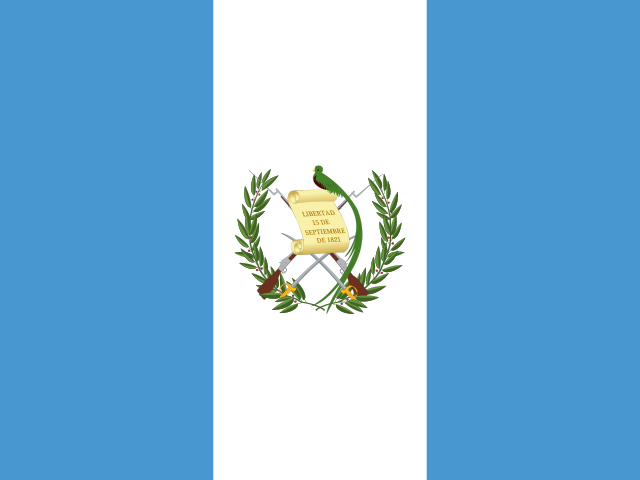
Overview
Guatemala, officially the Republic of Guatemala, lies in northern Central America. Mexico borders it to the north and west, Belize to the northeast, Honduras to the east and El Salvador to the southeast. It has a Pacific coast to the south and a short Caribbean coastline on the Gulf of Honduras to the northeast.
The territory was the heartland of Maya civilization. Spain conquered most of it in the 16th century, and Guatemala became independent in 1821. In the 20th century it went through dictatorships, a brief democratic opening (1944-1954) and a long civil war (1960-1996). A UN-brokered peace accord was followed by economic growth and regular democratic elections.
With about 17.6 million people, it has the largest population in Central America. Guatemala City is both capital and largest city, and its metro area is the most populous in Central America. The country is rich in ecosystems and endemic species and is part of the Mesoamerican biodiversity hotspot. Major challenges remain: poverty, crime, corruption, drug trafficking, political instability, and food insecurity affecting roughly a quarter of the population (about 4.6 million people).
History
Evidence of human presence in Guatemala goes back to around 12,000 BC, with some finds such as obsidian arrowheads suggesting even earlier occupation. Early inhabitants were hunter-gatherers, and maize cultivation had developed by about 3500 BC. Sites from around 6500 BC are known in the Quiché highlands and on the central Pacific coast (Sipacate, Escuintla). The region became a core area of Maya civilization, with Preclassic, Classic and Postclassic periods (the Classic-era city of Tikal is the best known).
The Spanish conquest began in the early 16th century under Pedro de Alvarado, sent by Hernán Cortés. In 1523-1524 he marched into the highlands, first allying with the Kaqchikel Maya against the K'iche', then fighting the Kaqchikel as relations broke down. Epidemics such as smallpox sharply reduced the indigenous population. Guatemala became the seat of a Captaincy General within the Spanish colonial system, and the capital was moved three times, twice because of natural disasters: volcanic mudflows in 1541 and earthquakes in 1773.
The Captaincy General declared independence from Spain on 15 September 1821 and briefly joined the First Mexican Empire. From 1823 to 1841 Guatemala was part of the Federal Republic of Central America. On 21 March 1847 it declared itself a fully independent republic, with the conservative Rafael Carrera as its first president. Carrera was forced out in 1848, returned in 1849, and dominated politics until 1865, when Vicente Cerna y Cerna took over until 1871.
The Liberal Revolution of 1871 under Justo Rufino Barrios modernized trade and institutions and made coffee a key crop. Barrios died in 1885 fighting in El Salvador during a failed attempt to reunite Central America. Manuel Estrada Cabrera ruled as president from 1898 to 1920 after the assassination of José María Reina Barrios. Jorge Ubico, elected unopposed in 1931 during the Great Depression, became increasingly authoritarian, replacing debt peonage with a harshly enforced vagrancy law.
Ubico resigned on 1 July 1944 after protests and a general strike. His successor Ponce Vaides was ousted in October 1944 by a coup led by Francisco Javier Arana and Jacobo Árbenz, and a junta organized the country's first free election, won by Juan José Arévalo. The decade of reform that followed (1944-1954) brought social and economic change but alarmed the United States and the United Fruit Company. A US-backed coup in 1954 ended the revolution and installed a dictatorship.
The civil war ran from 1960 to 1996, pitting the US-backed government against leftist rebels. Military forces carried out massacres of Maya communities, including in the early 1980s scorched-earth campaign. The UN-sponsored Commission for Historical Clarification found that government forces and state-backed paramilitaries were responsible for over 93% of human rights violations. A UN-negotiated peace accord in 1996 ended the war, with Norway and Spain among the countries that helped broker it; guerrillas disarmed and received land.
Since then Guatemala has held successive democratic elections. In 2012 the former dictator Efraín Ríos Montt faced genocide charges in a Guatemalan court over his 1982-1983 rule, with prosecutors citing many documented killings, rapes and displacements. President Otto Pérez Molina resigned on 2 September 2015 after a UN-backed anti-corruption investigation into the 'La Línea' customs fraud scandal implicated senior officials, including Vice President Roxana Baldetti's circle. Large anti-corruption protests preceded the election of Jimmy Morales, a former TV comedian, who took office in January 2016. In December 2017 he announced moving the Guatemalan embassy in Israel to Jerusalem. Alejandro Giammattei, who campaigned on a tough-on-crime platform, took office in January 2020, and large protests in November 2020 opposed cuts to education and health spending.
In August 2023 Bernardo Arévalo of the center-left Semilla movement won the presidential runoff by a wide margin. Outgoing authorities were accused of trying to obstruct the result through pressure on journalists, anti-corruption investigators and social movements, but indigenous-led protests and international pressure led to acceptance of the outcome. Arévalo, son of former president Juan José Arévalo, was sworn in just after midnight on 15 January 2024 after a delay over congressional procedures. His government has focused on anti-corruption and economic opportunity: it created the Special Group Against Extortion (GECE) in February 2024, with about 400 motorized police officers, and cut the presidential salary by 25% in April 2024. His opponents have pursued prosecutions of Semilla members and indigenous leaders involved in the 2023 protests.
Climate
Guatemala is mostly mountainous. Two mountain chains cross it from west to east, dividing it into the highlands, the Pacific coast to the south and the northern lowland region of Petén. Climate varies mainly with elevation, from hot, humid tropical lowlands to cooler, drier highland areas. Volcán Tajumulco, at 4,220 m, is the highest point in Central America.
Guatemala City, in the highlands at roughly 1,500 m (approx.), has a mild subtropical highland climate with pleasant temperatures year-round (typically about 15-27 °C, approx.), a rainy season from May to October and a dry season from November to April. Antigua Guatemala and Quetzaltenango are cooler highland cities, with Quetzaltenango noticeably colder at night. Pacific-coast areas such as Escuintla and Puerto San José are hot and humid, and Caribbean-side Puerto Barrios and Livingston are hot, very humid and rainy. Flores in Petén has a hot tropical climate with a distinct wet season (all approx.).
Guatemala is exposed to hurricanes from both the Caribbean and the Pacific. Hurricane Mitch (1998), Hurricane Stan (October 2005, over 1,500 deaths from floods and mudslides) and Hurricane Eta (November 2020, more than 100 dead or missing) caused serious damage, mostly through flooding and landslides.
The highlands lie along the Motagua Fault on the boundary of the Caribbean and North American plates. A magnitude 7.5 earthquake on 4 February 1976 killed more than 25,000 people. Offshore, the Cocos Plate sinks beneath the Caribbean Plate along the Middle America Trench, producing volcanic activity. Guatemala has 37 volcanoes, four of them active: Pacaya, Santiaguito, Fuego and Tacaná.
Biodiversity is high: 14 ecoregions, 252 listed wetlands, and at least 8,682 vascular plant species (13.5% endemic). About 5.4% of the land is protected under IUCN categories I-V. The Maya Biosphere Reserve in Petén covers about 2.1 million hectares and is the second-largest forest in Central America. Tikal National Park was the first mixed UNESCO World Heritage Site. Major rivers include the Motagua, Polochic, Dulce, Sarstún (boundary with Belize) and Usumacinta (boundary with Chiapas, Mexico).
Government and politics
Guatemala is a constitutional democratic republic with a multi-party system. The president is both head of state and head of government. Legislative power is held by the unicameral Congress of the Republic, and the judiciary is formally independent of the executive and legislature. Presidents serve a single four-year term (approx.). Bernardo Arévalo, a diplomat, sociologist and co-founder of the Semilla party, is the 52nd president, in office since January 2024. The next general election is not covered here.
The country is divided into 22 departments and about 335 municipalities. Each department has a governor appointed by the central government, assisted by a development council that includes the mayors of the department's municipalities. Power is therefore highly centralized: the national government sets education policy through the Ministry of Education, runs health services through the Ministry of Health, and controls national taxation and the legal system. Municipalities, headed by elected mayors, handle local services and have their own councils, funded in part by transfers from the national budget (approx.). Guatemala is not a federation, and there are no autonomous regions with separate law-making powers.
Guatemala has long claimed all or part of Belize. It did not recognize Belize's independence until 6 September 1991, and the dispute remains unresolved, with negotiations under way under the Organization of American States. The military is modest, at 15,000-20,000 personnel. In 2017 Guatemala signed the UN Treaty on the Prohibition of Nuclear Weapons. It maintains formal diplomatic relations with Taiwan.
On human rights, killings and death squads have persisted since the end of the civil war, often tied to clandestine security networks (CIACS) of current and former military members involved in organized crime. In 2004 the Inter-American Court condemned the 1982 Plan de Sánchez massacre of 188 Achi-Maya, the first ruling of its kind against the Guatemalan state for the 626 massacres reported in the 1980s. In 2008 Guatemala became the first country to officially recognize femicide as a crime, and it has one of the highest femicide rates in the world.
Economy
Guatemala has the largest economy in Central America, with a nominal GDP of about US$113.9 billion and a PPP GDP of about $264.8 billion in 2024. Growth has averaged about 3.5% a year over the past decade. Despite this, it is one of the poorest countries in Latin America, with highly unequal incomes: 56% of people lived in poverty and 16.2% in extreme poverty in 2024. Only about 29% of workers hold formal jobs, and unstable, low-paid informal work dominates.
Agriculture accounts for about 31% of employment. Traditional crops are sugar cane, coffee, bananas, cardamom and palm oil, and newer exports include avocados, berries, snow peas and broccoli. Guatemala is a leading exporter of cardamom and coffee, and also exports vegetables, flowers, handicrafts and textiles. Sugar cane and palm oil are increasingly grown for biofuels, which critics link to higher staple food prices. The country imports nearly half its corn from the United States. Mines produce gold, silver, zinc, cobalt and nickel; gold output was about 6 tons in 2015.
The United States and China are the main trade partners. Remittances from Guatemalans abroad, mainly in the US, are the largest single source of foreign income, growing from 11% to 19% of GDP between 2004 and 2024. Market reforms in the 1990s brought trade liberalization, privatization and deregulation. The banking system broadly follows international standards, and Guatemala has been in DR-CAFTA with the United States since 2006. A Competition Law was enacted in 2024.
Private property is constitutionally protected but not consistently enforced. Foreign investors have the same property rights as citizens except for land in certain restricted areas. Guatemala ranked 71st in the 2025 Index of Economic Freedom and 123rd in the Global Innovation Index. Social welfare programs exist but coverage is weaker in rural areas. In the 2024 Global Hunger Index it scored 18.8 (moderate), ranking 81st of 127.
Tourism is a major contributor, with about two million visitors a year and rising cruise ship arrivals. Main attractions are Maya sites (Tikal, Quiriguá, Iximché), natural sites (Lake Atitlán, Semuc Champey) and the UNESCO-listed colonial city of Antigua Guatemala. The currency is the quetzal (approx.).
Demographics and urbanization
Guatemala had an estimated 17,608,483 people in 2021, up from only about 885,000 in 1900, the fastest 20th-century population growth in the Western Hemisphere. Census records are patchy: several early censuses were destroyed or lost, and the 1940 census was burned. The country is roughly half urban (approx. 52-55%), with people concentrated in the highlands and the Pacific coast region; Petén is sparsely populated.
The largest city is Guatemala City, with about 1 million in the city proper and about 3 million or more in the metro area (approx.). Other notable cities include Mixco and Villa Nueva, which are part of the capital's urban sprawl, each with several hundred thousand people, and Quetzaltenango, with roughly 200,000-250,000 (all approx.). Antigua Guatemala is a smaller colonial and tourist city.
According to the 2018 census, 56% of the population is Ladino (mixed indigenous and European heritage) and 43.6% indigenous, one of the highest shares in the Americas after Peru and Bolivia. Maya groups make up 41.7% of the total: K'iche' 11.0%, Q'eqchi' 8.3%, Kaqchikel 7.8%, Mam 5.2% and other Maya 7.6%. Xinca are 1.8% and Garifuna 0.1%. Indigenous rights activists put the indigenous share closer to 61%. White Guatemalans (Criollos) are not counted separately; many descend from German and Spanish settlers. There are also Afro-Guatemalans, Garifuna communities around Livingston and Puerto Barrios, and Asian and Arab minorities.
Spanish is the sole official language, spoken by 93% and the mother tongue of about 75.9%. Twenty-one Mayan languages, Xinca and Garifuna are recognized as national languages under a 2003 law. Bilingual education, introduced in pilot form in the 1980s and made official in 1987, is available in indigenous regions.
Christianity dominates. Catholics fell from 55% to 47.9% between 2001 and 2012 while Protestants, mainly Evangelical and Pentecostal, rose from 30% to 38.2%; later estimates put Protestants as the largest group at about 45.7%. About 11.6% reported no affiliation. Guatemala has been described as the most heavily evangelical country in Latin America. Traditional Maya practices persist and sometimes blend with Catholic rites, and the government provides altars at Maya ruins.
Immigration has come from Spain in colonial times, Germany and other European countries from the mid-19th century (setting up coffee and cardamom farms in Alta Verapaz and elsewhere), East Asia since the 1890s and Latin America in the 20th century. Today the largest immigrant groups come from El Salvador and Mexico.
Education is mostly public and run by the Ministry of Education, taught in Spanish with bilingual options. Guatemala has 15 universities (one public, 14 private); the Universidad de San Carlos, founded in 1676, is the oldest. Education spending was about 3.2% of GDP in 2023. Adult literacy rose from 74.5% in 2012 to 82.1% in 2024, though rural and indigenous areas lag.
Health outcomes were among the weakest in Latin America in 2003. In 2012 there were about 16,000 doctors for 16 million people, around half the WHO-recommended ratio. Since the late 1990s the Ministry of Health has extended access to 54% of the rural population. Total health spending was around 6.4-7.3% of GDP in 2014, and many patients combine indigenous and Western medicine.
Capital city
Guatemala City (Ciudad de Guatemala) is the national capital and the country's largest city. It sits in a highland valley in the south-central part of the country, at roughly 1,500 m. The city proper has about 1 million people and the wider metro area roughly 3 million or more (approx.), making it the most populous metro area in Central America. It is the second most populous city in Central America according to the source.
The climate is mild subtropical highland: warm days, cool evenings, a wet season from May to October and a drier period from November to April, with average highs around 25-27 °C and lows around 14-16 °C (approx.). The city is exposed to earthquakes and volcanic hazards from nearby Pacaya and Fuego.
The present capital is the third location of the seat of government, after moves prompted by volcanic mudflows in 1541 and earthquakes in 1773. Independence was proclaimed here at a public meeting on 15 September 1821.
Guatemala City is the political, economic and cultural center. It hosts the presidency, Congress, the courts and the ministries, plus the main financial and commercial firms, the main international airport (La Aurora) and the oldest university, the Universidad de San Carlos. It is also the main economic city, so the capital and economic hub coincide. The city is divided into numbered zones; Zona 1 is the historic center, while zones 10 and 14 are known for business, hotels and embassies (approx.). Maya archaeological remains lie within the city, and it has museums and cultural institutions. Crime and inequality are significant issues, and expats typically live in the better-served zones or in nearby Antigua Guatemala (approx.).
About this summary
Includes approximate general-knowledge facts on Guatemala City's metro population, city climates, capital-city details, regional city populations and some pre-Columbian and recent-history context.